

Hydrogen sulfide is one of the few gas-quality parameters that is a safety, corrosion, contract and environmental issue at the same time. Sales gas leaving a sweetening unit, odorised distribution gas, refinery fuel gas, flare headers and even food-grade CO2 all need H2S, and often total sulfur, measured reliably at low ppm or ppb levels (general). In Pakistan that means gas processing plants, transmission and distribution companies, refineries, fertilizer and petrochemical sites and beverage CO2 suppliers all need an analyzer that gives a defensible number and keeps running between maintenance visits (general).
This note looks at the Galvanic ProTech903 tape-based H2S / total sulfur analyzer, a colorimetric paper-tape analyzer with 5 ppbv sensitivity, and covers what its datasheet says about performance, utilities, communications and approvals, how the W, D1 and D2 models differ, installation and maintenance points, and when another Galvanic analyzer is the better fit. Figures come from the ProTech903 datasheet hosted on our product page and the current Tetracon product pages. General engineering advice is labelled as general, and nothing here goes beyond the manufacturer's published data. Tetracon (Pvt.) Ltd. is the sole authorized agent for Galvanic Applied Sciences Inc. in Pakistan.
Why tape-based H2S analysis is still the reference choice
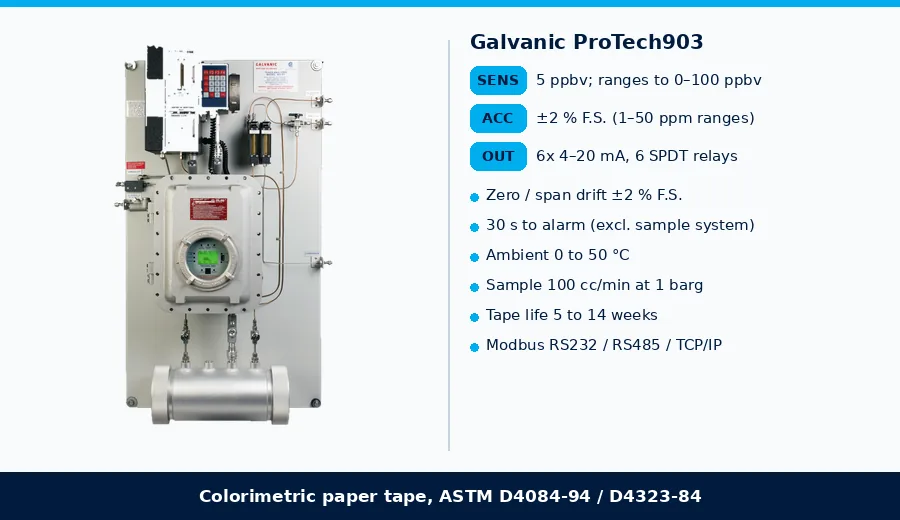
- Low ranges. The datasheet gives a 5 ppbv sensitivity level and low ranges of 0 to 1 ppmv and 0 to 100 ppbv, and states that the ProTech903 outperforms other analytical methods in the critical application range of 0 to 15 ppmv (datasheet).
- Specific to the analyte. The analyzer is described as interference free and not matrix dependent (datasheet), so changes in the hydrocarbon or CO2 background of the gas should not show up as H2S (general).
- Recognised methods. H2S measurement follows ASTM D4084-94 and D4323-84, and the total sulfur option follows ASTM D4468-95 (datasheet). ASTM D4084 is the lead acetate reaction-rate method widely used for H2S in natural gas (general).
- Fast alarms. Response time is 30 seconds to alarm, excluding the sample system (datasheet). In practice the sample line and conditioning system usually add more delay than the analyzer itself, so keep them short (general).
- Long unattended runs. Tape lifetime is five to 14 weeks depending on the application (datasheet), which suits remote metering and compressor sites that are visited only periodically (general).
ProTech903 at a glance
| Item | Galvanic ProTech903 (datasheet) |
|---|---|
| Measurement | H2S; total sulfur option; arsine, phosphine and phosgene analyzer versions also listed |
| Technology | Colorimetric paper tape; ASTM D4084-94 and D4323-84 (H2S), ASTM D4468-95 (total sulfur) |
| Sensitivity | 5 ppbv; low ranges 0 to 1 ppmv and 0 to 100 ppbv |
| Accuracy and repeatability | ±2 % F.S. for ranges 1 to 50 ppm; ±2.5 % F.S. above 50 ppm; ±3 % F.S. for 0.5 to 1 ppm; ±5 % F.S. below 0.5 ppm |
| Zero and span drift | ±2 % F.S. each |
| Linearity / sensitivity | ±2 % F.S. / ±1 % F.S. |
| Response time | 30 seconds to alarm (excluding sample system) |
| Ambient temperature | 0 to 50 °C (32 to 122 °F) |
| Sample flow | 100 cc/min at 1 barg (0.21 SCFH, 15 psig); total sulfur option also needs hydrogen at 180 cc/min, 1 barg |
| Power | H2S: 10–32 V DC, 10 W + 1.5 W per solenoid, or 90–230 V AC 50/60 Hz, 10 W + 17 W per solenoid; total sulfur: 90–230 V AC, 250 W + 17 W per solenoid |
| Analog outputs / inputs | 6 x 4–20 mA outputs (user scalable, loop powered); 2 x 4–20 mA inputs |
| Relays and digital inputs | 6 x SPDT relays (5 A at 30 V DC or 8 A at 120/230 V AC); 4 dry-contact and 4 wet inputs |
| Digital communication | Modbus RS232, Modbus RS485, Modbus TCP/IP (optional), Ethernet, USB |
| Dimensions | H2S: 686 W x 838 H x 318 D mm; total sulfur: 686 W x 1219 H x 318 D mm |
| Weight | H2S 27.2 kg (Div 1) / 20.4 kg (Div 2); total sulfur 36.3 kg (Div 1) / 29.4 kg (Div 2) |
| Approvals | CSA (C, US) Class 1 Div 1 and Div 2, Groups BCD T3; ATEX and IECEx Ex db [ia] ia op is IIB+H2 T4 Gb; China Pattern Approval, Russia TR-CU and Pattern Approval, India CCOE |
Choosing between the W, D1 and D2 models
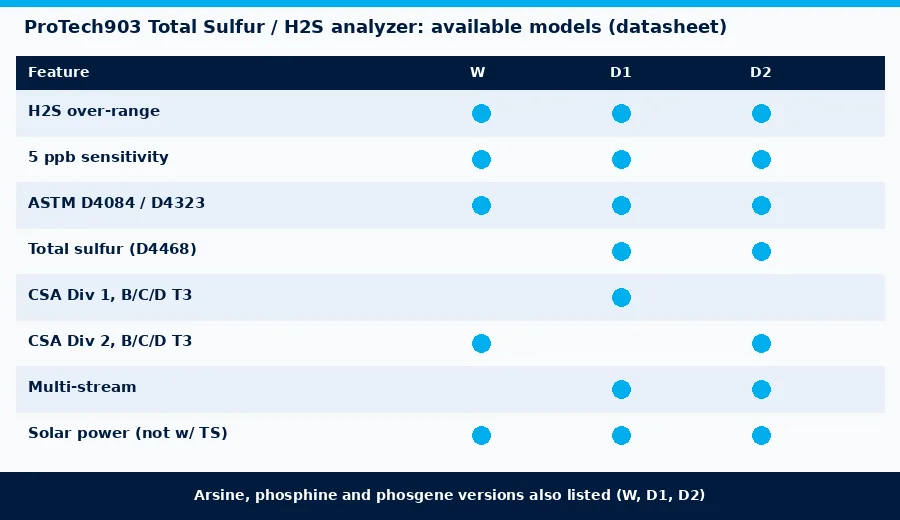
The datasheet lists the ProTech903 Total Sulfur / H2S analyzer in three models, W, D1 and D2 (datasheet):
- All three models: H2S over-range capability, the 5 ppb sensitivity level, ASTM D4084-94 and D4323-84, and the solar power option (solar is not available with the total sulfur option).
- Total sulfur (ASTM D4468-95) and multi-stream capability: listed for the D1 and D2 models.
- Area classification: CSA Class 1, Div 1, Groups B, C and D, T3 is marked for the D1 model; CSA Class 1, Div 2, Groups B, C and D, T3 is marked for the W and D2 models.
- Other analytes: arsine, phosphine and phosgene analyzer versions are listed in W, D1 and D2 form, with 5 ppb sensitivity on all, Div 1 on D1, Div 2 on D2 and multi-stream on D1 and D2.
As a general rule, start from the area classification of the analyzer location, then decide whether you need H2S only or total sulfur, and whether one analyzer must sequence several streams (general). Confirm the final model and range with Tetracon against your gas composition before ordering.
Design details that reduce maintenance
- Precision optical encoder ensures exact spacing between stains and keeps track of tape usage (datasheet).
- Advanced digital sensor puts the analog-to-digital conversion at the measurement point, eliminating noise from transmitting analog signals (datasheet).
- Proprietary membrane humidifier reduces dead volume for faster response (datasheet).
- Intrinsically safe external keypad lets the user configure and monitor the analyzer without declassifying the area, with full menu access to the high-resolution display (datasheet).
- Dual redundant power supplies allow AC or DC operation or DC backup, and the optional Ethernet connection puts the analyzer on a local network for remote operation and troubleshooting (datasheet).
- Diagnostics: 10 status LEDs, a large LCD, smart self-diagnostics with remote access, the proprietary Tape Assurance System and Windows-based software with a graphical interface (datasheet).
Installation and operation
- Shelter and ambient. The rated ambient range is 0 to 50 °C (datasheet). In Sindh and Punjab summers, an outdoor panel in direct sun can exceed that, so plan a sunshade or a ventilated or air-conditioned shelter (general).
- Sample system. The analyzer needs 100 cc/min at 1 barg (datasheet). Use a short, heated or insulated line where liquids could condense, a pressure reducer at the tap, and fast-loop bypass flow where the tap is far from the analyzer (general).
- Hydrogen for total sulfur. The total sulfur option needs hydrogen at 180 cc/min and 1 barg and AC power of 250 W plus solenoids (datasheet), so plan a hydrogen supply and its safety review in the shelter design (general).
- Remote sites. The H2S version runs on 10–32 V DC at 10 W plus solenoids, and a solar power option exists for H2S (not total sulfur) analyzers (datasheet), which suits unmanned SMS and valve stations (general).
- Integration. Six user-scalable 4–20 mA outputs, six SPDT relays and Modbus over RS232, RS485 or TCP/IP (datasheet) cover a DCS, SCADA RTU or flow computer link. Map stream number, concentration and alarm relays at design stage (general).
- Tape and validation. Plan tape changes from the five- to 14-week tape life and keep a certified H2S span gas near the operating range for routine checks (datasheet; general).
Where it fits in Pakistan
- Gas processing and sweetening. NG plant inlet/outlet gas and NG sweetening are listed applications (datasheet). Outlet H2S after the amine unit is the number that proves the gas is fit for the pipeline (general).
- Transmission and distribution. Custody transfer and odorant monitoring are listed natural gas pipeline applications (datasheet). Check the H2S and total sulfur limits in your gas sales agreement or pipeline specification before choosing the range (general).
- Refineries and petrochemicals. Catalyst protection, feedstock and fuel gas monitoring and flare gas emissions monitoring under 40 CFR 60 Subpart Ja are listed (datasheet); Subpart Ja is a US rule, but the same flare and fuel gas H2S duty applies to Pakistani refineries (general).
- Food-grade CO2. Food-grade CO2 is a listed food and beverage application (datasheet), relevant to beverage bottlers and CO2 recovery plants (general).
- Chemicals and pharma. Stack emissions reporting, industrial hygiene and worker safety, and phosgene in organic synthesis are listed pharmaceutical applications (datasheet).
When another Galvanic analyzer is the better fit
- ProTech 1000 Z2: compact lead-acetate tape analyzer with ranges from 0–100 ppb to 0–300 ppm (0–100 % with dilution), up to 70 days on a single tape roll, web-browser configuration and multi-stream H2S up to 4 streams (product page). Compare it in our ProTech 1000 Z2 note.
- AccuLase-GPA D1: TDLAS analyzer that measures H2S, CO2 and H2O with one laser and no H2S scrubber consumable, Class I Div 1 (product page); see our AccuLase note.
- FPA 4100: UV/visible process photometer for H2S and SO2, chlorine and oil-in-water, with no reagents or compressed gases (product page); see our FPA 4100 note.
- AccuChrome GC5: modular gas chromatograph for custody transfer, sulfur compound speciation and odorant stations (product page), when you need individual sulfur compounds rather than H2S or total sulfur.
- Brimstone: UV analyzer for sulfur recovery units measuring H2S, SO2, COS and CS2 (product page); see our Brimstone note.
Related products
| Need | Product | Key point |
|---|---|---|
| ppb H2S and total sulfur | Galvanic ProTech903 | 5 ppbv sensitivity, ASTM D4084 / D4323 / D4468, CSA Div 1 or Div 2 (datasheet) |
| Compact tape analyzer | Galvanic ProTech 1000 Z2 | 0–100 ppb to 0–300 ppm, up to 70-day tape roll (product page) |
| H2S, CO2 and H2O by laser | Galvanic AccuLase-GPA D1 | TDLAS, no scrubber consumable, Class I Div 1 (product page) |
| Reagent-free photometer | Galvanic FPA 4100 | UV/visible, gas or liquid streams, up to 8 streams (product page) |
| Sulfur speciation | Galvanic AccuChrome GC5 | Modular GC, sulfur compound speciation, odorant stations (product page) |
| Electrochemical ppm H2S | AII GPR-7500 | Online ppm H2S analyzer with electrochemical sensor (product page) |
For more background, read our H2S and total sulfur monitoring guide and the GPR-7500 note. The wider range is on the Gas Analysis category page, our selection guides and the Galvanic Applied Sciences manufacturer page.
What to send with an enquiry
- The gas stream: sales gas, plant inlet, fuel gas, flare, odorised gas or CO2, with a typical composition and pressure at the tap.
- The measurement: H2S only or total sulfur, the normal value, the alarm or contract limit and the range you want.
- Number of streams and the distance from the sample points to the analyzer.
- Area classification of the analyzer location (Div 1 / Zone 1 or Div 2 / Zone 2) and the available power: AC, DC or solar.
- The control system link: 4–20 mA, relays or Modbus RS485 / TCP/IP.
- Shelter, ambient temperature and whether hydrogen and span gas can be supplied on site.
FAQ
What does the Galvanic ProTech903 measure?
H2S, with a total sulfur option, using colorimetric paper tape to ASTM D4084-94 and D4323-84 (and ASTM D4468-95 for total sulfur). Arsine, phosphine and phosgene analyzer versions are also listed in the datasheet.
How low can it measure?
The datasheet gives a 5 ppbv sensitivity level with low ranges of 0 to 1 ppmv and 0 to 100 ppbv. Accuracy is ±2 % F.S. for ranges 1 to 50 ppm, ±3 % F.S. for 0.5 to 1 ppm and ±5 % F.S. below 0.5 ppm.
How fast does it respond?
30 seconds to alarm, excluding the sample system. Keep the sample line short and use a fast loop where the tap is far from the analyzer.
Can it be installed in a hazardous area?
Yes. The datasheet lists CSA Class 1 Div 1 and Div 2, Groups BCD T3, and ATEX and IECEx Ex db [ia] ia op is IIB+H2 T4 Gb, and an intrinsically safe external keypad allows configuration without declassifying the area. Choose the D1 or D2 model to match the location.
How often does the tape need changing?
The datasheet gives a tape lifetime of five to 14 weeks, depending on the application. Total sulfur versions also need a hydrogen supply at 180 cc/min and 1 barg.
Planning H2S or total sulfur measurement on sales gas, fuel gas, a flare or a CO2 line in Pakistan? Contact Tetracon with the stream, range and area classification. You can also browse the ProTech903 product page and the Galvanic Applied Sciences manufacturer page.