

Refineries, gas processing plants, fertilizer complexes and sulfur recovery units in Pakistan all live with hydrogen sulfide (H2S) and sulfur dioxide (SO2). Operators need a continuous number they can trust for amine and acid-gas streams, SRU feed and tail gas, scrubber outlets and stacks. Grab samples, lab titrations and hand-held tubes leave gaps between readings. A process photometer that measures the stream continuously, with no reagents and no carrier gas, is often the practical answer.
This note looks at the Galvanic FPA 4100™ UV-VIS process photometer. Figures come from the Galvanic FPA 4100 Product Specifications (SAM-BMM-E30-ALL-FPA4100, Rev. 2) hosted on our product page, from Galvanic's published product information and from the current Tetracon product pages. Where we give general engineering advice it is labelled as general. Nothing here goes beyond the manufacturer's published data. Tetracon (Pvt.) Ltd. is the sole authorized agent for Galvanic Applied Sciences Inc. in Pakistan.
Why a continuous UV photometer for H2S and SO2?
- Continuous, not batch. The FPA 4100 measures absorbance of the flowing sample in its cell and updates the result continuously, with no batch analysis cycle (manufacturer).
- No reagents, no compressed gases for measurement. Galvanic publishes continuous measurement without reagents or compressed carrier gases. That cuts consumables and logistics at remote sites (manufacturer; zero gas or DI water is still used for zeroing, see below).
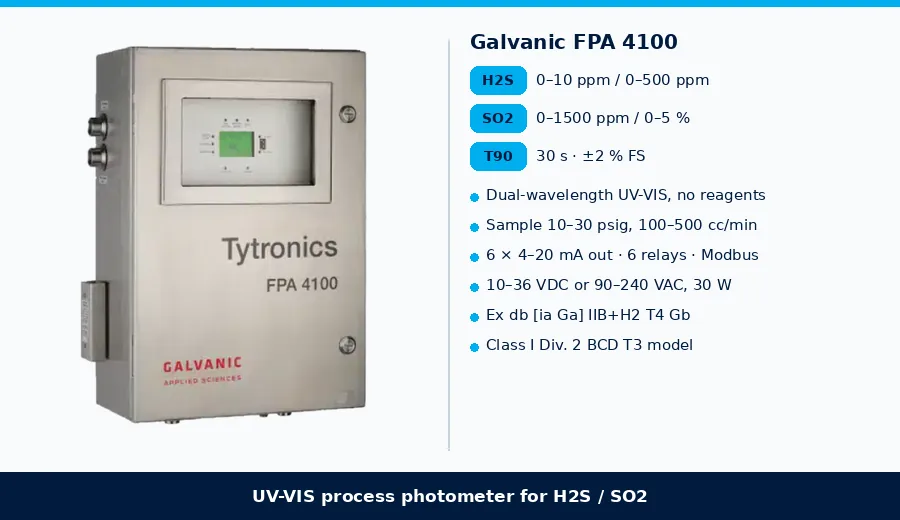
- Two published ranges per gas. H2S 0–10 ppm (low) or 0–500 ppm (high); SO2 0–1500 ppm (low) or 0–5 % (high) (datasheet).
- Fast enough for control. T90 response is 30 seconds and accuracy, repeatability and linearity are each ±2 % of full scale, with zero drift held to ±2 % FS by daily auto-zero. The sheet notes that performance is application-specific (datasheet).
- One analyzer, several points. Multi-stream analysis of up to 8 streams is offered, so one photometer can cover several sample points where the process allows (manufacturer).
How the FPA 4100 works
The FPA 4100 is an absorbance photometer. A photonics module holds the UV (or visible) light source and a temperature-controlled photodiode detector block. Fiber-optic cables carry light to the measurement cell and back, so the detector electronics stay isolated from the process. Concentration follows Beer's law: the more H2S or SO2 in the cell, the more light is absorbed at the measuring wavelength (manufacturer).
The analyzer also measures at a second, reference wavelength. This dual-wavelength method compensates for turbidity, changes in lamp intensity, coating on the optical windows and bubbles. The result is a linear response to concentration, and the photometer has no moving parts (manufacturer). The cell can sit in a bypass line or in-line, and can be heated in an oven or by steam jacketing for sticky or condensing samples. Galvanic engineers flow cells to order; standard wetted materials are stainless steel and Kynar (manufacturer).
Auto-calibration against external standards, auto-zero, auto cell washing when needed and automatic lamp-failure detection (shown on the front panel and available over serial or digital output) keep operator work low (manufacturer).
FPA 4100 at a glance
| Item | From the datasheet (Spec Rev. 2) |
|---|---|
| Method | UV-VIS photometry |
| H2S ranges | 0–10 ppm (low); 0–500 ppm (high) |
| SO2 ranges | 0–1500 ppm (low); 0–5 % (high) |
| Accuracy / repeatability / linearity | ±2 % FS each (performance application-specific) |
| Zero drift | ±2 % FS with daily auto-zero |
| Response time | T90: 30 seconds |
| Sample conditions | 10–30 psig; 100–500 cc/min |
| Zero sample | Gas phase: 0.5–1 L/min instrument air or nitrogen; liquid phase: 200 ml/min DI water |
| Ambient | −20 to 50 °C; 0–95 % RH non-condensing; indoors or suitable enclosure |
| Power | 10–36 VDC or 90–240 VAC, 50/60 Hz; 30 W |
| Analog I/O | 6 × 4–20 mA outputs (loop powered); 2 × 4–20 mA inputs |
| Digital | Modbus TCP/IP, RS232, RS485, PC GUI; 8 discrete inputs; 6 relays |
| HMI | Monochrome LCD with extendable keypad |
| Certification | ATEX / IECEx Ex db [ia Ga] IIB+H2 T4 Gb (Tamb −20 to +50 °C); North America Class I Div. 2 Groups BCD T3 |
| Enclosure / weight | ATEX/IECEx model: cast aluminium, 1,270 × 686 × 298 mm, 105 kg; Div. 2 model: painted 304 SS, 24″ W × 16″ H × 10″ D, 30 kg |
Where it fits in Pakistan
- Refinery sulfur recovery units. Galvanic lists H2S in SRU acid gas as a key FPA 4100 application. A continuous acid-gas H2S number helps operators balance air demand before the Claus furnace (manufacturer; general process practice).
- SO2 in stacks and scrubber outlets. SO2 in stack emissions is another published application. The 0–1500 ppm and 0–5 % ranges cover low-level outlet and high-level process duties (manufacturer, datasheet).
- Gas processing and fertilizer plants. Sour-gas sweetening, amine regeneration off-gas and sulfur handling streams where a ppm H2S trend supports process control and HSE (general application guidance; confirm the stream with Galvanic).
- Liquid streams on the same platform. The FPA 4100 family also handles liquid samples such as oil in water and chlorine / hypochlorite, so a utilities or wastewater team can standardise on one photometer platform (manufacturer).
- Hazardous areas. The ATEX/IECEx flameproof model (Ex db [ia Ga] IIB+H2 T4 Gb) and the Class I Div. 2 model let the analyzer sit close to the sample point in classified plant areas (datasheet).
Practical notes for a reliable installation
- Sample conditioning first. The datasheet asks for 10–30 psig and 100–500 cc/min at the cell. Plan pressure reduction, filtration and, for condensing streams such as SRU gas, a heated cell (oven or steam jacket) (datasheet, manufacturer; general).
- Zero medium on site. Gas-phase applications need 0.5–1 L/min instrument air or nitrogen for zeroing; liquid-phase applications need 200 ml/min DI water. The ±2 % FS zero-drift figure assumes daily auto-zero (datasheet).
- Pick the range for the stream. Use the low range (H2S 0–10 ppm or SO2 0–1500 ppm) for trace or outlet duties and the high range for process concentrations. Since accuracy is a percentage of full scale, a tight range gives a better absolute figure (datasheet; general).
- Use the I/O. Six loop-powered 4–20 mA outputs, two 4–20 mA inputs, eight discrete inputs, six relays and Modbus TCP/IP, RS232 or RS485 mean multi-stream values and alarms can go straight to the DCS (datasheet).
- Shelter. The datasheet rating is indoors or in a suitable enclosure, −20 to 50 °C ambient. In Sindh and Punjab summers, plan a shaded or air-conditioned analyzer shelter (datasheet; general for Pakistan).
Related Galvanic sulfur analyzers and when to choose them
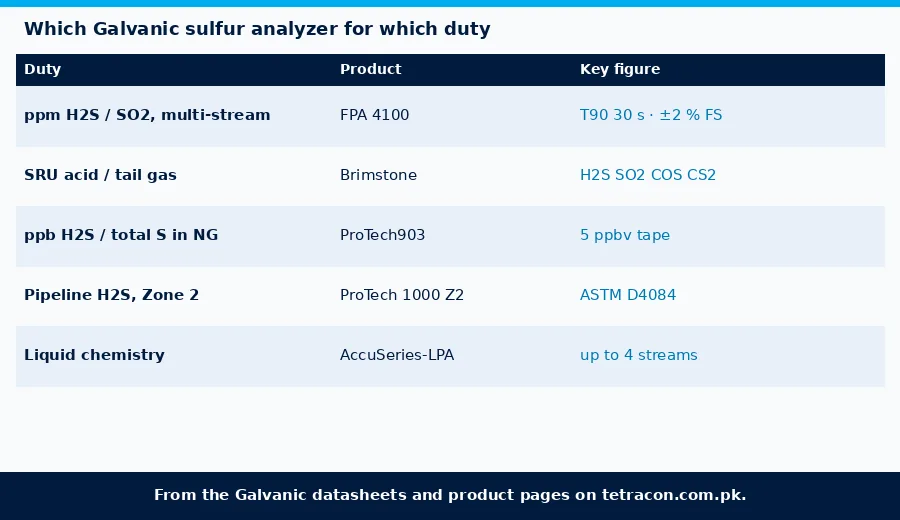
| Duty | Product | Key figure (datasheet / product page) |
|---|---|---|
| Continuous ppm H2S / SO2, gas or liquid, multi-stream | FPA 4100 | H2S 0–10 / 0–500 ppm; SO2 to 5 %; T90 30 s |
| SRU acid gas / tail gas, H2S + SO2 + COS + CS2 | Brimstone | CCD UV spectroscopy; ≤5 s close-coupled response |
| ppb H2S / total sulfur in natural gas | ProTech903 | Lead-acetate tape; 5 ppbv sensitivity |
| H2S in pipeline gas, Zone 2 / Div. 2 | ProTech 1000 Z2 | ASTM D4084; 0–100 ppb to 0–300 ppm; ±2 % FS |
| Liquid chemistry by titration / colorimetry | AccuSeries-LPA | Up to 4 streams; ±2 ppb on 0–100 ppb ranges |
For a full SRU tail-gas ratio controller see our Brimstone note; for natural-gas tariff and pipeline H2S see the ProTech 1000 Z2 note. The wider range is on the Gas Analysis category page and the Galvanic Applied Sciences manufacturer page.
What to send with an enquiry
- Analyte(s) and expected range: H2S (0–10 or 0–500 ppm), SO2 (0–1500 ppm or 0–5 %), or a liquid-phase duty.
- Full stream composition, including other UV absorbers, water content, dust or liquids, plus sample temperature and pressure.
- Number of sample points (up to 8 streams) and the distance from each tap to the analyzer.
- Area classification (Zone 1 / Zone 2 / Div. 2) and whether an indoor shelter is available.
- Available power (10–36 VDC or 90–240 VAC) and zero medium (instrument air, nitrogen or DI water).
- DCS interface: 4–20 mA count, Modbus TCP/IP or RS485, relays and alarm philosophy.
FAQ
What does the FPA 4100 measure?
It is a UV-VIS process photometer for compounds that absorb ultraviolet or visible light. The specification sheet publishes H2S ranges of 0–10 ppm and 0–500 ppm and SO2 ranges of 0–1500 ppm and 0–5 %. Galvanic also lists liquid-phase duties such as oil in water and chlorine.
How accurate and fast is it?
The datasheet gives ±2 % of full scale for accuracy, repeatability and linearity, zero drift of ±2 % FS with daily auto-zero, and a T90 response of 30 seconds. Galvanic notes that performance is application-specific.
Does it need reagents or carrier gas?
No reagents or compressed carrier gases are needed for measurement. A zero medium is still required: 0.5–1 L/min instrument air or nitrogen for gas phase, or 200 ml/min DI water for liquid phase.
Can it be installed in a hazardous area?
Yes. There is an ATEX/IECEx model marked Ex db [ia Ga] IIB+H2 T4 Gb (Tamb −20 to +50 °C), in cast aluminium, about 105 kg. There is also a North American Class I Div. 2 Groups BCD T3 model in painted 304 stainless steel, about 30 kg.
When should I choose Brimstone or ProTech instead?
Choose Brimstone for SRU acid-gas and tail-gas duties that need H2S, SO2, COS and CS2 together with a close-coupled probe. Choose ProTech903 or ProTech 1000 Z2 for ppb-level H2S or total sulfur in natural gas by lead-acetate tape. Choose the FPA 4100 for continuous ppm-to-percent H2S or SO2, multi-stream gas or liquid duty.
Need help selecting a continuous H2S or SO2 analyzer for a refinery, SRU, gas plant or stack in Pakistan? Contact Tetracon with the stream composition, range, number of sample points and area classification. You can also browse the FPA 4100 product page and the Galvanic Applied Sciences manufacturer page.