

Claus sulfur recovery units turn acid-gas H2S into elemental sulfur. The air-demand loop that keeps the H2S:SO2 ratio right depends on a fast, close-coupled analyzer on the tail-gas stream — and often on matching coverage of COS and CS2 after catalytic stages. Pakistani refinery and gas-plant teams also need clear answers for acid-gas feed, sulfur-pit vapour and stack compliance. That is the job of a purpose-built sulfur recovery analyzer, not a general-purpose H2S tape or a laboratory GC alone.
This note covers sulfur recovery unit (SRU) tail-gas analysis with the Galvanic Brimstone UV spectrophotometer. It explains what the Brimstone™ 943 datasheet specifies, how the instrument sits beside ProTech903 tape analyzers and MultiDetek3 EX hazardous-area chromatographs, and how to place it on a Claus train. Instrument figures come from the Galvanic Brimstone™ 943 Product Specifications (Rev. 2, April 2022) and the live Tetracon product page. No prices or exclusivity claims are made here.
Why SRU tail-gas UV matters on Pakistan Claus trains
Refineries and gas plants that run Claus SRUs write sulfur recovery, emissions and air-demand control into operating envelopes for good reason. Too little air leaves H2S unconverted; too much air leaves excess SO2 and hurts recovery; COS and CS2 after catalytic converters still load the tail-gas treater and the stack. Continuous UV analysis at the process answers that need when sample lines are short and response is measured in seconds:
- Claus air-demand control. A close-coupled tail-gas analyzer that reports H2S and SO2 (and calculates air demand) closes the combustion-air loop that protects recovery efficiency.
- Multi-component sulfur speciation. Resolving COS and CS2 alongside H2S and SO2 shows whether catalytic stages are doing their job, rather than treating “total sulfur” as a single number.
- Feed, pit and stack duties. The Brimstone family on the live catalogue covers acid-gas inlet, tail-gas, sulfur-pit and continuous emissions monitor variants so one measurement principle can follow the SRU from feed to compliance.
- Hazardous-area installation. Analyzer houses next to Claus equipment need Zone-rated enclosures and utilities that match Pakistani refinery practice (instrument air, optional nitrogen, steam for nozzle heat).
Galvanic Brimstone: what the datasheet says
The Brimstone is a direct-coupled UV spectrophotometer built for sulfur recovery units. Enhanced CCD UV spectroscopy measures absorption at 256 points with Chemometrics, rather than a single optical-filter wavelength, so H2S, SO2, COS and CS2 are resolved simultaneously with no moving parts in the optical path. Air demand is calculated for Claus control. The measurement cell sits on a condensing probe close to the process; a split oven and controller option separates the analyzer sections when layout demands it.
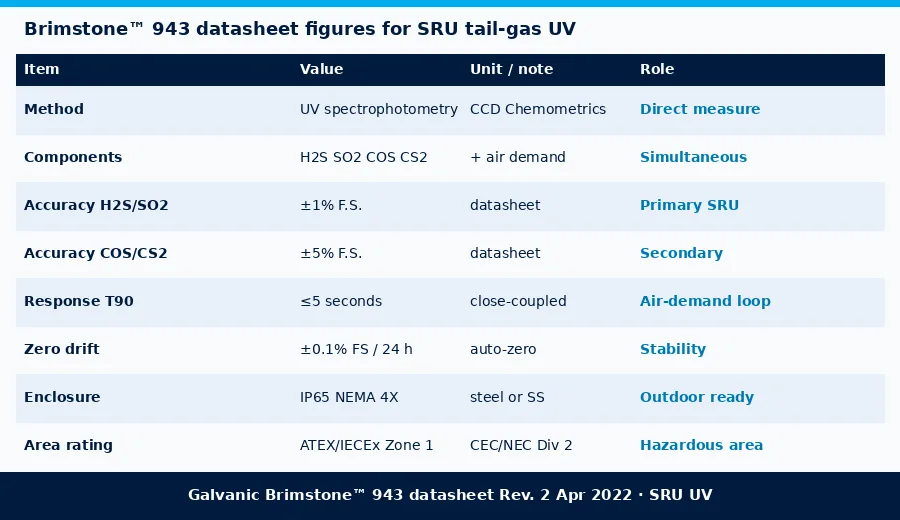
| Specification | Brimstone™ 943 (datasheet) |
|---|---|
| Method / technology | Direct measurement / UV spectrophotometry (deuterium or xenon lamp, ≥5 years life); CCD Chemometrics |
| Components | H2S, SO2, COS, CS2; air demand (calculated) |
| Accuracy | H2S, SO2: ±1% F.S.; COS, CS2: ±5% F.S. |
| Repeatability | H2S, SO2: ±0.1% F.S.; COS, CS2: ±0.5% F.S. |
| Linearity | H2S, SO2: ±1% F.S.; COS, CS2: ±5% F.S. |
| Sensitivity | H2S, SO2: ±0.1% F.S.; COS, CS2: ±5% F.S. |
| Zero drift | ±0.1% F.S. / 24 hours (auto-compensated via periodic auto-zero) |
| Response time | T90 ≤ 5 seconds |
| Ambient | CEC/NEC: 0 to 40 °C; ATEX/IECEx: −20 to 60 °C |
| Relative humidity | 0 to 95% non-condensing |
| Installation | Indoors or suitable enclosure; after 1st condenser and/or after catalytic stages |
| Dimensions / weight | 1,110 × 1,448 × 380 mm; 125 kg |
| Enclosure | Painted steel or 304/316 SS, IP65, NEMA 4X; split oven & controller option |
| Power | 100–240 VAC, 50/60 Hz, 800 W |
| Utilities | Instrument air 3.8–8 bar, 623 L/min; optional N2 3.8–8 bar, 25 L/min; steam 3.4–3.8 bar for nozzle/ball-valve heat |
| Sample flow | Adjustable via aspirator drive (air or nitrogen) |
| Outputs | 4 × 4–20 mA (loop-powered); Modbus TCP/IP or RS485; web-browser GUI; colour LCD with extendable keypad |
| Hazardous area | CEC/NEC Class I Div. 2 Groups CD or BCD T3; ATEX/IECEx Ex II 2 G (TGX-CE / TGS-CE / oven ratings as published) |
The live product page describes the family as covering acid-gas inlet analysis, Claus tail-gas air-demand control, sulfur-pit monitoring and stack continuous emissions monitoring — so specification work should name which stream and which components are contractual before the enclosure and probe layout are fixed.
How a close-coupled UV measurement works
- Mount on the process. Install after the first condenser and/or after catalytic stages as the datasheet installation note describes, so the probe sees a representative Claus stream without a long extractive lag.
- Condition utilities. Supply instrument air (and optional nitrogen for zero / aspirator drive) in the published pressure and flow bands; use steam to heat the sample nozzle and ball valve so sulfur does not freeze in the probe path.
- Measure all four sulfur species. The CCD Chemometrics method resolves H2S, SO2, COS and CS2 from the UV spectrum in one cell — no filter wheel and no sequential single-component optics.
- Close the air-demand loop. Calculated air demand feeds the Claus combustion-air controller so the H2S:SO2 ratio stays on target for recovery efficiency.
- Export to DCS / SIS. Four loop-powered 4–20 mA channels plus Modbus TCP/IP or RS485 and a web GUI give both regulatory and operations teams live values without waiting on a laboratory turnaround.
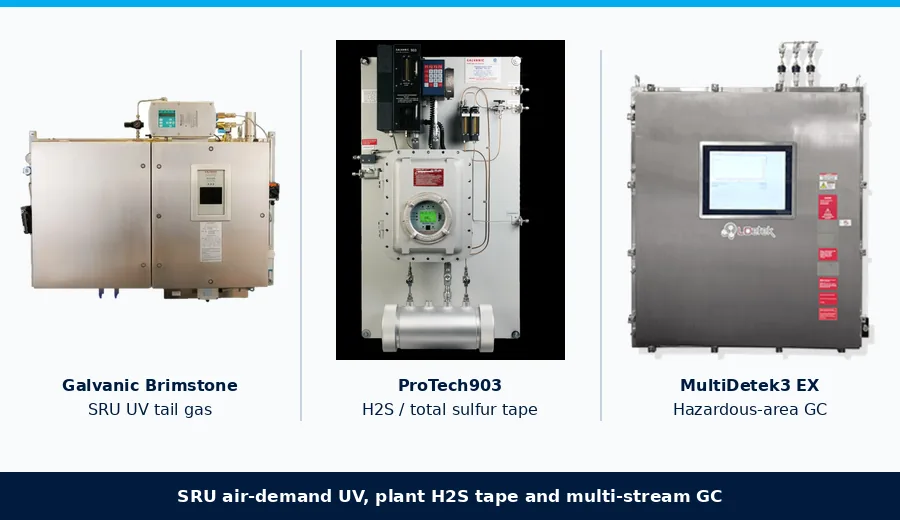
Brimstone, ProTech903 and MultiDetek3 EX — who does what
| Instrument | Primary job |
|---|---|
| Galvanic Brimstone | Close-coupled UV spectrophotometer for SRU streams: simultaneous H2S, SO2, COS and CS2 with calculated air demand; IP65 / hazardous-area rated for Claus trains. |
| Galvanic ProTech903 | Colorimetric tape analyzer for H2S, total sulfur and selected toxic gases on other plant streams — not a substitute for Claus UV air-demand control. See also our note on H2S and total sulfur monitoring. |
| LDetek MultiDetek3 EX | Explosion-proof multi-stream gas chromatograph for Zone 1 / Zone 2 when you need broader multi-component speciation rather than SRU UV air demand. |
| AII GPR7500 H2S | Dedicated H2S analyzer option for duties outside the Claus UV loop — link when a single-component H2S reading is the contractual ask. |
Use Brimstone when the duty is Claus SRU control or SRU-family streams that need simultaneous sulfur speciation and air demand. Keep ProTech903 for tape-based H2S / total sulfur elsewhere in the plant. Reach for MultiDetek3 EX when a hazardous-area GC is the right multi-component tool. Do not treat a single-component H2S analyzer as a substitute for SRU air-demand UV — they answer different control questions. For natural-gas BTU / composition GC framing see also AccuChrome GC.
Field practice for Pakistan SRU sites
- Name the stream. Acid gas, tail gas after the first condenser, post-catalytic, sulfur pit or stack each drive different probe, range and CEM documentation choices.
- Keep the sample hot and short. Steam-heated nozzle/ball-valve and close coupling protect against sulfur solidification and lag that would defeat a ≤5 s T90 loop.
- Utilities first. Confirm instrument air (and optional nitrogen) capacity before commissioning; 623 L/min air at 3.8–8 bar is a real compressor load, not a lab cylinder tip.
- Ambient and enclosure. Match CEC/NEC or ATEX/IECEx ambient bands and use the IP65 / NEMA 4X steel or stainless enclosure (or a suitable shelter) for Pakistani summer heat and dust.
- Auto-zero discipline. The ±0.1% F.S. / 24 h zero-drift figure assumes periodic auto-zero — leave that function enabled in the control narrative.
- Integrate, then verify. Map the four 4–20 mA channels and Modbus registers into the DCS air-demand faceplate, then validate against lab or portable checks during turnaround.
FAQ
What does the Brimstone measure on a sulfur recovery unit?
The Galvanic Brimstone™ 943 datasheet lists simultaneous measurement of H2S, SO2, COS and CS2 by UV spectrophotometry, with air demand calculated for Claus-process control. The live product family also covers acid-gas inlet, tail-gas, sulfur-pit and stack CEM variants.
What accuracy and response time does the datasheet quote?
Accuracy is ±1% of full scale for H2S and SO2 and ±5% of full scale for COS and CS2. Response time is T90 ≤5 seconds. Zero drift is ±0.1% F.S. over 24 hours with periodic auto-zero compensation.
Is the Brimstone certified for hazardous areas?
Yes. The datasheet lists CEC/NEC Class I Division 2 and ATEX/IECEx Ex II 2 G ratings for the analyzer configurations (TGX-CE / TGS-CE / oven as published), with an IP65 / NEMA 4X enclosure suitable for outdoor or sheltered installation.
When should we use Brimstone instead of ProTech903 or MultiDetek3 EX?
Use Brimstone for close-coupled Claus SRU tail-gas (and related SRU stream) UV control with air-demand calculation. Use ProTech903 when you need colorimetric tape measurement of H2S or total sulfur on other plant streams. Use MultiDetek3 EX when you need an explosion-proof multi-stream gas chromatograph for broader multi-component analysis in Zone 1 or Zone 2.
Where can Pakistani teams see the product and ask for support?
See the catalogue page for the Brimstone, browse gas analysis, or contact Tetracon with your SRU stream (acid gas, tail gas, pit or stack), required components and whether air-demand control is the primary duty.
Next steps
Tetracon supplies gas analysis and process instrumentation to Pakistan’s refineries, gas plants and laboratories, including Galvanic Applied Sciences products. Tell us which SRU stream you are instrumenting, which sulfur species are contractual, whether air-demand control is the primary loop, and how results must reach the DCS. Use the contact page or see our services. Start with the catalogue pages for the Brimstone, ProTech903 and MultiDetek3 EX; browse gas analysis and process instruments; or see all Galvanic Applied Sciences products. Free technical guides are collected under Guides.