

Oil in water is one of the most watched liquid-quality measurements on Pakistani refining wastewater trains, E&P produced-water systems, and industrial effluent plants. Discharge consents, reuse targets, separator upsets, and flare or disposal bottlenecks all depend on knowing whether free and emulsified oil — and often total suspended solids — are trending up before the next lab bottle comes back from the shift.
This note is for process, environmental, and analytical engineers specifying continuous oil-in-water (OIW) measurement in Pakistan. It maps ultrasonic acoustic-backscatter and photometric / absorption approaches to catalogue instruments available through Tetracon — the Galvanic Monitek Ultrasonic™ Oil in Water & TSS Analyzer for opaque, oily, coating-prone duties, and the Galvanic FPA 4100™ Photometer for UV/visible multi-species work that includes oil-in-water alongside H2S, SO2, and chlorine where the application fits. Related context: H2S and total sulfur monitoring (useful when FPA 4100 is considered for sulfur-species gas duties) and Galvanic Applied Sciences on the site.
Why oil-in-water monitoring matters
Refinery API separators, desalters, produced-water skids, and common effluent treatment plants (CETPs) see variable oil load with crude slate, well conditions, and weather. Continuous or well-timed OIW measurement supports:
- Discharge limits and compliance evidence — Effluent oil & grease / hydrocarbon limits are enforced against permits and customer or municipal receiving-water rules; trending beats a single disputed grab after a complaint.
- Water reuse and recycle — Cooling-water make-up, fire-water, or reinjection programmes need confidence that oil and solids are under control before the stream re-enters process or aquifer pathways.
- Process upsets and separator performance — Rising OIW after an API, CPI, IGF, or hydrocyclone train flags emulsion breaks, chemical dosing drift, or mechanical failure while the unit can still respond.
- Asset and integrity risk — Oil carry-over fouls exchangers, filters, and membranes; solids and oil together accelerate plugging and under-deposit corrosion on carbon-steel effluent lines.
- Operational accountability — When OIW and TSS share the same DCS/SCADA story as skimmer levels and chemical pumps, boards own the trend rather than waiting on the lab.
Lab grabs prove a point in time. Online oil-in-water analyzers show the trend that environmental, process, and integrity teams actually manage.
Ultrasonic vs photometric / absorption approaches
| Approach | How it works (catalogue framing) | When it tends to fit |
|---|---|---|
| Ultrasonic (acoustic backscatter) | An emitted ultrasonic pulse is reflected by particles/droplets; the echo is processed to oil-in-water or TSS | Opaque, dark, oily, or coating-prone streams where optical paths struggle; continuous OIW + TSS on produced water and industrial wastewater |
| UV/visible photometry (absorption) | Light through a sample cell to a temperature-controlled detector; dual-wavelength compensation for turbidity, window fouling, and bubbles | Clearer streams or multi-analyte programmes (oil-in-water plus gas/liquid H2S, SO2, chlorine) on one photometer platform |
| Laboratory oil & grease / IR / GC | Standard referee methods on grab or composite samples | Permit referee, commissioning checks, custody or dispute — not continuous control |
Write the measurement intent first: continuous OIW for control, OIW + TSS on opaque produced water, multi-species photometry including oil-in-water, or lab referee only. Buying “an oil-in-water analyzer” without that sentence is how teams install an optical cell on a coating-prone emulsion and wonder why the reading never settles.
When Galvanic Monitek Ultrasonic™ fits continuous OIW / TSS
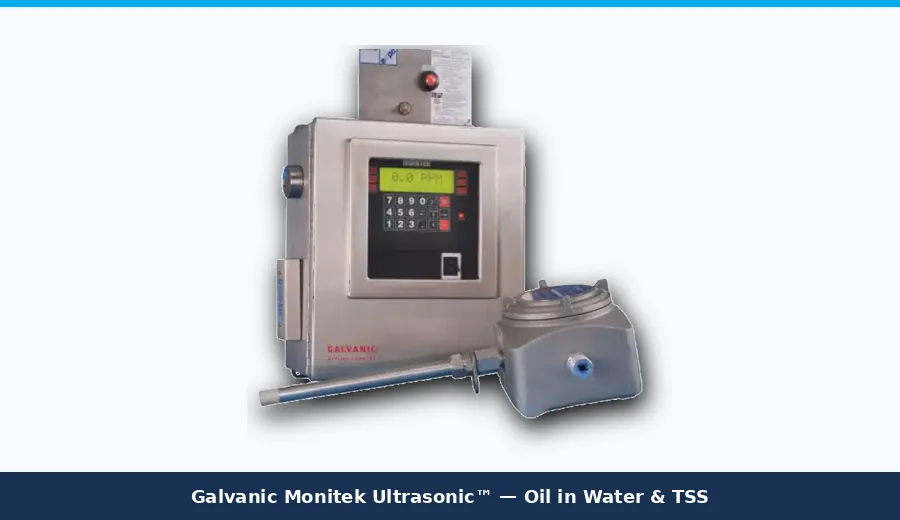
The Galvanic Monitek Ultrasonic™ is a process liquid analyzer that uses acoustic backscatter to measure oil in water and total suspended solids in samples too opaque or oily for traditional optical-based instruments. Catalogue positioning highlights include application-specific engineered-to-order sensors, a messenger controller with up to four discrete sensor inputs, 4–20 mA and Modbus outputs with relay alarms and data logging, and relative insensitivity to sensor coating compared with many optical windows. Hazardous-area options listed in the catalogue include CSA/NEC Class I Div 2 with Z-purge enclosure where required.
Prefer Monitek Ultrasonic-class measurement when you must:
- Trend oil-in-water and/or TSS continuously on produced water, refining wastewater, or industrial effluent that is dark, oily, or coating-prone.
- Reduce false “analyzer drift” from optical-window fouling on streams that coat glass or fibre cells.
- Cover multiple streams or parameters from one messenger controller where multi-input economics matter.
- Support process optimisation and regulatory compliance evidence with real-time results rather than shift-delayed lab turns alone.
Monitek Ultrasonic is not a substitute for every laboratory oil & grease referee method, nor for every multi-species gas photometry duty. Confirm sample matrix, range, and installation geometry with the application before purchase.
When Galvanic FPA 4100™ photometer fits
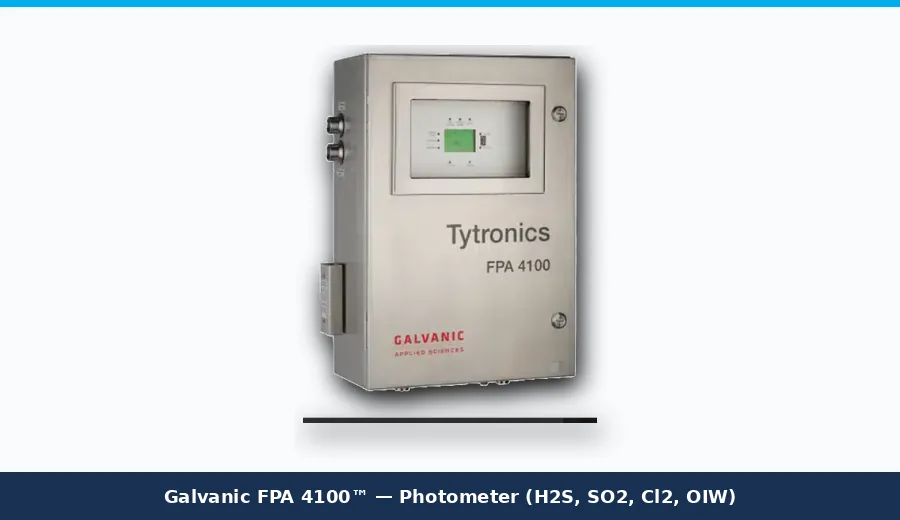
The Galvanic FPA 4100™ is a process photometer family covering analytes in gas and liquid streams. A photonics module supports UV or visible sources with a temperature-controlled photodiode block coupled by fibre optic cable — continuous measurement without reagents or compressed gases for the optical path. Dual-wavelength measurement compensates for turbidity, light-intensity drift, optical window coating, and bubbles. Catalogue notes include multi-stream capability (up to eight streams), auto-calibration with external standards, auto-zero and cell-washing options, Ethernet remote diagnostics, and area ratings listed as ATEX / IECEx Zone I and CSA Div. II.
Keep FPA 4100-class photometry when the duty is:
- Oil-in-water on streams suited to UV/visible absorption with manageable optical path cleanliness (or with auto cell-wash).
- Multi-species programmes where the same platform may also cover H2S, SO2, or chlorine in gas or liquid — see also the H2S / sulfur monitoring note for sulfur-species context.
- Multi-stream optical monitoring with bypass or in-line cells, including oven or steam-jacket heating options where the sample needs temperature control.
Do not treat FPA 4100 as a drop-in for every opaque, heavily coated produced-water emulsion where acoustic backscatter is the more robust continuous choice. Match the optical path to the matrix.
Sampling, fouling, calibration, and DCS / SCADA alarms
- Define the acceptance — Permit oil & grease / hydrocarbon limit, reuse specification, or internal separator KPI. Write units and method (online OIW vs lab referee) before the analyzer PO.
- Condition the sample — Stable flow, appropriate filtration or debubbling, and representative take-off reduce emulsion and gas-bubble faults that look like analyzer noise.
- Plan for fouling — Opaque and oily streams coat windows; ultrasonic backscatter is catalogue-positioned as more tolerant of coating, while photometers rely on dual-wavelength compensation, auto cell-wash, and maintenance discipline.
- Avoid dead legs — Stagnant sample lines separate oil and water and invent a reading the process does not have — or hide one it does.
- Align lab and online — Agree sample points, purge times, and reporting units so lab vs analyzer comparisons during commissioning are fair.
- Calibrate and verify on a schedule — Photometer auto-calibration with external standards and ultrasonic application setup both need a documented verification rhythm tied to the site quality system.
- Alarm into the same DCS/SCADA story as separators and dosing — OIW rising after an API/IGF upset should page the board that owns skimmers, chemical pumps, and diversion valves — not only the environmental inbox the next morning.
- Trend OIW with TSS and flow — Solids and oil often move together; multi-parameter or multi-stream controllers make that correlation visible.
Practical selection tips for Pakistan plants
- Inventory produced-water, refining wastewater, and final effluent points separately — range, opacity, and coating risk differ.
- Default to Galvanic Monitek Ultrasonic-class analyzers for continuous OIW/TSS on opaque, oily, coating-prone duties.
- Default to Galvanic FPA 4100-class photometry when UV/visible oil-in-water (and optional multi-species H2S / SO2 / chlorine) fits a clearer optical path or shared photometer programme.
- Keep laboratory oil & grease / hydrocarbon methods as referee for permits and disputes.
- Standardise tags, units, spare parts, and alarm bands so results outlive the turnaround crew that commissioned them.
Building a sensible oil-in-water programme
- Document critical streams and alarm bands in the environmental / process SOP set (not only in a vendor manual).
- Trend online OIW against separator chemical changes, storm events, and off-spec effluent incidents.
- Close the loop: OIW alarm → confirmed sample → process action → recorded close-out.
- Review OIW together with water-reuse and disposal capacity at the same integrity or HSE meeting — they share root causes more often than org charts admit.
FAQ
Is ultrasonic oil-in-water the same as a laboratory oil & grease test?
No. Online ultrasonic or photometric OIW is for continuous control and upset response. Laboratory oil & grease / hydrocarbon methods remain the usual permit referee. Use both deliberately — do not assume one number replaces the other without a site correlation study.
When should we choose Monitek Ultrasonic over an optical photometer?
When the stream is opaque, dark, oily, or known to coat optical windows, acoustic backscatter (Monitek Ultrasonic-class) is often the more robust continuous choice. Prefer FPA 4100-class photometry when the optical path is workable and you need multi-species or multi-stream UV/visible analysis including oil-in-water.
Can one FPA 4100 cover oil-in-water and H2S?
Catalogue FPA 4100 positioning covers H2S, SO2, chlorine, and oil-in-water across gas or liquid streams on the photometer platform, with multi-stream options. Application engineering still decides whether one installation or separate cells/streams are appropriate — specify each analyte and matrix clearly.
How Tetracon supports oil-in-water choices
Tetracon supplies oil-in-water, TSS, and process photometer analyzers for refining, E&P, and industrial effluent applications in Pakistan. Application support through the contact page and services team can help match Monitek Ultrasonic continuous OIW/TSS and FPA 4100 photometry to your duties. Start with catalogue pages for Galvanic Monitek Ultrasonic™ and Galvanic FPA 4100™, or browse Galvanic Applied Sciences on the site.
Key takeaways
Oil-in-water monitoring for Pakistani refining, produced-water, and effluent plants is a programme of continuous measurement, disciplined sampling, and DCS-owned alarms — not a single lab bottle after the complaint. Use Galvanic Monitek Ultrasonic-class analyzers when opaque or coating-prone OIW/TSS duties need acoustic backscatter; keep Galvanic FPA 4100-class photometry when UV/visible oil-in-water (and optional multi-species duties) fit the optical path. Write the acceptance criteria before the purchase order, and prove that oil-in-water is trended, alarmed, and closed.