

Hydrocarbon liquids moving through Pakistani refineries, petrochemical complexes, condensate systems, and specialty oil loops are rarely “dry” by default. Water dissolves, emulsifies, or saturates non-polar process fluids depending on temperature, composition, and upstream treating. A grab sample sent to the lab after a shift change tells you what the stream was hours ago — not what the unit is doing while catalyst, exchangers, and custody meters are already seeing that moisture.
This note is for process, analytical, and integrity engineers specifying moisture measurement on liquid hydrocarbon duties in Pakistan. It maps liquid vs gas moisture problems to catalogue instruments available through Tetracon — the Michell Liquidew I.S. Moisture in Liquids Analyzer for online water-in-liquid measurement, and the complementary Michell Promet I.S. Process Moisture Analyzer for high-pressure process gases and vaporized liquids. Related context: hydrocarbon and water dew point in natural gas and trace moisture technologies for process gases.
Why moisture in hydrocarbon liquids matters
Refining and petrochemical liquid streams operate under heat, pressure cycles, feedstock variability, and aging treating trains. Continuous or well-timed moisture measurement supports:
- Corrosion and integrity — Dissolved and free water accelerate corrosion under insulation, pitting in carbon-steel lines, and hydrate or ice risk when cold spots appear on light hydrocarbons and condensate.
- Catalyst and treating performance — Many catalysts, molecular sieves, and drying beds are poisoned or loaded faster when upstream liquid moisture drifts; online indication catches upsets before the next laboratory confirmation.
- Product quality and specifications — Finished naphtha, kerosene, diesel blendstocks, solvents, and petrochemical intermediates often carry water limits that matter for export, blending, and customer complaints.
- Custody and commercial disputes — When water content affects volume, quality claims, or demurrage arguments, a documented online trend beats a single disputed bottle sample.
- Predictive maintenance — Rising moisture in hydraulic, transformer, or process oil loops can flag seal leaks, cooler tube failures, or dryer breakthrough before a catastrophic trip.
Lab grabs prove a point in time. Online moisture-in-liquid analyzers show the trend that corrosion, catalyst, and custody teams actually manage.
Typical moisture duties — liquid vs gas
| Duty | What you need | Usual pattern |
|---|---|---|
| Online water in non-polar process liquids (naphtha, condensate, solvents, oils) | Moisture-in-liquids analyzer, hazardous-area capable, ppmW to saturation | Michell Liquidew I.S. on conditioned liquid sample lines |
| Multi-stream liquid moisture with shared control | Multi-channel liquid moisture system | Liquidew I.S. up to four independent channels |
| High-pressure process gas / vaporized liquid moisture | Process moisture / dew-point analyzer at line pressure with sample conditioning | Michell Promet I.S. with ES70-class sample systems |
| Pipeline / sales-gas water and hydrocarbon dew point | Dedicated hydrocarbon + water dew-point package | See dew-point note — different duty from liquid ppmW |
| Trace moisture in dry process gases (ppb–ppm) | Ceramic, chilled-mirror, or TDL technology choice | See trace-moisture technology comparison |
Write the phase first: liquid ppmW (or saturation), gas dew point / moisture content, or laboratory Karl Fischer confirmation. Buying “a moisture analyzer” without that sentence is how teams install a gas hygrometer on a liquid header and wonder why the reading never settles.
When Michell Liquidew I.S. fits
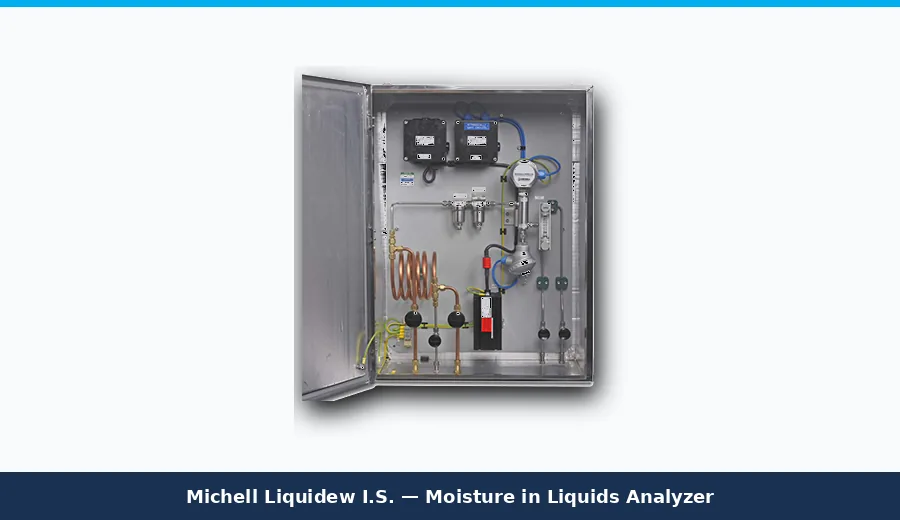
The Michell Liquidew I.S. is an intrinsically safe moisture-in-liquids analyzer for fast, reliable online measurements in non-polar process fluids. A ceramic metal-oxide moisture sensor measures water content from trace ppmW levels up to saturation. Catalogue positioning highlights include multi-channel control (up to four independent measurement channels), 4–20 mA and Modbus RTU outputs, NIST/NPL-traceable calibration, Michell Calibration Exchange for replaceable sensors, and optional loop-powered O2 transmitter. An EExd version is also listed in the catalogue for installation patterns that prefer flameproof rather than intrinsically safe architecture.
Prefer Liquidew I.S.-class liquid moisture when you must:
- Trend water in naphtha, condensate, light hydrocarbons, solvents, hydraulic oils, transformer oils, or similar non-polar liquids online.
- Cut dependence on delayed Karl Fischer or oven-method lab turns for process control and upset response.
- Cover several liquid streams from one control unit where multi-channel economics matter.
- Install in hazardous areas with intrinsically safe (or catalogue EExd) options matching the site electrical philosophy.
Liquidew is not a substitute for gas-phase dew-point packages on dry sales gas, nor for every polar or heavily emulsified aqueous duty outside the OEM’s recommended liquid types. Confirm fluid compatibility and sample conditioning with the application before purchase.
When gas-phase Promet I.S. still belongs
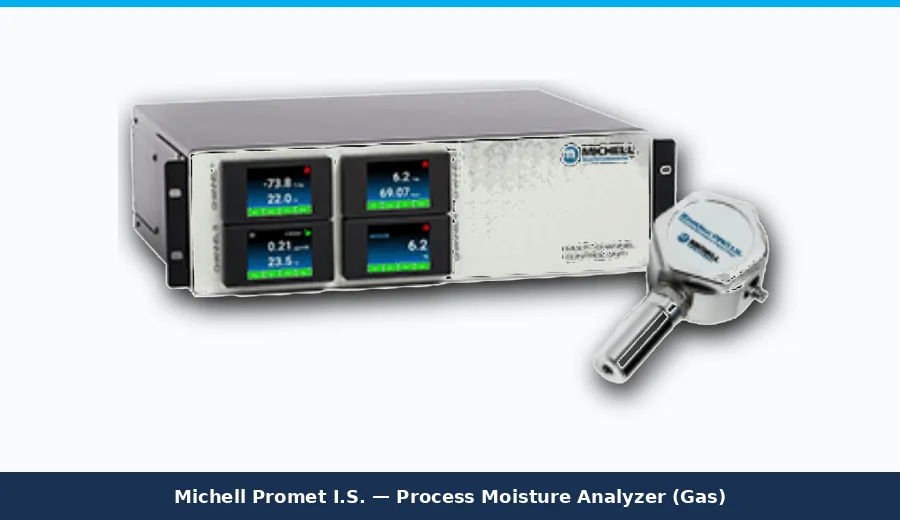
The Michell Promet I.S. is a heavy-duty industrial hygrometer system for measuring high-pressure process gases and vaporized liquids on natural gas platforms and terminals, petrochemical plants, and industrial gas facilities. It combines Michell’s ceramic metal-oxide moisture sensor with ES70 sample conditioning for reliable multi-channel online measurement of flammable and non-flammable gases. Catalogue notes also allow combining Promet channels with Liquidew I.S. moisture-in-liquid or Minox-i O2 functions under a shared control philosophy where the site needs both phases.
Keep Promet I.S.-class gas moisture when the duty is:
- Moisture in process gas headers, vaporized liquid sample paths, or high-pressure gas at platforms and terminals.
- Multi-channel gas moisture with real-time or programmed pressure compensation into moisture content.
- A gas-side companion to a liquid Liquidew installation on the same complex (for example liquid product moisture plus overhead or fuel-gas moisture).
Do not treat Promet as a drop-in for liquid ppmW on a liquid product line. Phase mismatch is the most common specification error in moisture RFQs.
Sampling tips for Pakistan refinery and petrochem teams
- Define the phase and the acceptance — Liquid ppmW vs gas dew point vs lab Karl Fischer referee method. Write what “on-spec” means before the analyzer PO.
- Condition the liquid sample — Stable flow, appropriate filtration, and temperature control reduce emulsion and particulate faults that look like “analyzer drift.”
- Avoid dead legs and long hot/cold runs — Moisture partitions with temperature; a 30-metre uninsulated sample line can invent a problem the process does not have — or hide one it does.
- Separate free water from dissolved moisture intent — If the stream routinely carries free water slugs, address knockout and phase separation upstream; dissolved-moisture sensors are not slug detectors.
- Align lab and online — Agree sampling points, purge times, and units (ppmW vs mg/kg vs % saturation) so lab vs Liquidew comparisons are fair during commissioning.
- Plan Calibration Exchange / spare sensors — Michell Calibration Exchange-class workflows keep uptime high without building a full on-site moisture primary lab for every unit.
- Integrate alarms into the same DCS story as treating — Moisture rising after a dryer, coalescer, or desalting upset should page the same board that owns that equipment.
- Do not ignore the gas companion — Many liquid moisture complaints start as wet gas, steam leaks, or poor dehydration on the vapour side — Promet I.S.-class measurement still belongs in the programme.
Practical selection tips
- Inventory liquid streams (product, intermediate, condensate, oil loops) separately from gas/vapour streams.
- Default to Michell Liquidew I.S.-class analyzers for online moisture in suitable non-polar hydrocarbon liquids.
- Default to Michell Promet I.S.-class (or related process moisture packages) for high-pressure gas and vaporized-liquid duties.
- Use dew-point and trace-moisture technology notes when the duty is dry gas quality rather than liquid ppmW.
- Standardise units, sample-point tags, and spare-sensor exchange so results outlive the turnaround crew that commissioned them.
Building a sensible liquid-moisture programme
- Document critical streams and alarm bands in the process safety / quality SOP set (not only in a vendor manual).
- Trend online moisture against treating bed change-outs, exchanger leaks, and off-spec incidents.
- Close the loop: moisture alarm → confirmed sample → process action → recorded close-out.
- Review liquid and gas moisture together at the same integrity or quality meeting — they share root causes more often than org charts admit.
FAQ
Is moisture in liquids the same measurement as water dew point in natural gas?
No. Liquid duties typically report water content in the liquid (for example ppmW toward saturation). Gas duties often report dew point or moisture content in the vapour. Related programmes — different analyzers. See the dew point and trace moisture notes for gas-side technology choices.
When should we still use laboratory Karl Fischer?
Use the lab as referee during commissioning, after major process changes, and for custody disputes. Online Liquidew I.S.-class measurement is for continuous control and upset response — not a reason to abandon a documented lab method where contracts require it.
Can one analyzer cover both liquid product and fuel gas?
Usually no as a single sensor path. Catalogue Promet I.S. systems can combine with Liquidew I.S. functions under multi-channel control philosophies, but liquid and gas sample systems remain distinct. Specify each stream’s phase clearly.
How Tetracon supports moisture-in-liquid choices
Tetracon supplies moisture-in-liquids and process moisture analyzers for refining, petrochemical, and industrial applications in Pakistan. Application support through the contact page and services team can help match Liquidew I.S. liquid measurement and Promet I.S. gas-side moisture to your duties. Start with catalogue pages for Michell Liquidew I.S. and Michell Promet I.S., or browse Michell Instruments on the site.
Key takeaways
Moisture in hydrocarbon liquids for Pakistani refining and petrochemical plants is a programme of online liquid measurement, disciplined sampling, and gas-side companion monitoring — not a single lab bottle after the complaint. Use Michell Liquidew I.S.-class analyzers when dissolved water in non-polar liquids drives corrosion, catalyst, quality, or custody risk; keep Michell Promet I.S.-class process moisture on high-pressure gas and vaporized-liquid duties. Write the phase and acceptance criteria before the purchase order, and prove that moisture is trended, alarmed, and closed.