

Natural gas keeps Pakistani cities, power plants, fertiliser units, and industrial boilers running — and every welded joint, valve packing, regulator, city-gate flange, and buried distribution main is a potential fugitive methane path. Soap solution and a handheld sniffer still earn their place for confirmation at a known fitting. They do not scale when an HSE or network integrity team must walk kilometres of above-ground piping, survey a city-gate yard after modifications, or prove that a suspected underground leak plume is methane rather than another VOC.
This note is for distribution, transmission, plant integrity, and HSE teams specifying natural gas leak survey tools for SNGPL/SSGC-style networks, city gates, and plant piping. It maps duties to catalogue instruments available through Tetracon — the Huberg LASER One™ Natural Gas Leak Detector (TDLAS methane survey from QED Environmental Systems / Huberg) and the complementary Omega HHLT-1 Ultrasonic Air or Gas Leak Detector for pressurised air/gas pinpointing. Fixed-point hazardous-area heads (for example the Status Scientific FGD10A) remain essential for continuous zone monitoring; this article focuses on survey and localisation. Related context: fixed vs portable gas detection and H2S / total sulfur on natural gas.
Why fugitive methane surveys matter in Pakistan
Distribution networks and plant piping operate under heat, dust, vibration, excavation risk, and aging fittings. Continuous or campaign leak survey supports:
- Public and worker safety — Methane is odourised for a reason; accumulation in pits, basements, valve boxes, and poorly ventilated plant rooms is an ignition and asphyxiation hazard.
- Network integrity and UFG — Unaccounted-for gas and recurring “smell of gas” complaints often track to the same joints, service tees, and regulator stations that a structured walk-survey would have flagged earlier.
- HSE and ESG evidence — Operators increasingly need geo-tagged methane findings, not only a verbal “we checked with soap.”
- Post-work assurance — After hot taps, meter replacements, city-gate upgrades, or plant turnarounds, a laser survey pass catches fugitives soap teams miss when they only hit the fittings they can see.
- Methane selectivity — Urban and plant atmospheres carry solvents, vehicle exhaust, and other hydrocarbons; a methane-selective TDLAS reading reduces false chases.
Soap proves a bubble at a fitting you already suspect. A TDLAS walk survey finds the plume you did not know to soap.
Typical leak-detection duties
| Duty | What you need | Usual pattern |
|---|---|---|
| Distribution / transmission walk survey (above-ground or bar-hole follow-up) | Methane-selective handheld with fast response, logging, GPS | Huberg LASER One™ TDLAS survey; soap/CGI confirmation at pinpoint |
| City-gate, RMS, plant piping campaign after work | Same laser survey plus documented route coverage | LASER One™ walk + tagged photos/notes; ultrasonic HHLT-1 on noisy pressurised fittings if air/gas leak path is acoustic |
| Compressed air / steam / process gas fitting pinpoint | Ultrasonic transmitter/receiver for pressurised leaks by ear | Omega HHLT-1 kit — complements methane survey, does not replace it |
| Continuous hazardous-area monitoring (fixed zones) | Ex-rated fixed heads into a gas panel / DCS | FGD10A-class flameproof detectors — different duty from handheld survey |
| Confined entry / personal exposure | Multi-gas portable with bump test discipline | Portable HSE programme (see fixed vs portable note) — not a network survey tool |
Write the duty first: methane survey of a network or yard, ultrasonic pinpoint of a pressurised fitting, or fixed continuous monitoring. Buying “a gas leak detector” without that sentence is how teams argue over the wrong technology on site.
When handheld TDLAS laser survey beats soap and sniffer
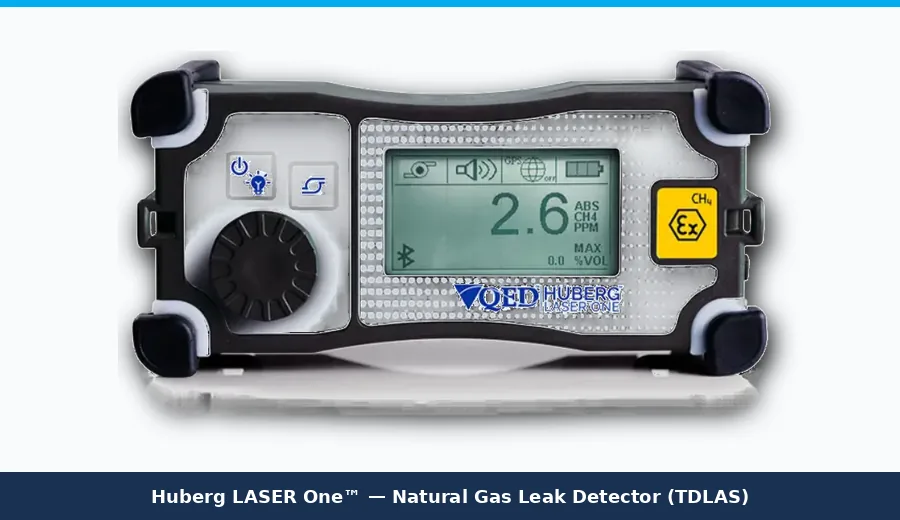
The Huberg LASER One™ is a professional methane detector for fast, accurate leak detection on underground and above-ground pipelines. It uses Tunable Diode Laser Absorption Spectroscopy (TDLAS) for methane-only selectivity with essentially zero cross-gas interference — a practical advantage when the site smells of “something” but you need methane evidence. Catalogue positioning highlights include: no calibration gas cylinders or external hydrogen required in the field workflow described by the OEM, no cross-gas false readings of the soap/FID/CGI style, a two-year factory calibration interval class, GPS and Bluetooth for geo-tagged data logging, and pairing with Huberg METREX instruments where multi-use compliance surveying is already established.
Prefer LASER One™-class TDLAS when you must:
- Walk long pipe racks, city-gate yards, or distribution routes faster than soap-every-fitting allows.
- Distinguish methane from other hydrocarbons or odours before excavating or isolating.
- Produce geo-tagged survey logs for integrity, HSE, or contractor handover files.
- Reduce dependence on carrying calibration gas for every daily survey crew (follow OEM calibration interval and local procedure).
Soap solution and conventional sniffers still confirm at the exact fitting once the laser (or complaint) has narrowed the search. TDLAS does not replace excavation safety rules, bar-holing practice, or isolation permits.
Ultrasonic leak detectors — complementary, not a methane substitute
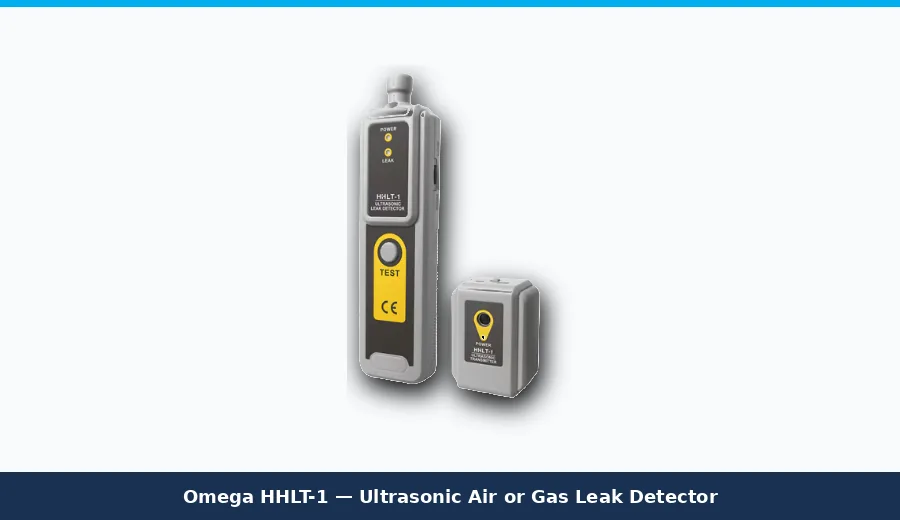
The Omega HHLT-1 is an economical handheld ultrasonic leak detector using a matched transmitter/receiver pair in the ultrasonic range. A battery-powered transmitter emits ultrasound at a suspected leak point; the receiver converts escaping ultrasonic energy to an audible tone and LED indication so the technician can pinpoint by ear. That workflow shines on compressed air headers, instrument air, and some pressurised gas fittings where turbulent leak noise dominates — plant energy-waste walks as much as natural-gas HSE.
Do not treat HHLT-1 as a methane-selective survey tool for buried distribution mains. Use it alongside TDLAS when the duty is acoustic localisation on pressurised lines you can access.
When fixed detectors still belong
Handheld survey finds and documents. Fixed detection protects people and assets continuously in defined zones — compressor buildings, metering houses, boiler rooms, and classified plant areas. Flameproof heads such as the Status Scientific FGD10A (ATEX/IECEx Ex d options, plug-in IR/pellistor/EC sensors, 4–20 mA and relay outputs) belong in the HSE architecture even when LASER One™ crews survey monthly. Survey without fixed coverage is a campaign; fixed without survey can miss fugitives outside the sensor footprint. See the fixed vs portable gas detection note for programme design.
Practical tips for Pakistan distribution and plant teams
- Define the route and acceptance — City-gate after outage, annual district walk, or turnaround close-out — write what “clear” means before the crew starts.
- Survey with wind and access in mind — Approach from upwind where practical; note pits, valve boxes, and low spots where methane can pool.
- Log GPS and photos — LASER One™-class Bluetooth/GPS logging beats clipboard memory when contractors argue about which flange leaked last month.
- Confirm before dig or isolate — Laser indication → local CGI/soap confirmation → excavation or isolation under permit.
- Separate methane survey from air-leak energy walks — Use TDLAS for natural gas; use HHLT-1-class ultrasonic for compressed air and acoustic fitting checks.
- Keep fixed systems calibrated — Survey campaigns do not excuse overdue bump tests or panel proof tests on FGD10A-class heads.
- Train for false confidence — Odour fade, wind, and “we always soap that joint” are how recurring UFG and complaints survive.
- Align with H2S / odorant programmes — Leak location and gas quality are related but different instruments; see the H2S / total sulfur note for sales-gas quality duties.
Practical selection tips
- Inventory survey routes (distribution districts, city gates, plant pipe racks) vs fixed zones (buildings, classified areas) vs compressed-air energy walks.
- Default to Huberg LASER One™-class TDLAS for methane-selective network and yard survey with geo-tagged reporting.
- Add Omega HHLT-1-class ultrasonic where pressurised air/gas fittings need acoustic pinpointing.
- Retain Status FGD10A-class (or equivalent) fixed heads and panels for continuous hazardous-area protection.
- Standardise SOPs for confirmation, excavation, isolation, and data file naming so survey results outlive the crew that walked them.
Building a sensible leak-survey programme
- Document frequency by asset class (city-gate, RMS, plant rack, complaint response) in the integrity or HSE SOP set.
- Put geo-tagged laser findings into the same work-order system that closes excavations and packing replacements.
- Trend repeat locations — the same flange leaking after every season is an asset problem, not a detector problem.
- Tie survey close-out, fixed-system proof tests, and contractor handover into one integrity package for audits.
How Tetracon supports leak-detection choices
Tetracon supplies natural gas leak survey instruments, ultrasonic leak kits, and fixed gas detection products for distribution, plant piping, and HSE applications in Pakistan. Application support through the contact page and services team can help match TDLAS survey, ultrasonic pinpointing, and fixed Ex heads to your duties. Start with catalogue pages for Huberg LASER One™, Omega HHLT-1, and FGD10A, or browse QED Environmental Systems, DwyerOmega, and Status Scientific Controls on the site.
Key takeaways
Natural gas leak detection for Pakistani distribution networks and plant piping is a programme of methane-selective survey, confirmation discipline, and fixed-zone protection — not a single soap bottle in a toolbox. Use Huberg LASER One™-class TDLAS when walk survey speed, methane selectivity, and geo-tagged evidence matter; Omega HHLT-1-class ultrasonic when pressurised fittings need acoustic pinpointing; FGD10A-class fixed heads when continuous hazardous-area coverage is the duty. Write the route and response SOP before the purchase order, and prove that fugitive methane is found, logged, and closed.