

Heating value and composition sit under almost every commercial and process decision that moves natural gas across Pakistan. Custody transfer, city-gate sales into distribution, and plant fuel-gas quality for turbines, boilers, and heaters all depend on knowing what is in the stream — not only that a meter spun.
This note is for gas-plant, pipeline, city-gate, and plant-utilities engineers specifying continuous BTU and composition analysis. It maps typical Pakistan duties to two catalogue process chromatographs available through Tetracon — the Galvanic AccuChrome™ GC4 — BTU & C9+ Hydrocarbon Analyzer for dedicated natural-gas BTU and heavier-hydrocarbon work, and the Galvanic AccuChrome™ GC5 Gas Chromatograph Analyzer when modular silicon GC covers broader custody, sulfur, odorant, or biomethane programmes. Related context: H2S and total sulfur monitoring and hydrocarbon and water dew point for natural gas.
Why BTU, composition, and C9+ matter in Pakistan
Transmission and distribution networks in the SNGPL/SSGC style, plus plant fuel-gas systems fed from them, see composition change with field mix, LNG / RLNG blending, processing upsets, and seasonal demand. Continuous or well-timed BTU and composition measurement supports:
- Custody transfer and energy accounting — Volume alone does not settle energy. Heating value from a validated composition package underpins sales-gas invoices, imbalance allocation, and dispute evidence.
- City-gate and distribution quality — Wobbe index, relative density, and inert specs protect appliances and industrial burners; composition trends flag blend or processing drift early.
- Plant fuel-gas performance — Turbines, fired heaters, and boilers need stable energy input. Unseen BTU swings look like combustion problems or unexplained efficiency loss.
- Heavy ends and C9+ risk — Incomplete heavy-end characterisation understates liquids dropout risk, skews calculated hydrocarbon dew point, and can mis-state energy when C6+/C7+/C9+ lumping is too coarse.
A flow computer without a trusted composition package is only half a custody story. Online GC shows the energy and quality trend that commercial and process teams actually manage.
What process GC is for — and what it is not
| Need | Typical approach | Notes |
|---|---|---|
| BTU + C1–C6+ (or C7+/C9+) composition | Process natural-gas GC (AccuChrome GC4-class) | Custody, city-gate, fractionation, multi-stream sales gas |
| Broader GC (BTU + H2S / odorants / sulfur / biomethane) | Modular process GC (AccuChrome GC5-class) | One compact platform beyond classic BTU-only |
| H2S / total sulfur only | Tape or dedicated sulfur analyzer | See the H2S / sulfur note |
| Hydrocarbon / water dew point (direct) | Chilled-mirror / dedicated dew-point analyzer | GC + EOS can estimate HCDP; many keep a direct dew-point measurement |
| Lab referee / dispute | Laboratory GC / GPA / ASTM methods | Commissioning and contractual referee — not continuous control |
Write the measurement intent first: custody BTU with heavy-end depth, multi-stream city-gate quality, plant fuel-gas energy, or a multi-variant GC programme. Buying “a gas chromatograph” without that sentence is how teams install a C6+-only package on rich gas that needs deeper heavy ends — or a complex multi-chain GC where a dedicated BTU analyzer would have been enough.
When Galvanic AccuChrome™ GC4 fits BTU + C9+ natural gas
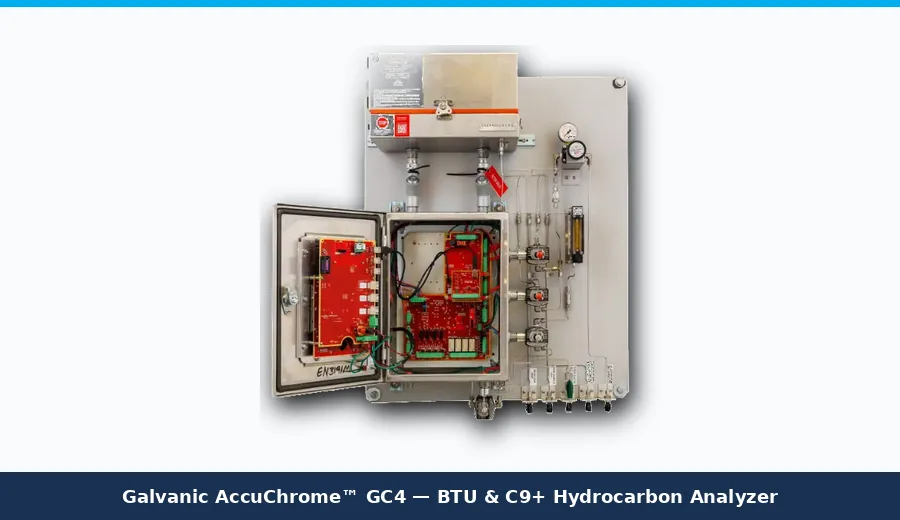
The Galvanic AccuChrome™ GC4 is catalogue-positioned for Btu and constituent analysis of natural gas — custody transfer, fractionation optimisation, and flare-gas emissions monitoring where heating value and hydrocarbon content matter. Catalogue highlights include ±0.25 Btu per SCF accuracy framing, full auto calibration and validation, an airless heat-sink oven with low-maintenance injection valves, a TCD that resists burnout from carrier-gas loss and withstands corrosive H2S, multi-stream capability (up to eight streams), and field-serviceable components. Variants listed include C6+, C6+ with O2/CO, C7+, C7+ with O2/CO, and hydrogen-only — match heavy-end depth to the gas and the contract.
Prefer GC4-class for custody / city-gate BTU and composition, heavier-hydrocarbon characterisation (C6+/C7+/C9+ per configuration), multi-stream coverage, or a rugged TCD process GC with auto calibration. Confirm stream matrix, carbon-number depth, and reporting standard before purchase; broader sulfur / odorant / biomethane multi-chain programmes often point to GC5.
When Galvanic AccuChrome™ GC5 modular silicon GC fits broader duties
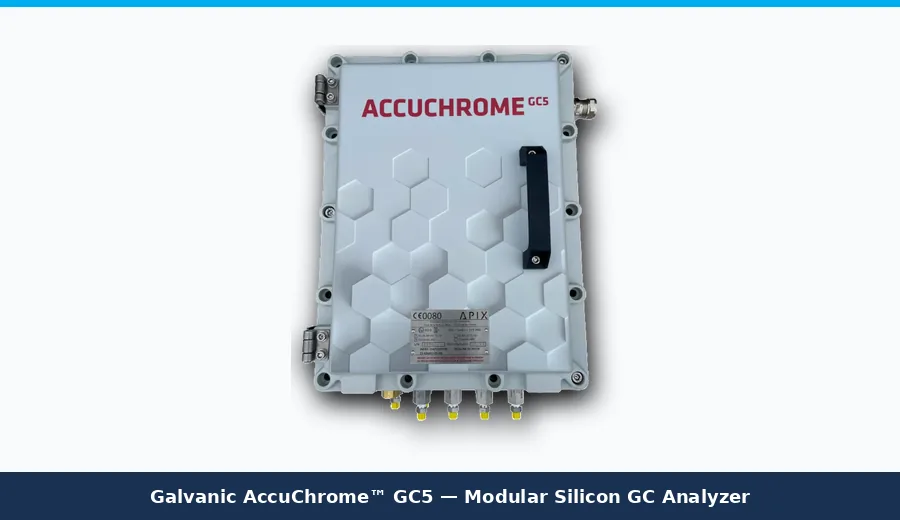
The Galvanic AccuChrome™ GC5 reworks process chromatography around silicon-miniaturized, modular analytical cores. Catalogue positioning covers custody transfer, natural gas quality monitoring, sulfur analysis, and biomethane measurement on one platform with a single carrier gas and a compact footprint versus many conventional process GCs. Features listed include up to four independent analytical chains, C1–C6 heating-value analysis in under two minutes (application dependent), a patented nano-gravimetric detector, modular cores for faster swaps, one-click operation with self-verification, and Modbus TCP/IP or RTU. Heating-value calculation standards referenced include ASTM D3588 (GPA 2172) and ISO 6976. Variants listed include BTU, BTU+H2S, BTU+odorants, sulfur, biogas, and siloxanes+VOC.
Keep GC5-class when custody or pipeline quality needs a compact modular GC, when the duty is broader than classic BTU-only, or when remote sites benefit from self-verification and low carrier-gas consumption framing. It does not replace every dedicated H2S tape or direct dew-point instrument — see the H2S / total sulfur note when sulfur is the primary KPI.
Sampling, calibration, and DCS / SCADA tips
- Define the acceptance — Contract BTU / Wobbe / composition table or plant fuel-gas energy band. Write units, reference conditions, and calculation standard before the analyzer PO.
- Condition the sample; avoid liquid and dead legs — Heat-traced lines, filtration, pressure reduction, and representative take-off reduce sample-system artefacts. Condensed heavies and stagnant volumes invent a composition the pipeline does not have — or hide one it does.
- Match heavy-end depth to risk — If calculated HCDP or liquids dropout matters, C9+/extended characterisation (or a direct dew-point analyzer) beats optimistic C6+ lumping. Pair with the dew-point note when both energy and liquids risk are contractual.
- Calibrate and validate on a schedule — Auto calibration / validation (GC4) and self-verification (GC5) still need certified calibration gas, audit-trail discipline, and a documented site rhythm.
- Align lab and online — Agree sample points, purge times, and reporting basis so commissioning comparisons are fair.
- Alarm into the same DCS story as the flow computer — BTU / Wobbe out of band, analyzer fault, carrier-gas low, and stream-switch failures should page the board that owns custody and fuel-gas.
- Trend BTU with flow and key components — Energy imbalance investigations go faster when composition, status bits, and metered volume share one historian view.
Practical selection tips for Pakistan plants
Inventory custody, city-gate, plant fuel-gas, and process points separately. Default to AccuChrome GC4-class for dedicated natural-gas BTU and C6+/C7+/C9+ hydrocarbon content; default to AccuChrome GC5-class when the programme needs a compact multi-chain platform (BTU plus H2S / odorants / sulfur / biomethane-style variants). Keep laboratory GC as referee for disputes, and keep dedicated H2S or dew-point analyzers when those KPIs are primary. Standardise tags, units, carrier-gas logistics, spare parts, and alarm bands so results outlive the commissioning crew.
FAQ
When should we choose GC4 over GC5?
Prefer GC4-class for classic natural-gas BTU and hydrocarbon content with rugged TCD / multi-stream custody framing. Prefer GC5-class for compact modular silicon GC covering broader variant packages (BTU+H2S, odorants, sulfur, biomethane) or sensor-like remote operation.
Does composition GC replace hydrocarbon dew-point measurement?
Not by itself. Extended GC plus an equation of state can estimate HCDP when heavies are well characterised, but many operators still keep a direct hydrocarbon dew-point analyzer for contract. See the hydrocarbon / water dew point note.
How Tetracon supports BTU and composition choices
Tetracon supplies process gas chromatographs and complementary gas-analysis instruments for natural gas, pipeline, and plant fuel-gas applications in Pakistan. Application support through the contact page and services team can help match AccuChrome GC4 BTU+C9+ duties and AccuChrome GC5 modular programmes to your streams. Start with catalogue pages for Galvanic AccuChrome™ GC4 and Galvanic AccuChrome™ GC5, or browse Galvanic Applied Sciences on the site.
Key takeaways
BTU and composition analysis for Pakistani custody, city-gate, and plant fuel-gas duties is trusted online chromatography, disciplined sampling, and DCS-owned alarms — not a lab bottle after an imbalance. Use AccuChrome GC4-class for dedicated BTU and C6+/C7+/C9+ content; keep AccuChrome GC5-class for broader custody, sulfur, odorant, or biomethane packages on one compact platform. Write acceptance criteria and heavy-end depth before the PO, and prove energy and composition are trended, alarmed, and closed.