

Natural gas custody transfer and transmission in Pakistan only stay trustworthy when moisture is measured as water vapour — not guessed from a dryer reading on a different stream, and not confused with hydrocarbon dew point. Liquid dropout from heavy hydrocarbons and hydrate / freeze risk from water are related integrity problems, but they are not the same measurement. A chilled-mirror hydrocarbon dew-point (HCDP) analyzer answers “when will C6+ start to condense?” A TDLAS laser dew-point / moisture analyzer answers “how much water vapour is in this gas right now?” Mixing those jobs invents false comfort on sales-gas contracts and pipeline integrity programmes.
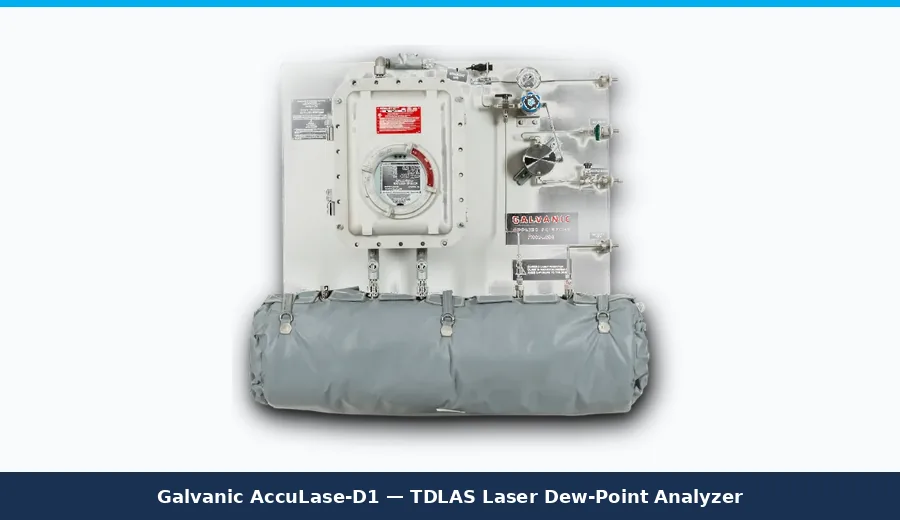
This note is for transmission, custody-transfer, underground gas storage, and plant fuel-gas teams specifying continuous laser dew-point / moisture analysis on natural gas. It maps practical selection to the catalogue Galvanic AccuLase-GPA D1 — a TDLAS (tunable diode laser absorption spectroscopy) process analyzer that measures H2S, CO2 and H2O (0–100 or 0–500 ppm) in natural gas with one laser and Herriott cell, 4 × 4–20 mA outputs, Modbus TCP/IP or RS485, Class I Div 1 / Zone 1 certification for the D1 model, and T90 of 30 seconds. The angle is deliberately distinct from the site’s overview of hydrocarbon and water dew point (Condumax / OptiPEAK class), from compressed-air / process-gas online dew point (Easidew), and from broader trace-moisture technology comparisons.
Why laser dew-point / moisture matters on Pakistani NG systems
Sales-gas contracts, city-gate stations, compressor stations, and underground storage withdrawals all care about water in the gas — but with a sampling and certification package that matches continuous custody-transfer duty. Typical Pakistani contexts include:
- Custody-transfer and sales-gas metering — Contractual moisture (ppmV, mg/Nm³, or dew point at a reference pressure) that must be measured, not only calculated from composition.
- Transmission and compressor stations — Continuous moisture trending so hydrate and freeze risk at pressure-reduction and orifice-meter points is managed before liquid forms.
- Underground gas storage — Injection and withdrawal streams where moisture can swing with reservoir conditions and must stay inside the written gas-quality envelope.
- LNG regasification and plant fuel gas — Downstream streams that still need certified moisture measurement when they feed turbines, reformers, or further custody points.
Write the contractual parameter first — water moisture (ppmV or dew point) vs hydrocarbon dew point (HCDP) vs both — before you pick “a dew-point analyzer.” AccuLase-D1 is a TDLAS H2S / CO2 / H2O analyzer that reports water in ppm; it is not an HCDP chilled-mirror instrument.
HCDP vs water moisture — brief contrast (do not conflate)
| Need | Typical approach | Catalogue / note fit |
|---|---|---|
| Continuous water vapour / dew point in natural gas (custody transfer, transmission, storage) | TDLAS moisture (ppm H2O) analyzer + sample system | Galvanic AccuLase-D1 |
| Hydrocarbon dew point (onset of C6+ condensate) | Direct chilled-mirror HCDP (Dark Spot / Bureau of Mines class) | See HCDP / water dew-point overview (Condumax class) |
| Online water in NG with alternate TDLAS framing | TDLAS moisture analyzers on process / NG streams | Covered in the same overview (OptiPEAK class) — different product family from AccuLase |
| Compressed-air dryer / utility process-gas dew point | Ceramic / polymer hygrometer transmitters and online systems | See Easidew online dew-point note |
| BTU / composition for custody energy | Process gas chromatograph | See AccuChrome BTU / composition GC note |
HCDP protects metering and equipment from hydrocarbon liquid dropout. Water moisture protects against hydrates, freeze-ups, corrosion, and contractual water limits. Many Pakistani entry and city-gate points need both stories written — but AccuLase-D1 is specified when the written duty is continuous laser measurement of water vapour / dew point on the NG sample system.
When AccuLase-D1 fits
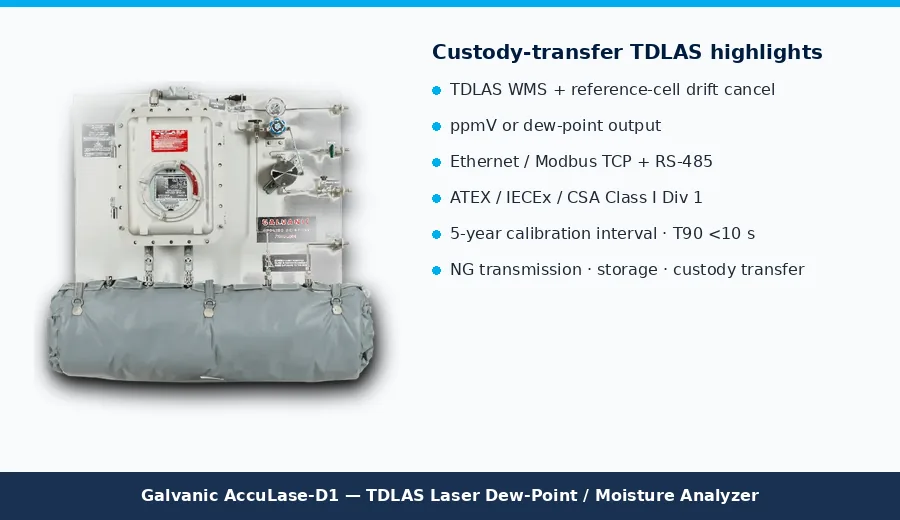
The AccuLase-D1 is the Class I Div 1 / Zone 1 model of the AccuLase-GPA, a TDLAS process analyzer that measures H2S, CO2 and H2O in natural gas and refinery streams. A near-infrared laser is tuned to each analyte’s absorption wavelength in a 52.6 cm Herriott cell (100 passes, 52.6 m optical path); an on-board vacuum pump keeps the cell at partial vacuum so H2S is measured without a scrubber consumable. Catalogue ranges are H2O 0–100 or 0–500 ppm (5 ppm sensitivity), H2S 0–10 or 0–500 ppm and CO2 0–1500 ppm or 0–5 %, with ±2 % FS accuracy and T90 of 30 seconds for all three analytes; one analyzer can monitor up to 4 streams. Outputs include 4 × 4–20 mA outputs, 2 × 4–20 mA inputs, 4 SPDT relays, Modbus TCP/IP or serial RS485 and a web-browser GUI. The D1 model is certified Class I Div 1 Groups B, C, D and ATEX / IECEx Zone 1 Ex db ia mb IIB+H2 T4. Sample must be dry and particle-free at 1000–3000 cc/min.
Prefer AccuLase-D1 when the written duty is continuous water-moisture / dew-point on NG transmission, custody-transfer metering, underground storage, or related regasification streams; when hazardous-area certification and digital communications into SCADA/DCS are required; when low maintenance (no H2S scrubber consumable) matters for operational ownership; and when the contractual parameter is water in ppm (with H2S and CO2 on the same analyzer), not hydrocarbon dew point. It is not a substitute for an HCDP chilled-mirror analyzer, not a compressed-air dryer transmitter, and not a BTU / composition GC.
Sample system, outputs and integration — brief but non-optional
A laser dew-point reading is only as good as the gas that reaches the cell. Custody-transfer sample systems must manage pressure let-down, flow, filtration, and heat tracing so the analyzer sees representative vapour — not condensed liquid, ambient wet air, or a dead-leg. Confirm whether contractual dew-point numbers are quoted at process pressure or at a standard / atmospheric reference; mixing those bases is a common source of false comfort. Integrate analog retransmission and Modbus/Ethernet into the same SCADA narrative as meter-run quality alarms, and treat fault relays as part of the written control story rather than an afterthought.
Practical use cases in Pakistan
- Custody-transfer / sales-gas stations — Continuous ppmV or dew-point moisture on the meter run sample system, with hazardous-area certified hardware and digital outputs into the station RTU/SCADA.
- Transmission and compressor stations — Moisture trending ahead of pressure-reduction and orifice points where hydrate and freeze risk concentrates.
- Underground gas storage — Injection and withdrawal quality envelopes where moisture can change with reservoir and dehydration performance.
- LNG regasification and industrial fuel-gas takeoff — Downstream streams that still need certified water-moisture measurement when feeding turbines, reformers, or further custody points.
- Complementary gas-quality stack — Pair water-moisture (AccuLase-D1) with HCDP where contracts require both, and with BTU/composition GC where energy content is the custody parameter (see related notes).
Selection and integration tips
- Write the contractual moisture parameter first — ppmV, mg/Nm³, or dew point at a stated reference pressure — before the purchase order.
- Separate HCDP from water moisture — AccuLase-D1 for TDLAS water vapour / dew point; Condumax-class for hydrocarbon dew point; do not assume one instrument closes both clauses.
- Own the sample system — Pressure, flow, filtration, and heat tracing are part of the measurement, not accessories.
- Match area classification and communications — ATEX / IECEx / CSA Class I Div 1 plus Ethernet / Modbus into the station control narrative.
- Plan calibration ownership — Catalogue 5-year calibration interval and fast T90 only help if sample integrity and alarm setpoints are written into operating procedures.
- Do not conflate duties — Laser NG dew point is not compressed-air dryer dew point, not HCDP, and not BTU/composition GC.
FAQ
Is AccuLase-D1 a hydrocarbon dew-point (HCDP) analyzer?
No. AccuLase-D1 is a TDLAS laser analyzer for H2S, CO2 and water vapour (ppm) in natural gas. Hydrocarbon dew point is a separate measurement, typically addressed with chilled-mirror condensation detectors. Both parameters can matter for custody transfer, but they answer different gas-quality questions — see the HCDP / water dew-point overview for the Condumax / OptiPEAK framing.
When does AccuLase-D1 fit Pakistani custody-transfer and transmission duties?
When you need continuous, drift-resistant water-moisture measurement on natural gas transmission, custody-transfer metering, underground gas storage, or related LNG regasification streams, with hazardous-area certification, digital communications, and a suitable sample system. Catalogue performance includes ±2 % FS accuracy, 5 ppm H2O sensitivity and T90 of 30 seconds for H2S, CO2 and H2O.
What outputs and approvals does AccuLase-D1 provide?
Catalogue features include ppm outputs for H2S, CO2 and H2O, 4 × 4–20 mA outputs and 2 inputs, 4 SPDT relays, Modbus TCP/IP or serial RS485, a web-browser GUI, and for the D1 model Class I Div 1 Groups B, C, D and ATEX / IECEx Zone 1 Ex db ia mb IIB+H2 T4 approvals.
How does AccuLase-D1 differ from ceramic moisture transmitters or compressed-air dew-point systems?
AccuLase-D1 is a TDLAS optical moisture analyzer designed for natural gas custody-transfer and transmission sample systems. Ceramic transmitters and compressed-air dew-point systems (for example Easidew-class) answer dryer and utility-gas questions; they are not a substitute for a certified NG TDLAS moisture analyzer on sales-gas or transmission duties.
Can AccuLase-D1 replace a BTU / composition GC?
No. Moisture / dew point and calorific value / composition are different custody parameters. Use AccuLase-D1 for water vapour; use a process GC (see AccuChrome BTU note) when energy content and composition are the written duty.
How Tetracon supports laser dew-point choices
Tetracon supplies gas analysis and industrial instrumentation for Pakistan industry, including Galvanic Applied Sciences TDLAS H2S / CO2 / H2O analyzers used on natural gas custody-transfer, transmission, and storage duties. Application support through the contact page and services team can help match analyzers, sample systems, and communications to your meter runs and area classifications. Start with the catalogue page for AccuLase-D1, download the datasheet (PDF), or browse Galvanic Applied Sciences on the site.
Key takeaways
Laser dew-point analysis for Pakistani natural gas custody transfer is about measuring water vapour continuously with a certified TDLAS analyzer — not confusing HCDP with moisture, and not borrowing a dryer transmitter from instrument air. AccuLase-D1 fits when transmission, custody-transfer, underground storage, or related streams need ppm H2O (with H2S and CO2), hazardous-area approvals and Modbus integration. Write the contractual moisture parameter and sample-system story first, keep HCDP and BTU/composition as separate layers where contracts require them, and treat the TDLAS analyzer as the continuous water-quality instrument on the meter run.