

A surprising amount of process control in Pakistani plants still runs on a titration done by hand. A shift chemist walks out to the amine unit with a sample bottle, a technician checks brine hardness before it reaches the membrane cells, someone measures hydrazine in boiler feedwater once a shift, and the effluent sample goes to the lab when there is time. By the time the result is written in the log book, the process has moved on. An online wet-chemistry analyzer does the same chemistry automatically, on a schedule, at the sample point, and sends the result to the DCS.
This note explains where Galvanic Applied Sciences' AccuSeries-LPA liquid process analyzer fits: amine sweetening in gas plants and refineries, sour water strippers, chlor-alkali brine purification, boiler feedwater, caustic scrubbers, steel pickling baths and wastewater effluent. All analyzer figures come from Galvanic's current AccuSeries-LPA specification sheet (Rev 3), brochure (Rev 2), O&M manual (Rev 1.3) and product page. No prices are given. Accuracy and response time are application-specific, so the method for your sample has to be confirmed with Galvanic's applications team before an order.
What an online wet-chemistry analyzer actually does
Galvanic describes the AccuSeries-LPA as a programmable "robotic chemist". For each analysis it draws a sample from an internal fast loop, adds the reagents the method needs with precision pumps, reads the result, reports it in your units and then cleans the reaction cell. Per the O&M manual it also recalibrates itself at pre-programmed intervals to compensate for changes in sample volume, pump flow, lamp intensity and reagent strength, and cleans at programmed intervals to stop precipitates, optics coating and bacterial or fungal growth.
There are two model lines, and some analyzers combine both:
- AccuColor runs colorimetric analyses and colour titrations. It uses dual-wavelength colorimetry with auto-blank: a second reading at a wavelength the analyte does not absorb cancels lamp variation and the effect of colour and turbidity in a real process sample. The optical path length is chosen for the concentration range, with multi-point calibration. Galvanic's examples include hardness in brine, mercaptans in jet fuel, hydrazine in boiler feed and manganese in municipal water.
- AccuSense runs potentiometric titrations (pH or ORP endpoint) and direct ion-selective electrode (ISE) measurements with an ionic-strength buffer, using known addition for low ranges. Galvanic's examples include acid gas loading for amine sweetening, H2S in wastewater, caustic/carbonate in scrubbers and ABC analysis in pulp liquor.
Because the methods are user-defined, Galvanic says they can be configured to the standard EPA, ISO or ASTM method your laboratory already uses, so the online number and the lab number can be compared directly. Optional sample conditioning (digestion, extraction or dilution) extends what can be measured.
AccuSeries-LPA at a glance
| Item | Galvanic specification |
|---|---|
| Techniques | Colorimetry, colour titration, potentiometric titration, ion-selective electrode, direct measurement |
| Accuracy / repeatability / linearity | ±2 % of full scale each (application-specific); sensitivity ±1 % F.S. Galvanic quotes ±2 ppb on 0–100 ppb calibration ranges. |
| Response time | 3 to 15 minutes, depending on the method |
| Reporting range | ppb sensitivity up to % level reporting |
| Streams and parameters | Multi-stream and multi-parameter: up to 4 streams per the product page, with the brochure and manual describing up to 6 stream channels. Confirm the stream count for your build at quotation. |
| Sample | 200 ml/min at 5 psi per stream, up to 70 °C, suspended solids up to 1,000 micron; wide ¼″ tubing for turbid samples and upsets; wetted parts selected for your sample |
| Outputs and comms | 8 × 4–20 mA (self-powered); Modbus TCP/IP, RS232 or RS485; 8 discrete inputs; 2 SPDT relays (up to 5 optional); 5.7″ colour LCD with extendable keypad; PC GUI over local USB or remote Ethernet |
| Hazardous area | CEC/NEC Class I Div. 2 Groups BCD T3; ATEX/IECEx Zone 2 (II 3 G Ex ec mb nC IIB+H2 T3 or T4 Gc, Tamb 0 to +60 °C), without a purge |
| Environment | −20 to 60 °C ambient, 0–95 % RH non-condensing; indoors or in a suitable enclosure |
| Size and power | 1,016 × 406 × 241 mm (16″ wide), 45.3 kg, painted 304 stainless steel; 24 VDC or 90–240 VAC, 310 W |
Where it earns its place in Pakistan
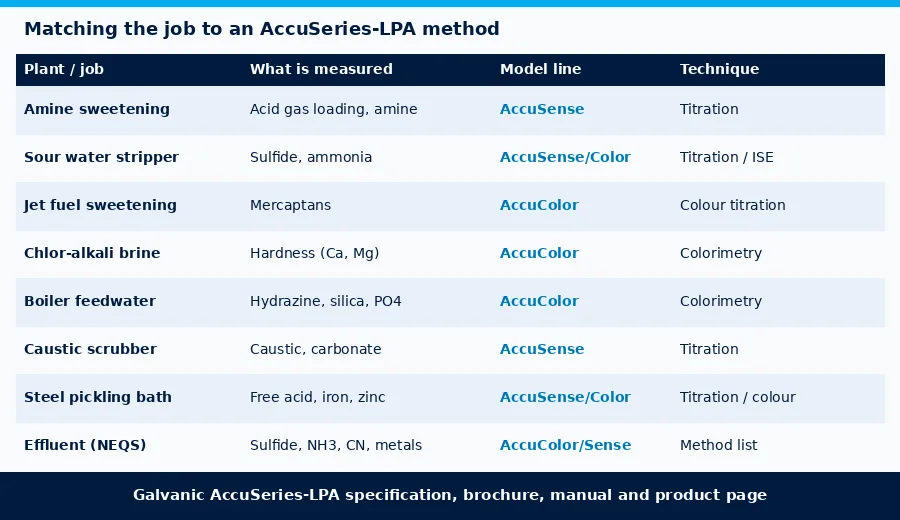
| Plant and job | What is measured | Model line | Why online |
|---|---|---|---|
| Gas processing plants and refineries: amine sweetening | Acid gas loading in rich and lean amine; amine strength | AccuSense (titration) | Loading decides circulation rate, regenerator steam and whether treated gas stays on H2S spec. A trend every few minutes replaces one titration per shift. Galvanic lists amine sweetening as a key refinery and petrochemical application. |
| Refineries: sour water stripper | Sulfide, ammonia | AccuSense / AccuColor | Stripper performance and the acid gas sent on to the sulfur recovery unit. Listed by Galvanic as a key application. |
| Refineries: jet fuel sweetening | Mercaptans | AccuColor (colour titration) | Mercaptan sulfur is a product specification. Galvanic gives mercaptans in jet fuel as an AccuColor example. |
| Chlor-alkali (caustic soda) plants: brine purification | Hardness (calcium, magnesium) in purified brine | AccuColor | Membrane cells need very low hardness in the brine that feeds them, and a breakthrough on the ion-exchange step costs membranes. Hardness in brine is one of Galvanic's headline AccuColor examples. |
| Power plants, fertilizer and process boilers | Hydrazine in boiler feedwater; also silica and phosphate methods | AccuColor | Oxygen-scavenger dosing control. Under-dosing risks corrosion; over-dosing wastes chemical. Galvanic lists hydrazine in boiler feed. |
| Chemical plants: caustic scrubbers | Caustic and carbonate | AccuSense | Shows when scrubbing liquor is spent before the outlet gas goes off spec. |
| Steel and galvanizing: pickling baths | Free acid (HCl or H2SO4), iron, zinc | AccuSense / AccuColor | Galvanic lists pickling bath chemistry as a steel-plant application. Holding acid strength and metal content steady means consistent pickling and less acid wasted. |
| Textile, chemical and refinery effluent | Sulfide, ammonia, cyanide, metals and other parameters from Galvanic's method list | AccuColor / AccuSense | Continuous evidence for NEQS and provincial EQS compliance, and an early warning before an upset reaches the outfall. |
The full parameter list in Galvanic's brochure runs from acid gas loading, alkalinity and ammonia through chloride, cyanide, hardness, hydrazine, iron, phosphate, silica and sulfide to urea and zinc, so it is worth asking about any titration or colorimetric test your lab repeats every shift. Where the species absorbs UV/visible light directly in a gas or liquid stream, such as H2S or SO2, Galvanic's reagent-free FPA 4100 photometer (UV-VIS, T90 30 s) may be the simpler choice.
The amine unit as a measurement chain
In a gas plant or refinery the amine unit sits in the middle of a chain that Tetracon already instruments with Galvanic analyzers:
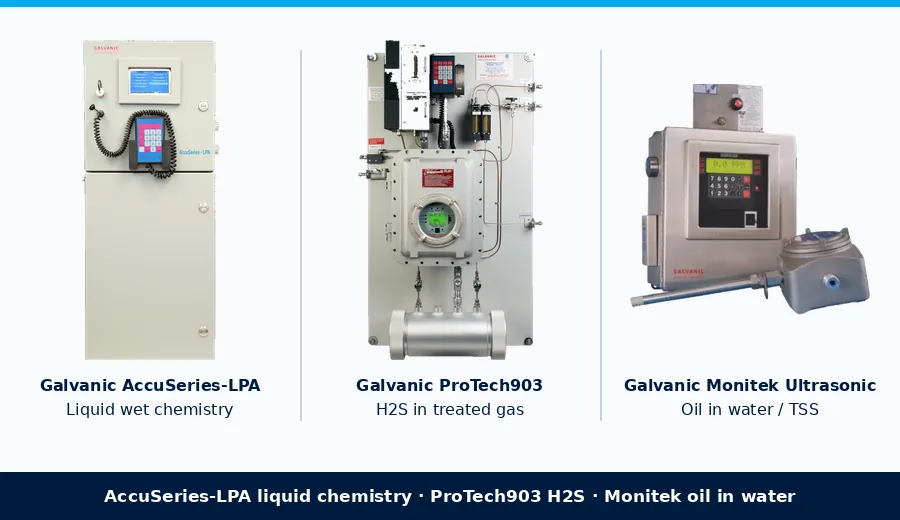
- Treated gas leaving the absorber is checked for H2S with a lead-acetate tape analyzer such as the ProTech903 (see our note on H2S and total sulfur in natural gas).
- Rich and lean amine loading and strength are measured by the AccuSeries-LPA, which tells operators whether the solvent can still do its job.
- Acid gas from the amine regenerator and the sour water stripper goes to the sulfur recovery unit, where the Brimstone tail-gas analyzer controls the air-demand loop (see sulfur recovery analyzers in Pakistan).
- Produced water and effluent are checked for oil in water with the Monitek Ultrasonic analyzer (see oil-in-water monitoring), and for dissolved species with an AccuSeries-LPA.
Measuring loading online closes the gap in the middle of that chain. Without it, the first sign that the solvent is overloaded is often an H2S alarm on the treated gas.
Installation and upkeep
- Bring the sample to the analyzer properly. Each stream needs about 200 ml/min at 5 psi, at 70 °C or below, with a return or drain. Cool hot samples (for example lean amine or boiler water) and keep lines short so the fast loop sees a fresh sample.
- Plan reagents and waste. Reagent and calibration-standard containers sit below the analyzer, and the manual schedules refilling them weekly. Size the drain vessel to hold several days of waste, and agree how spent reagent and sample are disposed of.
- Choose the location. The analyzer is rated −20 to 60 °C and certified for Class I Div. 2 / Zone 2 without a purge, but it needs to be indoors or in a suitable enclosure. Galvanic offers analyzer shelters from sun shades to complete buildings. In Sindh and southern Punjab summers that usually means at least a shaded, ventilated shelter, with UPS-backed power to ride through outages, and the sample itself must stay liquid across the site's temperature range.
- Follow the maintenance calendar. The O&M manual sets out weekly validation or calibration, monthly pump and valve recalibration, photonics optimisation and electrode calibration, quarterly replacement of peristaltic tubing, piston-pump seals and O-rings, and annual replacement of the optical filter, source lamp and electrode. Grab calibration and grab validation runs, where the reaction cup is filled by hand with standard, help conserve calibration standard.
- Connect it to the control room. Use the eight 4–20 mA outputs or Modbus TCP/IP for results and alarms, the discrete inputs to start analyses or calibrations remotely, and the Ethernet GUI for remote diagnostics.
What to send with an enquiry
- The parameter(s), expected normal and upset concentration ranges, and the lab method you use today (EPA, ISO, ASTM or in-house).
- The number of sample points, their temperature, pressure, solids content and distance from the analyzer location.
- Sample matrix details that affect wetted materials: amine type and strength, brine strength, acid type, solvents, and whether the sample is hazardous.
- Required analysis frequency, outputs (4–20 mA, Modbus TCP/IP, RS485) and alarm relays.
- Area classification and where the analyzer will sit (indoor room, shelter or outdoor enclosure).
FAQ
What is an online wet-chemistry analyzer?
It is a process analyzer that automatically takes a liquid sample, adds reagents and measures the result by colorimetry, titration or ion-selective electrode, then recalibrates and cleans itself at set intervals. Galvanic's AccuSeries-LPA does this for up to several streams and parameters, with results sent over 4–20 mA or Modbus.
How accurate is the Galvanic AccuSeries-LPA?
Galvanic specifies ±2 % of full scale for accuracy, repeatability and linearity, and ±1 % F.S. sensitivity, all application-specific. On 0–100 ppb calibration ranges Galvanic quotes ±2 ppb. Response time is 3 to 15 minutes depending on the method.
Can the AccuSeries-LPA measure amine acid gas loading?
Yes. Acid gas loading for amine sweetening is one of Galvanic's AccuSense examples, using potentiometric titration, and amine sweetening is listed as a key refinery and petrochemical application. Galvanic's parameter list also includes amine, sulfide and ammonia for amine and sour water units.
Can it be installed in a hazardous area?
The AccuSeries-LPA is certified CEC/NEC Class I Div. 2 Groups BCD T3 and ATEX/IECEx Zone 2 (Ex ec mb nC IIB+H2 T3 or T4 Gc, Tamb 0 to +60 °C) without a purge. It is rated −20 to 60 °C ambient and needs to be indoors or in a suitable enclosure.
Where can Pakistani plants see the product and ask for an application review?
See the AccuSeries-LPA catalogue page, browse process instruments, or contact Tetracon with the parameter, concentration range, lab method and sample conditions.
Next steps
Tetracon supplies Galvanic Applied Sciences analyzers to gas processing, refining, chemical, power and industrial water users across Pakistan. Send us the parameter you test by hand today, its normal and upset ranges, your lab method, the number of sample points and the sample conditions, and we will take the application to Galvanic for a method review. Use the contact page or see our services. Start with the AccuSeries-LPA catalogue page and the related ProTech903, Brimstone, Monitek Ultrasonic and FPA 4100 pages. You can also browse process instruments and gas analysis, or see all Galvanic Applied Sciences products. Free technical guides are collected under Guides.