

Hydrogen sulphide is the gas that decides whether a biogas engine lasts, whether a scrubber is doing its job and whether a natural gas stream is fit to send on. It is toxic, it corrodes engines, boilers and pipework, and it poisons downstream catalysts and upgrading membranes. Many plants in Pakistan still check it with occasional tube readings or a portable instrument. An online analyser gives a continuous ppm figure and a 4–20 mA signal that the plant control system can trend and alarm on.
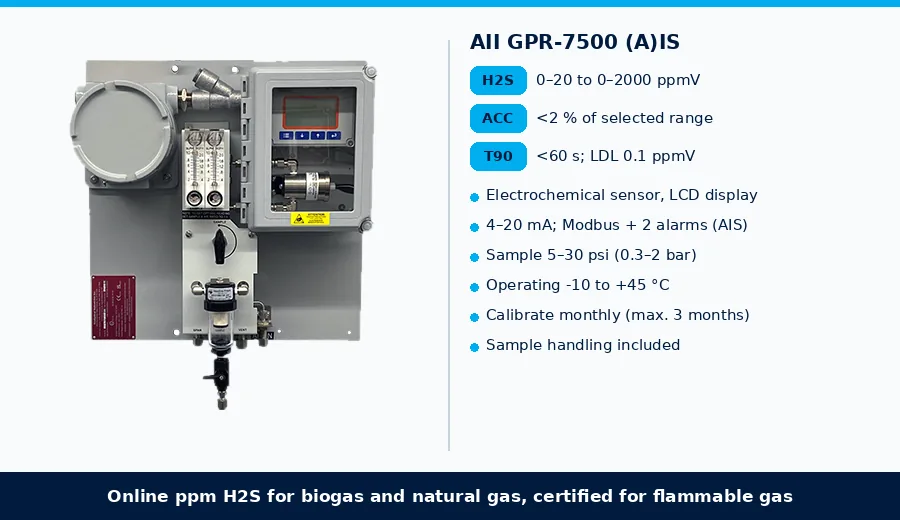
This note looks at the AII GPR-7500 (A)IS online H2S analyzer, an electrochemical ppm hydrogen sulphide analyser certified for flammable gas streams, with its portable companion, the GPR-7100. Figures come from the GPR-7500 (A)IS datasheet (PST-DS-3300-1.1, 06/2024) hosted on our product page and from the current Tetracon product pages. General engineering advice is labelled as general, and nothing here goes beyond the manufacturer's published data. Tetracon (Pvt.) Ltd. is the sole authorized agent for Analytical Industries Inc. in Pakistan.
Why measure H2S online
- The listed duties are natural gas and biogas. The datasheet names two applications: natural gas, and biogas before and after the H2S scrubber (datasheet).
- Scrubber performance needs two points. A reading before the scrubber shows the load and a reading after it shows what reaches the engine, boiler or upgrading unit. Together they show when the scrubber media or dosing needs attention, before it breaks through (general).
- A continuous signal beats spot checks. The GPR-7500 gives a 4–20 mA output, and the AIS version adds Modbus and two user-configurable alarms. H2S can be trended in the SCADA or PLC and alarmed, not just logged by hand once a shift (datasheet; general).
- It is built for flammable gas. The analyser is certified for use in flammable gas streams, with ATEX, IECEx and cMETus hazardous-area approvals (datasheet).
- Low running effort. Aii describes the low-power electrochemical sensor technology as cost-effective, minimal-maintenance H2S measurement in a compact design (datasheet).
GPR-7500 (A)IS at a glance
| Item | GPR-7500 (A)IS (datasheet) |
|---|---|
| Measured gas | H2S (hydrogen sulphide), ppmV, electrochemical sensor |
| Sensor models | OSV-72-7H and OSV-72-7HH; -LD versions with liquid drain (OSV-72-7H-LD, OSV-72-7HH-LD) |
| Ranges, OSV-72-7H / -7H-LD | 0–500, 0–1000, 0–2000 ppmV |
| Ranges, OSV-72-7HH / -7HH-LD | 0–20, 0–50, 0–100 ppmV |
| Accuracy | < 2 % of selected range at constant conditions |
| Output resolution | 0.01 ppmV |
| Lower detection limit | 0.1 ppmV; the -LD column prints 0.1 ppmV (1 ppmV with optional ranges) |
| Sample flow rate (application dependent) | 1:10 ratio (air:sample) for 7H; 1:1 ratio (air:sample) for 7HH |
| Sample pressure range | 5–30 psi (0.3–2 bar) |
| Response time (T90) | < 60 seconds |
| Operating temperature | -10 to +45 °C (+14 to 113 °F) |
| Humidity | 15–90 %rh non-condensing |
| Sensor life / shelf life | 12 months in air (application dependent) / up to 3 months |
| Calibration interval | Monthly recommended, no longer than 3 months (application dependent) |
| Display / output | LCD; 4–20 mA |
| Digital / relays | Modbus and two user-configurable alarms (AIS only) |
| Power | 12–28 V DC loop-powered, max 1 W (IS); 12–24 V DC, max 28 W (AIS) |
| Housing | Painted aluminium and fiberglass |
| Hazardous area | ATEX II 2 G and IECEx: Ex db ia IIC T4 Gb without the optional air pump, Ex db ia IIB+H2 T4 Gb with it; Tamb -20 to +50 °C. cMETus: Class I, Division 1, Groups B, C & D, T4 (with or without the pump) |
Choosing the sensor and range
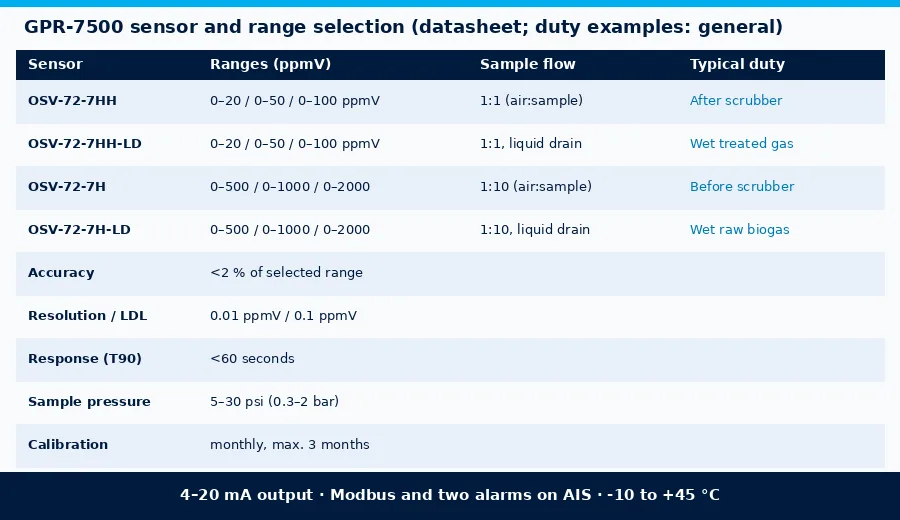
The GPR-7500 covers 0–20 ppmV up to 0–2000 ppmV with two sensor families (datasheet). Pick the range from the H2S level you expect at that point, with headroom for upsets (general).
- OSV-72-7HH, 0–20, 0–50 or 0–100 ppmV. This is the low-range family: treated biogas after the scrubber, natural gas and other streams where H2S should already be low and you need to see small changes. Its sample flow rate is given as a 1:1 air:sample ratio (datasheet; duty examples general).
- OSV-72-7H, 0–500, 0–1000 or 0–2000 ppmV. This is the high-range family, for example raw biogas before the scrubber. Its sample flow rate is given as a 1:10 air:sample ratio, and the optional air pump is for sample dilution (datasheet; duty example general).
- Know your raw gas. Raw biogas H2S varies widely with feedstock, and some digesters run above the 2000 ppmV top range. Confirm the raw-gas level with a lab or portable reading before fixing the range, and ask us about the dilution set-up if levels are high (general).
- -LD versions for wet gas. The OSV-72-7H-LD and 7HH-LD sensor versions go with the optional liquid drain for entrained liquids, which suits saturated biogas and gas with condensate carry-over (datasheet; general).
- Accuracy is relative to the range. Accuracy is < 2 % of the selected range at constant conditions, so on 0–100 ppmV that is better than 2 ppmV, while on 0–2000 ppmV it is up to 40 ppmV. Choosing the lowest range that covers the duty gives the best resolution of real changes (datasheet; arithmetic).
IS or AIS: loop-powered or line-powered
- IS: loop-powered. 12–28 V DC loop power, maximum 1 W, with an LCD and a 4–20 mA output. This is the simplest to wire into an existing analogue input in a hazardous area (datasheet; general).
- AIS: line-powered. 12–24 V DC, maximum 28 W, with Modbus and two user-configurable alarm relays in addition to 4–20 mA. Choose it when you want local alarm contacts for scrubber breakthrough or a digital link to the SCADA (datasheet; general).
- The air pump changes the gas group. Without the optional air pump the ATEX and IECEx marking is IIC T4 Gb; with the pump it is IIB+H2 T4 Gb. The cMETus rating is Class I, Division 1, Groups B, C & D, T4, with or without the pump. Check the marking against your area classification (datasheet).
Practical notes for installation and checks
- Use the sample system it comes with. Dedicated sample-handling systems are included with the GPR-7500. Keep the sample line short and supplied at 5–30 psi (0.3–2 bar), and add pressure reduction upstream on higher-pressure natural gas lines (datasheet; general).
- Keep liquids out. Biogas leaves the digester saturated and cools in the line, so condensate is common. Specify the liquid drain option, slope the sample line back to the take-off and avoid low points (datasheet option; general).
- Mind the site temperature. The operating range is -10 to +45 °C. In Sindh and Punjab summers, an outdoor panel in direct sun can exceed that, so shade the analyser or put it in a ventilated shelter (datasheet; general).
- Plan the calibration routine. Calibration is recommended monthly and no longer than every 3 months. Budget an H2S span gas in nitrogen or methane that matches the selected range (datasheet interval; general).
- Treat the sensor as a consumable. Sensor life is 12 months in air (application dependent) and shelf life up to 3 months, so order spares close to when you need them rather than stocking them for a year (datasheet; general).
- Cross-check in the field. A portable GPR-7100 or a lab result at the same point is a quick way to confirm the online reading after calibration or a process change (general).
Where online H2S analysers fit in Pakistan
- Biogas plants at dairies, sugar mills, poultry farms, food processors and municipal or industrial wastewater sites, monitoring H2S before and after the scrubber (datasheet application; general).
- Biogas-to-power and boiler fuel where engine and boiler warranties depend on keeping H2S low, so the after-scrubber reading protects the asset (general).
- Biomethane upgrading projects, where H2S must be removed before upgrading and the product gas checked (general).
- Natural gas at gathering facilities, processing plants and captive fuel gas systems that need a continuous ppm H2S signal (datasheet application; general).
Related products and when to choose them
| Duty | Product | Key figure (datasheet / product page) |
|---|---|---|
| Continuous ppm H2S on biogas or natural gas, hazardous area | AII GPR-7500 (A)IS | 0–20 to 0–2000 ppmV, < 2 % of range, T90 < 60 s, 4–20 mA; Modbus and alarms on AIS (datasheet) |
| Field H2S spot checks and verification | AII GPR-7100 portable | OSV-72-7HH sensor, 0–20, 0–50, 0–100 ppmV, LCD, 0–1 V DC, Ex ia IIC T4 Ga (product page) |
| ppb-level H2S or total sulfur on pipeline gas | Galvanic ProTech 1000 Z2 | Tape-based; 0–100 ppb to 0–300 ppm, 5 ppb LDL, true total sulfur option (product page) |
| Multi-point CH4, CO2, O2 with optional H2S on a digester | QED BIOGAS 3000 | Up to 4 sample points; H2S, H2 or CO optional (up to 2); ATEX and IECEx Zone 2 (product page) |
| Portable biogas composition | QED BIOGAS 5000 | % CH4, CO2, O2 with optional H2S, H2, CO and NH3 (product page) |
| Biomethane product gas quality | QED BIOMETHANE 3000 | CH4 90–100 % improved accuracy, low O2 to 2 d.p. (product page) |
| Trace or percent O2 in natural gas or blanketing gas | AII GPR-x800 (A)IS | 0–10 ppm to 0–25 % O2, hazardous-area rated (product page) |
| Area gas leak detection for personnel safety | Status Scientific FGD10A | Flameproof Ex db IIC fixed detector for oxygen, toxic and flammable gases (product page) |
An online process analyser measures the gas inside the line; it does not replace fixed gas detectors that protect people from leaks in the plant area (general). For more background, read our ProTech 1000 Z2 H2S tape analyser note, the BIOMETHANE 3000 note, the biogas and landfill gas monitoring guide and the H2S and total sulfur monitoring note. The wider range is on the Gas Analysis and Gas Detection category pages, our selection guides and the Analytical Industries manufacturer page.
What to send with an enquiry
- The gas (raw biogas, treated biogas, natural gas or other) and its approximate composition, including CH4, CO2 and moisture.
- The expected normal and maximum H2S in ppmV at each measuring point, for example before and after the scrubber.
- Line pressure and temperature at the take-off, and whether liquids or condensate are present.
- The hazardous-area classification at the analyser location and whether you prefer loop-powered IS or line-powered AIS with Modbus and alarms.
- Where the signal goes (PLC, SCADA, local alarm), the site ambient temperature range and whether a shelter is available.
FAQ
What does the AII GPR-7500 (A)IS measure?
It measures hydrogen sulphide (H2S) in ppmV with an electrochemical sensor. Ranges run from 0–20 ppmV to 0–2000 ppmV, and the listed applications are natural gas and biogas before and after the H2S scrubber.
How accurate and fast is it?
The datasheet gives accuracy of less than 2 % of the selected range at constant conditions, output resolution of 0.01 ppmV, a lower detection limit of 0.1 ppmV and a T90 response time under 60 seconds.
What is the difference between the IS and AIS versions?
The IS version is loop-powered from 12–28 V DC (maximum 1 W) with a 4–20 mA output. The AIS version is line-powered from 12–24 V DC (maximum 28 W) and adds Modbus and two user-configurable alarms.
How often does it need calibration?
Monthly calibration is recommended, and no longer than every 3 months, depending on the application. Sensor life is 12 months in air, also application dependent.
Can it be installed in a hazardous area?
Yes. It is certified for flammable gas streams: ATEX and IECEx Ex db ia IIC T4 Gb without the optional air pump, or IIB+H2 T4 Gb with it, Tamb -20 to +50 °C, and cMETus Class I, Division 1, Groups B, C & D, T4.
Need continuous H2S monitoring on biogas or natural gas in Pakistan? Contact Tetracon with the gas, the expected H2S levels, the line conditions and the area classification. You can also browse the GPR-7500 (A)IS product page and the Analytical Industries manufacturer page.