

Oxygen is a contaminant in a surprising number of hydrocarbon streams. A few ppm can poison a catalyst, a percent or two can push a hydrogen-rich or hydrocarbon mixture towards its flammable range, and pipeline and feedstock specifications often put a limit on it. The difficulty is that the place you need to measure is usually a classified hazardous area, and the gas itself may contain hydrogen, which rules out a lot of general-purpose equipment.
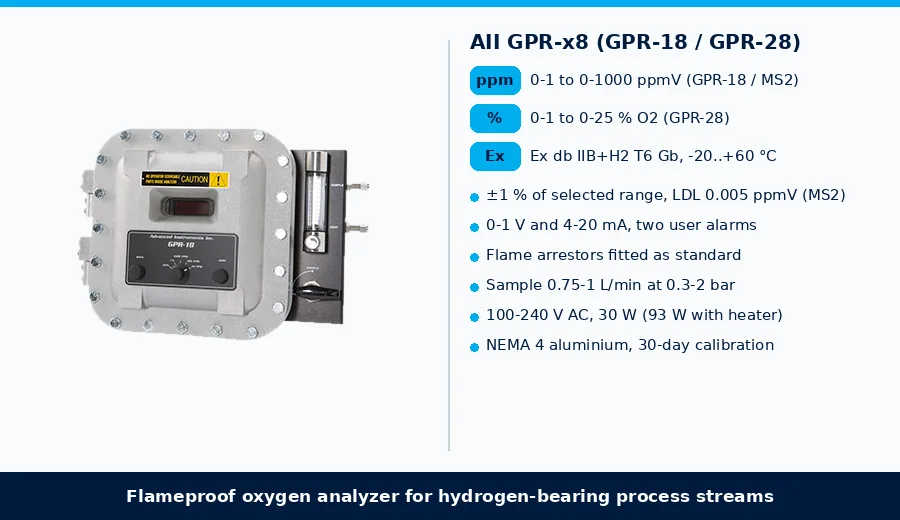
This note looks at the AII GPR-x8 explosion-proof oxygen analyzers (GPR-18 MS2, GPR-18 and GPR-28) from Analytical Industries Inc., which are built into flameproof Ex db enclosures with flame arrestors for petrochemical processes containing hydrogen and other flammable gases. Figures come from the GPR-x8 datasheet (AII-DS-3000-3.2, 07/2024, the copy hosted on our product page) and the current Tetracon product pages. Where we explain general hazardous-area practice, it is labelled as general. No prices are given; ranges, sensors and options should be confirmed at quotation.
Why oxygen is measured in hydrocarbon and hydrogen streams
- Catalyst protection. Petrochemical catalyst monitoring is the first application on the GPR-x8 datasheet. Oxygen at ppm level in a feed or recycle gas can damage some catalysts, so it is watched continuously rather than sampled once a shift.
- Natural gas quality. Gas entering a pipeline or a process unit may have an oxygen limit in its specification. An online analyzer gives a continuous record and an alarm instead of an occasional laboratory result.
- Hydrocarbon feedstock and ethylene pipelines. Both are listed applications. Oxygen in a feedstock or product line is a quality issue and, at higher levels, a safety issue.
- Sodium benzoate production. Also listed on the datasheet, as an example of a chemical process where oxygen in the process gas needs to be measured.
- The area classification. In refineries, fertilizer, petrochemical and gas processing plants (general), the analyzer often has to sit close to the sample point, inside a Zone 1 area. Moving it to a safe area means a long sample line, a slower response and more chance of leaks letting air in.
AII GPR-x8 at a glance
| Item | GPR-x8 datasheet (AII-DS-3000-3.2) |
|---|---|
| Models | GPR-18 MS2 and GPR-18 for ppm oxygen; GPR-28 for percent oxygen |
| GPR-18 MS2 (sensor GPR-12-2000-MS2E) | 0-1, 0-10, 0-100, 0-1,000 ppmV; resolution 0.001 ppmV; lower detection limit 0.005 ppmV; T90 under 20 seconds |
| GPR-18 (sensor GPR-12-333(-H) or XLT-12-333) | 0-10, 0-100, 0-1,000 ppmV, plus 0-1 % and 0-25 % for calibration; resolution 0.01 ppmV; LDL 0.05 ppmV; T90 under 10 seconds |
| GPR-28 (sensor GPR-11-60 or XLT-11-24) | 0-1, 0-5, 0-10, 0-25 % O2; resolution 0.001 %; LDL 0.01 %; T90 under 10 seconds |
| Accuracy | ±1 % of selected range at constant conditions |
| Sample | Flow 1.5-2 SCFH (0.75-1 LPM, application dependent); pressure 5-30 psi (0.3-2 bar) |
| Outputs | LCD display; 0-1 V and 4-20 mA; two user-configurable alarms |
| Power | 100/120-220/240 V AC; 30 W without heater, 93 W with heater |
| Enclosure | Unpainted aluminium, NEMA 4; flame arrestors fitted as standard; temperature compensation |
| Hazardous area | ATEX II 2 G Ex db IIB+H2 T6 Gb; IECEx Ex db IIB+H2 T6 Gb; Tamb -20 to +60 °C |
| Calibration interval | 30 days recommended (application dependent) |
GPR-18 MS2, GPR-18 or GPR-28: choosing by the oxygen level you expect
The three models share the same flameproof housing and electronics; the sensor decides the range.
- GPR-18 MS2 is the lowest-level version: its 0-1 ppmV range, 0.001 ppmV resolution and 0.005 ppmV lower detection limit suit streams where oxygen must stay well below 1 ppm. Its sensor has the shortest life of the three (12-18 months, application dependent) and a T90 of under 20 seconds.
- GPR-18 covers 0-10 to 0-1,000 ppmV with a 0.05 ppmV detection limit and a T90 under 10 seconds. The datasheet also lists 0-1 % and 0-25 % ranges on this model for calibration. Sensor life is up to 24 months.
- GPR-28 is the percent analyzer: 0-1, 0-5, 0-10 and 0-25 % O2 with 0.001 % resolution. The GPR-11-60 sensor is rated for 60 months in air and the XLT-11-24 for 24 months in air.
A simple rule (our own): pick the range so that the alarm set point sits in the upper half of the scale. Accuracy is ±1 % of the selected range, so on the 0-10 ppm range that is ±0.1 ppm, and on the 0-1,000 ppm range it is ±10 ppm.
Background gas and sensor choice
The datasheet offers sensor options for different background gases: GPR-12-333 or GPR-12-333-H and XLT-12-333 for the GPR-18, GPR-11-60 and XLT-11-24 for the GPR-28. On our other AII product pages the XLT sensors are the option for backgrounds containing CO2 (for example, more than 0.5 % CO2 on the GPR-x600 page). Tell us the full stream composition, including CO2, H2S and hydrogen content, and we will confirm the right sensor with the manufacturer. Note the operating temperature limits: +5 to +45 °C for the GPR-12-2000-MS2E, GPR-12-333(-H) and GPR-11-60 sensors, and -10 to +45 °C for the XLT-12-333 and XLT-11-24.
What "Ex db IIB+H2 T6 Gb" means on site
General hazardous-area background, not a substitute for your own area classification and inspection procedures:
- Ex db is flameproof protection: the enclosure is built to contain an internal ignition and stop it reaching the surrounding atmosphere. On the GPR-x8 the sample enters and leaves through flame arrestors, which are fitted as standard.
- IIB+H2 is the gas group: suitable for group IIA and IIB gases and also for hydrogen, which is the reason this analyzer is aimed at hydrogen-bearing petrochemical streams. It is not a full IIC rating, so check the gas list if acetylene or carbon disulphide could be present.
- T6 is the temperature class (maximum surface temperature 85 °C), the most restrictive class, so it covers gases with low ignition temperatures.
- Gb is the equipment protection level for Zone 1 (and therefore Zone 2) areas. The certified ambient range is -20 to +60 °C, though the sensors themselves have the narrower operating limits given above.
Flameproof enclosures depend on their joints, glands and cover bolts being kept as certified, so plan installation and periodic inspection with your Ex-competent staff.
Sample conditioning and installation
- Flow and pressure. The analyzer wants 0.75-1 L/min (1.5-2 SCFH) at 0.3-2 bar (5-30 psi). A pressure regulator and a flow meter at the inlet are the minimum (general).
- Keep air out. At ppm levels, the commonest error is air leaking into the sample line, not the analyzer. Use stainless tubing and compression fittings, keep the line short, and leak-test after every change (general).
- Liquids and dirt. Condensed hydrocarbons, water or particulates should be removed before the analyzer. Tell us about the stream so the sample system can be sized to suit.
- Heater. The datasheet gives a 93 W power figure with the heater fitted, against 30 W without. Ask us whether your installation needs it, particularly given the sensors' +5 °C lower limit (except the XLT versions).
- Outputs. 4-20 mA to the DCS or PLC and the two alarm relays for local action, for example a high-oxygen alarm or an interlock input (general).
Other AII oxygen analyzers and where they fit
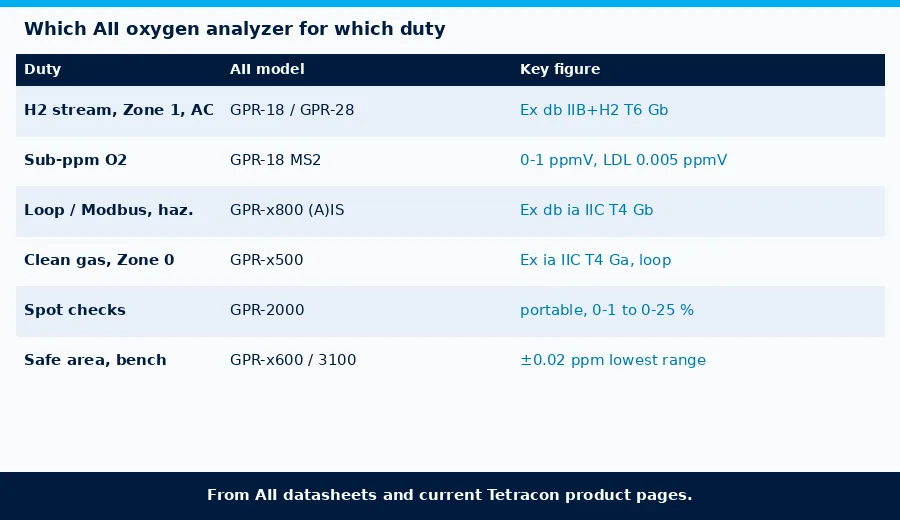
| Duty | AII model | From the datasheet / product page |
|---|---|---|
| Hydrogen-bearing stream, Zone 1, mains power | GPR-x8 | Ex db IIB+H2 T6 Gb, 0-1 ppm to 0-25 %, ±1 % of range |
| Hazardous area, loop-powered or line-powered with Modbus | GPR-x800 (A)IS | Ex db ia IIC T4 Gb; 18-24 V DC loop (IS) or line-powered analyzer (AIS) with two alarms and Modbus; 0-10 ppm to 0-25 % |
| Clean gas, loop-powered transmitter, Zone 0 | GPR-x500 | Ex ia IIC T4 Ga; 0-10 ppm to 0-25 %; sensor options for He, CO2 or H2 |
| Spot checks around the plant | GPR-2000 | Portable percent O2 (0-1 to 0-25 %), safe-area or hazardous-area (Ex ia IIC T4 Ga) versions, data logging |
| Safe area, highest accuracy | GPR-x600 / GPR-3100 | GPR-1600 0-10 ppm to 0-1 %, ±0.02 ppm in lowest range; GPR-3100 purity to 90-100 % |
For portable trace oxygen and the GPR-2800(A)IS process analyzer, see our earlier note on portable and process trace oxygen analysis.
Calibration and sensor replacement
The datasheet recommends a 30-day calibration interval (application dependent). Sensor life depends on the sensor and the application: 12-18 months for the GPR-12-2000-MS2E, up to 24 months for the GPR-12-333(-H) and XLT-12-333, 60 months in air for the GPR-11-60 and 24 months in air for the XLT-11-24. Shelf life of a stored sensor is up to 3 months, so plan replacement sensors to arrive shortly before they are needed rather than holding long-term stock (our own advice). Keep a certified zero gas (for example high-purity nitrogen) and a span gas suited to the range on site.
Typical uses in Pakistan
- Oxygen in hydrogen-rich recycle and make-up gas ahead of catalyst beds in refineries and petrochemical units.
- Oxygen limits on natural gas at gas processing plants, compressor stations and custody points.
- Oxygen in hydrocarbon feedstocks and product lines in chemical and fertilizer plants.
- Percent-level oxygen in blanketing or purge gas where the analyzer has to stand in a Zone 1 area (GPR-28).
These are general application areas from the datasheet and our experience of the sector; they are not customer references.
What to send with an enquiry
- Stream composition (hydrogen, hydrocarbons, CO2, H2S, moisture) and the expected and alarm oxygen levels.
- Area classification, gas group and temperature class for the analyzer location.
- Sample pressure, temperature and whether liquids or dirt may be present.
- Required outputs (4-20 mA, alarm relays) and the mains supply available.
- Whether you need a complete sample system and calibration gases.
FAQ
What ranges do the AII GPR-x8 analyzers cover?
From 0-1 ppmV on the GPR-18 MS2 up to 0-25 % O2 on the GPR-28. The GPR-18 MS2 covers 0-1 to 0-1,000 ppmV, the GPR-18 0-10 to 0-1,000 ppmV, and the GPR-28 0-1, 0-5, 0-10 and 0-25 %.
Can the GPR-x8 be used on gas containing hydrogen?
Yes. The analyzers are designed for petrochemical processes containing hydrogen and other flammable gases and are certified ATEX and IECEx Ex db IIB+H2 T6 Gb, for an ambient temperature of -20 to +60 °C.
How accurate is it?
±1 % of the selected range at constant conditions, with 0.5 % full-scale sensitivity listed in the datasheet highlights.
What outputs does it have?
An LCD display, 0-1 V and 4-20 mA analog outputs and two user-configurable alarms.
How often does it need calibration?
The datasheet recommends every 30 days, depending on the application. Sensor life ranges from 12-18 months (GPR-12-2000-MS2E) to 60 months in air (GPR-11-60).
What sample conditions does it need?
A flow of 1.5-2 SCFH (0.75-1 L/min) at 5-30 psi (0.3-2 bar), with the sample clean and free of liquids. Power is 100/120-220/240 V AC, 30 W, or 93 W with the heater.
Next steps
Tetracon supplies Analytical Industries oxygen and H2S analyzers across Pakistan, with sample systems, installation support and calibration. Send us the stream composition, area classification and oxygen levels, and we will help choose the model, sensor and sample system. Use the contact page or see our services. Start with the AII GPR-x8 explosion-proof oxygen analyzers, compare the GPR-x800 (A)IS, GPR-x500, GPR-2000 and GPR-x600 / GPR-3100, browse oxygen analysis, or see all Analytical Industries products and the full product catalogue. Related notes: portable and process trace oxygen analysis, oxygen analyzers for process safety and combustion control and gas chromatography in hazardous areas. Free technical guides are collected under Guides.