

Some of the most important gas measurements in a Pakistani plant are made by gas chromatographs: trace carbon monoxide and carbon dioxide in hydrogen, hydrogen in synthesis gas, CO in ethylene and propylene, trace impurities in oxygen, nitrogen and argon from an air separation unit, composition of natural gas and LNG streams. The trouble is where those streams are. A hydrogen unit, a reformer, an olefin plant or an LNG regasification skid is a classified hazardous area, and a laboratory or rack-mounted GC with heated ovens, valves, a PC and mains power cannot simply be bolted down next to the process. The usual answers are a long sample line to a distant analyser house, or a pressurised enclosure that makes the GC itself safe to install in the zone.
This note explains how a purged (pressurised) GC enclosure works, how to read its Ex marking, what the site must provide for purge air, carrier gas and power, and how LDetek's MultiDetek3 EX is specified. Instrument figures come from LDetek's MultiDetek3 EX datasheet (MULTIDETEK3EX V1.1, 06/22); detector figures and good-practice points for the GC inside come from the LDetek MultiDetek3 datasheet (V1, 09/21) and the MultiDetek3 user manual (V1.6), and are labelled as such. Where the documents disagree, we say so rather than pick a number. No prices are given; configuration, options and lead time should be confirmed at quotation.
Why put a GC inside the hazardous area at all?
A GC can only report what reaches it. A long sample line adds transport delay, gives moisture and reactive components (CO, H2S, oxygen at trace level) surfaces to adsorb on, and multiplies fittings that can leak air into a ppm or ppb measurement. Analyser houses solve the safety problem but are expensive civil and HVAC projects in their own right. Mounting the analyser close to the sample point in a certified enclosure keeps the sample path short and the response fast, while the enclosure, not the building, provides the explosion protection.
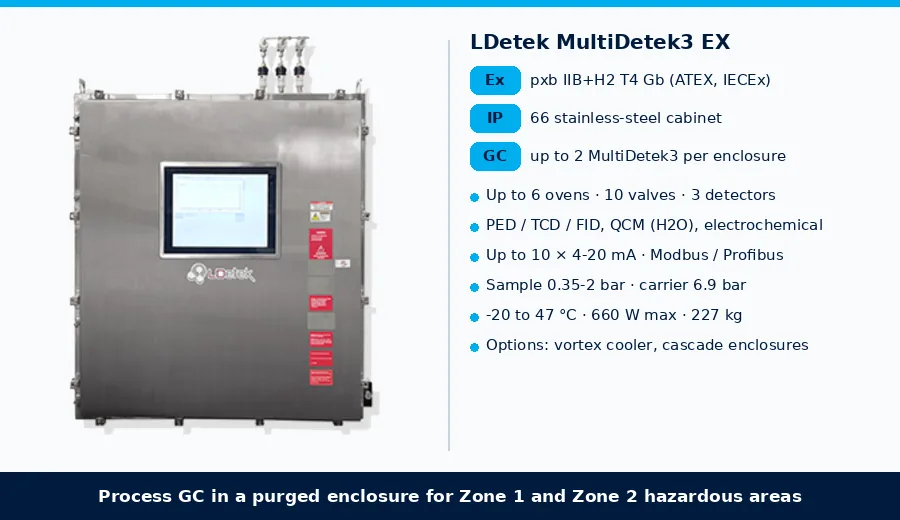
LDetek's approach is to take its standard industrial compact GC, the MultiDetek3, and put it inside a stainless-steel, ATEX- and IECEx-certified purged enclosure for Zone 1 and Zone 2. The GC hardware, the LDChroma software and the methods are the same as on the non-hazardous-area model, and LDetek also offers a non-purged version of the enclosure for safe areas.
How a purged enclosure makes a GC safe
Pressurisation (protection type "p" under IEC/EN 60079-2) works by keeping flammable gas out. Before power is applied, the enclosure is flushed with clean protective gas, normally instrument air, for long enough to dilute any flammable gas that leaked in while it was off. After that, a small continuous overpressure keeps the surrounding atmosphere from entering. A purge controller supervises flow and pressure and removes power if the protection is lost.
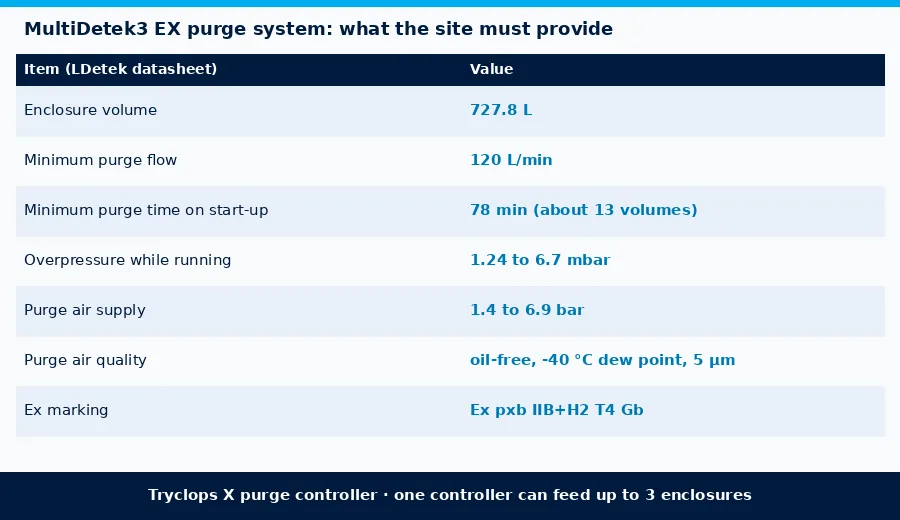
On the MultiDetek3 EX, that controller is a Tryclops X purge system, proved according to EN 60079, and one controller can feed up to three enclosures in cascade or in parallel. LDetek's figures for the enclosure are:
- Enclosure volume 727.8 litres; minimum purge flow 120 L/min; minimum purge time on start-up 78 minutes. (Our arithmetic: 120 L/min for 78 minutes is about 9,360 litres, roughly 13 enclosure volumes.)
- Overpressure kept between 0.02 psi (1.24 mbar) minimum and 0.1 psi (6.7 mbar) maximum.
- Protective gas supply at 15 to 100 psi (1.4 to 6.9 bar).
- Protective gas quality: dry air, water- and oil-free, -40 °C (-40 °F) dew point, particles 5 µm, ISA-grade hydrocarbon-free.
Two practical points follow. First, budget the start-up time: after any shutdown that drops the purge, the enclosure needs its full pre-purge before the GC is powered again, and the GC then needs its own warm-up and stabilisation. Second, the purge air is part of the safety system. Wet or oily instrument air can be a problem in Pakistani plants, especially in the humid monsoon months; if the site air cannot hold -40 °C dew point, that has to be fixed with a dryer and filtration before commissioning, and it is worth monitoring (see our note on online dew-point monitoring for compressed air).
Reading the marking: Ex pxb IIB+H2 T4 Gb
LDetek lists the certifications as IECEx Ex pxb IIB+H2 T4 Gb and ATEX II 2 G Ex pxb IIB+H2 T4 Gb, with CE marking for the MultiDetek3, and applied standards EN 60079-0, -2, -7, -11, -15 and -18. Decoded (our summary of the IEC 60079 conventions):
| Part | Meaning | What to check on your project |
|---|---|---|
| II 2 G (ATEX) | Equipment group II (surface industries), category 2, gas atmospheres | Category 2 equipment is suitable for Zone 1 and Zone 2 |
| p xb | Pressurised enclosure, level of protection "xb" | The level intended for Zone 1 installation; the purge controller must stay in service |
| IIB+H2 | Gas group IIB, plus hydrogen | Covers hydrogen, ethylene and typical hydrocarbons; not acetylene or carbon disulphide (full IIC) |
| T4 | Maximum surface temperature 135 °C | The auto-ignition temperature of every gas in the area must be above 135 °C |
| Gb | Equipment protection level "b" for gas | Matches Zone 1 (and Zone 2) in the area classification drawing |
The "+H2" matters in exactly the plants where this GC is most useful: hydrogen production, HyCO and synthesis gas units, and refinery hydrotreaters. Always check the marking against the site's hazardous-area classification and gas list, and against any local approvals the plant owner requires; the datasheet does not list Pakistan-specific certification.
What sits inside: the MultiDetek3 GC
The EX enclosure is designed to take up to two standard MultiDetek3 units on slide-out rails, so a unit can be pulled forward for maintenance or swapped for an application upgrade. There is also space for accessories such as extra sensors or an LDP1000 gas purifier, and an ultra-high-purity four-channel stream selector can be integrated in the GC. According to the EX datasheet, each MultiDetek3 can have:
- up to 6 isothermal ovens for capillary, micropacked or packed columns, with easy column access;
- up to 10 diaphragm or rotary valves to build multiple methods for multiple streams;
- up to 3 detectors in one GC: plasma emission detector (PED), TCD, FID, quartz crystal for H2O, electrochemical sensor or a third-party sensor;
- electronic pressure and flow controllers, and corrosion-resistant materials as an option;
- analysis at ppb, ppm and % levels.
The MultiDetek3 datasheet gives the detectors' lower detection limits as 100 ppt for the PED (with helium carrier), 1 ppb for the FID and 1 ppm for the TCD. The PED needs no fuel gas and runs on argon, helium or nitrogen carrier; LDetek lists hydrocarbons and CO-CO2 for the FID, and permanent and noble gases, sulphurs, ammonia and hydrocarbons for the PED and TCD; the TCD, with its 1 ppm limit, is the detector for higher concentrations. In the PED, the carrier and sample pass through a quartz cell where a high-intensity field creates a plasma, and narrow-band optical filters pick out the light emitted by each impurity, which is what gives it its selectivity.
Outputs and controls on the EX system: a front industrial panel PC, LAN remote control of the GC and stream selector, LDChroma GC software with the LDReport database, Modbus or Profibus over Ethernet, RS232 or RS485, up to 10 analogue 4-20 mA outputs, one status alarm contact and two level alarm contacts.
MultiDetek3 EX at a glance
| Item | LDetek MultiDetek3 EX datasheet (V1.1, 06/22) |
|---|---|
| Hazardous area | Zone 1 and Zone 2; IECEx Ex pxb IIB+H2 T4 Gb; ATEX II 2 G Ex pxb IIB+H2 T4 Gb |
| Enclosure | Stainless steel, secured doors, IP66; wall or floor mount; indoor and outdoor |
| Size and weight | 38 in (965 mm) wide × 30.37 in (771 mm) deep; door clearance 37 in (932 mm); 227 kg. Other sizes on request; confirm the height with the general-arrangement drawing at quotation |
| Operating temperature | -20 °C to 47 °C |
| Power | 115 VAC or 220 VAC, 50-60 Hz; maximum 660 W |
| Carrier gas pressure | 100 psi (6.9 bar) |
| Sample gas pressure | 5 to 30 psi (0.35 to 2 bar) |
| Gas connections | 1/8 in or 1/4 in VCR or compression type (Swagelok) |
| Sample safety hardware (standard) | Adjustable check valve, flashback arrestor and pneumatic shut-off valve on the sample gas |
| Purge | Tryclops X controller; 120 L/min minimum, 78 minutes minimum start-up purge; 1.24 to 6.7 mbar overpressure; dry air at -40 °C dew point |
| Options | Vortex cabinet cooler with AC muffler; additional instruments; up to three enclosures on one Tryclops; floor mount rack |
One note on the datasheet itself: it prints the overall height as 56.93 in and as 1116 mm, and those two figures do not agree (56.93 in is about 1446 mm), so we have not quoted a height. Also, the bare MultiDetek3 GC has its own ambient limits (10 to 45 °C in its datasheet); the -20 to 47 °C figure above is for the complete EX system.
Where it fits in Pakistani plants
LDetek lists hydrogen production, HyCO plants, hydrocarbon processing, petrochemicals (CO and CO2), chemical plants, natural gas and LNG processing, electronic gases, air separation units, refineries (CO in propylene and ethylene) and synthesis gas (H2) as the target applications. In Pakistan that maps onto:
- Fertilizer and refinery hydrogen: trace CO and CO2 in hydrogen and H2 in synthesis gas, where the analyser has to sit in a classified area near the reformer, shift or purification section.
- Air separation and industrial gas plants: trace impurities in oxygen, nitrogen and argon product, where ppb sensitivity and short sample lines matter. For a dedicated trace-nitrogen-in-argon measurement, see our note on the LDetek LD8001.
- Olefin and polymer feeds: CO in ethylene or propylene, a classic catalyst-poison measurement.
- Natural gas and LNG: multi-stream analysis near processing or regasification equipment, with one enclosure, several streams and several methods.
Two site conditions deserve special attention. Heat: summer shade temperatures in Sindh and southern Punjab can approach or exceed the 47 °C upper limit, and a stainless cabinet in direct sun gets hotter than the air around it. Plan a sunshade or shelter and ask about the vortex cooler option early. Utilities: the enclosure needs continuous, clean, dry purge air at -40 °C dew point; the GC needs high-purity carrier gas at 100 psi, uninterrupted. Both have to be designed in, not added at commissioning.
Installation and operating good practice
From the MultiDetek3 user manual (V1.6), points that apply equally inside the EX enclosure:
- Carrier gas: start with certified grade 5 (better than 99.999 %) carrier and purify it with LDetek's LDP1000 heated purifier, which LDetek states brings it to 99.999999 % (grade 8.0); some applications need different grades, set in the analyser's operating parameters. Use an automatic cylinder switchover so the carrier never runs out; LDetek suggests switching at 200 to 250 psig. A small to mid-size GC typically uses one 50-litre cylinder a month, depending on the application.
- Valve actuation gas: use the same gas specification as the carrier, and for low-ppb work LDetek recommends a separate, dual-stage regulated actuation supply so valve switching does not disturb the carrier pressure.
- Detector vent: keep the PED vent at atmospheric pressure. Back pressure on the vent can crack the quartz plasma cell. Never cap the analyser with carrier flowing, and route vents without restrictions.
- Fittings and regulators: stainless-steel pressure regulators, diaphragms, piping, valves and pigtail hoses to keep leak integrity and purity, with dual-stage regulation to avoid pressure fluctuation.
- Calibration: span gas at 50 to 90 % of the full scale of each component. For trace oxygen at ppm or ppb, LDetek describes an O2 doping option that keeps the columns saturated so oxygen peaks stay reproducible.
- Safe areas: where the analyser can sit outside the classified zone, LDetek's LDRack integrates MultiDetek3 GCs, stream selectors and purifiers into 19 in rack cabinets, and the compact MultiDetek-Lite covers simpler multi-impurity applications.
What to send with an enquiry
- Every stream: composition (with typical and maximum values), components to measure and their ranges, pressure, temperature, dew point and any condensables or corrosives.
- Number of streams and required cycle time; analogue and digital outputs; DCS protocol (Modbus or Profibus).
- Hazardous-area classification of the location: zone, gas group, temperature class, and the gases present.
- Installation: indoor or outdoor, sun exposure, maximum ambient, wall or floor mount, available space.
- Utilities: instrument air quality and pressure, power supply (115 or 220 VAC), and the carrier gas you can source locally.
FAQ
Can a gas chromatograph be installed in a Zone 1 hazardous area?
Yes, if it is housed in a certified enclosure. The LDetek MultiDetek3 EX puts the standard MultiDetek3 GC in a purged stainless-steel enclosure certified ATEX II 2 G and IECEx Ex pxb IIB+H2 T4 Gb for Zone 1 and Zone 2.
What does Ex pxb IIB+H2 T4 Gb mean?
Pressurised enclosure (p) at the "xb" level for Zone 1, gas group IIB plus hydrogen, maximum surface temperature 135 °C (T4), and equipment protection level Gb. It covers hydrogen and most hydrocarbons, but not acetylene or carbon disulphide.
How long does the MultiDetek3 EX take to purge before start-up?
LDetek specifies a minimum purge time of 78 minutes at a minimum purge flow of 120 L/min for the 727.8-litre enclosure, using dry, oil-free air at -40 °C dew point. The GC then needs its own warm-up and stabilisation.
Which detectors can the MultiDetek3 use?
Up to three per GC: plasma emission detector (PED), TCD, FID, a quartz crystal sensor for H2O, an electrochemical sensor or a third-party sensor. LDetek's MultiDetek3 datasheet gives lower detection limits of 100 ppt for the PED with helium carrier, 1 ppb for the FID and 1 ppm for the TCD.
Is the MultiDetek3 EX suitable for hot sites in Pakistan?
The datasheet operating range is -20 °C to 47 °C. In hot regions plan shade or shelter and ask about the vortex cabinet cooler option, and confirm the arrangement with LDetek for your site conditions.
Where can Pakistani users see the product and ask for a quotation?
See the MultiDetek3 EX catalogue page, browse gas analysis, or contact Tetracon with your streams, components, ranges and area classification.
Next steps
Tetracon supplies LDetek gas chromatographs and trace-impurity analysers to industry and laboratories across Pakistan. Send us your streams, components and ranges, cycle time, hazardous-area classification and site utilities, and we will work with LDetek on the MultiDetek3 EX configuration, methods and options. Use the contact page or see our services. Start with the MultiDetek3 EX catalogue page, the LDRack analyzer rack system and the LD8001+ trace nitrogen analyzer, browse gas analysis, oxygen analysis and moisture and dew point, or see all LDetek products. Related notes: trace nitrogen analysis for specialty gas and air separation, natural gas BTU and composition analysis, fixed gas detectors for hazardous areas, quartz-crystal process moisture analysis and online dew-point monitoring for compressed air. Free technical guides are collected under Guides.