

Refining, petrochemical and specialty-gas plants in Pakistan only stay trustworthy when process moisture is measured as water vapour in the process stream — not guessed from a dryer reading on instrument air, and not confused with hydrocarbon dew point or a natural-gas laser dew-point duty written for a different contract. Continuous low-ppm moisture protects catalysts, molecular sieves, NGL / LNG trains, gas storage and feedstock quality. A ceramic Easidew-class transmitter answers “is my dryer dry enough?” A TDLAS laser dew-point analyzer answers “how much water is in this sales-gas / transmission stream?” A chilled-mirror Condumax-class instrument answers “when will C6+ start to condense?” A quartz crystal microbalance (QCM) process moisture analyzer answers “what is the continuous ppmV H₂O in this process / NG sample right now?” Mixing those jobs invents false comfort on process quality programmes.
This note is for refining, petrochemical, NGL/LNG-related, gas-storage, and specialty-gas instrumentation teams specifying continuous QCM process moisture. It maps practical selection to the catalogue Michell QMA601 Process Moisture Analyzer and the ultra-low-range QMA601-LR, with a brief secondary pointer to QMA601-CO2 for CCS / CO₂ streams. The angle is deliberately distinct from the site’s hydrocarbon and water dew-point overview (Condumax / OptiPEAK), from TDLAS H₂S / CO₂ / H₂O analysis for NG (AccuLase-D1), from compressed-air / process-gas online dew point (Easidew), and from broader trace-moisture technology comparisons.
Why quartz-crystal process moisture matters on Pakistani plants
Process moisture is a written quality and integrity parameter across feedstock, dehydration, fractionation and specialty-gas duties. Typical Pakistani contexts include:
- Refining and petrochemical feedstock — Continuous ppmV H₂O on natural-gas or process-gas feeds where water damages catalysts, fouls exchangers, or breaches written gas-quality envelopes.
- NGL fractionation and LNG-related ultra-low moisture — Streams that need sub-ppm detection; catalogue QMA601-LR extends QCM measurement down to 0.02 ppmV for these duties.
- Molecular-sieve dehydration and gas storage — Outlet moisture trending so breakthrough is caught before it reaches downstream units or injection / withdrawal quality limits.
- Specialty-gas and hydrogen-tolerant NG blends — Process gases (including catalogue hydrogen-tolerant NG up to ~20% H₂ on QMA601-LR) where composition swings must not invent false moisture.
Write the measurement question first — continuous process ppmV H₂O vs dryer dew point vs TDLAS NG water moisture vs HCDP — before you pick “a moisture analyzer.” QMA601 is a QCM process moisture analyzer; it is not an Easidew-class dryer transmitter, not a TDLAS laser dew-point analyzer, and not a Condumax-class HCDP instrument.
QCM vs ceramic dryer dew point vs TDLAS vs HCDP — do not conflate
| Need | Typical approach | Catalogue / note fit |
|---|---|---|
| Continuous low-ppm process / NG moisture (custody-transfer-oriented QCM package) | Quartz crystal microbalance process moisture analyzer + integrated sample system | Michell QMA601 / QMA601-LR |
| Ultra-low trace moisture (NGL fractionation, LNG liquefaction) | Low-range QCM (ppbV–low ppmV) | QMA601-LR (0.02–100 ppmV) |
| Moisture in CO₂ capture / transport / storage | QCM specialised for CO₂ carrier | QMA601-CO2 |
| Continuous water vapour / dew point on NG custody transfer / transmission (TDLAS framing) | TDLAS laser dew-point / moisture analyzer | See AccuLase-D1 TDLAS note; OptiPEAK class in HCDP / water overview |
| Hydrocarbon dew point (onset of C6+ condensate) | Direct chilled-mirror HCDP | Condumax class — see HCDP / water dew-point overview |
| Compressed-air dryer / utility process-gas dew point | Ceramic / polymer hygrometer transmitters and online systems | See Easidew online dew-point note |
QCM process moisture protects catalysts, sieves, fractionation trains and contractual water limits with a composition-tolerant ppmV reading. TDLAS NG dew-point / moisture is the optical continuous-water story on custody-transfer framing. HCDP protects metering from hydrocarbon liquid dropout. Dryer dew point protects instrument air and utility gases. Many Pakistani plants need more than one of these stories written — but QMA601 is specified when the written duty is continuous QCM process moisture on the process / NG sample system.
When QMA601 and QMA601-LR fit
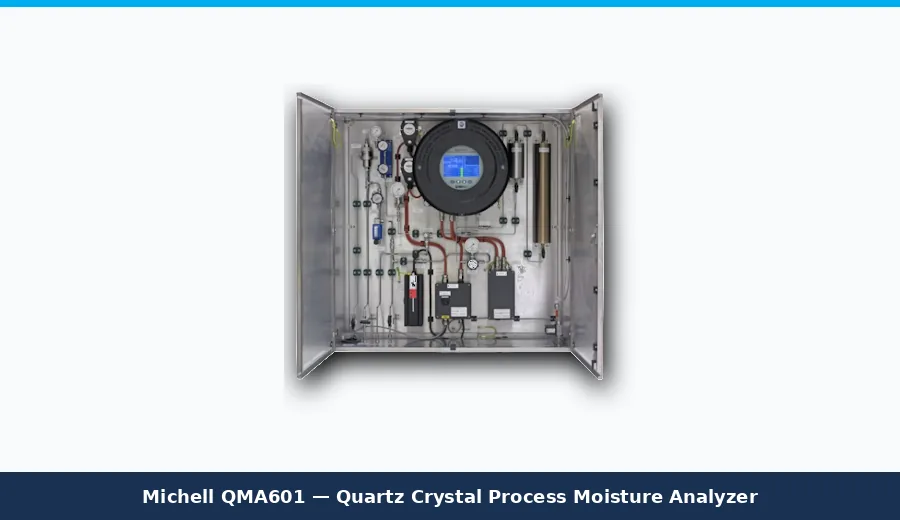
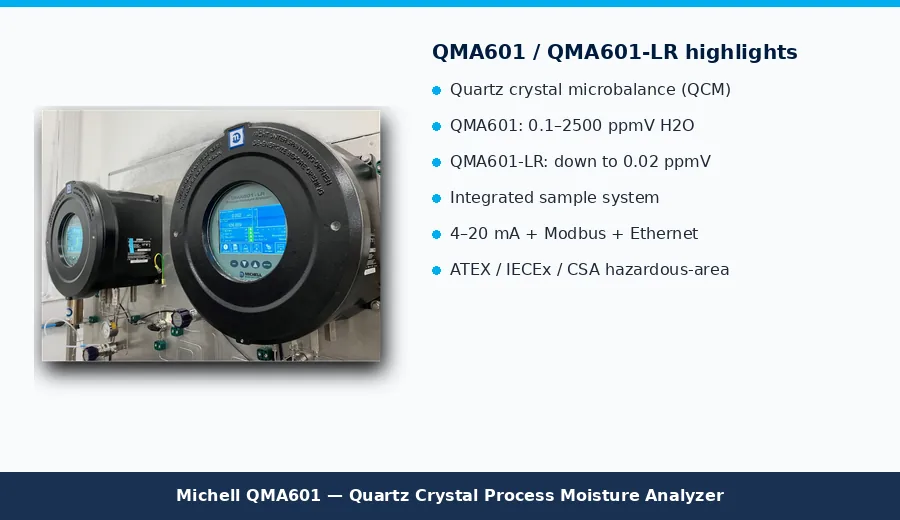
The QMA601 is a custody-transfer-oriented quartz-crystal moisture analyzer for continuous, drift-resistant ppmV measurement. A quartz crystal alternately samples wet gas and reference gas; the differential in resonant frequency due to adsorbed water yields a highly repeatable ppmV reading designed to be independent of gas composition. Catalogue features include a measurement range of 0.1–2500 ppmV H₂O, a fully integrated sample system, 4–20 mA + Modbus + Ethernet outputs, pressure capability up to about 138 barg, and ATEX / IECEx / CSA hazardous-area certification.
The QMA601-LR extends the same QCM platform to ultra-low trace moisture: catalogue range 0.02–100 ppmV, accuracy on the order of ±0.03 ppmV or 10% of reading, built-in verification against customer process gas, colour touchscreen HMI (interrogation without a hot-works permit on Ex units), IECEx / ATEX / UKCA / TR CU Ex (Exd) and cQPSus explosion-proof certification, maintenance-free operation positioned at 3 years, and hydrogen tolerance up to ~20% H₂ without modification. Prefer QMA601-LR when NGL fractionation, LNG liquefaction, or molecular-sieve outlet duties write ultra-low detection into the specification.
Prefer QMA601 / QMA601-LR when the written duty is continuous process ppmV H₂O on refining, petrochemical, gas-storage, NGL/LNG-related, or specialty-gas streams; when an integrated sample system and hazardous-area certification are required; when Modbus/Ethernet into DCS/SCADA matters; and when the contractual parameter is water moisture (ppmV), not hydrocarbon dew point and not dryer dew point. It is not a substitute for an Easidew-class compressed-air transmitter, not a Condumax-class HCDP analyzer, and not automatically the same framing as a TDLAS NG laser dew-point analyzer — choose by the written technology and duty.
Sample system, outputs and integration — brief but non-optional
A QCM moisture reading is only as good as the gas that reaches the crystal. Process sample systems must manage pressure let-down, flow, filtration, and (where needed) heat tracing so the analyzer sees representative vapour — not condensed liquid, ambient wet air, or a dead-leg. Confirm whether contractual moisture numbers are quoted as ppmV, mg/Nm³, or dew point at a stated reference pressure; mixing those bases invents false comfort. Integrate 4–20 mA retransmission and Modbus/Ethernet into the same DCS/SCADA narrative as process-quality alarms, and treat internal / fault alarms as part of the written control story rather than an afterthought.
Practical use cases in Pakistan
- Refinery and petrochemical feedstock moisture — Continuous ppmV H₂O on NG or process-gas feeds with hazardous-area certified hardware and digital outputs into the unit DCS.
- NGL fractionation / LNG-related ultra-low moisture — QMA601-LR where detection down to 0.02 ppmV and long service intervals matter for liquefaction and fractionation trains.
- Molecular-sieve dehydration outlets — Moisture trending so breakthrough is alarmed before it reaches downstream catalysts or contractual limits.
- Gas storage injection / withdrawal — Quality envelopes where moisture can change with reservoir and dehydration performance.
- CCS / CO₂ handling (secondary) — When the carrier is CO₂, evaluate QMA601-CO2 rather than assuming the standard NG process duty covers capture, transport and storage moisture.
- Complementary moisture stack — Pair QCM process moisture with TDLAS NG dew-point where custody-transfer laser framing is written separately, with Condumax-class HCDP where contracts require hydrocarbon dew point, and with Easidew-class online dew point for dryer / utility gases (see related notes).
Selection and integration tips
- Write the moisture parameter first — ppmV range (including whether ultra-low / QMA601-LR is required) before the purchase order.
- Separate QCM process moisture from dryer dew point, TDLAS NG dew-point, and HCDP — one instrument label does not close every clause.
- Own the sample system — Pressure, flow, filtration and heat tracing are part of the measurement, not accessories.
- Match area classification and communications — ATEX / IECEx / CSA plus 4–20 mA and Modbus/Ethernet into the plant control narrative.
- Plan verification / service ownership — Catalogue service intervals and built-in verification only help if sample integrity and alarm setpoints are written into operating procedures.
- Check CO₂ vs NG / process carrier — Use QMA601-CO2 when CCS moisture is the written duty.
FAQ
Is QMA601 the same as a ceramic dew-point transmitter or Easidew-class dryer monitor?
No. QMA601 is a quartz crystal microbalance process moisture analyzer for continuous low-ppm H₂O in process and natural-gas streams, typically with an integrated sample system. Ceramic transmitters and Easidew-class online systems answer compressed-air dryer and utility-gas dew-point questions — see the Easidew note.
When does QMA601 or QMA601-LR fit Pakistani refining and petrochemical plants?
When you need continuous, composition-tolerant ppmV moisture on natural-gas feedstock, petrochemical process gas, NGL/LNG-related ultra-low moisture (QMA601-LR), gas storage, or related specialty-gas streams, with hazardous-area certification, digital communications, and an integrated sample system.
How does QMA601 differ from TDLAS laser dew-point (AccuLase / OptiPEAK) and chilled-mirror HCDP (Condumax)?
QMA601 measures water vapour by quartz crystal microbalance. TDLAS analyzers measure water optically. Condumax-class instruments measure hydrocarbon dew point — a different contractual parameter. See the AccuLase TDLAS note and the HCDP / water overview for those framings.
What about QMA601-CO2?
QMA601-CO2 is a QCM variant specialised for moisture in CO₂ capture, transportation and storage. Use it when the carrier is CO₂; do not assume the standard QMA601 duty automatically covers CCS moisture without checking the CO₂ variant’s range and certification.
Can QMA601 replace a BTU / composition GC?
No. Moisture and calorific value / composition are different process parameters. Use QMA601 for water vapour; use a process GC (see AccuChrome BTU note) when energy content and composition are the written duty.
How Tetracon supports QCM process moisture choices
Tetracon supplies gas analysis and industrial instrumentation for Pakistan industry, including Michell Instruments quartz-crystal process moisture analyzers used on refining, petrochemical, gas-storage and specialty-gas duties. Application support through the contact page and services team can help match analyzers, sample systems, and communications to your process streams and area classifications. Start with the catalogue pages for QMA601, QMA601-LR, and QMA601-CO2, or browse Michell Instruments on the site.
Key takeaways
Quartz-crystal process moisture analysis for Pakistani refining and petrochemical plants is about measuring continuous low-ppm H₂O with a certified QCM analyzer — not confusing dryer dew point, TDLAS NG laser dew-point, or HCDP with process moisture. QMA601 fits the broader process / NG ppmV duty; QMA601-LR fits ultra-low NGL/LNG-related detection; QMA601-CO2 fits CCS / CO₂ streams. Write the measurement question and sample-system story first, keep TDLAS, HCDP and dryer dew point as separate layers where contracts or plant duties require them, and treat the QCM analyzer as the continuous process-moisture instrument on the written stream.