

Fixed gas detection protects people and assets in defined zones — compressor buildings, metering houses, loading racks, battery rooms, and classified process bays. On Pakistani process plants, terminals, and utilities, the hard part is rarely “buy a detector”; it is matching protection concept, sensor chemistry, placement, and alarm philosophy to the zone drawing and the response crew that will own it.
This note is for HSE, instrumentation, and plant-operations teams specifying continuous fixed heads for hazardous areas. It maps practical selection to three catalogue Status Scientific Controls instruments available through Tetracon — the FGD10A Flameproof (Ex d) Gas Detector, the FGD3 Intrinsically Safe Fixed Gas Detector, and the FGD56 Fixed IR Gas Detector. It is distinct from the programme-level fixed vs portable gas detection note: here the focus is hazardous-area head selection, zoning, and alarm design. Related context: natural gas leak survey and H2S / total sulfur monitoring.
Why fixed hazardous-area heads matter on Pakistan plants
Portable bump tests and survey campaigns find fugitives and prove readiness. They do not replace continuous coverage in rooms and zones where a release can accumulate faster than a round can catch it. Continuous fixed detection supports:
- Life safety in occupied or routinely entered classified spaces — Early warning before LEL or toxic concentrations reach people at the door or the board desk.
- Asset and process integrity — Compressor halls, vapor recovery, battery rooms, and chemical dosing areas need trending and trip logic, not only a handheld after an odor complaint.
- Permit and insurance discipline — Zone drawings, proof tests, and alarm logs are part of how plants show that hazardous-area risk is engineered, not assumed.
- Complement to survey tools — TDLAS walk surveys and ultrasonic pinpointing cover routes and fittings; fixed heads own the footprint under and around permanent equipment. See the leak detection note.
Write the zone, the target gas, and the response (alarm → evacuate / isolate / ventilate) before you pick an Ex concept. Hardware without that sentence becomes a wall ornament with a 4–20 mA cable.
Ex d flameproof vs intrinsically safe vs IR fixed — what each is for
| Need | Typical approach | Catalogue fit |
|---|---|---|
| Zone 1 / flameproof fixed head with local display, relays, magnetic calibration | Ex d flameproof enclosure, plug-in IR / pellistor / EC | FGD10A (display/comms/relays); compact display-less sibling FGD10B when panel-monitored |
| Intrinsically safe fixed head (energy-limited into hazardous area) | Ex ia detector + approved safety barrier | FGD3 |
| Hydrocarbon / CO2 where catalytic beads may be poisoned or O2 is low | NDIR fixed IR detector | FGD56 |
| Walk survey / fugitive methane outside fixed footprints | Handheld TDLAS / ultrasonic | See leak survey note — different duty |
| Programme design (fixed vs portable balance) | HSE architecture | Fixed vs portable note |
Match the electrical protection concept to the area classification and your site’s preferred maintenance model. Flameproof (Ex d) contains an internal ignition; intrinsically safe (Ex ia) limits energy so a fault cannot ignite. Neither choice excuses wrong sensor chemistry or detectors hung in dead air.
When Status Scientific FGD10A (Ex d) fits
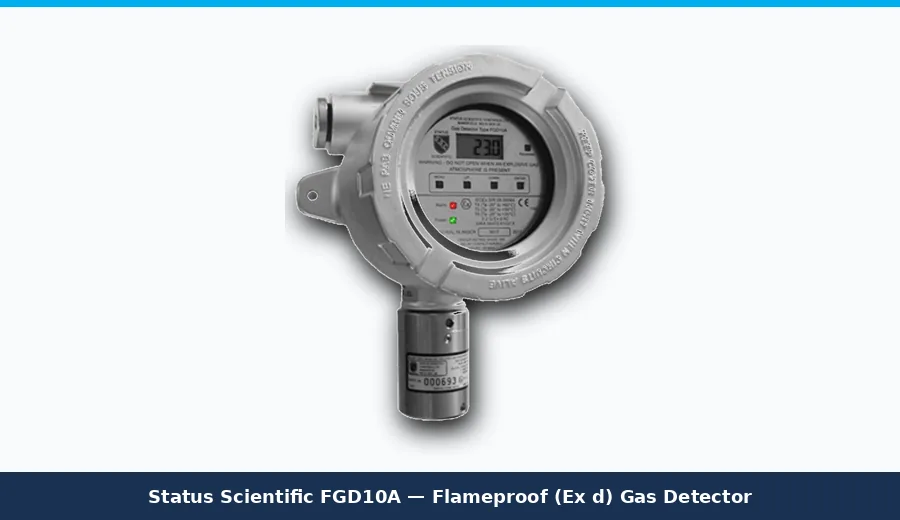
The FGD10A is catalogue-positioned as an ATEX and IECEx certified flameproof (Ex d IIC) fixed gas detector for oxygen, toxic, and flammable hydrocarbon gases in potentially explosive atmospheres. A magnetic pen-operated menu allows calibration and configuration through the display window without opening the flameproof enclosure. Catalogue sensor options are infrared (hydrocarbons/CO2), catalytic pellistor (hydrocarbons/H2), or electrochemical (toxics/O2). Outputs include 3-wire 4–20 mA; the display version adds RS232 (or RS485 Modbus on FGD10A-M) and three changeover relays for Alarm 1, Alarm 2, and Fault. Enclosure options include cast aluminium or grade 316 stainless steel; an optional weather guard is listed. Compatible with LC Series and MCU Series control panels.
Prefer FGD10A-class when you need a flameproof head with local display and non-intrusive magnetic calibration, relay contacts at the detector, or a single housing platform covering flammable, toxic, and oxygen duties via plug-in sensors. Use the compact display-less FGD10B when the panel owns the HMI and space is tight.
When Status Scientific FGD3 (intrinsically safe) fits
The FGD3 is an intrinsically safe (Ex ia) fixed gas detector for flammable, toxic, and oxygen hazards in potentially explosive atmospheres. Catalogue positioning covers water treatment, pharmaceuticals, chemical manufacturing, and similar processes where an electrical fault must not be capable of producing an incendive spark. It uses plug-in sensor heads (pellistor, electrochemical, or infrared depending on target gas) with 4–20 mA output, IP65 plastic or metal housing options, and 2- or 3-wire connection depending on sensor type. Hazardous-area use requires an approved electrical safety barrier that limits energy between the detector and safe-area equipment. Optional metal enclosure for IR versions improves RFI immunity near high-power radios.
Keep FGD3-class when the site’s hazardous-area philosophy prefers intrinsic safety and barrier-based loops, when lightweight field-replaceable heads matter for maintenance, or when plastic/metal housing options better match the environment than a heavy Ex d casting.
When Status Scientific FGD56 (fixed IR) fits
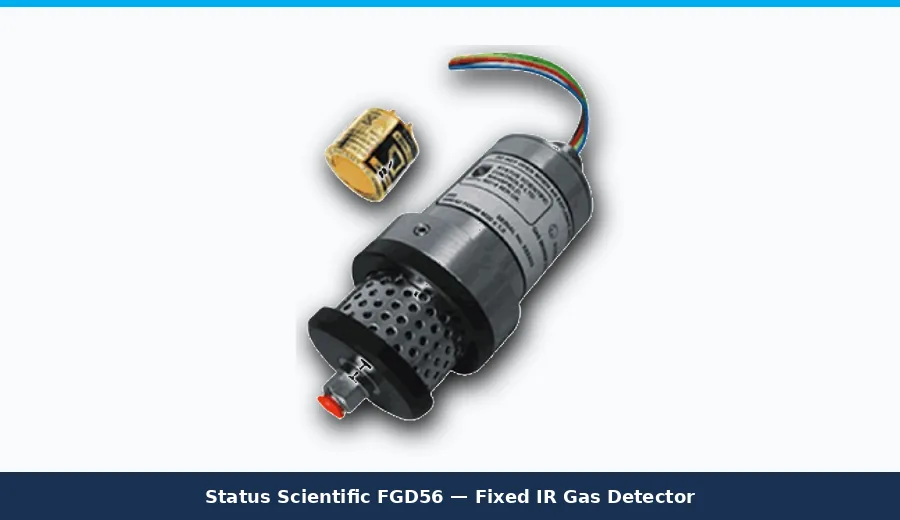
The FGD56 is a fixed non-dispersive infrared (NDIR) gas detector for continuous monitoring of hydrocarbon gases and CO2. Catalogue highlights include poison-immune NDIR sensing (immune to silicones, sulphur compounds, and lead that defeat pellistors), operation in inert / low-oxygen atmospheres, heated optics, 4–20 mA + HART, Modbus RTU, SIL 2 capable framing, and ATEX / IECEx / UL certification (including ATEX II 2G Ex d IIC T6 in the listed specs). Target gases listed include CH4, C3H8, C4H10, and CO2 (0–100 % LEL or 0–5 %vol depending on configuration); response T90 ≤ 12 s.
Prefer FGD56-class for hydrocarbon or CO2 duties where catalytic sensors would be unreliable — poisoning risk, inert backgrounds, or long-term stability needs. It does not replace electrochemical toxic/O2 cells; match the cartridge (or IR model) to the hazard.
Sensor choice: catalytic, IR, electrochemical
- Catalytic pellistor — Classic %LEL for many hydrocarbons and hydrogen. Needs oxygen; can be poisoned by silicones, lead, and some sulphur species. Budget for bump/proof and sensor life.
- Infrared (NDIR) — Strong for many hydrocarbons and CO2; works in low-O2 / inert atmospheres; immune to many catalyst poisons. Not a universal toxic-gas answer.
- Electrochemical — Workhorse for specific toxics (for example H2S, CO) and oxygen deficiency/enrichment. Cross-sensitivity and finite cell life are design inputs, not afterthoughts.
On FGD10A / FGD3 platforms, pick the plug-in chemistry per point. On FGD56, you are choosing an IR hydrocarbon/CO2 duty by design. Never specify “LEL” without naming the gas and the expected background.
Placement, zoning, and alarm philosophy
- Start from the classification drawing — Zone 0 / 1 / 2 (or Division equivalents) and gas group drive Ex concept. Do not hang an uncertified or wrong-concept head “temporarily.”
- Place for the release, not the pretty wall — Density (lighter/heavier than air), ventilation paths, and leak sources beat symmetry. Avoid stagnant corners that never see the plume — and equally avoid hurricane wash from HVAC that dilutes every alarm.
- Set two alarm levels plus fault — Low (warning / investigate) and high (evacuate / isolate / ESD as site SOP requires), plus detector fault. FGD10A-class relays map naturally to Alarm 1 / Alarm 2 / Fault when local contacts are wanted.
- Own the response in the same DCS / fire & gas story — Page the board that can ventilate, isolate, or muster. An orphan 4–20 mA into a historian without a SOP is not protection.
- Calibrate and proof-test on a written rhythm — Magnetic-pen menus and plug-in sensors speed work; they do not remove the need for certified gas, audit trail, and overdue lists that someone closes.
- Standardise tags, setpoints, and spares — Same manufacturer family across a unit reduces training and spare-cartridge chaos when FGD10A, FGD3, and FGD56 each have a clear duty.
Practical selection tips for Pakistan plants
Inventory compressor buildings, metering houses, loading racks, chemical stores, battery rooms, and process bays separately. Default to FGD10A-class Ex d when you want flameproof heads with display, magnetic calibration, and local relays; default to FGD3-class when intrinsic safety and barrier loops are the site standard; default to FGD56-class IR for hydrocarbon/CO2 where pellistors are a poor fit. Keep portable detectors and survey tools for rounds and fugitives — see fixed vs portable. Standardise panels (LC / MCU Series where Status heads are used), barriers, weather protection, and alarm bands so the system outlives the commissioning crew.
FAQ
Is Ex d always better than intrinsically safe?
No. Ex d and Ex ia are different protection concepts. Choose from the area classification, cable/gland practice, and maintenance model — then pick FGD10A-class or FGD3-class accordingly. Wrong concept is a compliance failure even if the sensor chemistry is right.
When should we prefer IR over catalytic LEL?
When catalyst poisons, inert or low-oxygen backgrounds, or long-term IR stability matter for the hydrocarbon/CO2 duty — FGD56-class NDIR is catalogue-positioned for that. Catalytic remains common for many %LEL points when oxygen is present and poisoning risk is managed.
Do fixed heads replace portable gas detection?
No. Fixed heads cover defined zones continuously; portables cover entries, rounds, and points outside the fixed footprint. Design both — see the fixed vs portable note.
How Tetracon supports fixed gas detection choices
Tetracon supplies fixed gas detection products and complementary survey instruments for process plants, terminals, and utilities in Pakistan. Application support through the contact page and services team can help match Ex d, intrinsically safe, and IR fixed heads to your zones and gases. Start with catalogue pages for Status Scientific FGD10A, FGD3, and FGD56, or browse Status Scientific Controls on the site.
Key takeaways
Selecting fixed gas detectors for hazardous areas on Pakistani plants is zone-correct Ex concept, sensor chemistry matched to the gas and background, placement that sees the release, and alarms owned by the response team — not a generic “LEL head” on the nearest column. Use FGD10A-class for Ex d flameproof duties with magnetic calibration and relays; FGD3-class for intrinsically safe barrier loops; FGD56-class IR when hydrocarbons/CO2 need poison-immune NDIR. Write zone, gas, and SOP before the purchase order, and prove the system is calibrated, alarmed, and closed.