

Trace and percent oxygen control on Pakistani specialty-gas, refining, chemical, air-separation (ASU), and glovebox / purge duties only works if you measure the right oxygen question with the right instrument. A portable analyzer answers “what is O2 at this point right now?” across many sample taps. A hazardous-area process analyzer answers “what is O2 on this stream every minute?” with alarms and retransmission into the control system. Confusing those two jobs wastes money and leaves gaps in purity, blanketing, and safety programmes.
This note is for plant, HSE, and instrumentation teams specifying portable spot-check / survey and continuous hazardous-area process oxygen analysis. It maps practical selection to two catalogue Analytical Industries Inc. (AII) products available through Tetracon — the GPR-1100 & GPR-1200 Portable Trace Oxygen Analyzers for periodic verification from 0–10 ppm up to 0–10,000 ppm (1%) O2, and the GPR-2800(A)IS Process Oxygen Analyzer for Hazardous Areas for continuous measurement from 0–1% up to 0–25% O2 in classified areas. A brief mention of the GPR-1500GB & GPR-2500GB glovebox / containment transmitters clarifies where a fixed loop-powered transmitter fits clean-gas and glovebox duties. The angle is deliberately distinct from the site’s notes on general oxygen analyzers for process safety and combustion, nitrogen blanketing / inerting with Ntron, and in-situ combustion O2/COe (RB ZTR).
Why portable survey vs process oxygen matters
Specialty-gas purity, vessel inerting verification, ASU product checks, and hazardous-area process streams all care about oxygen — but not with the same sampling rhythm or certification package. Typical Pakistani plant contexts include:
- Specialty gas and cylinder fill / purity checks — Periodic ppm O2 verification on nitrogen, argon, helium and mixed gases before release or after maintenance.
- Multi-point plant surveys — Walking sample points on headers, dryers, gloveboxes, and purge lines where a compact portable earns its keep faster than installing a fixed analyzer at every tap.
- Continuous process oxygen in classified areas — Vessel blanketing, inerting, natural-gas / biogas oxygen safety, and pharmaceutical reactor / centrifuge duties that need a hazardous-area process analyzer with modular sample systems and live outputs.
- Glovebox and containment purge verification — Clean-gas applications where a KF-40 or flow-through transmitter (GPR-x500GB family) may suit fixed monitoring better than a portable survey tool alone.
Write the duty (portable spot-check / multi-location survey vs continuous hazardous-area process), the oxygen range (ppm trace vs percent), background gas, and area classification — before you pick “an oxygen analyzer.” Portables and process units answer different questions on the same oxygen programme.
Portable vs process vs glovebox transmitter — what each is for
| Need | Typical approach | Catalogue fit |
|---|---|---|
| Quick point-to-point or multi-location ppm O2 spot checks / surveys | Portable electrochemical trace O2 analyzer (optional bypass / flow control) | GPR-1100 / GPR-1200 |
| Continuous percent-level O2 in hazardous gases or classified areas, with modular sample systems | Hazardous-area process O2 analyzer, loop- or line-powered | GPR-2800(A)IS |
| Fixed glovebox / containment / gas-generation purity (ppm to %) | Loop-powered transmitter, KF-40 or flow-through base | GPR-1500GB / GPR-2500GB |
| Nitrogen blanketing / inerting oxygen control (transmitter / portable kit focus) | Blanketing-specific oxygen programme | See Ntron blanketing note |
| In-situ flue-gas combustion O2 + COe on boilers / furnaces | Zirconia in-situ combustion analyzers | See RB ZTR combustion note |
| Broader process-safety / combustion oxygen overview | Technology and duty framing | See oxygen analyzers overview |
Match the instrument to the question you must answer every shift. If operations need periodic verification at many taps, or commissioning surveys after maintenance, GPR-1100/1200 is the natural frame. If the duty is continuous oxygen on a process stream in a classified area with sample-system and alarm integration, GPR-2800(A)IS earns its keep. Glovebox and containment systems often want a fixed transmitter (GPR-x500GB) rather than relying on portable visits alone.
When GPR-1100 & GPR-1200 fit
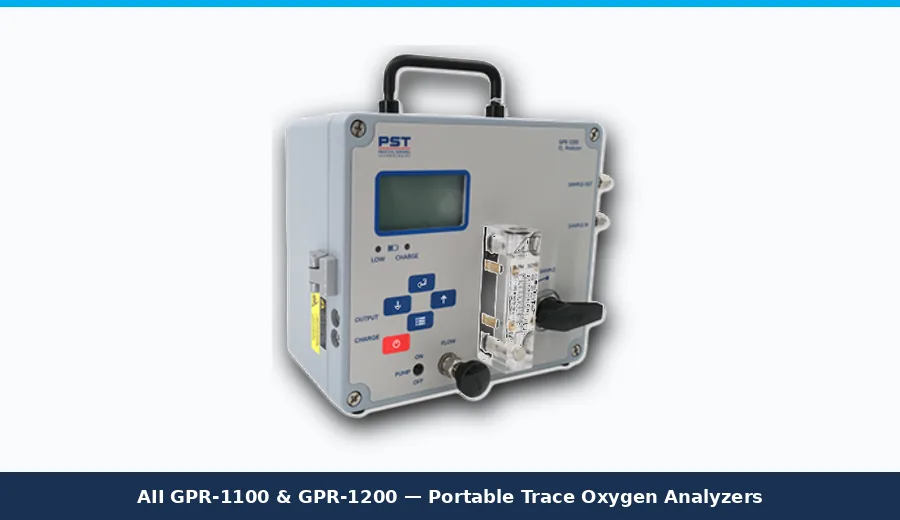
The GPR-1100 and GPR-1200 are portable trace oxygen analyzers designed for periodic verification of oxygen concentration in a gas stream. Catalogue performance covers four measurement ranges from 0–10 ppm to 0–10,000 ppm (1%) O2, sensor options matched to inert, hydrocarbon, mixed acidic, hydrogen or helium background gases, General Purpose or Hazardous Area configurations (ATEX, IECEx, cMETus, UKEx), integral measurement data logging, LCD display of O2 concentration, and sensor life of up to 24 months. The compact GPR-1100 suits quick point-to-point spot checks. The GPR-1200 adds a metering valve, flowmeter and sensor bypass valve so sample gas can be routed around the sensor between measurements — speeding location-to-location surveys and extending sensor life.
Prefer GPR-1100/1200 when you need portable ppm-class verification across specialty-gas fills, ASU product checks, glovebox purge surveys, solder-reflow / semiconductor support gases, or natural-gas storage and transport sample points; when controlled sampling and bypass (GPR-1200) matter for multi-tap routes; and when hazardous-area certified portable variants are required for classified plant walks. They are not a substitute for a continuous process analyzer with live alarms on a fixed stream — keep GPR-2800(A)IS for that — and they are not in-situ combustion zirconia instruments for flue gas.
When GPR-2800(A)IS fits
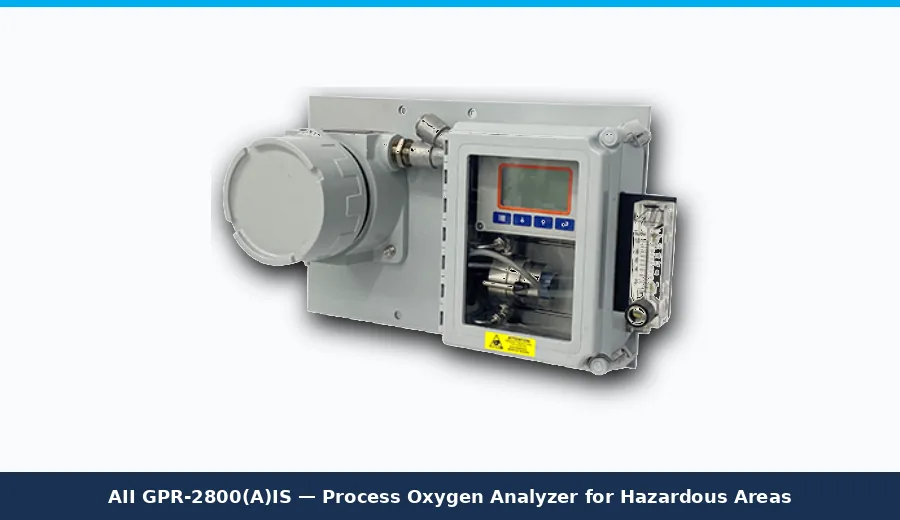
The GPR-2800(A)IS series of process oxygen analyzers allows measurement from 0–1% up to 0–25% oxygen in hazardous gases or areas. Catalogue features include four measurement ranges to 0–25% O2, hazardous-area rating (ATEX, IECEx, cMETus, UKEx), sensor options for inert, hydrocarbon, mixed acidic, hydrogen or helium backgrounds, a range of modular sampling system options, sensor life of up to 60 months (sensor-dependent), a simple intuitive HMI, and loop-powered or line-powered integration with alarm set points and signal retransmission. Analytical Industries’ long-life electrochemical sensor technology is positioned for low-maintenance ownership on process duties.
Prefer GPR-2800(A)IS when the sample point is (or may be) hazardous-area classified; when vessel blanketing and inerting, oxygen in natural gas or biogas safety, or pharmaceutical reactor / centrifuge safety needs continuous percent-level O2; when modular sample systems must adapt the analyzer to the process; or when alarm set points and retransmission into DCS/PLC are part of the written control story. Keep GPR-1100/1200 when the primary need is portable ppm surveys and spot checks rather than a fixed process install.
Optional: GPR-1500GB & GPR-2500GB for glovebox and clean-gas transmitters
Where the duty is fixed monitoring on glove boxes, containment systems, or gas-generation purity — rather than a walking survey or a full hazardous-area process panel — the GPR-1500GB & GPR-2500GB offer loop-powered 4–20 mA transmitters covering ranges from 0–10 ppm to 0–25% O2, accuracy better than 2% of range, KF-40 flange or flow-through base connections, general-purpose or hazardous-area configurations, and an XLT sensor option for acidic backgrounds such as CO2. Use the GB transmitters when installation wants a permanent glovebox / containment / generator loop; use GPR-1100/1200 when technicians must survey many points with one portable; step up to GPR-2800(A)IS when continuous hazardous-area process percent O2 with modular sampling is the written duty. Browse the full Analytical Industries Inc. range on the site.
Background gas, sensors and sampling — brief but non-optional
Electrochemical oxygen sensors must be selected for the background gas. Inert, hydrocarbon, mixed acidic, hydrogen and helium streams are not interchangeable sensor choices — cross-interference and lifetime suffer when the wrong cell is fitted. For portables, the GPR-1200 bypass valve reduces unnecessary sensor exposure between taps. For process installs, modular sample systems (filtration, flow control, pressure let-down) are part of the analyzer, not an afterthought. Condensation, liquid carryover, and dead legs invent oxygen readings or slow response. Treat the sample path as part of the measurement — invented O2 is an expensive false alarm on purity and safety programmes.
Practical use cases in Pakistan
- Specialty-gas and industrial-gas purity surveys — GPR-1100/1200 for ppm O2 checks on N2, Ar, He and mixed gases after maintenance or before customer release; log readings for QA.
- ASU and nitrogen-generator verification — Portable surveys at product headers and critical use points; fixed transmitters or process analyzers where continuous purity is written into the control philosophy.
- Vessel blanketing and inerting (process continuous) — GPR-2800(A)IS where hazardous-area percent O2 must stay online with alarms; complement with blanketing-focused programmes where applicable (see Ntron blanketing note).
- Glovebox / containment purge programmes — GPR-x500GB for fixed KF-40 / flow-through monitoring; GPR-1100/1200 for commissioning and multi-box surveys.
- Refining, chemical and pharma classified process points — GPR-2800(A)IS with modular sample systems for continuous O2 into DCS/PLC on blanketing, inerting and safety duties.
Selection and integration tips
- Write range and duty first — ppm trace survey vs percent process continuous, alarm limits, and trip setpoints before the purchase order.
- Portable kit vs process analyzer — Many taps / periodic QA → GPR-1100/1200; fixed stream / classified continuous → GPR-2800(A)IS.
- Match the sensor to background gas — Inert, hydrocarbon, mixed acidic, H2 or He options are catalogue choices, not afterthoughts.
- Area classification — Hazardous-area portable variants exist for classified walks; process installs need the full ATEX / IECEx / cMETus / UKEx package on GPR-2800(A)IS.
- Own the alarm / retransmission story — Process O2 alarms belong in the same DCS/PLC narrative as blanketing valves and purge interlocks.
- Do not conflate duties — Portable trace survey is not in-situ combustion O2/COe, not a blanketing-only Ntron programme, and not a glovebox transmitter by itself.
FAQ
Can a portable GPR-1100/1200 replace a process GPR-2800(A)IS?
No for continuous control and alarms on a fixed hazardous-area stream. Portables are for spot checks, surveys, and commissioning. Continuous process oxygen in classified areas needs a process analyzer (or fixed transmitter) with a live signal and alarm set points into the control system.
When is GPR-1100 enough vs GPR-1200?
Choose GPR-1100 for compact, quick point-to-point spot checks. Choose GPR-1200 when multi-location surveys need metering valve + flowmeter control and a sensor bypass valve to speed moves between points and extend sensor life.
When should we choose GPR-2800(A)IS instead of a portable?
When the duty is continuous percent-level O2 in hazardous gases or classified areas, modular sample systems are required, and alarm set points / signal retransmission into DCS/PLC are part of the written process-safety or blanketing story.
Where do GPR-1500GB / GPR-2500GB fit?
As fixed loop-powered transmitters for glovebox purging, containment systems, and gas-generation purity (ppm to %), with KF-40 or flow-through mounting — complementary to portable surveys and distinct from a full hazardous-area process analyzer install.
How Tetracon supports portable and process oxygen choices
Tetracon supplies oxygen analysis and industrial instrumentation for Pakistan industry, including Analytical Industries portable trace and hazardous-area process oxygen analyzers used on specialty-gas, refining, chemical, ASU, and glovebox / purge duties. Application support through the contact page and services team can help match portables, process analyzers, and glovebox transmitters to your sample points, background gases, and area classifications. Start with catalogue pages for GPR-1100 & GPR-1200, GPR-2800(A)IS, optionally GPR-1500GB & GPR-2500GB, or browse Analytical Industries Inc. on the site.
Key takeaways
Portable and process trace oxygen analysis on Pakistani plants is about matching the instrument to the question: survey many points with ppm portables (GPR-1100/1200), or run continuous hazardous-area percent O2 with modular sampling and alarms (GPR-2800(A)IS). Use glovebox transmitters where fixed clean-gas / containment loops are the duty. Write range, background gas, and area classification before the purchase order, protect the sample path, and keep portable surveys, process analyzers, blanketing programmes, and in-situ combustion O2/COe as distinct layers of the same plant oxygen story.