

Boiler, furnace, and process-heater efficiency on Pakistani plants only holds if you can prove residual oxygen — and ideally combustibles (COe) — in the flue, not if you assume “the burner is trimmed.” Excess air wastes fuel and raises NOx; too little oxygen risks incomplete combustion, CO, and safety trips. The practical answer for combustion trim is usually an in-situ zirconia probe measuring flue gas at process temperature, with optional COe for closed-loop air/fuel control.
This note is for plant, energy, and instrumentation teams specifying in-situ flue-gas O₂ + COe on boilers, furnaces, incinerators, kilns, and process heaters. It maps selection to two catalogue RB Technologies products available through Tetracon — the ZTR-4 In-Situ Oxygen / Combustion Analyzer for general combustion-trim duties, and the ZTR3 Ex-Proof Zirconia O₂+COe Combustion Analyzer for Zone 1 hazardous-area probe and transmitter packages. It is deliberately distinct from the site’s broader note on oxygen analyzers for process safety and combustion control (technology overview across zirconia, paramagnetic, and electrochemical), and from oxygen monitoring for nitrogen blanketing and inerting (headspace / inerting O₂, not flue-gas trim).
Why in-situ flue-gas O₂ + COe matters
Extractive sample lines on hot flue gas add lag, condensation risk, and maintenance. In-situ zirconia measures residual O₂ directly in the flue at process temperature — typically the right first choice for combustion trim on steam boilers, fired heaters, and industrial furnaces. Adding COe (unburnt combustibles) closes the loop: you can push excess air down without drifting into incomplete combustion.
- Steam and utility boilers — Continuous flue O₂ (and COe) for combustion trim, fuel savings, and NOx / CO control on gas-, oil-, or dual-fuel boilers.
- Process heaters and furnaces — Refinery heaters, petrochemical furnaces, and heat-treatment lines where air/fuel ratio directly hits energy cost and tube-life risk.
- Incinerators and kilns — High-temperature flue points where in-situ probes avoid long heated sample lines.
- Hazardous-area fired equipment — Zone 1 classified heater / furnace areas that need Ex-certified probe and transmitter packages rather than a general-purpose analyzer alone.
Write the duty (general combustion trim vs Zone 1 Ex package), flue temperature, probe length, whether COe is required for closed-loop trim, and area classification — before you pick “an oxygen analyzer.” In-situ flue O₂ is not blanketing O₂, not portable spot-check O₂, and not a paramagnetic process purity analyzer.
In-situ combustion vs other O₂ duties — what each is for
| Need | Typical approach | Catalogue fit |
|---|---|---|
| In-situ flue O₂ + COe for boiler / furnace combustion trim (general / safe-area) | Heated zirconia probe inserted in flue; optional COe; 4–20 mA + Modbus | ZTR-4 |
| In-situ zirconia O₂+COe with Zone 1 Ex-proof probe and remote transmitter | 316L ZPL2 probe + ZTR3 Ex d/e transmitter; FiNCORE fast response | ZTR3 Ex-Proof |
| Technology overview (zirconia vs paramagnetic vs electrochemical; combustion vs safety O₂) | Selection framing across duties | See oxygen analyzers overview |
| N₂ blanketing, inerting, tank headspace O₂ (not flue gas) | Process O₂ transmitter / portable verification | See blanketing / inerting note |
Match the instrument to the question you must answer every shift. If operations need continuous residual O₂ (and ideally COe) in the flue for combustion trim on a general boiler or furnace, ZTR-4 is the natural frame. If the heater / furnace area is Zone 1 classified and you need an Ex-proof probe plus remote transmitter package, ZTR3 earns its keep. Blanketing and inerting O₂ analyzers answer a different safety question on the same site — do not substitute a flue probe for a headspace transmitter, or vice versa.
When RB Technologies ZTR-4 fits
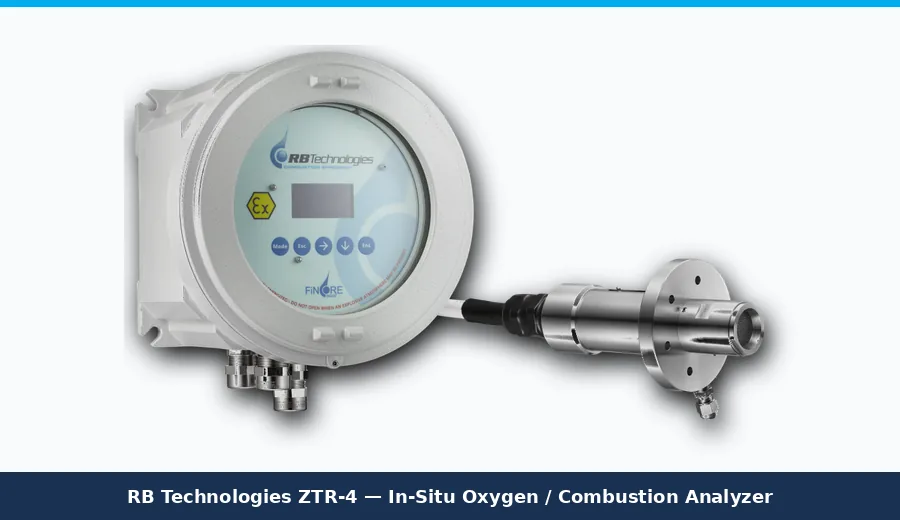
The ZTR-4 is an in-situ combustion analyzer measuring residual O₂ and combustibles (COe) directly in the flue. Catalogue framing covers a directly inserted heated zirconia cell at process temperature with an optional COe detector; confirm O₂/COe ranges, probe length and temperature rating, calibration arrangement, outputs and any hazardous-area option against the current RB Technologies datasheet before specifying. Direct in-situ measurement avoids a long extractive sample line for boiler and furnace duties.
Prefer ZTR-4 when you need continuous flue O₂ (and optional COe) for combustion trim on steam boilers, furnaces, incinerators, or kilns in general / safe-area contexts; when probe temperature and length match the flue; and when 4–20 mA + Modbus into the boiler or DCS trim loop is the primary integration story. It is not a Zone 1 Ex-proof package — keep ZTR3 for that — and it is not an oxygen transmitter for nitrogen blanketing or inerting headspace.
When RB Technologies ZTR3 Ex-Proof fits
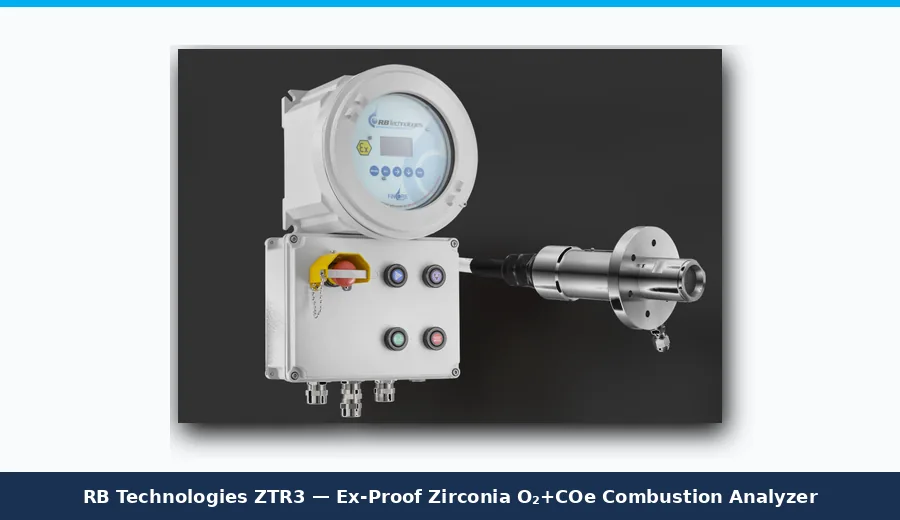
The ZTR3 is an Ex-proof in-situ zirconia O₂+COe dual analyzer for combustion control, combining a compact 316L stainless-steel ZPL2 probe with remote electronics. Catalogue features include FiNCORE Technology for fast response, remote calibration via the ZTR3 transmitter (four integrated Ex-proof buttons), ATEX/IECEx Zone 1 ratings for both probe (Ex db IIB+H₂ T4 Gb) and transmitter (Ex d e IIC T6 Gb), and PESO approval (certificate P630870). The system package typically includes the ZPL2 probe, ZTR3 transmitter, deflecting sampling tube, junction box and cable when runs exceed 3 m, and a calibration kit.
Prefer ZTR3 when the fired heater, furnace, or boiler area is (or may be) Zone 1 classified; when you need a certified Ex probe + remote transmitter rather than a general-purpose analyzer; when fast FiNCORE response and remote electronics placement matter for harsh probe environments; or when PESO / ATEX/IECEx documentation is part of the project deliverable. Keep ZTR-4 when the primary need is general combustion-trim in-situ O₂/COe without a full Zone 1 Ex package.
Installation and integration — brief but non-optional
In-situ probes only report the flue gas they see. Probe insertion depth, orientation, and location relative to burners and leaks determine whether the reading represents true excess air or a local bias. Keep cable runs and junction boxes per manufacturer guidance; place remote transmitters where operators can calibrate and view status without working at the hot flue. Wire O₂ and COe into the same combustion-control or DCS story as fuel valves and damper actuators — an orphaned 4–20 mA display does not trim the burner. Plan reference-gas auto-calibration and spare filters / probe tips on a written maintenance rhythm.
Practical use cases in Pakistan
- Utility and captive-power boilers — ZTR-4 in-situ O₂ (± COe) for continuous combustion trim and fuel-cost control on gas/oil dual-fuel boilers.
- Refinery and petrochemical process heaters — Flue O₂+COe into heater APC / DCS; step up to ZTR3 where Zone 1 classification applies at the heater bay.
- Cement, steel, and glass kilns / furnaces — High-temperature in-situ probes for residual O₂ without long heated sample lines.
- Incinerators and thermal oxidizers — Continuous flue O₂ for combustion completeness and emissions-related trim.
- Hazardous-area fired equipment packages — ZTR3 Ex-proof probe + transmitter where project specs demand Zone 1 ATEX/IECEx (and PESO where applicable).
Selection and integration tips
- Write area classification first — General / safe-area → ZTR-4; Zone 1 Ex package → ZTR3.
- Decide O₂-only vs O₂+COe — COe enables tighter excess-air trim without CO excursions; specify it when closed-loop efficiency is the goal.
- Match probe length and temperature — Flue geometry and the probe temperature rating (confirm on the ZTR-4 datasheet) must fit the actual stack / duct.
- Own the 4–20 mA / Modbus story — Flue O₂ and COe belong in the same control narrative as fuel and air actuators.
- Plan calibration gas and access — Auto-calibration and remote transmitter placement reduce hot-work exposure at the probe.
- Do not conflate duties — In-situ flue combustion O₂ is not blanketing / inerting O₂, not portable process O₂, and not a general “any oxygen analyzer” purchase.
FAQ
Can a portable O₂ meter replace an in-situ ZTR probe on a boiler?
No for continuous combustion trim. Portables are for spot checks, commissioning, and cross-checks. Continuous flue O₂ (and COe) into the control system needs a fixed in-situ analyzer with a live signal.
When is ZTR-4 the better first buy than ZTR3?
When you need in-situ flue O₂/COe for combustion trim on a general boiler, furnace, incinerator, or kiln duty, and a full Zone 1 Ex-proof probe + transmitter package is not required at that point.
When should we choose ZTR3 Ex-Proof instead?
When the sample / probe location is Zone 1 hazardous-area classified, when project specs require ATEX/IECEx (and PESO where applicable) for both probe and transmitter, or when remote Ex electronics with FiNCORE fast response are needed for harsh heater / furnace environments.
How is this different from blanketing / inerting O₂?
Flue-gas combustion trim measures residual O₂ (and COe) in hot combustion products. Blanketing and inerting measure oxygen in nitrogen-purged vessel headspace or process lines — different sensors, alarms, and safety cases. See the blanketing / inerting note for that duty.
How Tetracon supports in-situ combustion O₂ choices
Tetracon supplies oxygen and combustion instrumentation for Pakistan industry, including RB Technologies in-situ zirconia analyzers used on boilers, furnaces, and process heaters. Application support through the contact page and services team can help match in-situ O₂/COe packages to your flue temperatures, probe lengths, and area classifications. Start with catalogue pages for ZTR-4, ZTR3 Ex-Proof, or browse RB Technologies on the site.
Key takeaways
In-situ combustion O₂ and COe monitoring on Pakistani boilers and furnaces is about proving residual oxygen — and unburnt combustibles — continuously in the flue so trim loops can cut excess air without inviting CO. Use ZTR-4 for general in-situ combustion-trim duties; ZTR3 Ex-Proof when Zone 1 hazardous-area probe and transmitter certification is required. Write area classification, probe temperature/length, and whether COe is needed before the purchase order; integrate the signals into the same control story as fuel and air; and keep blanketing / inerting O₂ on a separate programme.