

Anaerobic digestion (AD) turns farm manure, crop residues, food waste and sewage sludge into raw biogas, a wet mixture of methane, carbon dioxide and smaller amounts of hydrogen sulphide and other gases. Upgrading that biogas, mainly by removing CO2, H2S and water, produces biomethane that can be used as vehicle fuel or, where the network operator accepts it, injected into a gas grid. For Pakistani AD and waste-to-energy developers looking at biomethane rather than just burning biogas in an engine, the measurement question changes: it is no longer "how much methane do we have?" but "can we prove, continuously, that the product gas is rich enough in methane and low enough in oxygen before it leaves the plant?"
This note looks at the QED (Geotech) BIOMETHANE 3000 fixed biomethane analyser, which is designed for exactly that product-gas check, and at the QED, Analytical Industries and Michell instruments that usually sit around it. Instrument figures come from the BIOMETHANE 3000 datasheet (Data Sheet Reference DS-2399 Issue 06, the copy hosted on our product page) and from the current Tetracon product pages. Where we do our own arithmetic it is labelled. Gas quality limits for grid injection, CNG or any offtake contract are set by the receiving utility, regulator or buyer, not by this article. No prices are given; configuration and lead time should be confirmed at quotation.
Why biomethane needs its own analyser
Raw biogas monitoring and biomethane monitoring look similar on paper (both measure CH4, CO2 and O2) but the numbers that matter are at opposite ends of the scale. In raw biogas the methane content varies widely and the main concerns are digester health, H2S and air ingress. In upgraded biomethane the methane is high and the oxygen should be very low, so what matters is accuracy near the top of the methane range and near the bottom of the oxygen range.
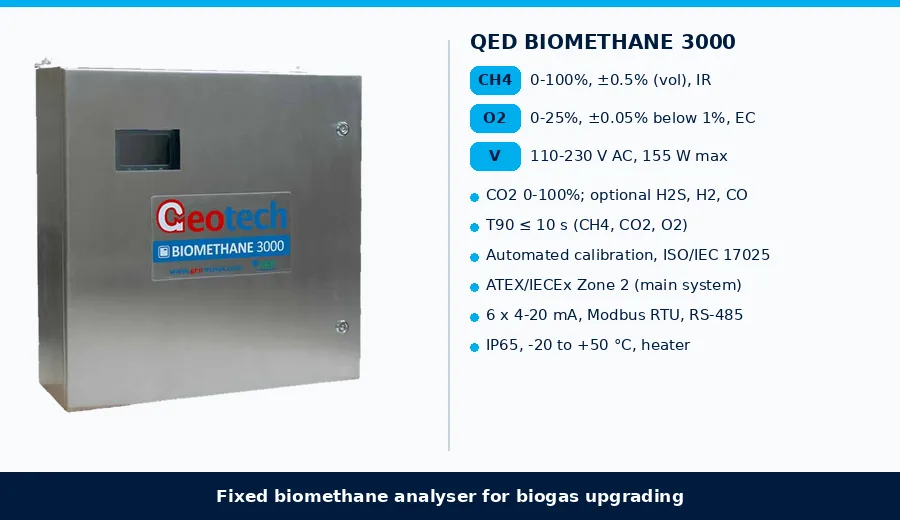
QED states that the BIOMETHANE 3000 is designed for high-accuracy methane and oxygen readings in biomethane applications, giving the operator confidence at first-stage production that readings are above the 95% methane level and below the 1% oxygen level. Its feature list highlights improved CH4 accuracy between 90 and 100%, and improved O2 accuracy below 1%, shown to two decimal places. Among the benefits QED lists are preventing the risk of injecting poor-quality gas into the grid network and protecting against O2 issues.
Oxygen is the number to watch. It can enter through leaks on the suction side of blowers and compressors, through digester covers, or deliberately where air dosing is used for biological desulphurisation upstream. Too much oxygen in the product gas is a quality and safety problem, so a reading resolved to 0.01% below 1% O2 is far more useful than a general-purpose 0-25% reading with ±1% accuracy.
QED BIOMETHANE 3000 at a glance
| Item | QED BIOMETHANE 3000 datasheet (DS-2399 Issue 06) |
|---|---|
| Type | Fixed biomethane analyser for biogas upgrading; continuous monitoring of 1 sample point |
| Gases | CH4, CO2 and O2, with optional H2S, H2 and CO (choice of up to 4 gases in total) |
| Sensing | CH4 and CO2 by dual-wavelength infrared cell with reference channel; O2 by internal electrochemical cell; H2S / H2 / CO by external electrochemical cell |
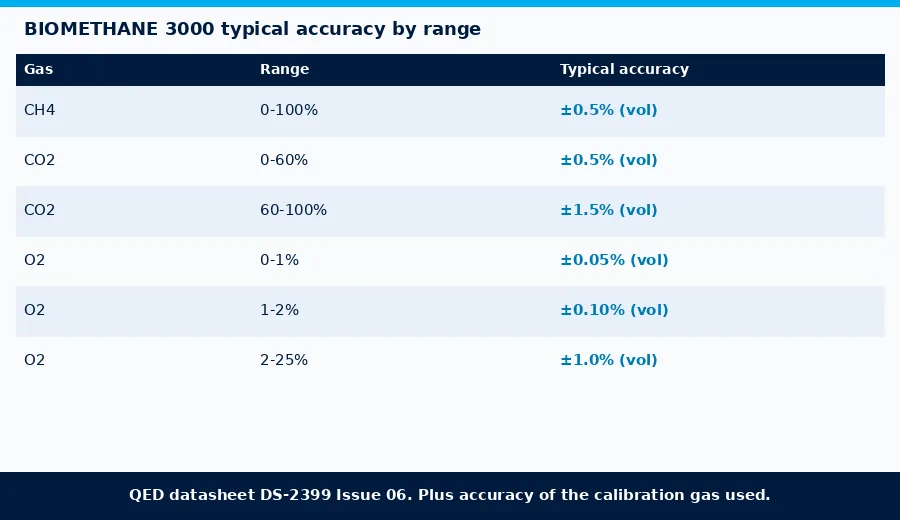
| CH4 | 0-100%; typical accuracy ±0.5% (vol) |
| CO2 | 0-100%; typical accuracy ±0.5% (vol) for 0-60%, ±1.5% (vol) for 60-100% |
| O2 | 0-25%; typical accuracy ±0.05% (vol) for 0-1%, ±0.10% (vol) for 1-2%, ±1.0% (vol) for 2-25% |
| Optional cells | H2S ranges from 0-50 ppm up to 0-10,000 ppm; CO 0-1,000 ppm; H2 0-1,000 ppm |
| Response (T90) | CH4, CO2 and O2 ≤ 10 seconds, timed from the point gas enters the module (sample pipe length adds to this) |
| Calibration | Fully automated calibration function to maintain CH4 accuracy in extreme temperatures; ISO/IEC 17025 calibration; accuracies are plus the accuracy of the calibration gas used |
| Outputs | Up to 6 x 4-20 mA (user configurable for current sink or source), Modbus RTU over RS-485; optional Profibus, Profinet or Ethernet module |
| Alarms and relays | 1 fault relay; 7 user-configurable alarms (including auto-calibration result and catchpot full); single-pole changeover 6 A 24 V DC volt-free relays |
| Sample handling | Pump off by default (uses positive sample pressure), 300 ml/min typical; operating pressure +175 to +350 mbar; microfibre filter and 2.0 µm PTFE water traps; built-in liquid level monitoring; optional automated moisture removal drain |
| Hazardous area | ATEX / IECEx II 3G Ex nA nC IIA T1 Gc (-20 °C ≤ Ta ≤ +50 °C), main system only; CSA nA nC IIA T1 Gc; certification does not apply to the auto-calibration section |
| Environment | Operating temperature -20 °C to +50 °C; IP65; 0-95% RH non-condensing; 100 W ATEX-certified heater as standard |
| Power | 110-230 V AC 50/60 Hz; 155 W maximum |
| Physical | 2 stainless-steel enclosures, each 600 x 600 x 210 mm (650 x 600 x 210 mm with wall brackets), maximum 36.5 kg each; 480 x 272 pixel colour TFT display; membrane keypad |
| Cell life | O2 cell 3 years in air; all other cells 2 years in air |
QED lists the applications as biogas upgrading, agricultural waste, farm waste AD, mixed food waste AD, sewage and waste water treatment AD, vehicle fuel and biomethane production.
What the accuracy figures mean in practice
The datasheet gives typical accuracy as a fixed band in % by volume, so it is worth translating into the readings an operator will actually see. The examples below are our own arithmetic on the datasheet figures and leave out the extra uncertainty of the calibration gas.
| Displayed reading | Datasheet band | Range of true value (Tetracon arithmetic) |
|---|---|---|
| CH4 95.0% | ±0.5% (vol) | about 94.5% to 95.5% |
| CO2 3.0% | ±0.5% (vol), 0-60% band | about 2.5% to 3.5% |
| O2 0.50% | ±0.05% (vol), 0-1% band | about 0.45% to 0.55% |
| O2 1.50% | ±0.10% (vol), 1-2% band | about 1.40% to 1.60% |
| O2 5.0% | ±1.0% (vol), 2-25% band | about 4.0% to 6.0% |
Two practical points follow. First, if your offtake or injection limit sits close to a value the analyser reads, set the alarm with this band in mind rather than exactly at the limit. Second, the fine oxygen resolution only applies below 2% O2. Above that, the BIOMETHANE 3000 behaves like a general survey instrument for oxygen, which is fine for spotting a major air leak but is not the purpose of the analyser.
Where it sits in an upgrading plant
The BIOMETHANE 3000 monitors one sample point continuously, so it normally goes on the upgraded product gas, before the gas leaves the site for a grid connection, a compressor or a vehicle-fuel dispenser. The rest of the plant usually needs other instruments:
- Raw biogas and desulphurisation: QED BIOGAS 3000. A fixed ATEX/IECEx Zone 2 analyser for anaerobic digestion and biomethane upgrading with up to 4 sample points, CH4, CO2 and O2 as standard and up to two optional gases from H2S, H2 and CO. Our product page notes it can monitor gas quality before and after desulphurisation, so one unit can cover digester outlet and scrubber points.
- Portable checks: QED BIOGAS 5000. A portable analyser for % CH4, CO2 and O2 with optional H2S, H2, CO and NH3, datalogging and a rechargeable battery, useful for commissioning, checking individual digesters and cross-checking a fixed analyser.
- Online H2S: Analytical Industries GPR-7500 (A)IS. An online electrochemical ppm H2S analyser with ranges from 0-20 ppmV to 0-2,000 ppmV; biogas before and after the H2S scrubber is one of its listed applications. If you need H2S on the BIOMETHANE 3000 itself, the optional H2S cells start at 0-50 ppm.
- Moisture in biomethane: Michell OptiPEAK TDL600. A TDLAS moisture analyser for natural gas and biomethane down to a 1 ppmV operating range, with D-MET handling for varying gas compositions. The BIOMETHANE 3000 does not measure water content, so where a dew point or moisture limit applies it needs a separate moisture measurement.
Personal and area gas detection for people working around digesters, scrubbers and compressors is a separate HSE duty and should not be replaced by any process analyser; see our note on fixed gas detectors for hazardous areas.
Installation points for Pakistani sites
- Hazardous area class. The ATEX/IECEx marking is II 3G Ex nA nC IIA T1 Gc, which is a Zone 2 category, and it applies to the main system only: the datasheet notes that the certification does not apply to the auto-calibration section. Agree the area classification and where each enclosure goes with your HSE team before installation.
- Heat and sun. The operating range is -20 °C to +50 °C. Summer air temperatures in much of Pakistan come close to that, and a stainless-steel box in direct sun can run hotter, so plan a shaded location or sun canopy. The 100 W heater is standard for cold conditions.
- Power and load shedding. The analyser takes 110-230 V AC, 50/60 Hz, up to 155 W. The lithium manganese dioxide battery is for memory retention only, so if continuous readings matter during outages, put the analyser on the plant UPS or generator-backed supply.
- Sample pressure. The default mode uses the positive pressure of the gas at the sample point, with the pump off. The datasheet gives an operating pressure of +175 to +350 mbar and states that pressure must be regulated so as not to damage the system, which is the user's responsibility. Specify a regulator on the sample take-off if the product line runs above that.
- Condensate. Gas leaving a digester or a water-based upgrading step can carry moisture. The analyser has a microfibre filter, 2.0 µm PTFE water traps, liquid level monitoring with a dedicated alarm and an optional automated moisture removal drain, but sample lines should still be short, sloped and drained.
- Calibration pauses. The process measurement is paused during an auto-calibration. Tell your SCADA or PLC programmer so that a short pause or a held value is not treated as a plant trip, and use the dedicated alarm that flags when the auto-calibration needs attention.
- Space and weight. The system is two wall-mounted stainless-steel enclosures of up to 36.5 kg each, so allow a suitable wall or frame and cable routes between them.
Calibration and maintenance
QED's design aims at keeping the analyser running during servicing: the modular design allows hot-swap for serviceability and on-site maintenance, and QED lists zero operational downtime for servicing among the benefits. Plan for the cell lives given in the datasheet (O2 cell 3 years in air, other cells 2 years in air), keep suitable calibration gases on site, and remember that the quoted accuracies are plus the accuracy of the calibration gas used. QED offers extended warranty and service pack options through its approved service centres; ask us which options apply when you request a quotation.
What to send with an enquiry
- The upgrading technology and where the product gas goes (grid connection, CNG or vehicle fuel, own use)
- The methane, oxygen and any H2S, H2 or CO limits you must demonstrate, and who sets them
- Sample point pressure and temperature, and whether condensate is expected
- Area classification at the proposed analyser location
- Outputs needed (number of 4-20 mA signals, Modbus RTU, or Profibus / Profinet / Ethernet) and alarm philosophy
- Whether raw biogas, scrubber or moisture points also need monitoring (BIOGAS 3000, GPR-7500, OptiPEAK TDL600)
FAQ
What does the QED BIOMETHANE 3000 measure?
CH4 and CO2 by dual-wavelength infrared, and O2 by an internal electrochemical cell, continuously on one sample point. H2S, H2 or CO can be added as options, up to a choice of four gases in total.
How accurate is the oxygen reading?
The datasheet gives typical O2 accuracy of ±0.05% (vol) from 0 to 1%, ±0.10% from 1 to 2% and ±1.0% from 2 to 25%, plus the accuracy of the calibration gas used.
Is the BIOMETHANE 3000 certified for hazardous areas?
Yes, for Zone 2. The main system carries ATEX / IECEx II 3G Ex nA nC IIA T1 Gc and CSA nA nC IIA T1 Gc markings. The certification does not apply to the auto-calibration section.
Does it need a sample pump?
By default the pump is off and the analyser uses the positive pressure of the gas at the sample point, at an operating pressure of +175 to +350 mbar. Typical flow is 300 ml/min, and a flow-fail is flagged below 75 ml/min.
How does it connect to SCADA?
Up to six configurable 4-20 mA outputs and Modbus RTU over RS-485 as standard, with optional Profibus, Profinet or Ethernet, plus a fault relay and seven user-configurable alarms.
Does it measure moisture in biomethane?
No. Water content is not among its measured gases, so a separate moisture analyser such as the Michell OptiPEAK TDL600 is used where a moisture or dew point limit applies.
Next steps
Tetracon supplies QED Environmental Systems gas analysers across Pakistan, together with Analytical Industries H2S analysers and Michell moisture instruments. Send us your upgrading process, product gas limits and sample point details, and we will work with the manufacturer on the right configuration. Use the contact page or see our services. Start with the QED BIOMETHANE 3000, browse gas analysis, environmental and oxygen analysis, or see all QED Environmental Systems, Analytical Industries and Michell Instruments products and the full product catalogue. Related notes: biogas and landfill gas monitoring for waste-to-energy plants, landfill gas extraction monitoring with the QED GEM5000, H2S and total sulfur monitoring and moisture in natural gas with the OptiPEAK TDL600. Free technical guides are collected under Guides.