

Landfill gas extraction fields only make money when the well field is balanced. Too much vacuum pulls air and kills methane quality; too little leaves CH4 in the ground and loads the flare or engine with a weak fuel gas. Pakistani landfill operators and LFG-to-energy teams therefore need a portable analyser that reads CH4, CO2 and O2 at the wellhead, captures static and differential pressure, and can feed flow and calorific-value calculations when an external flow device is fitted — not a surface-walkover methane detector alone, and not a laboratory GC.
This note covers landfill gas extraction monitoring with the QED GEM5000 (Geotech). It explains what the DS44 Issue 14 datasheet specifies, how the instrument sits beside SEM5000 surface methane walkovers and Huberg LASER One natural-gas network surveys, and how to place it on a Pakistani extraction field. Instrument figures come from the QED / Geotech GEM5000 Data Sheet Reference DS44 (Issue 14) and the live Tetracon product page. No prices or exclusivity claims are made here.
Why extraction-well balancing matters on Pakistan LFG sites
Municipal and industrial landfills that collect gas for flaring or power write wellhead composition and vacuum into their operating envelopes for good reason. Oxygen ingress oxidises methane and can push the mixture toward explosive limits; nitrogen dilution from air leaks cuts calorific value; H2S (where present) attacks engines and flares. Continuous or frequent portable checks at each well answer that need when the field is being tuned:
- Gas-field balancing. A portable CH4 / CO2 / O2 reading at the wellhead, with static and differential pressure, shows whether a well is over-pulled, under-pulled or on target.
- Energy and flare output. With an external flow device and Gas Analyser Manager software, the datasheet states the GEM5000 can calculate gas flow (m3/h) and calorific value (kW or BTU) so site teams can estimate engine or flare duty from the same round.
- Optional toxics. H2S up to 10,000 ppm, H2-compensated CO, NH3 and H2 cells can be specified when the landfill gas chemistry demands them — without changing the primary IR CH4/CO2 path.
- Hazardous-area portable work. Wellheads and header corridors need an IP65, ATEX/IECEx Zone-class portable that matches Pakistani summer heat and dust, not a benchtop analyser.
QED GEM5000: what the datasheet says
The GEM5000 is a landfill gas extraction monitor for measuring CH4, CO2 and O2. The datasheet describes it as an easy-to-use analyser designed to aid balancing the gas field, maximise power output and ultimately maximise revenue from CH4 extraction. CH4 and CO2 use a dual-wavelength infrared sensor with a reference channel; O2 (and optional CO, H2S, NH3, H2) use internal electrochemical cells. Up to six gases can be monitored. Static and differential pressure are recorded; flow and calorific value require an external flow device plus Gas Analyser Manager software.
| Specification | GEM5000 (DS44 Issue 14) |
|---|---|
| Method / technology | CH4 & CO2: dual-wavelength IR with reference channel; O2 & optional toxics: internal electrochemical |
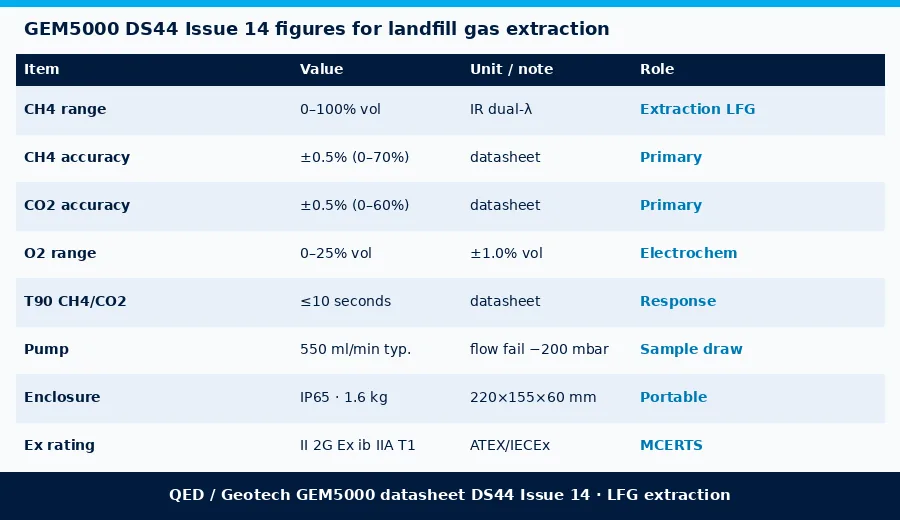
| Standard gases | CH4 0–100% vol; CO2 0–100% vol; O2 0–25% vol |
| Accuracy (primary bands) | CH4 0–70%: ±0.5% (vol); CO2 0–60%: ±0.5% (vol); O2 0–25%: ±1.0% (vol). Upper CH4/CO2 bands ±1.5% (vol) |
| Optional cells (examples) | CO 0–500 / 1,000 / 2,000 ppm; H2-comp CO 0–2,000 ppm (±1.0% FS); H2S 0–50 to 0–10,000 ppm; NH3 0–1,000 ppm; H2 0–1,000 ppm |
| Response time T90 | CH4 & CO2 ≤10 s; O2 & CO ≤20 s; H2S ≤30 s; NH3 & H2 ≤90 s |
| Pump | 550 ml/min typically; flow-fail point −200 mbar (user settable); max vacuum restart ≈ −375 mbar @ ≈80 ml/min |
| Pressure | Relative ±500 mbar (±4 mbar typ. to ±15 mbar max); barometric 500–1500 mbar (±5 mbar) |
| Battery | Rechargeable NiMH pack (not user-replaceable); typical 8 h use; ≈4 h charge from 100–240 V charger |
| Operating ambient | −10 to +50 °C; 0–95% RH non-condensing; atmospheric pressure 700–1200 mbar |
| Physical | 1.6 kg; L 220 × W 155 × D 60 mm; high-impact ABS with rubber over-moulding; 4.3″ colour TFT |
| Case seal / filters | IP65; external user-changeable 2.0 μm PTFE water traps |
| Memory / comms | 2,000 IDs, 4,000 readings, 2,000 events (with Gas Analyser Manager); USB or optional Bluetooth |
| Hazardous area | ATEX / IECEx II 2G Ex ib IIA T1 Gb (Ta = −10°C to +50°C); CSA Ex ib IIA T1 / AEx ib IIA T1; MCERTS MC / 130239; UKAS ISO17025 cal. 4533 |
| Warranty (datasheet) | 3 years |
The live product page positions the GEM5000 as a fixed/portable landfill gas extraction monitoring analyser under gas analysis. Specification work should name which optional cells, whether GPS / Bluetooth / flow devices are required, and how results will be downloaded before the field round is locked.
How a wellhead extraction round works
- Connect at the sample point. Use the colour-coded gas inlet, outlet and pressure ports with the external 2.0 μm PTFE water trap so condensate does not reach the IR cell.
- Zero and read pressure. Relative-pressure accuracy is quoted as ±4 mbar typically after zeroing (up to ±15 mbar max); barometric pressure covers 500–1500 mbar.
- Draw the sample. The pump typically moves 550 ml/min; set the flow-fail vacuum (datasheet default −200 mbar, user settable) so a blocked line alarms before the round continues blind.
- Log CH4, CO2, O2 (and options). Dual-wavelength IR covers the primary landfill gases; optional electrochemical cells add CO, H2S, NH3 or H2 when specified at manufacture or later upgrade.
- Export and balance. Download via USB or optional Bluetooth into Gas Analyser Manager; with an external anemometer or Pitot tube, calculate flow and calorific value to tune vacuum valves toward target methane and power output.
GEM5000, SEM5000, GA5000 and LASER One — who does what
| Instrument | Primary job |
|---|---|
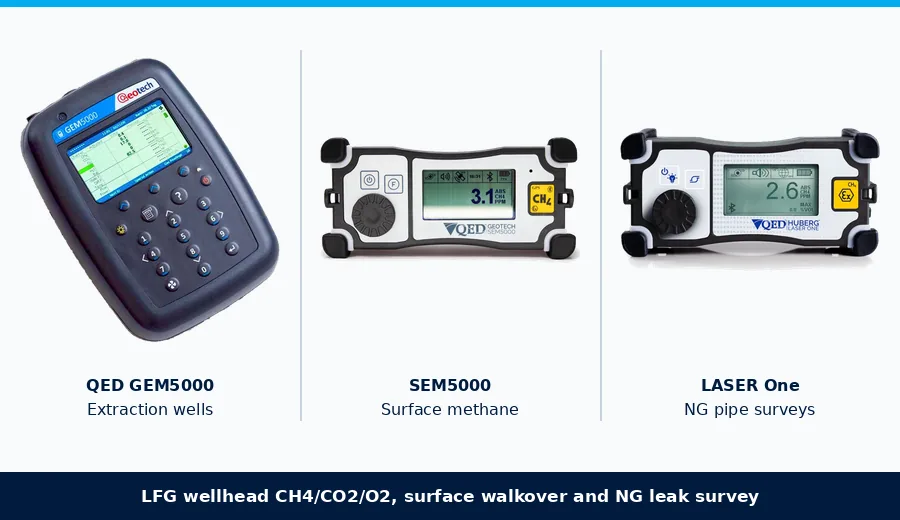
| QED GEM5000 | Portable landfill gas extraction monitor for wellhead CH4, CO2, O2, pressure and optional toxics; field balancing, energy estimation and flare/engine output support. |
| QED SEM5000 | TDLAS portable methane detector for landfill surface emissions walkovers (1 ppm–100% vol) — complementary to extraction-well work, not a substitute. See our note on landfill surface emissions monitoring. |
| QED GA5000 | Related Geotech portable landfill / biogas analyser in the same family — use when the site specification names GA5000 rather than GEM5000; confirm cells and firmware against the order. |
| Huberg LASER One | Methane-specific TDLAS for natural-gas network leak surveys on buried pipes — a different duty from landfill extraction. See natural gas leak detection. |
Use GEM5000 when the duty is extraction-well / header balancing and LFG energy or flare estimation. Keep SEM5000 for surface methane walkovers over the cap. Reach for LASER One when the ask is a natural-gas distribution leak survey. Do not treat a surface-walkover detector as a substitute for wellhead CH4/CO2/O2 and pressure — they answer different landfill questions. Perimeter groundwater sampling around the same sites is covered separately with the MicroPurge MP100 (low-flow groundwater note).
Field practice for Pakistan landfill extraction sites
- Name the sample point. Individual wells, manifolds and header sampling each drive different hose lengths, water-trap discipline and optional H2S ranges.
- Watch oxygen. Rising O2 at the wellhead is the first sign of air intrusion; treat it as a balancing alarm, not just a composition curiosity.
- Zero pressure before each critical set. The ±4 mbar typical relative-pressure figure assumes a zero before reading.
- Respect ambient and Ex limits. Operating band is −10 to +50 °C with IP65 sealing and ATEX/IECEx II 2G Ex ib IIA T1 Gb — match site Ex zoning before entering restricted areas.
- Plan battery and filters. Typical 8 h NiMH runtime and ≈4 h recharge, plus spare 2.0 μm PTFE water traps, keep a multi-well round from stopping mid-field.
- Integrate flow when energy matters. Order the ATEX anemometer or Pitot option and Gas Analyser Manager if m3/h and kW/BTU are contractual outputs, not afterthoughts.
FAQ
What does the GEM5000 measure on a landfill gas extraction field?
The QED / Geotech GEM5000 datasheet (DS44 Issue 14) lists measurement of % CH4 and % CO2 by dual-wavelength infrared with a reference channel, and % O2 by an internal electrochemical sensor. Optional electrochemical cells cover CO (including H2-compensated), H2S, NH3 and H2. The analyser also records static and differential pressure and can calculate gas flow and calorific value with an external flow device and Gas Analyser Manager software.
What accuracy and response time does the datasheet quote?
CH4 accuracy is ±0.5% (vol) from 0–70% and ±1.5% (vol) from 70–100%. CO2 accuracy is ±0.5% (vol) from 0–60% and ±1.5% (vol) from 60–100%. O2 is ±1.0% (vol) over 0–25%. Response time T90 is ≤10 seconds for CH4 and CO2, ≤20 seconds for O2 and CO, ≤30 seconds for H2S, and ≤90 seconds for NH3 and H2.
Is the GEM5000 certified for hazardous areas?
Yes. DS44 Issue 14 lists ATEX / IECEx II 2G Ex ib IIA T1 Gb (Ta = −10°C to +50°C), CSA Ex ib IIA T1 / AEx ib IIA T1 for the same ambient band, MCERTS MC / 130239, and UKAS ISO17025 calibration (certificate 4533). The case seal is IP65.
When should we use GEM5000 instead of SEM5000 or Huberg LASER One?
Use GEM5000 for extraction-well / gas-field balancing (CH4, CO2, O2, pressure and optional toxics at the wellhead). Use SEM5000 for landfill surface-emissions methane walkovers with TDLAS. Use Huberg LASER One for natural-gas network leak surveys on buried pipes — a different duty from landfill extraction monitoring.
Where can Pakistani teams see the product and ask for support?
See the catalogue page for the GEM5000, browse gas analysis and environmental, or contact Tetracon with your well count, target gas mix, whether H2S/CO options or flow/calorific calculation are required, and how results must be logged.
Next steps
Tetracon supplies gas analysis and environmental instrumentation to Pakistan’s landfill, remediation and industrial sites, including QED Environmental Systems / Geotech / Huberg products. Tell us how many wells you balance, which optional gas cells you need, whether flow and calorific value are contractual, and how results must reach your reporting system. Use the contact page or see our services. Start with the catalogue pages for the GEM5000, SEM5000, GA5000 and Huberg LASER One; browse gas analysis and environmental; or see all QED Environmental products. Free technical guides are collected under Guides.