

Landfill and dumpsite methane does not only come out of the wells. It seeps through the cover, around penetrations, along leachate drains and at the edges of gas-collection pipework. A surface emissions walkover is how operators and consultants find those paths before regulator, lender or client audits ask for evidence. In Pakistan that work shows up at engineered sanitary landfills, dumpsite closure and capping projects, waste-to-energy and biogas sites, and industrial estates where organic waste is landfilled on site.
This note covers portable methane detection for landfill surface walkovers with the QED SEM5000, how it sits beside wellhead monitoring with the QED GEM5000, and when a network-style TDLAS instrument such as the Huberg LASER One is the better fit off the landfill. Instrument figures come from the QED SEM5000 datasheet (TDS-2398 Issue 04) and the live Tetracon product page. No prices or exclusivity claims are made here.
Why surface methane walkovers matter
Wellhead readings tell you what is happening in the gas-extraction network. They do not tell you whether the cap is sealing, whether a flange is leaking into open air, or whether a hot spot has opened after settlement or after a cover repair. Surface walkovers close that gap:
- Find fugitive paths. Methane that bypasses the collection system still reaches the atmosphere through cracks, penetrations and poorly sealed edges.
- Document compliance. Audits and environmental monitoring plans often expect a geo-tagged survey trail, not only spot checks at manholes.
- Prioritise repairs. A clear ppm reading at a known GPS point turns a vague “smell of gas” into a work order.
- Protect people on site. Elevated methane near plant rooms, flares and vehicle routes needs a detector that is selective and fast.
Where Pakistani teams need it
Surface methane surveys typically appear in operational monitoring plans, EIA follow-up, dumpsite rehabilitation and lender or client audits. Typical sites include:
- Engineered sanitary landfills with active gas-collection wells and flares.
- Dumpsite capping and closure projects where temporary covers still vent.
- Waste-to-energy and biogas plants that share a landfill footprint (see our note on biogas and landfill gas monitoring).
- Industrial estates and municipal sites with on-site organic-waste cells.
- Perimeter programmes that already sample groundwater wells with low-flow pumps (see low-flow groundwater sampling with the MicroPurge MP100).
QED SEM5000: what the datasheet says
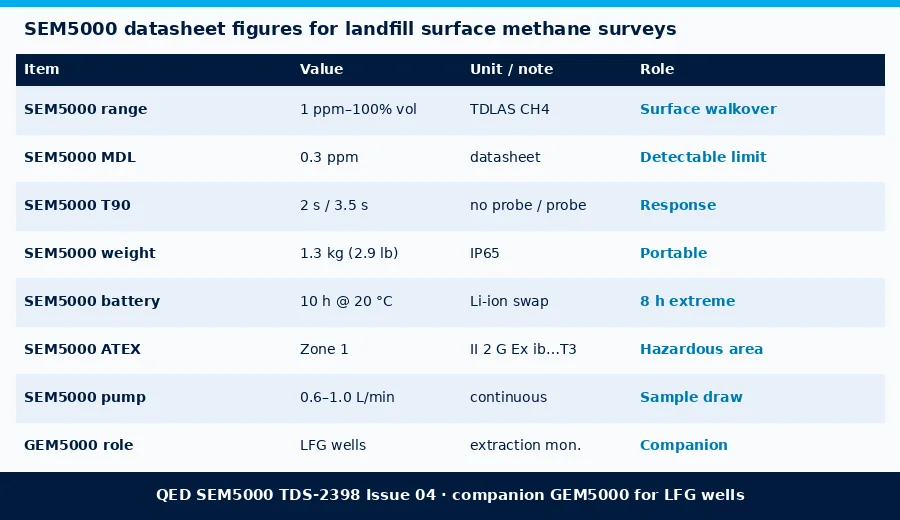
The SEM5000 is a portable methane detector built for landfill surface emissions monitoring. It uses laser-based Tunable Diode Laser Absorption Spectroscopy (TDLAS), so the reading is specific to methane rather than a broad combustible-gas response. Integral GPS and Bluetooth support geo-tagged logging; the live Tetracon product page lists included SEMSoft reporting software for leak documentation. The instrument is ATEX Zone 1 certified and IP65 rated for outdoor walkovers.
| Specification | SEM5000 |
|---|---|
| Target gas / method | Methane (CH4); Tunable Diode Laser Absorption Spectroscopy (TDLAS) |
| Measurement range | 1 ppm to 100% by volume (1–9,999 ppm / 1%–100% vol) |
| Minimum detectable limit | 0.3 ppm |
| Accuracy | ≤10 ppm: ±1.0 ppm; 11–9,999 ppm and 1–100% vol: ±10% of reading |
| Resolution | 0.1 ppm / 0.1% (range dependent) |
| Response time (T90) | 2 seconds without probe; 3.5 seconds with probe |
| Start-up | Surveying in under 60 seconds (datasheet) |
| Pump flow | 0.6 L/min minimum; 0.8 L/min typical; 1.0 L/min maximum |
| Battery | Swappable Li-ion; 10 hours at 20 °C; 8 hours at extreme temperatures with backlight; charge ~4.5 hours from empty |
| Weight / dimensions | 1.3 kg (2.9 lb); 229 × 97 × 109 mm |
| Protection / temperature | IP65; operating −25 to +50 °C; humidity 5–80% RH non-condensing |
| Alarm | ~85 dBA at 30 cm; four visual LED alarms |
| Certification | ATEX Zone 1: II 2 G Ex ib op is IIB T3 Gb (−25 °C ≤ Ta ≤ +50 °C) |
| GPS / communications | Integral GPS and Bluetooth; USB multiway adaptor for charger and PC |
| Factory / field calibration (PDP) | Factory every 2 years; daily field calibration to support Method 21 §§7.0/8.0 |
| Warranty (PDP) | 3 years |
Figures in the table come from TDS-2398 Issue 04 unless marked PDP. Where the live product page differs (for example weight 1.6 kg / 3.5 lb, or a 0.5 ppm range start), this note follows the datasheet.
Running a surface emissions walkover
Exact grids and action levels belong in your site monitoring plan or the method your regulator or client specifies. The SEM5000 datasheet and PDP point to the practical field habits that make those plans usable:
- Warm up and field-check. The datasheet says you can be surveying in under 60 seconds. The live PDP notes daily field calibration to support Method 21 §§7.0 and 8.0 — follow your written procedure before the first transect.
- Walk a defined grid. Cover the capped area, edges, penetrations, wellheads, leachate drains and pipe crossings. Keep the probe height and walking speed consistent so readings are comparable along the route.
- Watch response time. T90 is 2 seconds without the probe and 3.5 seconds with it. Pause briefly over elevated spots so the reading can catch up before you mark a leak.
- Save leaks with GPS. Use the instrument’s leak-save / logging functions with GPS on so each elevated point has a coordinate for the report.
- Export through SEMSoft. The live PDP lists included SEMSoft reporting software for compliance documentation after the walkover.
- Respect ATEX and weather. Zone 1 certification covers hazardous areas on site; IP65 and the −25 to +50 °C range cover typical outdoor Pakistani conditions when you manage heat, dust and monsoon rain sensibly.
SEM5000, GEM5000 and LASER One — who does what
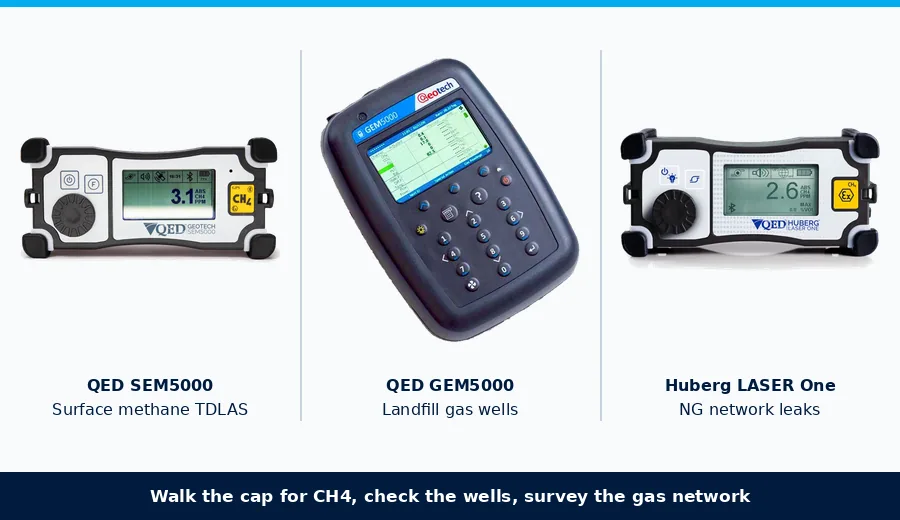
These three instruments sit in the same methane toolbox but answer different questions:
| Instrument | Primary job on a Pakistan landfill / gas programme |
|---|---|
| SEM5000 | Surface emissions walkovers across the cap, penetrations and collection points; methane-specific TDLAS from 1 ppm to 100% vol. |
| GEM5000 | Landfill gas extraction / wellhead monitoring (CH4, CO2, O2 and options). Pair it with the SEM5000 when the same visit covers wells and the surface. |
| Huberg LASER One | Natural-gas network and distribution leak surveys off the landfill. See our note on natural gas leak detection with Huberg LASER One. |
Use the SEM5000 when the question is “where is methane leaving the surface?” Use the GEM5000 when the question is “what is the well or extraction line doing?” Use LASER One when the question is “where is the buried gas network leaking?”
Practical points for Pakistan sites
- Heat and sun. Operating range goes to +50 °C; still shade the instrument and spare batteries during long summer transects, and carry a charged spare pack (10-hour life at 20 °C, shorter in extremes).
- Dust and monsoon. IP65 helps; keep the probe inlet and filters clean and dry after dusty tracks or heavy rain.
- Hazardous areas. ATEX Zone 1 rating matters near flares, blowers and confined plant rooms — follow the site’s hazardous-area plan.
- Reporting. GPS-tagged leak saves plus SEMSoft exports make it easier to hand auditors a route map rather than a notebook list.
- Calibration interval. Plan for daily field checks and the two-year factory calibration interval listed on the live product page.
FAQ
What measurement range does the SEM5000 cover?
Per QED TDS-2398 Issue 04, methane from 1 ppm to 100% by volume (1–9,999 ppm and 1%–100% vol), with a minimum detectable limit of 0.3 ppm.
How fast does it respond during a walkover?
T90 is 2 seconds without the probe and 3.5 seconds with the probe. Pause briefly over elevated spots so the reading can settle before you save a leak.
Is the SEM5000 suitable for hazardous areas on a landfill?
Yes. It is ATEX Zone 1 certified: II 2 G Ex ib op is IIB T3 Gb for −25 °C ≤ Ta ≤ +50 °C. Always follow the site hazardous-area plan.
How does the SEM5000 relate to the GEM5000?
The SEM5000 is for surface walkovers; the GEM5000 is the landfill gas extraction / wellhead analyser. Many monitoring rounds use both on the same visit.
Where can Pakistani teams see the product and ask for support?
See the catalogue page for the SEM5000, browse gas detection and environmental instruments, or contact Tetracon with your site layout and reporting needs.
Next steps
Tetracon supplies environmental, gas-detection and industrial instrumentation to Pakistan’s industry, utilities, consultants and laboratories, including QED Environmental Systems products. Tell us the landfill layout, whether you need surface walkovers, wellhead analysis or both, and the reporting format your monitoring plan requires. Use the contact page or see our services. Start with the catalogue pages for the SEM5000, GEM5000 and Huberg LASER One; browse gas detection, environmental and gas analysis; or see all QED Environmental Systems products. Free technical guides are collected under Guides.