

Groundwater is the hidden half of most environmental monitoring programmes in Pakistan. Industrial estates, fuel depots and filling stations, landfill and dumpsite perimeters, tannery and textile clusters, refineries and remediation sites all end up with monitoring wells. The value of those wells depends on how the water is pulled out. Bail a well hard, or pump it fast with a large drawdown, and the sample can come up full of stirred-up sediment, aerated, warmed and stripped of volatile compounds. The lab then reports the sampling method as much as it reports the aquifer.
This note explains low-flow (low-stress) groundwater purging and sampling with the QED MicroPurge MP100 peristaltic pump system, and how to log sample-cooler temperature on the way to the lab with a Lascar EL-USB-1 temperature data logger. Pump figures come from the QED MicroPurge MP100/MP100-CE datasheet (TDS-2435 Issue 01) and the live Tetracon product page. Logger figures come from the Lascar EL-USB-1 datasheet (Issue 18). Method points come from the US EPA Region 1 Low-Stress (Low-Flow) SOP, EQASOP-GW4 (Revision 4, revised 19 September 2017). No prices or exclusivity claims are made here.
Why low-flow sampling matters
The EPA Region 1 SOP states the goal plainly: collect samples that reflect the total mobile organic and inorganic load moving through the subsurface under ambient flow conditions, with minimal physical and chemical alteration from the sampling itself. It gets there by keeping hydraulic stress at the well-aquifer interface low. That means low pumping rates, small and stable water-level drawdown, and watching indicator field parameters until they settle before any bottle is filled. The SOP is based on Puls and Barcelona's 1996 EPA low-flow (minimal drawdown) procedure.
- Less turbidity. Gentle pumping does not scour fines off the screen and filter pack, so metals results are not inflated by particles.
- Representative chemistry. Stabilised indicator parameters show that formation water, not stagnant casing water, is reaching the pump.
- Repeatable rounds. The SOP recommends keeping the same intake depth and pumping rate for every event, so quarter-on-quarter trends mean something.
- Smaller purge volumes. Less purge water has to be contained and disposed of on contaminated sites.
Where Pakistani teams need it
Groundwater sampling usually appears in environmental monitoring plans, lender or client audits, site investigations and remediation verification. Typical sites include:
- Fuel depots, pipelines and filling stations with hydrocarbon monitoring wells.
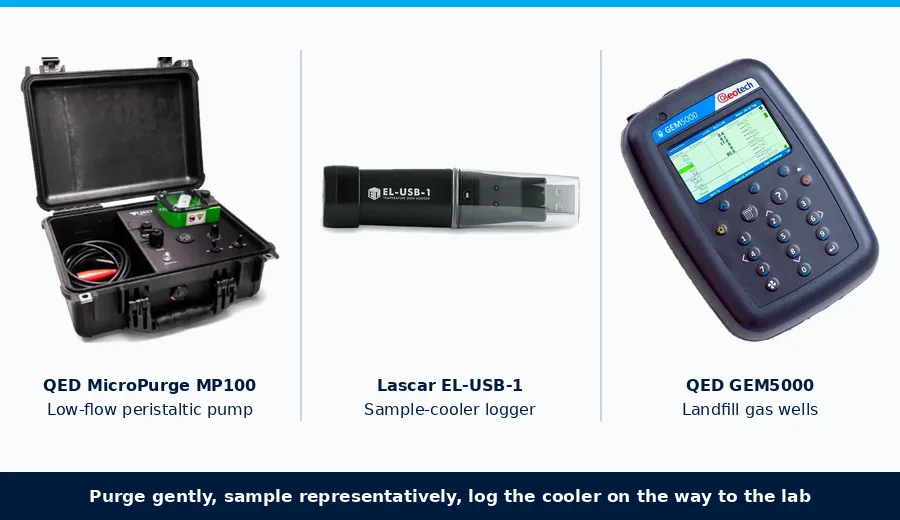
- Landfill and dumpsite perimeters, where groundwater wells sit alongside landfill-gas wells (see our note on biogas and landfill gas monitoring and the QED GEM5000 landfill gas analyser).
- Textile, tannery, chemical and pharmaceutical plants that track what is reaching the shallow aquifer under effluent and storage areas.
- Power plants, refineries and industrial estates with baseline and operational monitoring rounds.
- Remediation projects that must show concentrations falling over time.
QED MicroPurge MP100: what the datasheet says
The MP100 is a two-roller peristaltic pump with a brushless DC motor, built into a hard-shell case so the pump head and control panel are fully enclosed for transport. The flow control runs from zero to maximum, and an integral voltmeter on the panel shows battery charge. Because the sample touches only the tubing in the well and around the pump head, QED notes that peristaltic systems suit dedicated sampling setups, including PFAS programmes where a PFAS-free tubing train is needed.
| Specification | MicroPurge MP100 |
|---|---|
| Pump type | Two-roller peristaltic, brushless DC motor, fixed stator housing, removable guard cover |
| Power source | 12 VDC storage battery (SLA, AGM) or 12.6 V @ 3 A minimum power supply (not included) |
| Operating current | 2.0 A |
| Pump tubing sizes | L/S 15, L/S 24, L/S 35 |
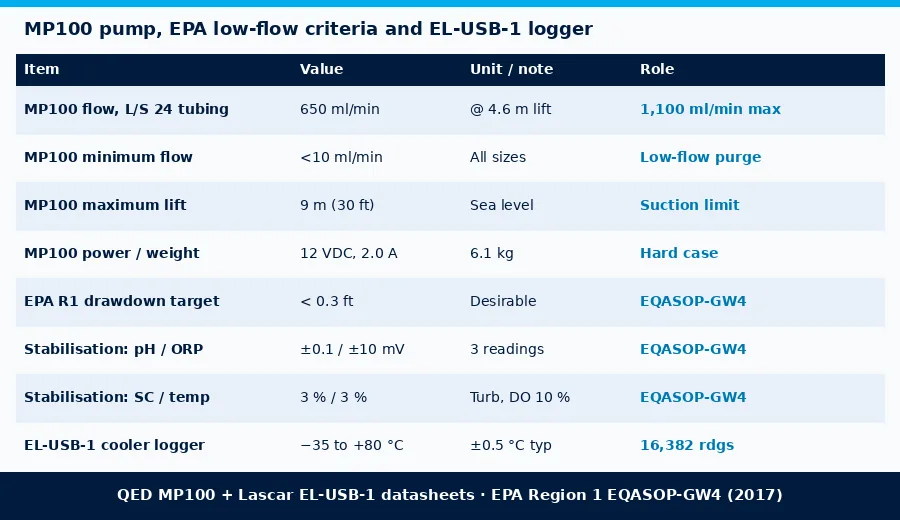
| Flow, L/S 15 | 550 ml/min @ 15 ft (4.6 m) lift; 700 ml/min maximum; <10 ml/min minimum |
| Flow, L/S 24 | 650 ml/min @ 15 ft (4.6 m) lift; 1,100 ml/min maximum; <10 ml/min minimum |
| Flow, L/S 35 | 480 ml/min @ 15 ft (4.6 m) lift; 1,500 ml/min maximum; <10 ml/min minimum |
| Maximum lift depth | 30 ft (9 m) at sea level (depends on tubing size, wall thickness and elevation) |
| Case dimensions | 42 × 33 × 17 cm (16.5 × 13.0 × 7.0 in) |
| Weight | 6.1 kg (13.5 lb) |
| Warranty | 1 year |
| Compliance | RoHS 3 (2015/863/EU) with exemption 6c; CE Machinery Directive 2006/42/EC when fitted with the slotted-screw pump head guard |
The sub-10 ml/min minimum flow matters most for low-flow work. Slow-recharging wells can be purged gently without dewatering them, and the rate can be turned down further for VOC bottles.
Tubing and accessories
QED lists matching silicone pump-head tubing, HDPE drop tubing, recessed well caps and a drop-tubing weight kit, so each well can have its own dedicated tubing train:
| Pump size | Silicone pump tubing (25 ft roll) | HDPE drop tubing (100 ft roll) |
|---|---|---|
| L/S 15 | 42402: 3/8" OD × 3/16" ID | P014-100: 1/4" OD × 0.170" ID |
| L/S 24 | 42403: 7/16" OD × 1/4" ID | P516-100: 5/16" OD × 3/16" ID |
| L/S 35 | 42404: 1/2" OD × 5/16" ID | P038-100: 3/8" OD × 1/4" ID |
Recessed well caps come for 2" (50 mm) casing (P24, P25, P26) and 4" (100 mm) casing (P44, P45, P46), with 1/4", 5/16" or 3/8" drop-tube fittings and dust covers. P100WT is the drop-tubing weight kit with fittings for all three sizes. The EPA Region 1 SOP adds three points for peristaltic work. Use silastic (silicone) tubing only for the short section around the rotor head, less than a foot long. Make the rotor-head tubing inside diameter the same as the tubing in the well. Prefer 1/4" or 3/8" ID tubing so the line stays liquid-filled at very low pumping rates. Settle the exact tubing pairing in your sampling and analysis plan before the round.
A low-flow purge, step by step
- Measure the static water level before anything goes into the well, and record it.
- Set the intake within the screen at a depth that stays under water; the mid-point of the saturated screen is commonly used. Keep the same depth for every event.
- Start the pump slowly and increase speed until discharge begins. If the well has a history, match the previous pumping rate. Otherwise adjust for little or no drawdown.
- Watch drawdown. The SOP's target is drawdown under 0.3 ft (about 9 cm). This is desirable, not mandatory: if the minimum achievable drawdown is larger but stable, continue. Make rate adjustments in the first fifteen minutes and record each one. Avoid clamps or constrictions on the tubing to slow the flow; they cause degassing.
- Connect a flow-through cell once the water level is stable. Read turbidity before the cell, and temperature, specific conductance, pH, ORP and dissolved oxygen in it, at intervals of five minutes or more. The flow must turn over at least one cell volume between readings. The SOP's example is a 250 mL cell at 50 mL/min read every five minutes, or a 500 mL cell every ten minutes.
- Start sampling once three consecutive readings are stable within the limits below.
| Indicator parameter | Stabilisation limit (EPA Region 1 EQASOP-GW4) |
|---|---|
| Turbidity | 10 % for values above 5 NTU; three readings below 5 NTU count as stable |
| Dissolved oxygen | 10 % for values above 0.5 mg/L; three readings below 0.5 mg/L count as stable |
| Specific conductance | 3 % |
| Temperature | 3 % |
| pH | ± 0.1 unit |
| Oxidation/reduction potential | ± 10 mV |
If the parameters have not stabilised after two hours of purging, the SOP allows three options: keep purging, stop without sampling and document why, or sample with a full explanation that the data may carry bias. For new wells that recover at less than 50 mL/min, or are being dewatered, sample as soon as enough water has recovered and record the decision.
VOCs, dissolved gases and peristaltic pumps
A peristaltic pump lifts water by suction, and that is its main limitation. Appendix A of the EPA Region 1 SOP quotes EPA and USGS guidance warning that suction lift can degas the sample, shift pH and alkalinity and lose volatile compounds. The SOP's position is practical. If small differences in VOC or dissolved-gas results could change a decision, such as whether clean-up goals are met, use a bladder or centrifugal pump for those analytes. If that extra sampling error does not matter for the data's intended use, a peristaltic pump may be acceptable. Either way:
- Keep the pump tubing completely filled with water during purging and sampling.
- Collect non-VOC samples first; if the tubing is not full at the sampling point, increase the flow slightly until it is, then fill the VOC and dissolved-gas vials and record the new rate.
- Let the discharge run gently down the inside of each container.
Peristaltic sampling remains a strong fit for inorganics, metals, general chemistry and many dedicated-tubing programmes in shallow wells. The datasheet also makes the depth limit clear: lift is quoted to 30 ft (9 m) at sea level and depends on tubing and elevation. Where the water table is deeper than that, plan on a submersible or bladder pump instead.
Pakistani heat, winter and the sample line
The SOP warns that direct sun and hot air can heat the water in the tubing and the flow-through cell, causing degassing and loss of VOCs and dissolved gases. In a Punjab or Sindh summer, shade the pump, tubing and cell with an umbrella or tent, keep the tubing out of the well as short as possible, and avoid the hottest part of the day. At the other end, the SOP recommends low-flow sampling above 0 °C. Winter rounds in the north need precautions against ice forming in the equipment, and a transparent flow-through cell lets you see it start.
Logging the sample cooler with a Lascar EL-USB-1
Samples that need cooling go into a cooler with ice or refrigerant for delivery to the laboratory. The EPA SOP describes a temperature blank in each cooler that the lab measures on receipt. A small logger in the same cooler adds the full time-temperature record for the trip. That matters when samples spend hours in a vehicle between a remote site and a lab in Lahore, Karachi or Islamabad. Compare it with the cooling limit your lab's method sets, for example the ≤6 °C criterion in US 40 CFR Part 136 Table II.
| Specification | Lascar EL-USB-1 |
|---|---|
| Measurement range | −35 to +80 °C (−31 to +176 °F) |
| Resolution | 0.5 °C (1 °F) |
| Accuracy (overall error) | ±0.5 °C typical |
| Readings stored | 16,382 |
| Logging rate | User-selectable, 10 seconds to 12 hours |
| Alarms / start | User-programmable high and low alarms; immediate or delayed start; red/green and amber LEDs |
| Protection | IP67 with the cap fitted |
| Battery life | 3 years (at 25 °C and 1-minute logging rate), 3.6 V ½AA lithium |
| Dimensions | 99 × 25 × 23 mm |
Set the high alarm to the method's cooling limit before leaving the office. With the EasyLog "hold" setting the LED keeps flashing red if the limit was ever exceeded, so the receiving lab or site lead can see a breach before downloading the data.
Field-round checklist
- Sampling and analysis plan agreed: analytes, intake depths, pump type per analyte group, tubing pairing.
- MP100 battery charged (check the panel voltmeter), dedicated or decontaminated tubing per well, well caps fitted.
- Water-level meter, flow-through cell, turbidity meter and calibration solutions.
- Purge log: time, water level, flow rate, every adjustment, every indicator reading.
- Shade for summer; freeze precautions for northern winters.
- Cooler, ice, temperature blank, EL-USB-1 started with alarms set; chain-of-custody forms.
FAQ
What flow rates can the QED MicroPurge MP100 deliver?
Per the QED datasheet, the minimum is below 10 ml/min on all three tubing sizes. At 15 ft (4.6 m) lift it delivers 550 ml/min with L/S 15, 650 ml/min with L/S 24 and 480 ml/min with L/S 35 tubing. Maximum rates are 700, 1,100 and 1,500 ml/min respectively.
How deep can a peristaltic pump such as the MP100 sample?
The datasheet quotes a maximum lift of 30 ft (9 m) at sea level. Actual lift depends on tubing size, wall thickness and elevation above sea level. For deeper water tables use a submersible or bladder pump.
When is low-flow purging complete under the EPA Region 1 SOP?
Purging is complete when three consecutive readings are within limits: turbidity 10 % above 5 NTU, dissolved oxygen 10 % above 0.5 mg/L, specific conductance 3 %, temperature 3 %, pH ±0.1 unit and ORP ±10 mV.
Can I collect VOC samples with a peristaltic pump?
Only with caution. The EPA Region 1 SOP says suction pumps can cause degassing and loss of volatiles. If small differences could change a clean-up decision, use a bladder or centrifugal pump for VOCs and dissolved gases. Otherwise keep the tubing full, collect other samples first and fill VOC vials gently.
Why put a Lascar EL-USB-1 in the sample cooler?
It records the cooler temperature from −35 to +80 °C with ±0.5 °C typical accuracy at 10-second to 12-hour intervals. That gives a time-stamped transport record alongside the lab's temperature blank, and the programmable alarm shows whether the cooling limit was exceeded.
Summary
Low-flow sampling protects groundwater data from the sampling method itself: low rate, small stable drawdown, stabilised indicators, then gentle filling. The QED MicroPurge MP100 gives shallow-well teams a cased, battery-powered peristaltic pump that turns down below 10 ml/min and supports dedicated tubing trains. Respect its 9 m suction-lift limit and the EPA cautions on VOCs, and log the cooler with a Lascar EL-USB-1 so the samples reach the lab with a full temperature record.
How Tetracon helps
Tetracon supplies environmental, gas-analysis and industrial instrumentation to Pakistan's industry, utilities, consultants and laboratories, including QED Environmental Systems and Lascar Electronics products. Tell us the number of wells, typical depth to water, the analytes and the tubing you plan to dedicate, and we will put the pump, accessories and loggers together. Use the contact page or see our services. Start with the catalogue pages for the MicroPurge MP100, EL-USB-1 and GEM5000; browse environmental, process instruments and gas analysis; or see all QED Environmental Systems and Lascar Electronics products. Free technical guides are collected under Guides.