

Winter in Pakistan brings gas heaters, geysers, coal and charcoal burners, and standby generators running in closed or poorly ventilated spaces. Every one of them can produce carbon monoxide (CO), a gas with no colour, smell or taste. Industry has its own year-round sources: boiler rooms, furnaces and kilns, diesel and LPG forklifts in warehouses, kitchens with gas ranges and tandoors, basement car parks, and gas-fired brooders in closed poultry sheds. Facilities managers and HSE officers usually know CO is a risk. What they rarely have is data showing how much CO is actually there, when it peaks, and whether a ventilation fix worked.
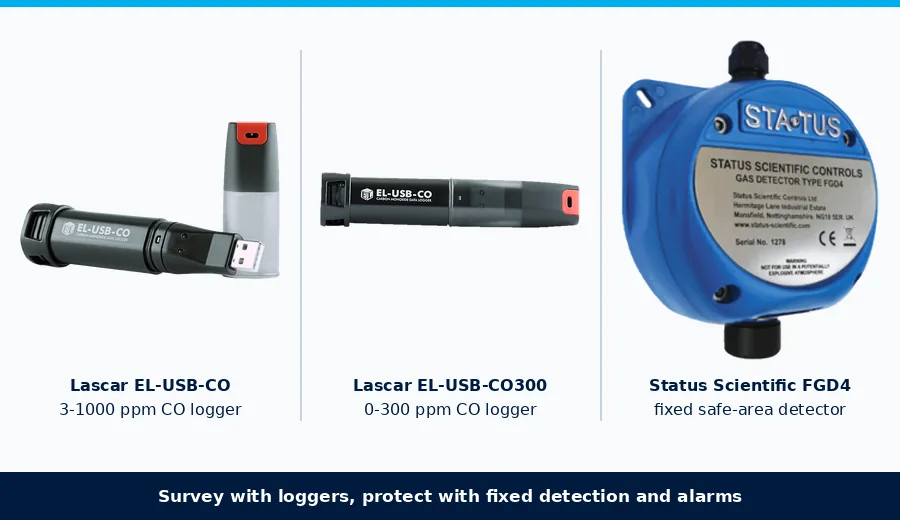
This note explains how to run a CO survey with low-cost USB data loggers, which exposure limits to compare the results against, and where a logger stops and a proper CO alarm must take over. It uses real catalogue instruments from Lascar Electronics: the EL-USB-CO (3 to 1000 ppm) and the EL-USB-CO300 (0 to 300 ppm). For permanent alarm duty it points to the Status Scientific FGD4 fixed detector. Every instrument specification below comes from the published Lascar and Status Scientific datasheets.
Why log CO instead of taking spot readings
CO levels change minute by minute. A boiler room can read near zero at 11 am and spike when the burner relights at dawn. A warehouse is clean until three forklifts work the same aisle during a loading rush. A spot reading with a handheld meter shows one moment. A logger left in place for days shows the pattern, the peaks and the time-weighted average, which is what exposure limits are written against.
- Find the source. Logged peaks lined up against shift logs, burner cycles or generator run times usually point straight at the cause.
- Prove a fix. Log for a week before and a week after a flue repair, extract-fan upgrade or forklift change, and you have evidence instead of opinion.
- Size permanent detection. A survey shows where fixed detectors and alarms are needed and what range they should cover.
EL-USB-CO and EL-USB-CO300 compared
Both loggers are the same stick-shaped unit, 125 × 26.4 × 26.4 mm, with an electrochemical CO sensor, a USB connector for set-up and download, red and green status LEDs and a buzzer. They differ in range and accuracy.
| Specification | EL-USB-CO | EL-USB-CO300 |
|---|---|---|
| Measurement range | 3 to 1000 ppm CO | 0 to 300 ppm CO |
| Internal resolution | 0.5 ppm | 0.5 ppm |
| Accuracy (overall error) | ±7 ppm or ±6 %, whichever is greater | ±5 ppm or ±4 %, whichever is greater |
| Logging rate | User selectable, 10 seconds to 5 minutes; immediate or delayed start | |
| Memory | 32,510 readings | |
| Operating temperature | −10 to +40 °C | |
| Battery | 3.6 V ½AA lithium, about 3 months at 5-minute logging and 25 °C | |
| Expected sensor life | 4 years (shown under Current Status in the EasyLog software) | |
| Best for | Boiler rooms, furnaces, generator rooms, garages: where peaks can run into hundreds of ppm | Workplaces, kitchens, car parks, poultry sheds and offices: where you care about tens of ppm |
Lascar's older datasheet for the EL-USB-CO also gives a response time of 1 minute to reach 90 %, repeatability of ±2 % of reading, sensor decay of about 5 % of reading per year, and operating conditions of 15 to 90 %RH (non-condensing) and 900 to 1100 mbar. Readings are downloaded with Lascar's free EasyLog software for Windows, which graphs the data and exports it to Excel, PDF or JPEG for reports.
Which CO limits to compare against
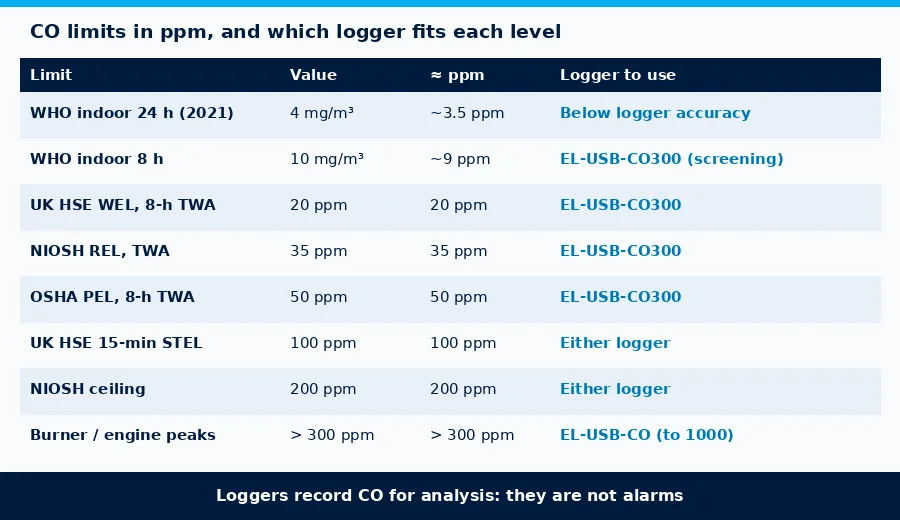
Where no specific local CO limit has been set for a workplace, auditors, multinational clients and insurers usually fall back on international limits. The common ones are:
- UK HSE (EH40/2005, 2020 edition): workplace exposure limit of 20 ppm as an 8-hour TWA and 100 ppm as a 15-minute short-term limit.
- US NIOSH: recommended limit of 35 ppm as a TWA, with a 200 ppm ceiling. NIOSH gives 1200 ppm as immediately dangerous to life or health.
- US OSHA: permissible exposure limit of 50 ppm as an 8-hour TWA.
- WHO indoor air guidelines (2010): 100 mg/m³ for 15 minutes (about 87 ppm), 35 mg/m³ for 1 hour (about 30 ppm) and 10 mg/m³ for 8 hours (about 9 ppm), using the NIOSH conversion of 1 ppm = 1.15 mg/m³. The WHO's 2021 update sets a 24-hour guideline of 4 mg/m³ (about 3.5 ppm).
Be realistic about what a logger can show. At 30 ppm the EL-USB-CO300 is accurate to ±5 ppm and the EL-USB-CO to ±7 ppm. That is good enough to compare a workplace against 20 to 50 ppm TWA limits and to catch 100 ppm-plus peaks. It is not good enough to prove a home or office meets the WHO's 3.5 ppm 24-hour guideline. For low-level indoor air work, treat logger results as screening.
How to run a CO survey with USB loggers
- Pick the logger by expected level. Use the EL-USB-CO300 where you expect tens of ppm and want the better low-range accuracy. Use the EL-USB-CO near burners, flues, generators and engine exhausts, where peaks may pass 300 ppm.
- Set the logging rate to suit the survey length. The 32,510-reading memory lasts about 90 hours (3.75 days) at 10-second logging, about 22 days at 1-minute logging and about 113 days at 5-minute logging. At 5 minutes the battery, at about 3 months, runs out before the memory does. Ten-second or one-minute logging catches short peaks such as a burner light-off.
- Fit a fresh battery for important surveys. Lascar recommends replacing the battery before logging critical data. Stored readings survive a flat battery, but logging stops until the logger is restarted.
- Place loggers in the breathing zone. Mount them at head height where people work or sleep, not in a corner next to an open window. Use the wall clip and record each location with a photo.
- Use the alarm thresholds and HOLD setting. Set a high threshold, for example at your chosen short-term limit, and switch on HOLD so the red LED keeps flashing after a peak has passed. Anyone walking past can then see that the limit was exceeded without downloading the data.
- Log activities alongside the data. Note burner cycles, generator starts, forklift shifts, cooking peaks and door or fan changes. The graph only makes sense next to what was happening.
- Download, calculate and report. Export from EasyLog, calculate the 8-hour TWA for each shift, list the peaks and compare against the limits you have chosen. Repeat after any fix.
Where Pakistani facilities use CO loggers
- Boiler houses and thermal fluid heaters in textile, food and pharmaceutical plants: CO at the burner front and in control rooms next to the boiler house points to poor combustion or flue leaks. For combustion tuning itself, see our note on in-situ combustion oxygen and COe measurement.
- Warehouses and cold stores with LPG or diesel forklifts, where loading rushes in closed buildings create short, high peaks.
- Hotel, hospital and factory kitchens with gas ranges and tandoors, where extract hoods are switched off or undersized.
- Basement car parks and loading bays in malls, hospitals and offices, to check that ventilation fans start when they should.
- Generator rooms and spaces next to them, where exhaust leaks and blocked louvres let CO into occupied areas.
- Closed poultry sheds and greenhouses heated with gas brooders or heaters in winter, where the birds or plants and the people tending them share the same air.
A logger is not a CO alarm
This matters more than any specification. Lascar states plainly that the EL-USB-CO and EL-USB-CO300 are professional measuring instruments for recording CO for later analysis, and are not alarm, safety or warning devices. The datasheet gives four reasons: the LED and buzzer are not an adequate warning for people nearby, the battery drains quickly while the alarm is active, the logger only checks CO when it takes a sample at the set interval, and the user can configure it to give no warning at all. Where people or animals could be harmed, Lascar insists on a CO detector or alarm built to a nationally approved standard, with a loud siren and a clear visual warning.
In practice that gives a clear division of labour:
- Survey with loggers to find out where CO comes from, how high it gets and whether ventilation fixes work.
- Protect with fixed detection in the spaces the survey identifies. The Status Scientific FGD4 is a safe-area (non-hazardous area) detector with an electrochemical CO sensor in 0–50, 0–100 or 0–1000 ppm ranges. It runs on 8–24 V dc and sends a 4–20 mA two-wire signal to a separate control panel, such as the Status Scientific LC Series, which handles the alarms. For hazardous areas, see our guide to fixed gas detectors for hazardous areas.
- Protect people at home with certified domestic CO alarms near gas heaters and geysers, and never with a data logger.
Common mistakes
- Using a logger as a life-safety alarm. See above. It samples at intervals and can be set to stay silent.
- A logging interval too slow for the hazard. At 5-minute logging a short peak at burner light-off can fall between samples. Use 10 seconds to 1 minute for source-finding.
- Running outside the operating window. The loggers are rated for −10 to +40 °C and non-condensing humidity. Do not leave them on a hot boiler casing, in direct sun on a roof or in a wash-down area.
- Old sensors. Expected sensor life is 4 years and readings decay by about 5 % per year. Check sensor status in EasyLog before each survey and replace ageing loggers.
- Leaving the logger in the USB port. Lascar notes that leaving it plugged into a PC for long periods drains the battery.
- Comparing single peaks with TWA limits. A 60 ppm spike is not a breach of a 20 ppm 8-hour TWA on its own. Calculate the average over the shift, and check peaks against the short-term limit.
Specification checklist for your enquiry
- Spaces to survey (boiler room, kitchen, warehouse, car park, poultry shed, generator room) and how many points in each
- Expected CO levels: tens of ppm (EL-USB-CO300) or hundreds (EL-USB-CO)
- Survey length and logging rate, and whether you need before-and-after comparison
- The limits you report against (HSE, NIOSH, OSHA, WHO or a client standard)
- Whether permanent detection will follow: number of fixed detector points, ranges, control panel and alarm outputs
- Who will download, analyse and report the data
FAQ
What is the difference between the Lascar EL-USB-CO and EL-USB-CO300?
The EL-USB-CO measures 3 to 1000 ppm CO with an accuracy of ±7 ppm or ±6 %, whichever is greater. The EL-USB-CO300 measures 0 to 300 ppm with a better accuracy of ±5 ppm or ±4 %. Both store 32,510 readings, log every 10 seconds to 5 minutes and run about 3 months on a battery.
Can I use the EL-USB-CO as a carbon monoxide alarm?
No. Lascar states that both loggers are measuring instruments, not alarm or safety devices. They sample only at the set interval, their warnings are not loud enough and they can be configured to give no warning. Use a certified CO alarm or a fixed detector such as the Status Scientific FGD4 for protection.
How long can the EL-USB-CO log before the memory is full?
The 32,510-reading memory lasts about 90 hours at 10-second logging, about 22 days at 1-minute logging and about 113 days at 5-minute logging. At 5-minute logging the battery, rated for about 3 months, normally runs out first.
What is the workplace exposure limit for carbon monoxide?
The UK HSE limit is 20 ppm as an 8-hour TWA and 100 ppm over 15 minutes. NIOSH recommends 35 ppm TWA with a 200 ppm ceiling, and OSHA's permissible limit is 50 ppm as an 8-hour TWA.
Can these loggers check indoor air against the WHO CO guideline?
Only roughly. The WHO 8-hour indoor guideline is about 9 ppm and the 2021 24-hour guideline about 3.5 ppm, which is close to the loggers' accuracy of ±5 to ±7 ppm. Use them to find peaks and sources, and treat low-level results as screening.
Key takeaways
CO problems are intermittent, so log rather than spot-check. Choose the EL-USB-CO300 for workplaces and indoor spaces where tens of ppm matter, and the EL-USB-CO near burners, flues and engines where peaks can reach hundreds. Log fast enough to catch peaks, place loggers in the breathing zone and record what was happening. Compare 8-hour averages and short-term peaks against HSE, NIOSH or OSHA limits. Never use a logger as an alarm: put fixed detectors such as the FGD4 with a control panel, or certified CO alarms, wherever people could be harmed.
How Tetracon helps
Tetracon supplies gas detection, data logging and environmental monitoring instruments to Pakistan's industry, hospitals, hotels, warehouses and agriculture, including Lascar EasyLog data loggers and Status Scientific gas detectors. Tell us which spaces you need to survey, the CO levels you expect and the limits you report against, and we will propose a suitable set of loggers and, if needed, fixed detection. Use the contact page or see our services. Start with the catalogue pages for the EL-USB-CO, EL-USB-CO300 and FGD4, browse the gas detection and environmental monitoring categories, or see all Lascar Electronics and Status Scientific Controls products. Free technical guides are collected under Guides.