

Carbon dioxide is the simplest continuous clue that people are breathing the same air for too long. In Pakistani offices, schools, hospitals, meeting rooms, and light industrial controlled spaces, CO2 rises with occupancy and falls when outdoor air or demand-controlled ventilation (DCV) catches up. A wall transmitter that never talks to the BMS — or a Wi-Fi logger nobody opens after commissioning — turns “fresh air” into a slogan instead of a measured setpoint.
This note is for facility, HVAC, BMS, and HSE teams specifying CO2 monitoring for indoor air quality (IAQ) and ventilation control. It maps duties to catalogue instruments available through Tetracon — the Lascar EasyLog EL-IOT-CO2 wireless CO2 and air-quality data logger, the DABECO DB317 CO2 / humidity / temperature transmitter for smart buildings, and the SST SprintIR®-6S fast-response NDIR CO2 sensor for OEM and rapid-response applications. Related RH/T envelope monitoring remains complementary (see humidity & temperature for pharma cleanrooms); this article stays on CO2 as the IAQ and HVAC ventilation signal.
Why CO2 matters for Pakistani IAQ and HVAC
Pakistan’s dense urban offices, sealed glass façades, school classrooms with intermittent windows, and hospital waiting areas make outdoor-air dilution a daily operations problem — not a design-only calculation. Continuous or regularly reviewed CO2 supports:
- Occupancy-linked ventilation — Rising CO2 shows when DCV or manual outdoor-air increase is actually needed; empty rooms should not over-ventilate all afternoon.
- IAQ evidence for HSE and facilities — Meeting rooms and open floors that spike above common comfort bands (often discussed around 800–1,000+ ppm relative to outdoor baseline) show up in logs before complaints become attrition.
- Energy-aware HVAC — DCV that follows CO2 can reduce unnecessary outdoor-air load on chillers and AHUs when spaces are empty — especially valuable under peak summer grid stress.
- Controlled-space discipline — Greenhouses, incubation rooms, and some process enclosures need CO2 as a process variable, not only as a comfort metric.
- Remote ownership — Cloud loggers and BMS-wired transmitters give nights, weekends, and multi-site managers a record that a clipboard walk cannot.
A bright CO2 display in the boardroom proves the meeting was stuffy. A Modbus transmitter into the BMS proves the AHU actually opened outdoor air — or shows exactly when it did not.
Typical CO2 monitoring duties
| Duty | What you need | Usual pattern |
|---|---|---|
| Occupied room IAQ logging (offices, schools, clinics) | Local CO2 (+ often RH/T) with clear display and history | Wireless cloud logger such as EL-IOT-CO2; alarms by email/SMS when thresholds exceeded |
| Smart building / DCV into BMS | Wall CO2 with RH/T and digital bus or analog into HVAC controllers | DB317-class wall transmitter (LCD + RS485 Modbus RTU) for ventilation and BAS loops |
| Fast-changing CO2 (OEM, portable, wearable, process) | High update-rate NDIR sensor, small sample volume | SprintIR®-6S-class solid-state NDIR (up to 20 Hz) for integrators and rapid-response duties |
| Multi-parameter IAQ campaigns | CO2 plus particulates / VOC context where justified | Dedicated IAQ monitors (e.g. broader EasyLog IAQ devices) for surveys; keep CO2 as the ventilation KPI |
| Climate envelope alongside CO2 | RH and temperature as complementary channels | Combined CO2/RH/T wall units (DB317) or separate RH/T transmitters — do not confuse comfort RH with ventilation proof |
Write the duty first: cloud logging for people spaces, Modbus wall sensing for DCV, or fast OEM sensing for devices. Buying “a CO2 sensor” without that sentence is how plant rooms fill with the wrong interface and no one trusts the ppm reading.
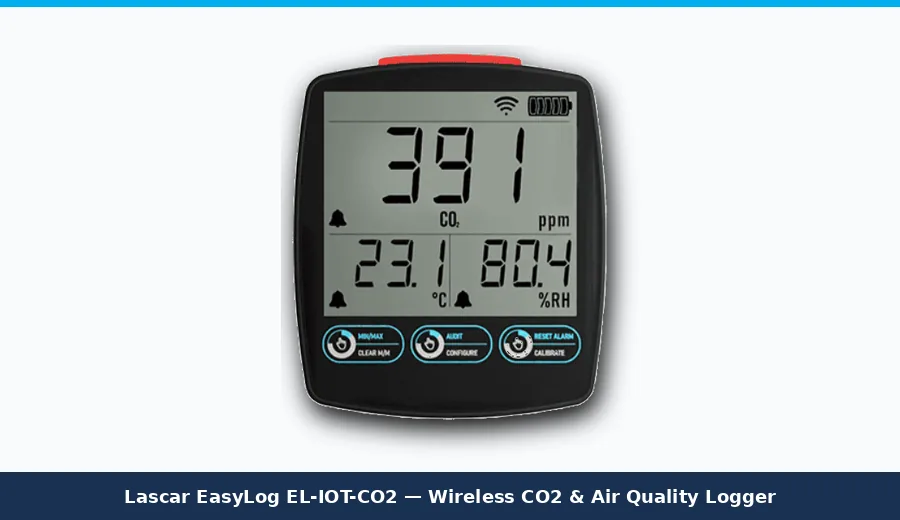
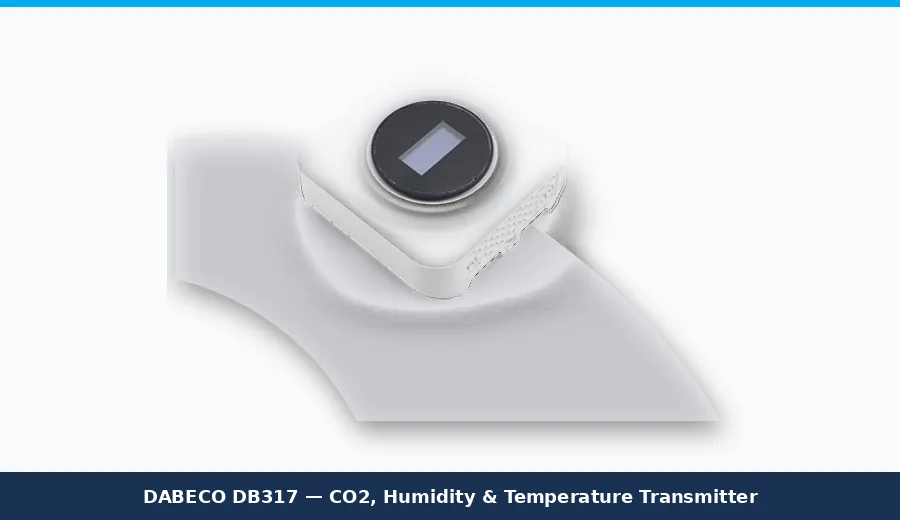
Wireless CO2 logging for occupied spaces
The Lascar EasyLog EL-IOT-CO2 targets homes, workplaces, schools, and horticultural spaces that need continuous CO2, temperature, and humidity with remote visibility. Catalogue highlights include a self-calibrating CO2 sensor, bright local display of current/min/max, automatic upload to EasyLog Cloud, programmable high/low alarms with status indicator and sounder, email/SMS notifications, onboard storage for 300,000+ readings, and USB power with AA battery backup for short outages. CO2 range extends to 40,000 ppm with stated accuracy of ±(50 ppm + 5% of reading) in the common 400–2,000 ppm band.
For Pakistani facilities teams, place loggers in representative occupied zones (not in diffuser blast or dead corners), set alarm bands that match your IAQ policy, and review Cloud trends after peak occupancy — especially when windows stay shut and AHUs chase temperature only.
Wall transmitters for BMS and demand-controlled ventilation
When CO2 must drive dampers, VAV outdoor-air fractions, or BAS graphics, specify a wall transmitter with a bus the controllers already speak. The DABECO DB317 combines CO2 (0–2,000 ppm class), humidity, and temperature in a wall-mountable LCD package with RS485 Modbus RTU — a common pattern for smart ventilation and building automation. Accuracy on CO2 is stated as ±(40 ppm + 3% of reading) with response under three minutes — suitable for occupied-space DCV, not for millisecond process spikes.
Mount at breathing-zone height away from doors and supply jets; map Modbus registers into the BMS before handover; and name who answers a high-CO2 alarm after hours.
When a fast NDIR sensor earns its place
Room transmitters average human time constants. OEM products, portables, and some process loops need faster gas exchange. The SST SprintIR®-6S is a solid-state LED NDIR CO2 sensor for rapidly changing concentrations: up to 20 readings per second, ~2 ml sample volume, low ~35 mW power, UART output, and range variants covering 0–5%, 0–20%, and 0–100% CO2. That is an integrator duty — not a drop-in wall IAQ display — but it belongs in the selection conversation when “CO2 sensor” means embeddable NDIR.
Placement and alarm tips that survive real buildings
- Represent the occupied zone — Mid-room breathing height beats a sensor behind a curtain or under a cold diffuser.
- Know outdoor baseline — Urban outdoor CO2 is not always 400 ppm; interpret indoor rise relative to a sensible outdoor or night-time baseline.
- Separate comfort from process — 0–2,000 ppm wall IAQ bands are not the same as 0–100% process CO2 ranges.
- Alarm with ownership — Cloud SMS or BMS high-CO2 points still need a named responder and a clear “open OA / reduce occupancy / check AHU” rule.
- Commission the interface — Wi-Fi Cloud credentials, Modbus parity, and register maps fail more often than the NDIR cell itself.
- Verify after HVAC changes — Re-check readings after damper, schedule, or filter work; stuck OA dampers masquerade as “bad sensors.”
- Complement RH/T and ΔP — CO2 proves ventilation vs occupancy; RH/T proves climate; ΔP proves cascade/filters — see the differential pressure note and humidity & temperature note.
Practical selection tips for Pakistani sites
- Inventory every meeting room, classroom, ward waiting area, and open floor that needs IAQ evidence or DCV — note local-only vs Cloud vs BMS-wired.
- Default to EL-IOT-CO2-class wireless logging where facilities want trends and alarms without a BAS project; use DB317-class wall units where Modbus DCV is the goal.
- Reserve SprintIR®-6S-class sensors for OEM, portable, or fast-response integration — not as a casual substitute for a wall IAQ transmitter.
- Standardise alarm bands, mounting heights, and point names; train one owner for Cloud fleets and one for BMS CO2 points.
Building a sensible CO2 / IAQ programme
- Document target bands and response actions per space type in the facility or HSE SOP set.
- Put local display or Cloud visibility on rooms people occupy daily; wire Modbus CO2 where outdoor-air control must prove itself overnight.
- Trend peak-occupancy hours (and sealed-window seasons) so ventilation schedules follow people — not only thermostat setpoints.
- Tie high-CO2 response, AHU outdoor-air checks, and post-maintenance as-found checks into maintenance or quality workflows.
How Tetracon supports CO2 monitoring choices
Tetracon supplies CO2 loggers, wall transmitters, and NDIR sensing products for indoor air quality, HVAC, and controlled-space applications in Pakistan. Application support through the contact page and services team can help match wireless logging, Modbus wall sensing, and fast OEM NDIR to your duties. Start with catalogue pages for EL-IOT-CO2, DB317, and SprintIR®-6S, or browse Lascar, DABECO, and SST Sensing on the site.
Key takeaways
CO2 monitoring for Pakistani IAQ, HVAC, and controlled spaces is a programme of clear duties, correct interfaces, and owned alarms — not a random ppm sticker on a wall. Use wireless EL-IOT-CO2-class loggers where Cloud history matters; DB317-class wall transmitters where BMS/DCV must act on CO2 with RH/T; SprintIR®-6S-class NDIR where update rate and OEM integration dominate. Pair CO2 with RH/T and ΔP where relevant, write response SOPs before the PO, and prove ventilation is doing its job.