

Differential pressure (ΔP) is the quiet backbone of cleanroom integrity and HVAC health. In Pakistani pharmaceutical plants, hospitals, electronics areas, and industrial filter houses, the difference between two spaces — or across a filter bank — shows whether air is cascading correctly, whether HEPA or bag filters are loading, and whether a door just broke containment. A wall Magnehelic that never moves, or a transmitter that never alarms into the BMS, is how Grade B corridors quietly become Grade “maybe.”
This note is for facility, HVAC, validation, and QA teams specifying ΔP monitoring on cleanrooms, duct static, and filter banks. It maps duties to DwyerOmega catalogue instruments — the Series 2000 Magnehelic, related Series 2000 industrial DP gauge, and Omega PX309 pressure transmitter. RH/T remains complementary climate monitoring (see humidity & temperature for pharma cleanrooms); this article stays on ΔP.
Why ΔP matters on Pakistani cleanrooms and HVAC plant
Pakistan’s dust load, monsoon humidity swings, and long filter-change cycles make pressure drop a daily operations metric — not a commissioning-only reading. Continuous or regularly observed ΔP supports:
- Cleanroom cascade & containment — Positive rooms relative to corridors (or negative containment relative to surroundings) protect product and people; lost cascade shows up as ΔP first.
- Filter bank loading — Rising ΔP across bag, HEPA, or carbon banks signals when differential pressure — not calendar days — should drive change-out.
- HVAC balancing & fan performance — Duct static and fan ΔP help diagnose damper positions, belt slip, and undersized make-up air before temperature complaints start.
- Audit & deviation evidence — Inspectors ask whether room-to-corridor differentials were maintained during production, not only at PQ.
- Early warning — Optional Magnehelic switches or transmitter alarms give nights-and-weekends coverage that a clipboard walk cannot.
A Magnehelic on the filter door proves the bank is loading. A transmitter into SCADA proves the cascade held at 02:00 — or shows exactly when it did not.
Typical differential-pressure duties
| Duty | What you need | Usual pattern |
|---|---|---|
| Cleanroom room-to-corridor / interlock cascade | Low-range DP (often inches of water column) with clear local indication | Wall Magnehelic (Series 2000 class) at the room; optional switch or electronic transmitter where BMS alarm is required |
| HEPA / bag / pre-filter banks | Across-filter ΔP with readable dirty/clean marks | Magnehelic on AHU or filter door; trend rising ΔP for change-out; high-side tap upstream, low-side tap downstream |
| Duct static / fan performance | Static or differential indication for balancing | Panel Magnehelic or Series 2000 industrial gauge; pitot/static taps per HVAC practice |
| BMS/SCADA continuous ΔP with alarm | Analog or digital electronic output | Electronic DP transmitter (or Magnehelic with optional set-point switches) into PLC/BMS; PX309-class transmitters for related process pressure loops |
| Process / utility pressure (hydraulics, pumps, skids) | Gauge or absolute pressure, not micro-inch WC cascade | Industrial transmitters such as PX309 with 4–20 mA — different duty from cleanroom Magnehelic ranges |
Write the duty first: cascade proof, filter loading, duct static, or process pressure into a control system. Buying “a pressure gauge” without that sentence is how AHU panels fill with the wrong range and no one trusts the needle.
Magnehelic gauges for local ΔP indication
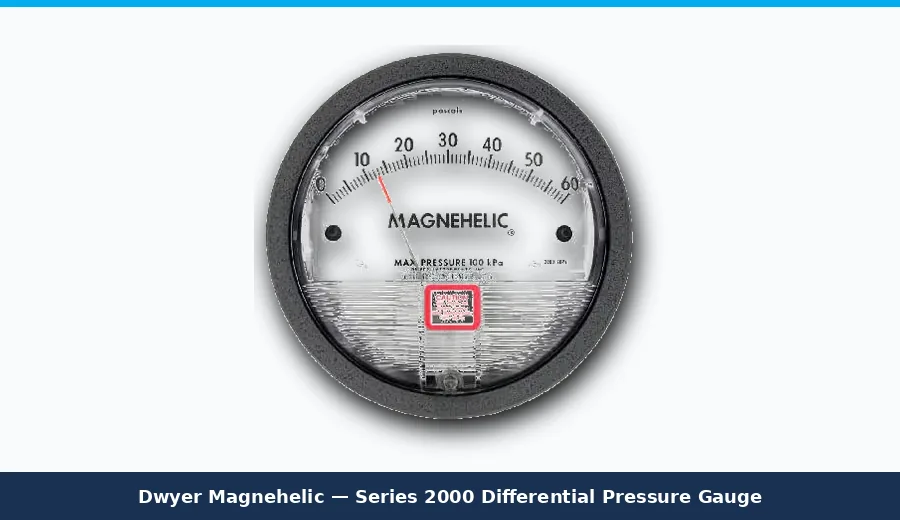
The Dwyer Magnehelic (Series 2000 Magnehelic) is the familiar industry standard for low differential-pressure measurement in HVAC, cleanroom, and filter-monitoring applications. Catalogue overview highlights a rugged die-cast aluminium case, ±2 % full-scale accuracy class, frictionless magnetic-helix indication, and no liquid columns to spill. Ranges span from very low inches of water column through higher industrial spans; optional adjustable set-point switches support simple local alarm without a full transmitter loop.
The related Series 2000 gauge uses the same magnetic-helix principle in a panel-oriented industrial package. For most Pakistani cleanroom walls and AHU filter doors, a correctly ranged Magnehelic remains the default local eye — readable on every walk-through, vibration-tolerant, and low-maintenance when installed with proper tubing and taps.
When electronic transmitters earn their place
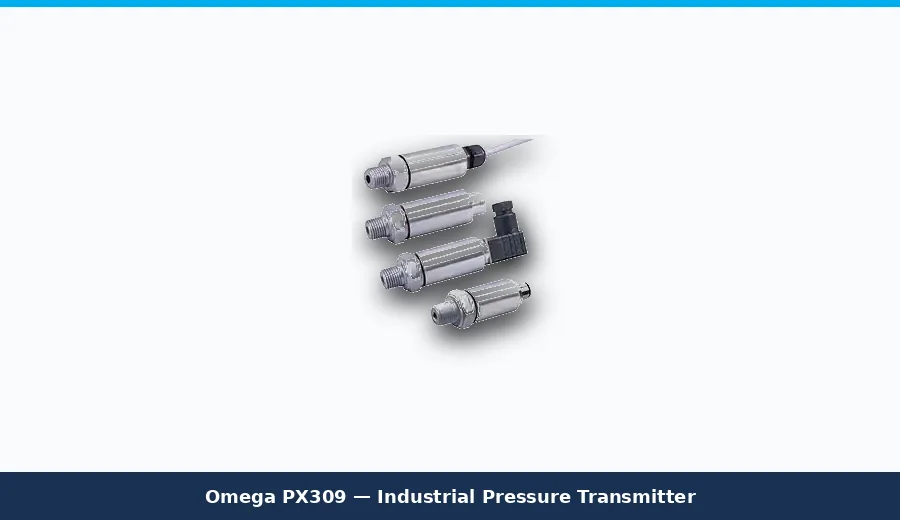
Local indication alone does not page the night shift. When cascade or filter ΔP must enter BMS/SCADA with time-stamped alarms, specify an electronic DP transmitter (or Magnehelic set-point switches on discrete inputs). Separate process and utility pressure — hydraulics, pumps, compressors, water/wastewater skids — often needs a general-purpose 4–20 mA transmitter such as the Omega PX309: 316L wetted parts, 1/4" NPT connection, stainless enclosure, and industrial accuracy across a wide pressure family.
Do not confuse duties: a Magnehelic on inches of water column for a Grade C room is not interchangeable with a PX309 on bar/psi for a pump discharge. Match range, media, and output to the duty sentence.
Placement and alarm tips that survive audits
- Tap the right volumes — Cascade: high/low lines to the two spaces you protect. Filters: upstream vs downstream of the media — not the whole AHU by accident.
- Keep tubing short and tight — Leaks and shared manifolds create “ghost” ΔP that QA cannot defend.
- Mark clean/dirty or min/max bands — Site-agreed Magnehelic bands beat verbal “about half an inch.”
- Alarm with ownership — Switch contacts or 4–20 mA into BMS still need a named responder and a clear deviation vs filter-change rule.
- Avoid door and blast artefacts — Keep room sense points away from door jets and diffuser blast.
- Verify after AHU or filter work — Re-check zero and polarity; clogged taps and reversed high/low lines are common post-maintenance failures.
- Complement, don’t confuse, with RH/T — ΔP proves airflow direction and filter health; RH/T proves the climate envelope — see the humidity & temperature monitoring note.
Practical selection tips for Pakistani sites
- Inventory every cascade, HEPA/bag bank, and critical duct static point with range (in WC or Pa), criticality, and local-only vs BMS-alarmed.
- Default to Magnehelic / Series 2000-class gauges for local filter and cascade indication; add electronic DP or switch contacts where alarm history matters.
- Use PX309-class transmitters for process/utility 4–20 mA loops — not as a casual substitute for micro-range cleanroom ΔP.
- Standardise taps, tubing, and labelling; name one owner for Magnehelic fleets and one for electronic loops.
Building a sensible ΔP programme
- Document cascade setpoints and filter dirty limits per AHU in the facility or validation SOP set.
- Put Magnehelic indication on critical filter banks and cascades operators must see daily; wire alarms where lost cascade is a batch or containment risk.
- Trend filter ΔP so change-outs follow loading — especially under high dust seasons — and keep RH/T as complementary climate monitoring.
- Tie alarm response, filter-change work orders, and post-maintenance as-found checks into the quality or maintenance system.
How Tetracon supports differential-pressure choices
Tetracon supplies DwyerOmega differential-pressure gauges and process pressure transmitters for pharmaceutical, HVAC, and industrial applications in Pakistan. Application support through the contact page and services team can help match Magnehelic ranges, Series 2000 panel gauges, and PX309-class transmitters to your cascade, filter, and process duties. Start with catalogue pages for Magnehelic, Series 2000, and PX309, or browse DwyerOmega on the site.
Key takeaways
Differential pressure monitoring for Pakistani cleanrooms, HVAC, and filter banks is a programme of clear duties, correct ranges, and owned alarms — not a single random gauge on an AHU door. Use Magnehelic / Series 2000-class gauges for local cascade and filter indication; add electronic transmitters or switch contacts where BMS/SCADA must prove the cascade overnight; use PX309-class transmitters for industrial process pressure loops that need 4–20 mA. Pair ΔP with RH/T envelope monitoring, write placement and response SOPs before the PO, and sites spend less time explaining lost cascade — and more time keeping air moving the right way.