

Most vaccines, insulin, many biologics and a long list of diagnostic reagents have to stay between +2 °C and +8 °C from the manufacturer’s cold room to the point of use. In Pakistan that chain is long and harsh: national and provincial immunization stores, district and tehsil stores, Basic Health Units and Rural Health Centres, hospital pharmacies, the cold rooms of pharmaceutical distributors in Karachi, Lahore and Islamabad, and the reefer vans and insulated boxes that link them. Summer ambient temperatures above 45 °C in Sindh and southern Punjab, scheduled and unscheduled load-shedding, and patchy Wi-Fi at rural sites all push against it. An unrecorded excursion is worse than a recorded one: stock of unknown history cannot be confidently used or released.
This note is for pharmacists, cold-chain and EPI logisticians, QA managers at manufacturers and distributors, and hospital biomedical teams who need to choose temperature monitoring for fridges, freezers, cold rooms and shipments. It maps those duties to real catalogue products on this site from Lascar Electronics (EasyLog) and SensoScientific. It is deliberately different from our pharma cleanroom humidity and temperature note, which covers RH/T transmitters in production areas; here the subject is cold-chain storage and transport.
Why cold-chain temperature data matters in Pakistan
Temperature-sensitive medicines fail quietly. A vaccine that has been warmed or frozen usually looks exactly the same as a good one, and freezing in particular can permanently damage many vaccines and biologics. The only evidence of what happened is a temperature record. That is why WHO guidance on the storage and transport of time- and temperature-sensitive pharmaceutical products, good distribution practice expectations of regulators such as DRAP, and the quality systems of multinational manufacturers all ask the same thing: continuous, time-stamped, tamper-resistant temperature records, alarms that reach a responsible person, and documented action when a limit is breached.
Local conditions make three failure modes common:
- Power interruptions. When a fridge or cold room loses power during load-shedding, the temperature rises slowly at first and then quickly. A logger that keeps recording on battery, and an alarm that does not depend on the same mains supply, are what tell you whether the stock is still good.
- Freezing in cold rooms and near evaporators. Overcooling after a thermostat fault, or stock placed close to the cooling coil, is as damaging as heat. Low-temperature alarms at +2 °C matter as much as high alarms at +8 °C.
- Transport gaps. The trip from a provincial store to a district, or from a distributor to a private hospital, is often the least-documented part of the chain. A record that only starts when the box is opened misses the risk.
Before choosing any logger, write down four things for each location: the temperature band (2–8 °C, frozen, or 15–25 °C ambient), whether there is reliable Wi-Fi or only mobile coverage, who must be alerted and how quickly, and whether the records must meet 21 CFR Part 11-style electronic-record controls. Those four answers usually pick the product for you.
Four monitoring duties in the cold chain
| Duty | Typical location | What the monitor must do | Catalogue fit |
|---|---|---|---|
| Connected storage | Vaccine fridges, pharmacy fridges, cold rooms with Wi-Fi | Continuous logging, on-site alarm plus remote alerts, cloud records | EL-WiFi-VACX; SensoScientific B13 Wi-Fi OTA for T/RH rooms |
| Standalone storage | Fridges without network access, QA-validated storage | Large memory, local display and alarm, PC download, audit trail where required | EL-GFX-VAC2; EL-21CFR-TP-LCD |
| Remote sites, no internet | BHUs, RHCs, district stores, pharmacies with mobile coverage only | Alarm by SMS to several phones, periodic “I’m alive” summaries | EL-SMS-2G-TP+ |
| Shipments | Insulated boxes, reefer vans, inter-city and export consignments | Single-use trip record, or live 4G tracking with location | EL-CC-1-001 PK10; SensoTag Cellular |
Why vaccine monitors use glycol-filled probes
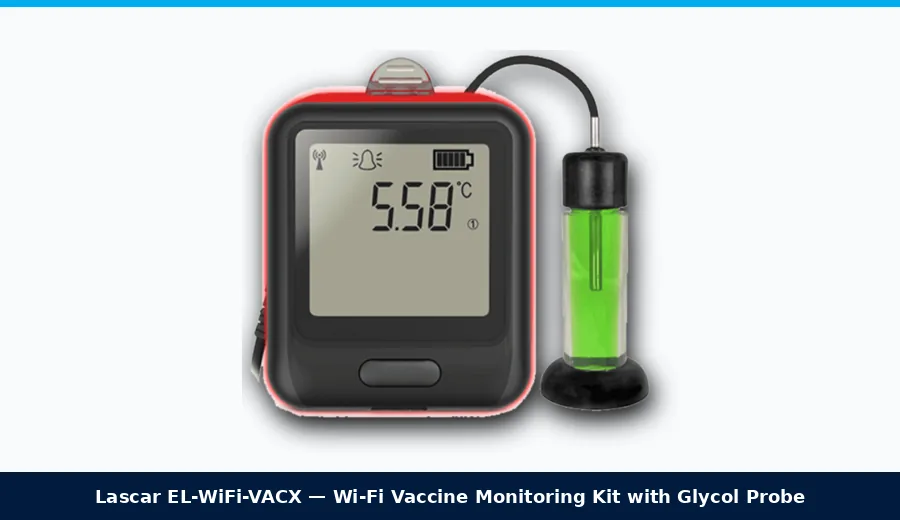
An air-temperature sensor in a fridge reacts to every door opening. Staff then see brief “excursions” that never affected the product, alarms get ignored, and the real event is missed. A glycol-buffered probe sits in a small bottle of fluid so that it responds with a thermal lag closer to that of a vial or a carton. The Lascar EL-WiFi-VACX and EL-GFX-VAC2, and the SensoScientific SensoTag Cellular (supplied with glycol bottles), all use this approach. Place the probe in the middle of the stored product, not on the door, the back wall or next to the evaporator, and record its position in your mapping or SOP.
Connected fridges and cold rooms: Lascar EL-WiFi-VACX
The Lascar EL-WiFi-VACX Wi-Fi Vaccine Monitoring Kit is built for exactly this duty. It logs over Wi-Fi to EasyLog Cloud, so readings can be viewed from any internet-connected device, and it alarms locally with a sounder and LED as well as by email. The points that matter for Pakistani sites:
- No data gaps when Wi-Fi drops — the logger buffers readings locally and re-syncs automatically when the connection returns. This matters during power cuts, when the router often fails first.
- Accuracy suited to a 2–8 °C band — ±0.1 °C typical from −10 to +60 °C (±0.5 °C maximum over −40 to +60 °C), 0.01 °C resolution, logging every 10 seconds to 12 hours.
- Calibration where it counts — a calibration certificate at 2 °C and 8 °C is supplied, and the probe is field-replaceable and separately calibratable, so recalibration does not take the whole kit out of service.
- Standards — listed as complying with BS EN 12830:2018 and meeting CDC vaccine monitoring standards. Battery life is over 6 months; the logger is IP42 and the probe IP67.
For ambient-controlled stores and warehouses (typically 15–25 °C or below 30 °C, often with an RH limit), the SensoScientific B13-200-OTA Wi-Fi temperature and humidity sensor adds RH (±3% RH, ±0.5 °C) on enterprise Wi-Fi (PEAPv0) with FDA 21 CFR Part 11-compliant cloud records, on-board E-Ink display and alarms, and battery or AC power.
Standalone and validated storage: EL-GFX-VAC2 and EL-21CFR-TP-LCD
Not every fridge can be on a network, and some QA teams prefer standalone loggers that are downloaded and reviewed on a fixed schedule.
- Lascar EL-GFX-VAC2 is a dual-channel vaccine kit with two thermistor glycol-bottle probes, so one logger can watch two shelves of a fridge, or a fridge and its freezer compartment. It stores over 250,000 readings at 2 seconds to 1 hour, shows max/min/last log and an on-screen graph, alarms with LEDs and a sounder, and runs on batteries (typically up to 4 months) or a USB wall adaptor. Probe accuracy is ±0.3 °C from −10 to +70 °C, and it ships with a 2 °C / 8 °C calibration certificate.
- Lascar EL-21CFR-TP-LCD is for sites whose QA system needs 21 CFR Part 11-style data integrity: Lascar’s 21CFR software enforces user permissions, encrypts stored data against editing, and keeps a full audit trail with electronic signatures. It stores 32,000+ readings from a thermistor probe on a 1 m cable (±0.6 °C from −5 to +40 °C), has an LCD for spot checks without a PC, a 2-year battery and BS EN 12830:2018 compliance, and clips inside fridges and coolers.
Either way, the logger is only as good as the review routine: download on a fixed day, sign off the graph and investigate every alarm.
Remote sites without internet: Lascar EL-SMS-2G-TP+
At many rural health facilities and small district stores the only dependable link is a mobile phone signal. The Lascar EL-SMS-2G-TP+ needs no Wi-Fi or internet. It uses a micro SIM (purchased separately) on a quad-band 2G GSM network and sends SMS alerts to up to three phone numbers when the temperature crosses a high or low limit. It also sends daily, weekly or monthly summaries with minimum, maximum and average temperature, so a silent unit is noticed. It is configured from the free EasyLog SMS app, comes with a high-accuracy Type A thermistor probe (±0.1 °C from −10 to +70 °C) and runs about a year on 4 × AA batteries. Check 2G coverage at the actual fridge location before you standardise on it, and choose SIM plans that do not expire after inactivity.
Shipments: single-use EL-CC-1 or live 4G SensoTag
For transport there are two very different approaches, and many organisations use both.
Single-use trip loggers: Lascar EL-CC-1-001 PK10
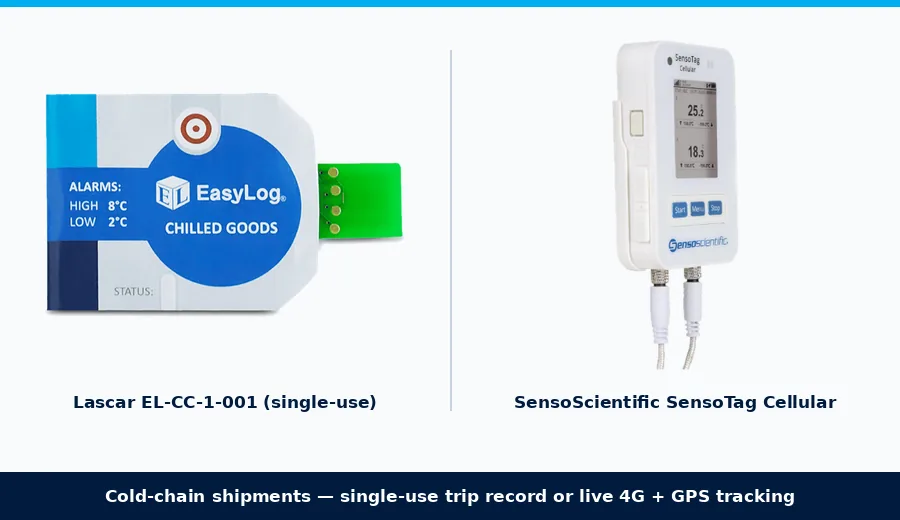
The EL-CC-1-001 chilled goods logger is sold in packs of 10 and comes pre-configured with 8 °C high and 2 °C low alarms: press the button and it starts. LEDs show at a glance whether an alarm limit was exceeded during the trip, which lets the receiving pharmacist decide quickly whether to accept or quarantine the consignment. It stores 32,600 readings at a fixed 10-minute interval (about 220 days), has a measurement range of −30 to +60 °C with ±0.5 °C maximum error, a minimum 12-month battery life, and sits in an IP67 plastic wallet. At the end of the trip the wallet is torn open to expose a USB connector, and the free EasyLog CC software downloads, graphs and archives the data. Custom alarm profiles can be specified for goods with non-standard limits.
Live in-transit tracking: SensoScientific SensoTag Cellular
When you need to know during the trip, for example on long inter-city routes, high-value biologics or frozen shipments, the SensoScientific SensoTag Cellular (SensoTag-C-B80K) uploads readings over 4G with GPS and LBS positioning, so temperature and location appear together in the SensoScientific Cloud with 24/7 alarms. It takes one or two ultra-low-temperature RTD probes covering −196 to +150 °C (±0.3 °C from −20 to +40 °C), records every 1 minute to 24 hours and keeps a 100,000-reading on-device buffer. By default it uploads every 5 minutes, and every 2 minutes in alarm. It is rechargeable, IP64, and supplied with glycol bottles and start/stop buttons. Battery life is quoted as ≥3 months with LBS only or ≥14 days with LBS plus GPS (30-minute uploads), so plan charging for long trips.
Practical selection and set-up tips
- Set alarm delays deliberately. A short delay on the high alarm avoids nuisance alarms from door openings. Keep the low (freeze) alarm tight, because freezing damage is usually irreversible.
- Plan for power cuts. Battery-backed loggers keep recording when mains fails; make sure the router or SIM path that carries alerts is on UPS too, or rely on the on-board alarm.
- Map before you mount. Temperature-map large fridges and cold rooms (empty and loaded) and put the monitoring probe at the warmest and coldest representative points, not just the easiest place to drill.
- Name the alarm owners. Every alert needs a named responder with a phone, a backup person and a written response: check, move stock, quarantine, record.
- Keep calibration current. Prefer probes with 2 °C and 8 °C certificates and a recalibration plan.
- Match the record system to QA. If your quality system requires Part 11-style controls, choose the EL-21CFR family or the SensoScientific cloud, and validate it as part of the system.
FAQ
What temperature range should vaccine fridges be monitored at?
Most vaccines and many medicines are stored at +2 to +8 °C, so monitors are usually set with a low alarm at 2 °C and a high alarm at 8 °C. Always follow the product labels and your national immunization programme or QA procedures for the exact limits and alarm delays.
Why does a vaccine temperature probe sit in a glycol bottle?
The glycol buffers the sensor so it responds more like stored vials than like air. Brief air-temperature spikes from door openings cause fewer false alarms, while real warming or freezing of the product is still recorded. The Lascar EL-WiFi-VACX and EL-GFX-VAC2 and the SensoScientific SensoTag Cellular use glycol probes.
Which logger works at a health facility with no Wi-Fi?
The Lascar EL-SMS-2G-TP+ uses a micro SIM on a 2G GSM network and sends SMS alarms to up to three phone numbers, plus daily, weekly or monthly summary messages. For fully offline storage records, the standalone EL-GFX-VAC2 or EL-21CFR-TP-LCD are downloaded to a PC over USB.
What is the simplest way to monitor a cold-chain shipment?
The Lascar EL-CC-1-001 single-use chilled goods logger (pack of 10) is pre-set with 2 °C and 8 °C alarms, starts at the press of a button, shows alarm status on LEDs, and is downloaded over USB at the end of the trip. For live temperature and location during transport, use the SensoScientific SensoTag Cellular with 4G and GPS/LBS.
Are these loggers suitable for 21 CFR Part 11 records?
The Lascar EL-21CFR-TP-LCD is used with Lascar’s 21 CFR Part 11-compliant software (user permissions, encrypted data, audit trail and electronic signatures), and SensoScientific Wi-Fi OTA sensors store edit-locked, time-stamped data in a cloud designed for FDA 21 CFR Part 11-compliant monitoring. Compliance also depends on your own validation and procedures.
Can the SensoTag Cellular monitor frozen or ultra-cold shipments?
Yes. Its RTD probes cover −196 to +150 °C, with accuracy of ±0.3 °C from −20 to +40 °C, ±0.5 °C from −50 to +85 °C and ±1 °C from −100 to +150 °C, which suits frozen and deep-frozen consignments as well as 2–8 °C ones.
How Tetracon supports cold-chain monitoring
Tetracon supplies environmental monitoring and industrial instrumentation for Pakistan’s pharmaceutical, healthcare, food and process sectors, including Lascar EasyLog data loggers and SensoScientific wireless monitoring. Our team can help match loggers, probes, alarm routes and calibration to your fridges, cold rooms and shipping lanes through the contact page and services. Start with the catalogue pages for the EL-WiFi-VACX, EL-GFX-VAC2, EL-21CFR-TP-LCD, EL-SMS-2G-TP+, EL-CC-1-001 PK10 and SensoTag Cellular, browse the environmental monitoring and humidity & pressure categories, or see all Lascar Electronics and SensoScientific products. Free technical guides are collected under Guides.
Key takeaways
A cold chain is only as strong as its temperature record. Split the job into connected storage, standalone storage, remote sites and shipments, use glycol-buffered probes and tight freeze alarms, and name an alarm owner. In catalogue terms: EL-WiFi-VACX for Wi-Fi fridges and cold rooms; EL-GFX-VAC2 or EL-21CFR-TP-LCD for standalone or Part 11-controlled storage; EL-SMS-2G-TP+ where there is only mobile coverage; and EL-CC-1-001 single-use loggers or the 4G/GPS SensoTag Cellular for shipments.