

Compressed air is one of the most expensive utilities in a Pakistani plant. Every unsealed coupling, cracked hose, open drain or leaking solenoid dumps energy that the compressor has already paid for as electricity. Natural gas, LPG, nitrogen, instrument air and medical air behave the same way on their own lines: a small orifice under pressure turns laminar flow into turbulence, and that turbulence radiates ultrasound. Soap solution and listening with the ear still work on quiet days, but on a noisy factory floor they miss leaks and waste time.
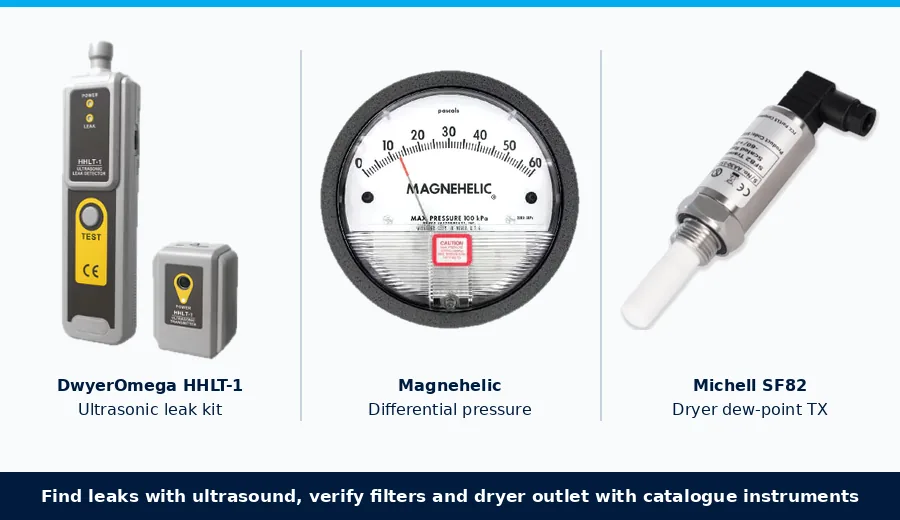
This note explains how to run an ultrasonic air and gas leak survey with the DwyerOmega HHLT-1 handheld kit — a matched HHLT-1R receiver and HHLT-1T transmitter — and when to pair the survey with a Magnehelic differential pressure gauge and a Michell SF82 dryer dew-point transmitter. Every instrument figure below comes from the published Omega HHLT-1, Magnehelic and Michell SF82 datasheets (or the live Tetracon product pages that quote them). No prices or exclusivity claims are made here.
Why ultrasonic leak detection belongs on the plant round
When pressurised air or gas is forced through a restricted orifice, the flow leaves the laminar regime and becomes turbulent. That turbulence generates a broad spectrum of sound — white noise — with ultrasonic components above the range of human hearing (the HHLT-1 datasheet cites the 20 to 100 kHz band). Ultrasound is highly directional, so the signal is loudest at the leak. A receiver that amplifies and heterodynes that band into an audible tone plus an LED lets a technician pinpoint fittings, traps and flanges without coating every joint in soap.
- Energy loss. Compressed-air leaks are a continuous parasitic load on the compressor. Finding and tagging them is usually the cheapest energy project a plant can run.
- Noise immunity. Factory fans, looms and pumps sit in the audible band. An ultrasonic receiver tuned around 40 kHz ignores most of that background.
- Low-pressure and sealed systems. When there is not enough pressure to generate ultrasound, the kit's transmitter puts a 40 kHz tone through the volume so cracks and openings still show up on the receiver.
- Steam traps and vacuum. The same principle applies to steam-trap inspection, exhaust leaks, and pressure or vacuum system checks listed on the Omega datasheet.
HHLT-1 kit: receiver and transmitter
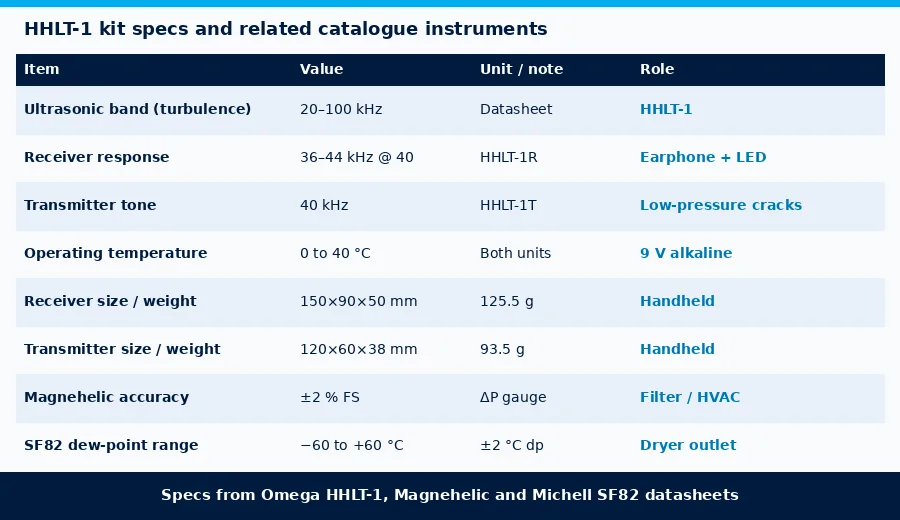
The HHLT-1 is sold as a package: the HHLT-1R receiver and the HHLT-1T transmitter, with a 9 V alkaline battery and an operator's manual. Both units are compact handhelds powered by a 9 V cell.
| Specification | HHLT-1R Receiver | HHLT-1T Transmitter |
|---|---|---|
| Frequency | Response 36 to 44 kHz (centred at 40 kHz) | Emits 40 kHz |
| Indication | LED and earphone | LED |
| Operating temperature | 0 to 40 °C (32 to 104 °F) | |
| Operating humidity | <80 % RH | |
| Storage temperature | −10 to 40 °C (14 to 104 °F) | |
| Power | 9 V alkaline battery (included) | |
| Dimensions | 150 × 90 × 50 mm | 120 × 60 × 38 mm |
| Weight | 125.5 g | 93.5 g |
| Best for | Scanning pressurised air and gas lines, steam traps, exhausts | Finding cracks and openings when pressure is too low to generate ultrasound |
Datasheet applications include pressure and vacuum system leak detection; exhaust system leaks; tanks, pipes and general leak testing; steam trap inspection; and gas leaks in general. The kit does not measure gas concentration and is not a fixed gas detector or a methane laser survey tool.
How to run a compressed-air or gas-line survey
- Plan the route. Walk the compressor house, main headers, drop legs, filter/regulator/lubricator (FRL) sets, open drains, hoses to machines, and any nitrogen, instrument-air or process-gas branches. Mark zones on a simple plot plan.
- Set expectations. Ultrasonic detection finds turbulent leaks. Soap still helps confirm a pinpoint. Concentration-based tools (sniffers, TDLAS) are a different job — see our note on natural gas leak detection with Huberg LASER One for methane network surveys.
- Scan with the HHLT-1R. With earphone and LED, sweep fittings slowly. Ultrasound is directional: the tone and LED rise as you aim at the orifice. Tag each find with tape and a photo.
- Use the HHLT-1T on low-pressure or sealed volumes. Place the transmitter inside a tank, duct or enclosure (or on one side of a panel) and scan joints with the receiver. This is the datasheet method for cracks and openings that do not generate their own ultrasound.
- Prioritise by size and duty. Large continuous leaks on main headers and machine FRLs usually pay back first. Steam traps that blow through are another high-value target.
- Repair, re-scan, then check the air system. After fixes, re-walk the tagged points. Then check filter differential pressure and dryer outlet dew point so the energy win is real and product quality is unchanged.
Pairing with Magnehelic ΔP and Michell SF82 dew point
A leak survey rarely stands alone. Two catalogue instruments from the same plant toolkit close the loop:
- Magnehelic differential pressure gauge (DwyerOmega) — industry-standard ΔP gauge with ranges from about 0–0.25 in WC up to high-pressure options, and standard accuracy of ±2 % of full scale (±1 % on the high-accuracy −HA option per the Magnehelic datasheet). Use it on filter housings, cleanroom or hospital room-to-room pressure, and HVAC balancing. After you stop dumping air through leaks, flows and filter ΔP often shift; the Magnehelic shows the new balance. Browse humidity and pressure.
- Michell SF82 dew-point transmitter — thick-film transmitter for compressed-air dryer outlets: −60 to +60 °C dew point, ±2 °C dp accuracy, 4–20 mA two-wire (Modbus RTU/RS-485 on the M12 variant), max operating pressure 10 MPag (100 barg), 316 stainless housing. After leak repairs the dryer load changes; the SF82 confirms the outlet still meets the site dew-point target. See also online dew-point monitoring for compressed air and the moisture / dew-point category.
Where Pakistani sites use ultrasonic leak surveys
- Textile, food and general manufacturing — compressor houses and machine drop-legs that run 24/7.
- Utilities and power — instrument air, nitrogen blanketing lines and steam-trap rounds.
- Hospitals and labs — medical air and vacuum piping, plus HVAC filter and room-pressure checks with a Magnehelic.
- Pharma and clean manufacturing — compressed air to packaging and process, with dryer dew-point verification on the SF82 and room ΔP on Magnehelic gauges.
- Process plants — plant air, inert gas and general gas-line fittings (species-specific toxic or flammable monitoring still needs proper gas detection — see gas detection).
Common mistakes
- Treating ultrasound as a gas analyser. The HHLT-1 finds turbulent leaks by sound. It does not read %LEL, ppm methane or oxygen deficiency.
- Skipping the transmitter on low-pressure tests. Cracks in tanks and ducts often need the 40 kHz HHLT-1T tone.
- Ignoring ambient ultrasonics. Some valves, VFDs and electrical corona also emit ultrasound. Confirm suspects with soap or isolation when unsure.
- Leaving dryer and filter checks for "later". Leak repairs change compressor and dryer load. Verify ΔP and dew point before closing the job.
- Working outside the rated window. Both HHLT-1 units are specified for 0 to 40 °C and <80 % RH. Hot compressor-room casings and wash-down spray are outside that window.
Specification checklist for your enquiry
- Systems to survey: plant air, instrument air, nitrogen, LPG/natural gas branches, steam traps, vacuum
- Whether you need the full HHLT-1 kit (receiver + transmitter) for low-pressure crack tests
- Number of drop-legs / FRL sets / trap rounds and how you will tag and close out finds
- Whether Magnehelic gauges are needed for filter or room ΔP after repairs
- Dryer outlet dew-point target and whether an SF82 (or Easidew) transmitter is already installed
- Any hazardous-area constraints (the HHLT-1 is a general industrial handheld kit — confirm site rules before use)
FAQ
What does the DwyerOmega HHLT-1 ultrasonic leak detector kit include?
The HHLT-1 package is the HHLT-1R receiver and the HHLT-1T transmitter, supplied with a 9 V alkaline battery and an operator's manual. The receiver responds from 36 to 44 kHz (centred at 40 kHz) with LED and earphone indication; the transmitter emits 40 kHz with an LED.
When do I need the HHLT-1T transmitter instead of listening only with the receiver?
Use the transmitter when the leak does not have enough pressure to create detectable ultrasound — for example finding cracks and openings in tanks, ducts or sealed enclosures. Place the transmitter inside or on one side and scan with the receiver on the other.
Can ultrasonic leak detection replace a methane laser survey?
No. Ultrasonic kits find turbulent air and gas leaks by sound. They do not measure gas concentration and are not a substitute for TDLAS methane surveys on distribution networks. Use ultrasonic tools on compressed air, steam traps and plant gas lines; use laser methane tools where you need species-specific leak detection.
How does a Magnehelic gauge fit with a leak survey?
A Magnehelic differential-pressure gauge (accuracy ±2 % of full scale on standard ranges) shows filter loading, cleanroom or HVAC room-to-room ΔP. After you fix compressed-air leaks, filter ΔP and airflow often change — the Magnehelic confirms the balance.
Why check dryer dew point with a Michell SF82 after fixing air leaks?
Less air loss means the dryer sees a different load. The SF82 measures −60 to +60 °C dew point with ±2 °C dp accuracy and a 4–20 mA output, so you can verify the dryer outlet still meets the site dew-point target after energy-saving leak repairs.
Key takeaways
Ultrasonic leak detection turns the turbulence of escaping air or gas into a directional signal you can walk down on a noisy floor. The DwyerOmega HHLT-1 pairs a 36–44 kHz receiver with a 40 kHz transmitter for both pressurised leaks and low-pressure crack tests. Tag finds, repair, re-scan, then confirm filter ΔP with a Magnehelic and dryer outlet dew point with a Michell SF82 so energy savings do not come at the cost of air quality. Use concentration-based tools when the job is methane speciation or toxic-gas compliance, not when the job is finding compressed-air leaks.
How Tetracon helps
Tetracon supplies gas detection, dew-point, differential-pressure and industrial instrumentation to Pakistan's plants, utilities, hospitals and pharmaceutical facilities, including DwyerOmega and Michell Instruments products. Tell us which air or gas systems you need to survey and whether dryer dew point or HVAC ΔP should be checked in the same visit. Use the contact page or see our services. Start with the catalogue pages for the HHLT-1, Magnehelic and SF82; browse gas detection, humidity and pressure, moisture / dew point, environmental and process instruments; or see all DwyerOmega and Michell Instruments products. Free technical guides are collected under Guides.