

Oxygen is measured in Pakistani plants for many different reasons: combustion control on a boiler or furnace, inert-gas purity in a nitrogen system, oxygen depletion in a room, or the oxygen level inside a hot process gas stream or a piece of equipment that a machine builder is designing. For the percent-level duties in hot gas, a heated zirconium dioxide (zirconia) sensor is often the practical choice, because it does not depend on a consumable electrolyte and needs no reference gas.
This note looks at two zirconia products from SST Sensing Ltd. (UK) that Tetracon supplies: the OXY-Flex zirconia oxygen analyser, a complete analyser with an integral probe, and the Zirconia Oxygen Analyzer System, an OXY-LC interface board with an O2S-FR-T2-18BM screw-fit sensor for integration into equipment. Instrument figures come from SST's OXY-Flex Oxygen Analyser datasheet (DS-0073 Rev 15) and Oxygen Measurement System datasheet (DS-0055 Rev 5). The altitude and weather examples are our own calculations and are labelled as such. No prices are given; options and lead time should be confirmed at quotation.
How a zirconia oxygen sensor works, and what it actually measures
Zirconium dioxide conducts oxygen ions when it is hot, so zirconia sensors carry an integral heater and operate at a high, controlled temperature (SST's system datasheet quotes the pump impedance at 700 °C). The SST sensors work by cycling oxygen through the ceramic cell; the OXY-Flex even provides a cycling 3.3 V DC logic output that follows the sensor's pump cycle, so the cycle can be monitored directly for diagnostics.
The most important point for users is what the sensor responds to. SST states that the sensor measures the partial pressure of oxygen (PPO2) in the gas, not the percentage directly. The reading is converted to % O2 at calibration, so if the barometric pressure changes from the value at calibration, the reading changes in proportion. SST's own example: a sensor reading 21% O2 at 1013.25 mbar will read 21.21% O2 if the barometric pressure rises by 1%. The accuracy and repeatability figures in both datasheets assume the barometric pressure stays constant.
Why this matters in Pakistan: altitude and weather
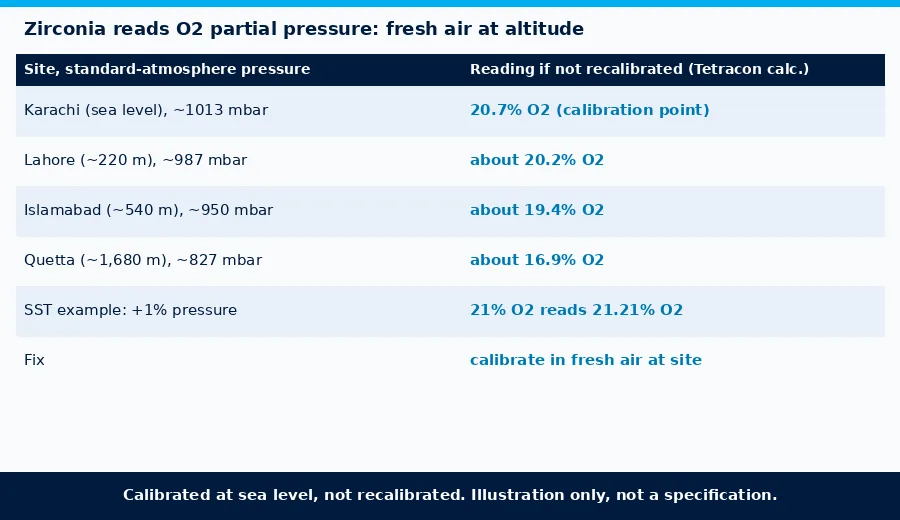
Pakistan's industrial sites range from sea level in Karachi to well over 1,000 m in Balochistan and the north. The table below is our own calculation, using the standard atmosphere for pressure and SST's proportional rule, for an instrument calibrated in fresh air (20.7% O2, the fresh-air value SST uses) at sea level and then moved inland without being recalibrated. It is an illustration of the effect, not a specification.
| Site (approx. elevation) | Standard-atmosphere pressure | Fresh-air reading if calibrated at sea level and not recalibrated (Tetracon calculation) |
|---|---|---|
| Karachi (sea level) | about 1013 mbar | 20.7% O2 (calibration point) |
| Lahore (about 220 m) | about 987 mbar | about 20.2% O2 |
| Islamabad (about 540 m) | about 950 mbar | about 19.4% O2 |
| Quetta (about 1,680 m) | about 827 mbar | about 16.9% O2 |
The fix is simple: calibrate on site. Both SST products can be calibrated in fresh air (20.7% O2) or to any other known O2 concentration, and the OXY-Flex calibration can be triggered externally, automatically or manually. Day-to-day weather also moves the barometric pressure by roughly 10 to 15 mbar, which by the same rule is about 1 to 1.5% of the reading (our estimate). Where that matters, recalibrate periodically or compensate the reading with a barometric pressure signal in the PLC. The OXY-LC system datasheet also gives an operating pressure range of 260 to 1260 mbar absolute, so the sensor is meant for gas near atmospheric pressure, not for pressurised lines.
SST OXY-Flex at a glance
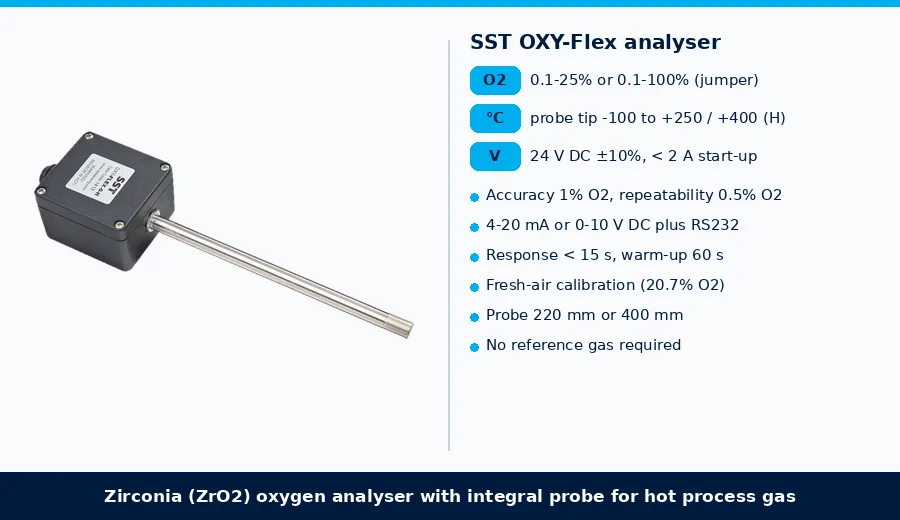
The OXY-Flex is a complete zirconia analyser: housing, electronics and a stainless probe in one unit, powered from 24 V DC and wired through a single connector. It is ordered as OXY-FLEX-x-x, choosing a 220 mm or 400 mm probe and the standard or high gas-temperature version.
| Item | SST OXY-Flex Oxygen Analyser datasheet (DS-0073 Rev 15) |
|---|---|
| Oxygen range | Analogue output 0.1-25% O2 or 0.1-100% O2 (jumper selectable); RS232 output 0.1-100% O2 |
| Accuracy / repeatability after calibration | 1% O2 / 0.5% O2 (assuming constant barometric pressure) |
| Output resolution | 0.01 mA (4-20 mA), 0.01 V (0-10 V DC), 0.01% O2 (RS232) |
| Response and start-up | Response time < 15 s; warm-up 60 s before sensor operation; output stabilisation about 180 s |
| Outputs | 4-20 mA (600 Ω max load) or 0-10 V DC (10 kΩ min load), plus RS232; cycling 3.3 V DC logic output for diagnostics |
| Calibration | Externally triggered automatic or manual; in fresh air (20.7% O2) or any known O2 concentration |
| Output filtering | Selectable: adaptive, fast and dynamic, or slow and stable |
| Supply | 24 V DC ±10%; < 1 A operating, < 2 A at start-up |
| Gas temperature at probe tip | Standard -100 to +250 °C; high-temperature version -100 to +400 °C |
| Housing temperature | -10 to +85 °C (storage and operating) |
| Gas flow / vibration | 0 to 10 m/s; 5 g repetitive, 30 g incidental acceleration |
| Probe length | 220 mm or 400 mm |
| Connector | Amphenol Ecomate C016 30C006 100 12; mating Binder 99-4218-00-07 supplied |
One wiring detail from the datasheet is worth repeating: both output pins are referenced to the supply ground, which carries the heater current. When reading the 0-10 V output, SST recommends taking a separate ground wire for the measurement system from the supply ground pin, to avoid errors from voltage drop in the power wiring. The 4-20 mA option avoids this issue on long cable runs.
Zirconia Oxygen Analyzer System (OXY-LC board + O2S-FR-T2-18BM sensor)
For machine builders and system integrators who want the oxygen measurement inside their own enclosure, SST supplies the sensor and its interface electronics separately. The sensor screws into an M18 x 1.5 port and the OXY-LC board drives the heater and pump cycle and provides the output.
| Item | SST Oxygen Measurement System datasheet (DS-0055 Rev 5) |
|---|---|
| Oxygen range | Analogue 0.1-25% or 0.1-100% O2; Modbus RTU 0.1-100% O2 |
| Accuracy after calibration | 0.5% O2; resolution 0.01% O2 |
| Response time (10-90% step) | < 4 s |
| Warm-up | Initial 5-10 min until stable output; output inactive for 60 s from OFF to ON (20 s from Standby to ON, RS485 version only) |
| Interface boards | OXY-LC-485 (RS485 Modbus RTU); OXY-LC-A25-455 / -A100-455 (4-20 mA, 0.1-25% / 0.1-100%); OXY-LC-V25-455 / -V100-455 (0-10 V DC) |
| Supply | RS485 variant 8-28 V DC; analogue variants 20-28 V DC; 600 mA max at 24 V DC, 1.2 A max at 12 V DC |
| Sensors | O2S-FR-T2-18BM-A (55 mm), -B (45 mm), -C (28 mm) probe length; M18 x 1.5 screw mounting |
| Process limits | Gas -100 to +250 °C; flow 0-10 m/s with baffle fitted; 260-1260 mbar absolute |
SST's example order, OXY-LC-A25-455 with O2S-FR-T2-18BM-C, gives a 4-20 mA board output and a sensor with 28 mm from the tip to the start of the M18 thread. For flue-gas duties the datasheet specifies a baffle to shield the sensor from direct cooling and from pollution by the flue gas (details in SST's DS0122 screw-fit probe datasheet).
OXY-Flex or the board-and-sensor system?
- Choose the OXY-Flex when you want a ready analyser to insert into a duct, vent or vessel nozzle and wire to a PLC: probe up to 400 mm, gas at the tip up to +250 °C or +400 °C, analogue output plus RS232, and built-in calibration triggering.
- Choose the OXY-LC system when oxygen measurement is a component of your own equipment: the sensor is compact, the board fits inside your enclosure, the response is faster (< 4 s, 10-90%) and the stated accuracy is 0.5% O2, with a Modbus RTU option for digital integration.
- Neither is a trace-oxygen analyser. Both ranges start at 0.1% O2, and SST warns that prolonged operation below 0.1% O2 can damage the sensing element. For ppm oxygen in nitrogen, argon or CO2, see our notes on the Michell XZR400 zirconia analyser for inert gas purity and on portable and process trace oxygen analysis.
- For full combustion control on large boilers and furnaces with O2 and COe and flue gas well above +400 °C, an in-situ combustion analyser such as the RB Technologies ZTR4 or FiNCORE AFiH is the usual route; see our note on in-situ combustion O2 and COe monitoring.
Installation and care
- Keep silicone away. SST states that zirconium dioxide sensors are damaged by silicone: vapours from RTV rubbers and sealants poison the sensor and must be avoided. Check gaskets, sealants and greases near the probe, and do not use chemical cleaning agents.
- Do not run below 0.1% O2 for long periods, for example during a nitrogen purge of the equipment the probe sits in.
- Allow for warm-up. Ignore the output until the heater has reached temperature (60 s warm-up and about 180 s stabilisation for the OXY-Flex; 5-10 min for the OXY-LC system) and make sure the PLC does not alarm on start-up values.
- Size the 24 V supply for the heater. The OXY-Flex can draw up to 2 A at start-up; the OXY-LC system up to 600 mA at 24 V DC.
- Calibrate where it is installed. Calibrate in fresh air or with a known gas at site, after any move to a different altitude, and record the barometric pressure at calibration.
- Respect the temperature limits. The probe tip can see up to +250 °C (+400 °C with the high-temperature OXY-Flex), but the OXY-Flex housing must stay within -10 to +85 °C, so keep it out of the hot zone and away from direct radiant heat.
What to send with an enquiry
- The gas and its normal oxygen range (and the lowest oxygen it may ever see), plus any combustible, corrosive or silicone-bearing components
- Gas temperature at the measuring point, gas velocity, and pressure (near atmospheric or not)
- Whether you need a complete analyser (OXY-Flex, 220 or 400 mm probe) or a board and sensor for your own equipment (OXY-LC with 28, 45 or 55 mm sensor)
- Required output: 4-20 mA, 0-10 V DC, RS232 (OXY-Flex) or Modbus RTU (OXY-LC-485), and the 0.1-25% or 0.1-100% range
- Site elevation and how calibration will be done (fresh air or a known gas)
FAQ
What oxygen range does the SST OXY-Flex measure?
The analogue output is jumper selectable for 0.1-25% O2 or 0.1-100% O2, and the RS232 output covers 0.1-100% O2. SST states an accuracy of 1% O2 and repeatability of 0.5% O2 after calibration.
Does the OXY-Flex need a reference gas?
No. SST lists "no reference gas required" as a benefit. It can be calibrated in fresh air (20.7% O2) or to any other known O2 concentration, triggered automatically or manually.
How hot can the gas be?
At the probe tip the standard OXY-Flex accepts gas from -100 to +250 °C and the high-temperature version from -100 to +400 °C. The housing itself is rated -10 to +85 °C. The OXY-LC system sensor is rated -100 to +250 °C.
Why does a zirconia reading change with altitude or weather?
The sensor measures the partial pressure of oxygen. If the barometric pressure changes from the value at calibration, the reading changes in proportion: SST's example is 21% O2 becoming 21.21% O2 for a 1% rise in pressure. Calibrating at site removes the altitude effect.
Can these sensors measure ppm oxygen in nitrogen?
No. Both ranges start at 0.1% O2 and SST warns that prolonged operation below 0.1% O2 can damage the sensing element. Trace-oxygen duties need a dedicated trace analyser.
What is the difference between the OXY-Flex and the Zirconia Oxygen Analyzer System?
The OXY-Flex is a complete analyser with a 220 or 400 mm probe, analogue plus RS232 output and 1% O2 accuracy. The system is an OXY-LC interface board with a compact M18 screw-fit sensor for building into equipment, with < 4 s response, 0.5% O2 accuracy and 4-20 mA, 0-10 V or Modbus RTU output.
Next steps
Tetracon supplies SST Sensing oxygen and gas sensors to industry, OEMs and laboratories across Pakistan. Send us your gas, oxygen range, temperature, output and site elevation and we will work with SST on the right configuration. Use the contact page or see our services. Start with the OXY-Flex zirconia oxygen analyser and the Zirconia Oxygen Analyzer System, browse oxygen analysis, sensors and gas analysis, or see all SST Sensing products and the full product catalogue. Related notes: oxygen analyzers for process safety and combustion control, in-situ combustion O2 and COe monitoring, trace oxygen in inert gases and process oxygen by thermo-paramagnetic analysis. Free technical guides are collected under Guides.