

Nitrogen, argon, carbon dioxide and helium are bought and generated for one reason: they are not air. A few hundred ppm of oxygen in a nitrogen blanket, a welding shield gas or beverage-grade CO2 can be enough to cause oxidation, off-flavour, discoloured welds or a failed batch. In Pakistan that risk sits with on-site PSA and membrane nitrogen generators, cylinder-filling plants, food and beverage lines, pharmaceutical packaging, heat-treatment furnaces, electronics assembly and laboratories that depend on high-purity gas.
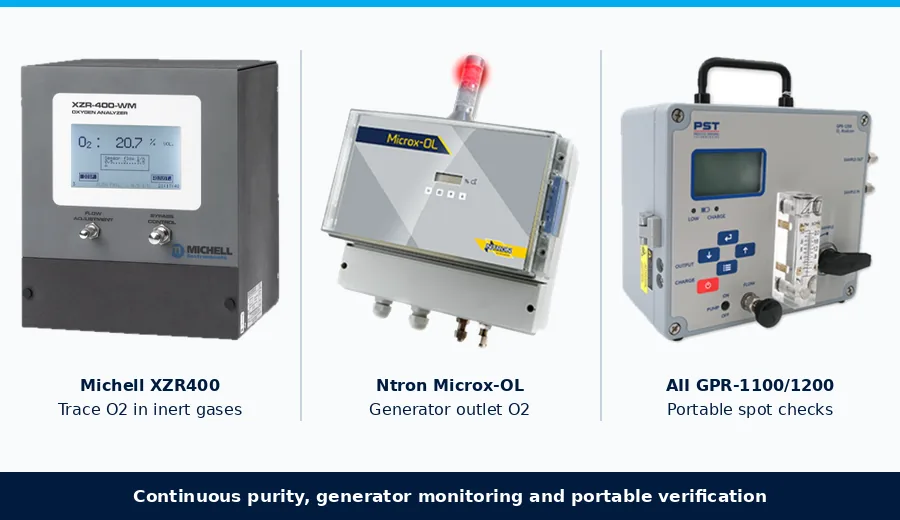
This note covers continuous trace-oxygen measurement in inert gases with the Michell XZR400 zirconia analyzer. It explains what the datasheet actually specifies, how to choose between its four chassis, and when a different oxygen analyzer such as the Ntron Microx-OL or a portable AII GPR-1100 / GPR-1200 is the better fit. Instrument figures come from the Michell XZR400 Series datasheet (issue XZR400_97204_V10) and the live Tetracon product page. No prices or exclusivity claims are made here.
Why trace oxygen is the purity number that matters
Most inert-gas specifications are really oxygen specifications. The gas is there to keep oxygen away from a product, a weld pool, a furnace load or a sensitive process, so the residual O2 content is the figure that decides whether the gas is doing its job:
- Nitrogen generators. PSA and membrane units trade purity against flow. A continuous O2 reading shows when a bed is tiring, a valve is sticking or demand has outrun the generator.
- Cylinder filling and gas distribution. Filling plants need a documented purity check on every batch, not a reading taken once a month.
- Food, beverage and pharma packaging. Nitrogen flushing and CO2 carbonation only protect shelf life if the gas itself is low in oxygen. The XZR400 datasheet lists measuring oxygen traces in carbon dioxide for breweries as a named application.
- Heat treatment and furnaces. Protective atmospheres for annealing, brazing and galvanizing lines rely on low O2; the datasheet names heat-treating applications such as galvanizing furnaces.
- Glove boxes and labs. A rising O2 trace is often the first sign of a leak in a glove box or purge line, and the datasheet lists tracing leaks in glove boxes.
Michell XZR400: what the datasheet says
The XZR400 Series measures oxygen as an impurity in pure inert gases such as N2, CO2, He, Ar and Kr, and is also offered for cylinder filling. Its sensor is a zirconium oxide cell with Michell’s Metallic Sealed Reference Sensor (MSRS) technology. The sealed reference means no reference air has to be piped to the analyzer, and the analyzer can be calibrated with a single reference gas such as dry air. Michell reports field-test drift of less than 140 ppb in one month at 1 ppm O2, and states calibration is typically needed only once or twice a year.
| Specification | XZR400 (datasheet) |
|---|---|
| Sensor | Zirconium oxide with Metallic Sealed Reference (MSRS) and S-type thermocouple; sensor temperature optimized at 634 °C |
| Background gases | O2 impurity in pure inert gases: N2, CO2, He, Ar, Kr; cylinder filling |
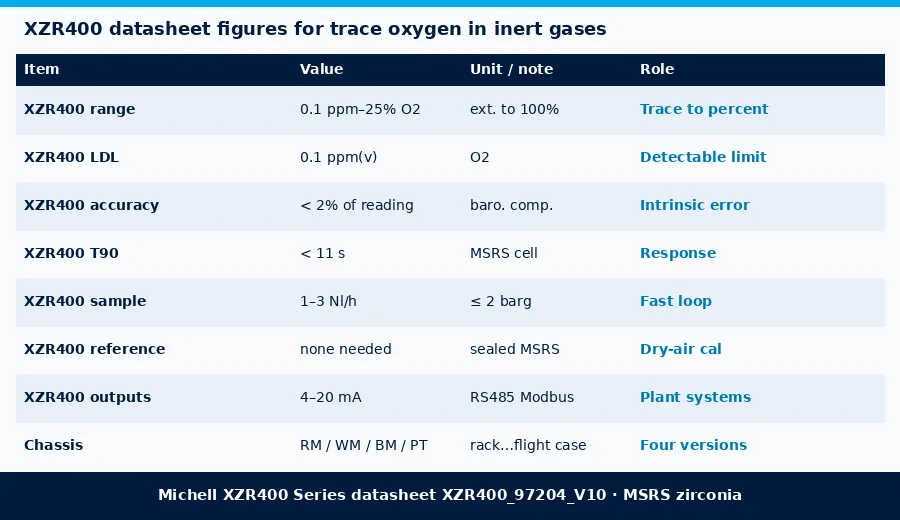
| Measurement range | 0.1 ppm up to 25% O2; extended ranges up to 0–100% O2 available |
| Lowest detectable limit | 0.1 ppm(v) O2 |
| Accuracy (intrinsic error) | Less than 2% of reading, with built-in atmospheric pressure compensation |
| Response time | Less than 11 seconds (T90) |
| Repeatability / linearity | ±0.1% of reading / better than ±1% |
| Stability / drift | 1% per month; drift less than 1% of reading per week |
| Sample flow | 1 to 3 Nl/h with built-in fast loop |
| Max sample pressure / temperature | 2 barg (29 psig) / +100 °C |
| Sample condition | Clean, dry, oil free, particles less than 3 µm |
| Display resolution | 0.01 ppm (0.1–10 ppm); 0.1 ppm (10–10,000 ppm); 0.01% (1–10%); 0.1% (10–25%) |
| Outputs | 0, 1 or 2 × 0/4–20 mA (galvanically isolated); Modbus RTU over RS485; RS232 optional |
| Alarms | 2 freely configurable threshold alarms; 1 general fault alarm including flow; optional flow alarm |
| Optional moisture | Built-in Easidew sensor (rack version), −100 to +20 °C dew point |
| Power / ambient | 90–264 V AC, 47/63 Hz, 50 VA; 0 to +55 °C, 5–90% RH non-condensing |
| Connections | Swagelok male fittings, 316 stainless steel |
The touch-screen HMI has a basic mode for daily work and an access-coded expert mode, following the NAMUR recommendation. The datasheet also notes that only about 2 l/h of sample is needed, compared with up to 1 l/min for some other analyzer types — useful when the gas being measured is expensive or the sample point is small.
Choosing a chassis: rack, wall, bench or transportable
All four XZR400 versions use the same measurement technology. The choice is about where the analyzer lives and what it connects to:
| Version | Datasheet description | Size / weight / IP | Typical fit |
|---|---|---|---|
| XZR400-RM (rack) | 19" 3U chassis; 2 × 4–20 mA and Modbus RS485 as standard; optional integrated pump, auto adjustment and Easidew moisture sensor | 482.5 × 133 × 371.5 mm; 10 kg; IP20; 1/8" connections | Analyzer houses and control rooms at gas plants and large generator installations |
| XZR400-WM (wall) | Primarily for cylinder filling or where the analyzer must sit close to the process | 200 × 220 × 290 mm; 5 kg; IP40; 6 mm connections | Filling manifolds, nitrogen generator skids, furnace atmosphere lines |
| XZR400-BM (bench) | Transportable, with carry handle and rubber feet, for labs or processes with multiple sample points | 290 × 260 × 236 mm; 5.2 kg; IP20; 6 mm connections | QC laboratories and rotating checks across several lines |
| XZR400-PT (transportable) | A wall-mount unit in an aluminium flight case for moving between sites | 450 × 300 × 330 mm; 13.5 kg; IP40; 6 mm connections | Service teams and gas suppliers commissioning or auditing customer systems |
Options such as total pressure correction, a wider range beyond 25%, automatic range switching and an abnormal-flow contact are available across the range; check the datasheet option table for which items are standard on each chassis.
Installing it well
- Condition the sample. The datasheet asks for clean, dry, oil-free gas with particles below 3 µm. Put filtration ahead of the analyzer, especially on compressor-fed nitrogen generators.
- Respect pressure and flow. Maximum sample pressure is 2 barg, so regulate down from line or cylinder pressure. The built-in fast loop takes 1–3 Nl/h.
- Use leak-tight tubing. At ppm levels, air diffusing into a poor fitting or plastic tubing can read as product oxygen. Use stainless steel lines and the supplied Swagelok-type connections, and keep sample lines short.
- Think about the background gas. The cell runs hot, and as with any heated zirconia sensor, combustible components such as hydrogen, carbon monoxide or hydrocarbons can consume oxygen at the cell and pull the reading low. The XZR400 is specified for pure inert gases; for hydrocarbon backgrounds, an electrochemical sensor option such as the Microx-OL EC version or a GPR hydrocarbon sensor is the safer choice.
- Wire alarms to the process. Use the two threshold alarms for warning and action levels (for example, diverting off-spec nitrogen to vent), and the fault/flow alarm so a blocked sample line does not look like good gas.
- Calibrate on a schedule. Michell states once or twice a year with dry air is typically enough; the optional auto calibration reduces operator handling.
XZR400, Microx-OL and GPR portables — who does what
| Instrument | Primary job |
|---|---|
| Michell XZR400 | Continuous trace-to-percent O2 in pure inert gases (0.1 ppm to 25%, extended to 100%), with Modbus and 4–20 mA for plant systems and an optional built-in moisture sensor. |
| Ntron Microx-OL | Compact wall-mounted O2 analyzer for inert gas supplied under positive pressure, with zirconia or electrochemical sensors and 0–1,000 ppm, 0–25% or 0–96% O2 ranges — a good fit on nitrogen and oxygen generator outlets. |
| AII GPR-1100 / GPR-1200 | Portable electrochemical trace O2 spot checks and nitrogen-generator validation. See our note on portable process and trace oxygen analyzers. |
| Michell XZR500 | A different job: in-situ zirconia probes for excess-air combustion control in boilers and furnaces, not inert-gas purity. |
Many sites pair oxygen with moisture, because wet nitrogen or CO2 causes problems of its own. The rack XZR400 can carry an Easidew sensor; standalone dew-point monitoring is covered by the Easidew Online and our note on online dew point for compressed air.
Practical points for Pakistan sites
- Heat. The analyzer ambient rating is 0 to +55 °C. In summer, mount wall units out of direct sun and away from hot compressor exhausts, and ventilate analyzer cabinets.
- Power quality. The 90–264 V AC input copes with typical supply variation; still put the analyzer on a protected or UPS-backed circuit so alarms stay live during load-shedding switchovers.
- Dust. Rack and bench versions are IP20 and the wall/transportable versions IP40, so keep them in a clean panel or analyzer room rather than on an open skid.
- Records. Modbus RTU over RS485 or the 4–20 mA outputs let a PLC, SCADA or data logger keep a continuous purity record for audits and customer certificates.
- Generator tuning. A live O2 trend makes it practical to set PSA cycle times or membrane flow for the purity your process actually needs, instead of running generators harder than necessary.
FAQ
What oxygen range does the XZR400 measure?
Per the Michell XZR400 Series datasheet, 0.1 ppm up to 25% O2, with extended ranges up to 0–100% O2 available and a lowest detectable limit of 0.1 ppm(v).
Does the XZR400 need reference air?
No. Its Metallic Sealed Reference Sensor does not need reference air, and the analyzer can be calibrated with a single reference gas such as dry air, typically once or twice a year.
Which gases can it be used on?
The datasheet specifies oxygen as an impurity in pure inert gases such as nitrogen, carbon dioxide, helium, argon and krypton, plus cylinder filling. The sample must be clean, dry and oil free. For backgrounds containing hydrocarbons, an electrochemical oxygen analyzer is the better choice.
How fast does it respond and how much sample does it use?
Response time is under 11 seconds, and the built-in fast loop needs only 1 to 3 Nl/h of sample at up to 2 barg.
Where can Pakistani teams see the product and ask for support?
See the catalogue page for the XZR400, browse oxygen analyzers, or contact Tetracon with your gas type, purity target, sample pressure and output requirements.
Next steps
Tetracon supplies gas analysis, moisture and process instrumentation to Pakistan’s industry, gas producers, food and pharmaceutical plants and laboratories, including Michell Instruments products. Tell us the background gas, the oxygen level you need to prove, sample pressure, where the analyzer will be mounted and how readings must reach your control system. Use the contact page or see our services. Start with the catalogue pages for the XZR400, Microx-OL and GPR-1100 / GPR-1200; browse oxygen analysis, moisture and dew point and gas analysis; or see all Michell Instruments products. Free technical guides are collected under Guides.