

Percent-level oxygen is a safety and quality variable on Pakistani biogas plants, hydrogen and nitrogen generators, CO2 purification skids and inert blanketing loops. Too much O2 in a blanketing gas risks fire or product oxidation; too little purity on a generator wastes energy and fails contractual specs. Sites therefore need a stable process oxygen analyzer that is calibrated in the real background gas — biogas, CH4, H2, N2 or CO2 — not a portable electrochemical cell that drifts or a laboratory GC that cannot sit on the skid.
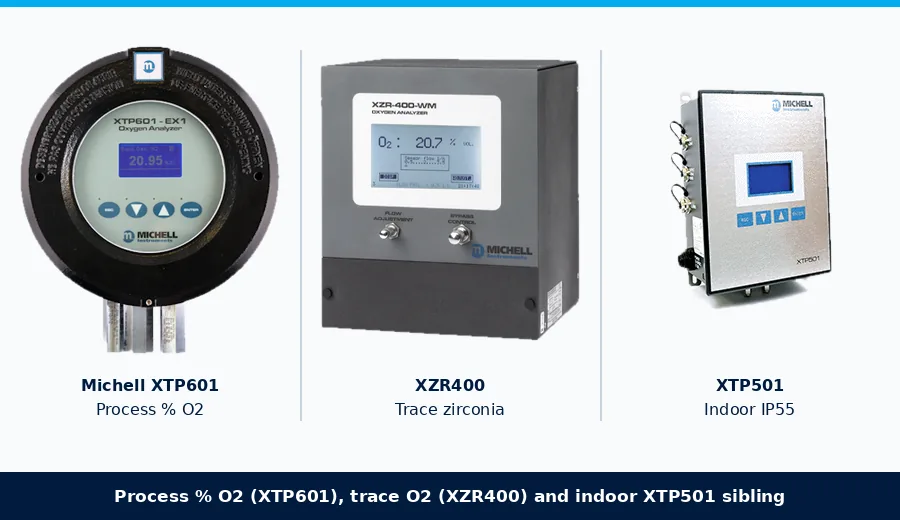
This note covers process oxygen measurement with the Michell XTP601 thermo-paramagnetic analyzer. It explains what the Michell XTP Series datasheet (Issue XTP Series_97314_V8.9_EN_0624) specifies, how the instrument sits beside the XZR400 zirconia trace analyzer and the lighter XTP501 indoor sibling, and how to place it on a Pakistani process skid. Instrument figures come from that datasheet and the live Tetracon product page. No prices or sole-agent claims are made here.
Why percent-level process O2 matters on Pakistan plants
Engineers write oxygen into operating envelopes because the consequences of a wrong reading are immediate:
- Inert blanketing. Hydrocarbon, solvent and powder vessels need a confirmed low O2 atmosphere; a slow or drifting sensor leaves the safety loop guessing.
- Biogas and digester gas. Rising oxygen signals air ingress that cuts calorific value and can approach explosive limits — the same concern landfill and AD operators already track with portable LFG tools, now needed as a fixed process measurement.
- Hydrogen and nitrogen generators. Contractual purity bands (whether impurity O2 in the low percent or suppressed-zero high-purity bands) require an analyzer calibrated in H2 or N2, not air.
- Hazardous-area and SIL loops. Many Pakistani skids sit in Ex-rated rooms or feed safety instrumented functions; the analyzer must carry matching Ex markings and, where specified, SIL2 capability.
Michell XTP601: what the datasheet says
The XTP601 is a robust, linear thermo-paramagnetic oxygen analyzer for measurements in gases such as biogas, methane, hydrogen, nitrogen or carbon dioxide. The stainless-steel sensor combines paramagnetic and thermal-conductivity principles; Michell states there are no moving parts in the sensing element, which improves tolerance to vibration compared with classic dumbbell paramagnetic cells. The XTP601 is housed in a rugged IP66 / NEMA 4X casing and can be supplied general-purpose (GP1/GP2 with flame arrestors for flammable samples in safe areas) or hazardous-area certified (Ex). It can be ordered SIL2 Capable to IEC 61508 with a supplementary SIL manual.
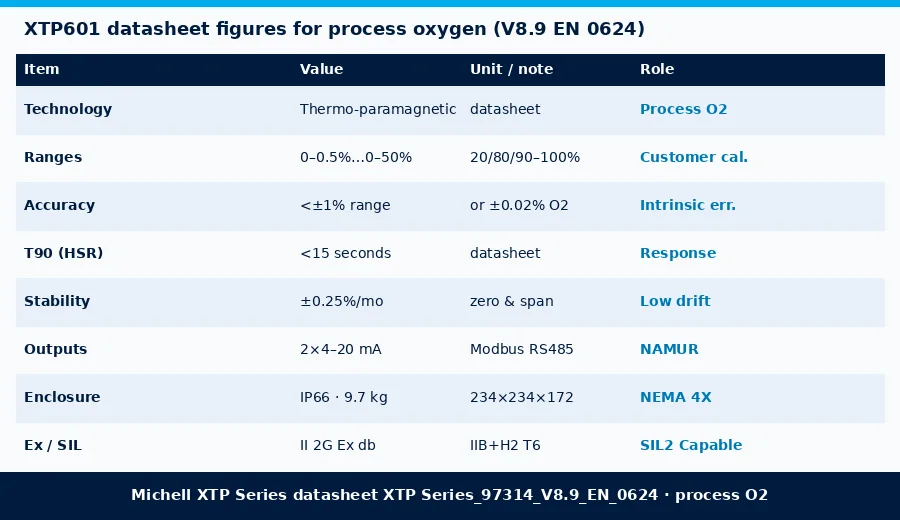
| Specification | XTP601 (XTP Series_97314_V8.9_EN_0624) |
|---|---|
| Method / technology | Thermo-paramagnetic oxygen sensor |
| Measured gas / backgrounds | O2; standard backgrounds N2, CO2, CH4, H2, He & BIOGAS (calibrated in process background) |
| Sample condition | Non-condensing; particles <3 μm |
| Measurement ranges | 0…0.5% up to 0…50%; suppressed-zero 20…100% up to 90…100% |
| Display resolution | 0.01%; 0.1% for suppressed-zero ranges |
| Intrinsic error (accuracy) | < ±1% of range or ±0.02% O2 (whichever greater); suppressed-zero: < ±0.2% O2 or ±1% of range (whichever greater) |
| Response time T90 | <15 seconds with High Speed Response (HSR) enabled |
| Repeatability / linearity | ±0.2% of range or ±0.02% O2; ±0.5% of range or ±0.05% O2 (whichever greater) |
| Zero / range stability | ±0.25% of range per month each |
| Sample flow | GP: 100…500 ml/min; Ex: 270…330 ml/min (flow effect <1% of range within band; calibrated at 300 ml/min) |
| Sample pressure | 0.75…2 BarA (calibrate at the same pressure as the process sample) |
| Outputs | 2 × 4…20 mA (24 V excitation); Modbus RTU over RS485; 2 × SPCO concentration relays (250 V, 5 A max); NAMUR high/low when cell temperature unstable |
| Power | 24 V DC, 1.6 A max |
| Ambient / warm-up | +5…+60 °C (+5…+50 °C cQPSus); warm-up <25 min at 20 °C; stabilisation 5 min |
| Physical | 234 × 234 × 172 mm; 9.7 kg; wetted parts 316L SS, borosilicate glass, platinum (+ O-ring) |
| Case seal | IP66, NEMA 4X |
| Hazardous area (Ex variants) | ATEX/UKCA II 2 G D Ex db IIB +H2 T6 Gb; Ex tb IIIC T85 °C Db IP66; IECEx matching; cQPSus Class I Div 1 / Zone 1; TR CU Ex 1Ex d IIB+H2 T6 Gb |
| Functional safety | SIL2 Capable (IEC 61508) with supplementary SIL manual |
The live product page positions the XTP601 under oxygen & combustion analyzers for safe or hazardous-area biogas, H2, N2 and CO2 service. Specification work should name the background gas, exact range (including any suppressed-zero purity band), whether Ex and SIL2 are required, O-ring material (Viton / silicone / Ekraz), and how the dual 4–20 mA and Modbus outputs feed the DCS or safety system.
How a process O2 installation works
- Match the background gas. The analyzer is calibrated in the process background (N2, CO2, CH4, H2, He or biogas). Order the correct background — do not assume an air-calibrated unit will read correctly in H2 or CO2.
- Set range and pressure. Choose 0…x% impurity bands or 20/80/90…100% purity bands as the duty requires. Calibrate at the same sample pressure you will run (0.75…2 BarA).
- Condition the sample. Keep the sample non-condensing and below 3 μm particulate; Ex versions run a tighter 270…330 ml/min flow window.
- Wire outputs. Use the two 4…20 mA loops (primary = calibrated range; second user-selectable) and Modbus RTU over RS485; concentration relays and NAMUR fail behaviour support alarm and SIS integration.
- Commission through the glass. On Ex models the capacitive touch-screen lets operators calibrate or adjust without a hot-work permit — a practical point for Pakistani hazardous-area rooms.
XTP601, XTP501, XZR400 and Ntron options — who does what
| Instrument | Primary job |
|---|---|
| Michell XTP601 | Fixed process % O2 by thermo-paramagnetic sensing in biogas / H2 / N2 / CO2; IP66; Ex and SIL2 Capable options; dual 4–20 mA + Modbus. |
| Michell XTP501 | Same sensor family in a lighter IP55 indoor wall-mount — use when hazardous-area certification is not required and panel space / weight matter. |
| Michell XZR400 | Zirconia (MSRS) for trace oxygen in inert gases (ppm to low %) — a different duty from percent-level process O2. See our note on trace oxygen in inert gas purity. |
| Ntron SIL-O2 / Minox i | SIL2-capable analyzer (solid-state sensor) / solid-state or electrochemical transmitter oxygen options for blanketing and inerting when the site standard names Ntron rather than Michell thermo-paramagnetic. See oxygen blanketing and inerting. |
| RB ZTR4 | In-situ combustion / flue-gas oxygen (zirconia) for boilers and furnaces — not a substitute for clean process-gas % O2 on a generator or blanketing skid. |
Use XTP601 when the duty is fixed percent-level process oxygen in a named background gas, especially with Ex or SIL2 requirements. Reach for XZR400 when the ask is ppm-level purity in nitrogen, argon or CO2. Keep XTP501 for indoor non-Ex mounts. Do not treat a combustion flue analyzer as a blanketing or generator purity instrument — they answer different oxygen questions.
Field practice for Pakistan process oxygen skids
- Name the background and range on the PO. Biogas vs H2 vs N2, and 0…x% vs 80…100%, change the factory calibration.
- Respect sample pressure. The datasheet requires calibration at the same absolute pressure as the process sample (0.75…2 BarA).
- Plan Ex and SIL early. Order Ex db / SIL2 Capable hardware and the SIL manual before the SIS functional-design review, not after panel fabrication.
- Watch warm-up. Allow <25 minutes warm-up (at 20 °C ambient) and 5 minutes stabilisation before locking a safety trip or contractual purity reading.
- Keep the sample clean and dry. Particles <3 μm and non-condensing sample protect the borosilicate / platinum cell; add filtration and knock-out as the process demands.
- Use both analog and digital. Dual 4–20 mA for the DCS/SIS and Modbus RTU for diagnostics / range confirmation reduce “which range is live?” confusion during audits.
FAQ
What does the Michell XTP601 measure?
The Michell XTP Series datasheet (Issue XTP Series_97314_V8.9_EN_0624) describes a thermo-paramagnetic oxygen sensor measuring percent-level O2 in background gases such as N2, CO2, CH4, H2, He and biogas. Ranges are selected from 0–0.5% up to 0–50%, and suppressed-zero ranges from 20–100% up to 90–100%.
What accuracy and response time does the datasheet quote?
Intrinsic error (accuracy) is < ±1% of range or ±0.02% O2, whichever is greater. For suppressed-zero ranges (20/80/90 to 100%), accuracy is < ±0.2% O2 or ±1% of range, whichever is greater. Response time T90 is <15 seconds with High Speed Response (HSR) enabled. Zero and range stability are each ±0.25% of range per month.
Is the XTP601 certified for hazardous areas and SIL?
Yes for Ex variants. The datasheet lists ATEX/UKCA II 2 G D Ex db IIB +H2 T6 Gb and Ex tb IIIC T85 °C Db IP66, matching IECEx markings, plus cQPSus and TR CU Ex options. The XTP601 can be supplied SIL2 Capable to IEC 61508 with a supplementary SIL manual. Ingress protection is IP66 / NEMA 4X.
When should we use XTP601 instead of XZR400 or XTP501?
Use XTP601 for percent-level process oxygen in biogas, H2, N2, CO2 or similar backgrounds where an IP66, Ex-capable, SIL2-capable thermo-paramagnetic analyzer is required. Use XZR400 when the duty is trace (ppm to low %) oxygen in inert gases with zirconia MSRS technology. Use XTP501 when a lighter IP55 indoor wall-mount sibling is enough and hazardous-area certification is not required.
Where can Pakistani teams see the product and ask for support?
See the catalogue page for the XTP601, browse oxygen analysis and gas analysis, or contact Tetracon with your background gas, target O2 range, whether Ex/SIL2 is required, and how 4–20 mA or Modbus outputs must reach the DCS or safety system.
Next steps
Tetracon supplies gas analysis and oxygen instrumentation to Pakistan’s process, biogas and industrial sites, including Michell Instruments / Process Sensing Technologies products. Tell us your background gas, target range, whether Ex and SIL2 are required, and how results must reach your control or safety system. Use the contact page or see our services. Start with the catalogue pages for the XTP601, XTP501 and XZR400; browse oxygen analysis and gas analysis; or see all Michell Instruments products. Free technical guides are collected under Guides.