

Most plants, warehouses, hospitals and laboratories in Pakistan already have good 4-20 mA transmitters installed: pressure and differential pressure transmitters, level and flow transmitters, gas detectors and analysers (general). The problem is often not the sensor but the signal: it ends at a local display, a chart recorder or a PLC input that nobody looks at after hours, and there is no cabling budget to bring it back to a SCADA or BMS (general).
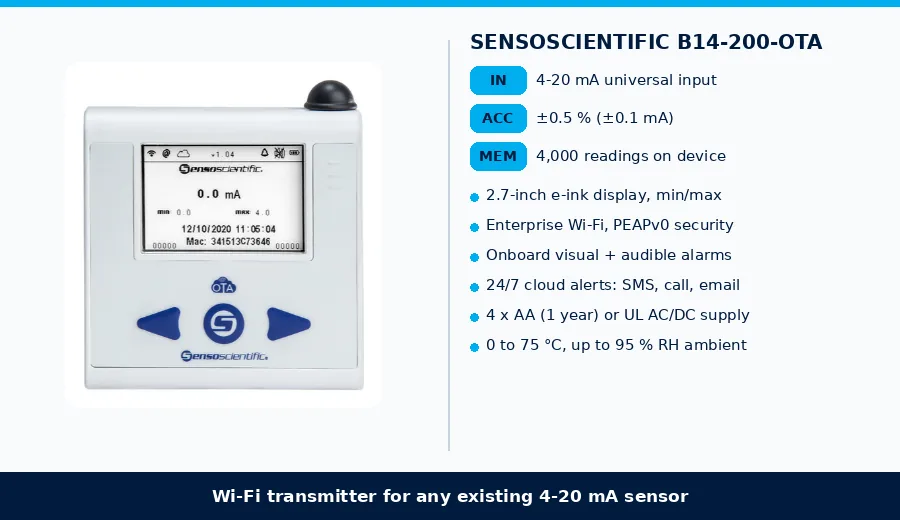
This note looks at the SensoScientific B14-200-OTA 4-20mA Universal Sensor, an enterprise Wi-Fi transmitter that accepts a standard 4-20 mA input and turns an existing current-loop sensor into a wireless, cloud-monitored point with on-device alarms. It covers what the published data says, how the OTA node works, how to set it up on a facility network and where it fits in Pakistani sites. Figures come from the SensoScientific OTA series datasheet and OTA series user guide hosted on our product pages, and from the current Tetracon product page. General engineering advice is labelled as general, and nothing here goes beyond the published data. Tetracon (Pvt.) Ltd. is the sole authorized agent for SensoScientific in Pakistan.
Why put a 4-20 mA signal on Wi-Fi
- Keep the sensor you have. The B14 is described as adding Wi-Fi cloud monitoring to legacy 4-20 mA instrumentation without replacing existing sensors (product page). That protects the investment in transmitters that are already installed and calibrated (general).
- No extra infrastructure. SensoScientific OTA sensors use the facility Wi-Fi to upload data to the SensoScientific Cloud, with no need for an external infrastructure (OTA datasheet).
- Alarms that reach people. Out-of-limit readings trigger onboard visual and audible alarms and 24/7 alert notifications through the cloud, by phone, email, SMS, text, pager, fax and more (OTA datasheet).
- Records that stand up to audit. Readings are time-stamped and stored in a tamper-proof database that cannot be edited through the user interface, supporting FDA 21 CFR Part 11 compliant monitoring (product page), on a cloud the OTA datasheet describes as an FDA 21 CFR Part 11 validated cloud (OTA datasheet).
- No data lost during a Wi-Fi outage. When the Wi-Fi, internet or cloud connection cannot be established, readings are buffered on the device, which holds 4,000 readings (OTA user guide).
B14-200-OTA at a glance
| Item | SensoScientific B14-200-OTA (source) |
|---|---|
| Input | 4-20 mA from an externally connected sensor or transmitter (product page) |
| Accuracy | ±0.5 % (±0.1 mA) (product page; OTA datasheet, Universal probe) |
| Versions | B14-200-OTA single band 2.4 GHz; B14-500-OTA dual band 2.4 GHz / 5 GHz (product page) |
| RF / radio | 802.11 Wi-Fi; OTA series dual-band models 2.4 GHz and 5 GHz (802.11a/b/g/n), FCC, IC/ISED, ETSI/CE, MIC and SRRC certified (OTA datasheet) |
| Authentication | WEP, WPA/WPA2 PSK, WPA2 Enterprise, WPA3 Personal, WPA3 Enterprise (OTA datasheet) |
| Enterprise security | 2.4 GHz: PEAPv0 with EAP-MSCHAPv2 (PEAP) (OTA datasheet; product page) |
| Memory | On-transmitter buffer of 4,000 readings; unlimited cloud memory (OTA datasheet) |
| Display | 2.7-inch e-ink display showing the latest reading, min/max, battery level and connection status (OTA user guide) |
| Alarms | Onboard visual and audible alarms; 24/7 alert notifications through the cloud (OTA datasheet) |
| Power | 4 × 1.5 V AA batteries (lithium or alkaline); optional UL-certified external AC/DC supply, universal input 100-240 Vac (OTA datasheet) |
| Battery life | 1 year (OTA datasheet) |
| Ambient operating range | 0 to 75 °C (32 to 167 °F), up to 95 % RH (OTA datasheet) |
| Housing and mounting | ABS plastic enclosure with TPU rubber covers on open ports; zip tie mount hooked with screw holster wall mount (OTA datasheet) |
| Dimensions | 108 × 98 × 35 mm (4.25 × 3.88 × 1.38 in) (OTA datasheet) |
| Calibration | A2LA accredited and NIST traceable SNAP calibration (OTA datasheet) |
| Warranty | 1 year (OTA datasheet) |
The OTA series datasheet lists the Universal probe in current (4-20 mA) and voltage (0-5 V and 0-10 V) versions, with ±0.5 % (±0.1 mA), ±0.5 % (±25 mV) and ±0.5 % (±50 mV) accuracy respectively (OTA datasheet). The B14 product page specifies the 4-20 mA input, so tell us if your transmitter has a voltage output and we will confirm the right version (general).
How the OTA node works
- Read, buffer, transmit. The transmitter reads the 4-20 mA loop from the connected sensor, buffers up to 4,000 readings locally and streams data over Wi-Fi to the SensoScientific Cloud for storage, reporting and 24/7 alarm monitoring (product page).
- Sleep and wake. The device wakes up periodically to take a reading and refresh the screen, shown by a solid yellow LED; a press of the centre button wakes it for the most current reading and time stamp (OTA user guide).
- Status at a glance. The notification panel at the top of the e-ink display shows Wi-Fi, internet and cloud connection symbols (crossed out when there is no connection), a B when readings are being buffered, the firmware version, power supply, speaker, battery level, min/max readings and the MAC address (OTA user guide).
- Traffic-light LEDs. Three LEDs (green, yellow and red) give feedback on wake-up, sleep, an unregistered MAC address and data alarms (OTA user guide).
- Over-the-air firmware. The OTA series can upgrade firmware remotely without the device being manually serviced (OTA user guide).
Setting it up on a facility network
- Talk to IT first. The node supports enterprise security (OTA user guide), and the datasheet lists WPA2 and WPA3 Enterprise as well as PSK authentication (OTA datasheet). Agree the SSID, security type and whether the device needs a static IP before installation (general).
- Two ways to configure. Wi-Fi can be set up from the SensoScientific app on iOS or Android, or from a browser on any Wi-Fi enabled laptop, phone or tablet; SensoScientific can also pre-configure the device (OTA user guide).
- Static IP if needed. In the browser method, DHCP can be disabled and the IP address, subnet mask, default gateway and DNS server entered on the IP Config tab (OTA user guide).
- Register the MAC address. Blinking yellow and red LEDs mean the device reaches the internet but its MAC address is not registered (OTA user guide); the MAC address is shown on the display (OTA user guide).
- Power from mains where you can. The optional UL-certified AC/DC supply takes 100-240 Vac (OTA datasheet), and the product page notes that dual power removes the single point of failure of battery-only designs (product page).
- Mount it near the loop. The node mounts with a zip tie or a screw wall mount (OTA datasheet). Keep it within good Wi-Fi coverage and protected from direct water spray (general).
Where it fits in Pakistan
- Pharma and cold chain. Pharmaceutical cold chain and laboratory and incubator monitoring are listed applications (product page), for example bringing an existing transmitter in a store, cold room or QC lab under the same audited cloud records as the temperature points (general).
- Process and equipment monitoring. Process control and automation and industrial equipment monitoring are listed (product page), for example remote alarms on a pressure, level or gas transmitter at a pump house, tank farm or utility skid (general).
- Facilities management. Facilities management is listed (product page): hospitals, offices and campuses can watch plant-room transmitters without new cabling to a BMS (general).
- Load-shedding resilience. The 4,000-reading buffer (OTA datasheet) and battery power (OTA datasheet) help keep records complete through Wi-Fi or power interruptions, which are common at many Pakistani sites (general).
Related products
| Need | Product | Key point |
|---|---|---|
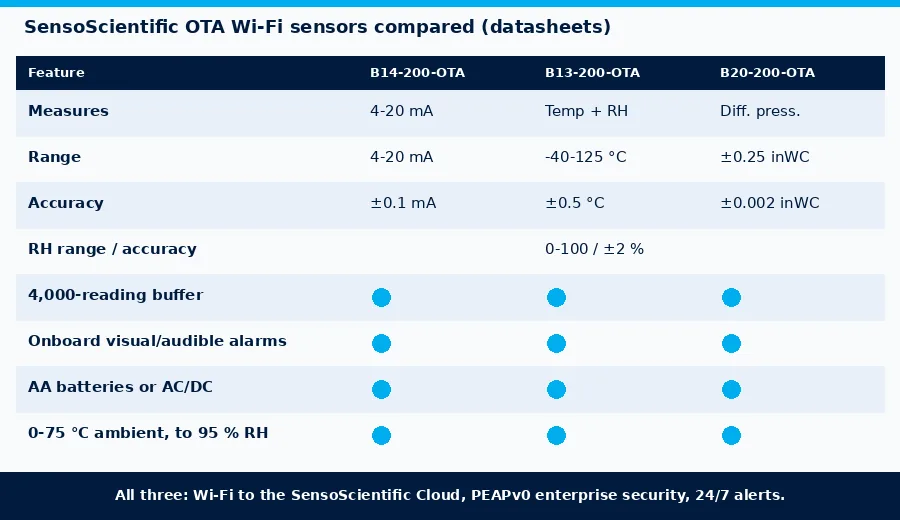
| Put an existing 4-20 mA transmitter on Wi-Fi | SensoScientific B14-200-OTA | 4-20 mA input, ±0.5 % (±0.1 mA), 4,000-reading buffer (product page; OTA datasheet) |
| Wi-Fi temperature and humidity point | SensoScientific B13-200-OTA | -40 to 125 °C, 0-100 %RH, ±0.5 °C; ±2 %RH (B13 datasheet) |
| Wi-Fi room differential pressure | SensoScientific B20-200-OTA | DP001 probe ±0.25 inWC, ±0.002 inWC (OTA datasheet) |
| Cellular logger for transport and remote sites | SensoScientific SensoTag | Cellular RTD temperature sensor (product page) |
For commissioning and troubleshooting a loop on the bench, read our 4-20 mA current loop data logger note, and for cold chain our SensoScientific SensoTag note. Transmitters to connect are on the Process Instrumentation and Humidity & Pressure category pages, with more in our selection guides and on the SensoScientific manufacturer page.
What to send with an enquiry
- The transmitter you want to connect: make, model, measured variable, range and output (4-20 mA, or 0-5 V / 0-10 V).
- How the loop is powered today, and whether the signal also goes to a PLC, recorder or display.
- The site Wi-Fi: 2.4 GHz or 5 GHz, security type (PSK or enterprise) and whether a static IP is required.
- Whether mains power is available at the mounting point or the node must run on batteries.
- Alarm limits, who should receive alerts, any 21 CFR Part 11 or audit requirements, and the number of points.
Send these to Tetracon and our engineers will confirm the right model, power option and lead time. Our services team in Islamabad supports installation, commissioning and calibration across Pakistan.
FAQ
What is the SensoScientific B14-200-OTA?
It is an enterprise Wi-Fi transmitter that accepts a standard 4-20 mA input, so an existing 4-20 mA sensor or transmitter can be turned into a wireless, cloud-monitored point with onboard alarms and 24/7 cloud alerts (product page).
How accurate is the 4-20 mA input?
The accuracy is ±0.5 % (±0.1 mA) (product page), the same figure the OTA series datasheet gives for the Universal 4-20 mA probe (OTA datasheet).
What happens if the Wi-Fi goes down?
Readings are buffered on the device, which holds 4,000 readings, and a B appears on the display while it buffers (OTA user guide). The cloud memory itself is unlimited (OTA datasheet).
Does it work on enterprise Wi-Fi?
Yes. The OTA series supports WPA2 and WPA3 Enterprise as well as WEP and WPA/WPA2 PSK, with PEAPv0 and EAP-MSCHAPv2 on 2.4 GHz (OTA datasheet). The B14-200-OTA is the single-band 2.4 GHz version and the B14-500-OTA the dual-band 2.4 / 5 GHz version (product page).
Who supplies SensoScientific in Pakistan?
Tetracon (Pvt.) Ltd., Islamabad, is the sole authorized agent for SensoScientific in Pakistan and supplies the SensoScientific Wi-Fi and cellular monitoring range with local technical support. Contact us with your transmitter, Wi-Fi and alarm requirements for a quotation.
Want alarms and cloud records from a 4-20 mA transmitter you already have in Pakistan? Contact Tetracon with the transmitter, range and site Wi-Fi details. You can also browse the B14-200-OTA product page and the SensoScientific manufacturer page, or the full product catalogue and all manufacturers.