

Vaccine shipments, insulin and blood products, frozen food and dry-ice or liquid-nitrogen payloads all share the same problem in Pakistan: the logger that watched the fridge cannot follow the van. Wi-Fi drops at the loading bay. A USB logger that is read at the destination only tells you after the fact that the load went out of range. A cellular logger uploads while the vehicle is moving, keeps a local buffer when the network drops, and can carry a location with the temperature so a quality or GDP review can see both the excursion and where it happened.
This note looks at the SensoScientific SensoTag Cellular (catalogue model SensoTag-C-B80K). Figures come from the SensoTag Cellular datasheet hosted on our product page and from the current Tetracon product pages. Where we give general engineering advice it is labelled as general. Nothing here goes beyond the manufacturer's published data. Tetracon (Pvt.) Ltd. is the sole authorized agent for SensoScientific in Pakistan.
Why a 4G logger with GPS?
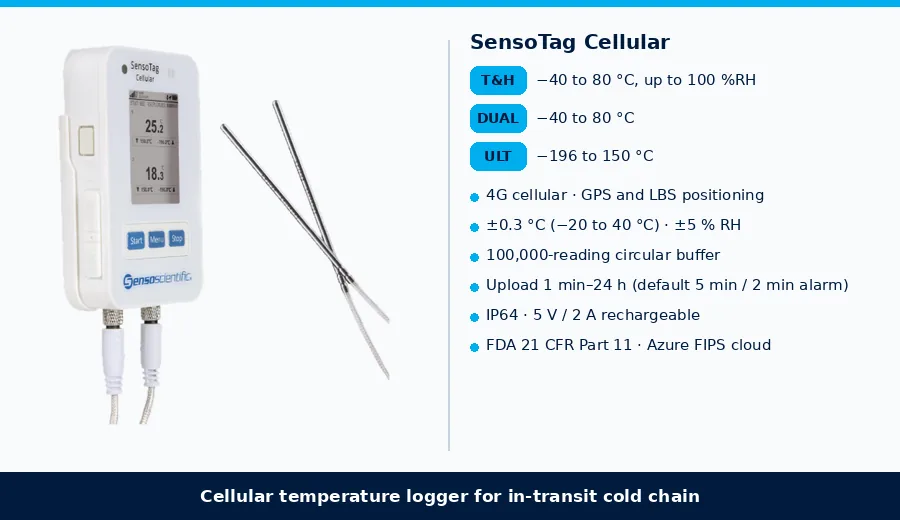
- It does not need site Wi-Fi. Communication is 4G cellular, so the same unit can leave a hospital pharmacy, travel a city route or an inter-city corridor, and keep uploading without joining each site's wireless network (datasheet).
- Location travels with the reading. Positioning is GPS and LBS (location-based service). That supports in-transit reviews where you need to know not only that a load warmed up, but roughly where it was at the time (datasheet; general for how the data is used).
- Three measurement options in one family. The hosted datasheet lists temperature & humidity, dual temperature, and ultra-low temperature. Dual temperature covers −40 to 80 °C; temperature/humidity covers −40 to 80 °C and up to 100 % RH; ultra-low covers −196 to 150 °C (datasheet).
- A large local display. A TFT colour screen shows the current reading, min and max, battery and connectivity, so a driver or receiving store can see the state of the trip without opening a laptop (datasheet).
- Start and stop on the device. On-device Start/Stop buttons suit trip-by-trip use: start at dispatch, stop at goods-in (datasheet; general for trip workflow).
- A compliance-oriented cloud. Storage on the SensoScientific Cloud is described as unlimited, FDA 21 CFR Part 11 compliant, and hosted on a validated, FIPS-compliant Microsoft Azure cloud (datasheet).
How the SensoTag Cellular works
The transmitter takes temperature (and, on the humidity option, relative humidity) and shows the live value on the TFT screen at 0.1 °C or 0.1 % RH resolution. It stores readings on the device in a circular buffer of 100,000 readings and uploads them to the cloud over 4G (datasheet). Recording and upload intervals are independently set from 1 minute to 24 hours. The normal upload interval defaults to 5 minutes; the alarm upload interval defaults to 2 minutes. The alarm recording interval must be less than or equal to the normal recording interval, and the alarm upload interval must be greater than or equal to the alarm recording interval (datasheet).
When an alarm is active the unit uses the faster alarm intervals, lights an indicator, sounds an audible alarm and can send 24/7 alert notifications through the cloud (datasheet). If the cellular link drops, the on-transmitter buffer keeps the record until the next successful upload, so a tunnel or a coverage gap does not wipe the trip (datasheet basis; general for coverage gaps). Power is 5 V / 2 A DC with a charging indicator; the battery is rechargeable via AC power (datasheet).
SensoTag Cellular at a glance
| Item | From the datasheet |
|---|---|
| Communication / positioning | 4G cellular; GPS and LBS |
| Measurement options | Temperature & humidity; dual temperature; ultra-low temperature |
| Dual temperature range | −40 to 80 °C (−40 to 176 °F) |
| Temperature / humidity range | −40 to 80 °C (−40 to 176 °F); up to 100 % RH |
| Ultra-low temperature range | −196 to 150 °C |
| Accuracy | ±0.3 °C (−20 to 40 °C); ±0.5 °C (−50 to 85 °C); ±1 °C (−100 to 150 °C); ±2 °C (others); ±5 % RH |
| Display | TFT colour; current, min and max; battery and connectivity; 0.1 °C / 0.1 % RH resolution |
| Recording / upload | 1 min to 24 h each; normal upload default 5 min; alarm upload default 2 min |
| Memory | Circular on-transmitter buffer, 100,000 readings; unlimited cloud storage |
| Alarms | Indicator light, audible alarm, 24/7 cloud notifications |
| Enclosure / size | IP64; 109 × 69.4 × 22.9 mm (4.29 × 2.73 × 0.90 in) |
| Power / battery | 5 V / 2 A DC, rechargeable via AC; ≥3 months (25 °C, 30 min upload, LBS only) or ≥14 days (same conditions with LBS + GPS) |
| Compliance (sheet) | FDA 21 CFR Part 11; validated FIPS-compliant Microsoft Azure cloud |
Picking the measurement option
- Chilled and frozen food, 2–8 °C pharma, and dual-point loads (dual temperature, −40 to 80 °C). Use this option when you need one or two temperature channels in the normal cold-chain band, for example a refrigerated body and a probe in a product simulant (datasheet ranges; general for typical loads).
- Packs that also need humidity (temperature & humidity, −40 to 80 °C, up to 100 % RH). Some oral solids, diagnostics and food cargoes are sensitive to moisture as well as temperature. Humidity accuracy on the sheet is ±5 % RH (datasheet; general for cargo types).
- Dry ice, ultra-low freezers and cryogenic payloads (ultra-low, −196 to 150 °C). This band covers liquid-nitrogen temperatures at the bottom end and warm excursions at the top. Accuracy tightens to ±0.3 °C only between −20 and 40 °C; at −100 to 150 °C it is ±1 °C, and outside the listed bands it is ±2 °C, which is the figure that applies below −100 °C (datasheet).
- Match the option to the duty, then set the intervals. A 5-minute normal upload is the factory default and is enough for most city routes; drop to the 2-minute alarm upload when a limit is breached if you need a faster cloud trail (datasheet defaults; general for city routes).
Where it fits in Pakistan
- In-transit vaccine and medicine shipments. SensoScientific lists medicine and in-transit use on the sheet. For the wider fridge-plus-shipment picture see our vaccine and pharma cold-chain note (datasheet; general).
- Hospital, wholesale and distributor transfers. 4G means the logger does not have to join each clinic or warehouse Wi-Fi, which is useful when a van calls at many sites in one day (datasheet; general).
- Food safety routes. The sheet also lists food. Chilled and frozen deliveries between plants, cold stores and retail can use the dual-temperature or temperature/humidity options (datasheet; general).
- Ultra-low and cryogenic moves. The −196 °C end of the ultra-low range is the liquid-nitrogen point, so the family can be considered for LN2 and dry-ice shipments as well as −80 °C freezer transfers (datasheet; general for those cargoes).
- Battery planning in the heat. Published battery life is at 25 °C with a 30-minute upload: at least three months on LBS only, or at least 14 days with LBS and GPS together. Cabin temperatures in a closed van in Sindh or Punjab summer will be higher than 25 °C, and a 5-minute upload draws more than a 30-minute upload, so treat the sheet figures as the reference condition and plan a recharge between trips (datasheet; general for Pakistan heat).
Practical notes for a reliable trip
- Charge before dispatch. Power is 5 V / 2 A DC with a charging indicator. Confirm a full charge and that the screen shows battery and connectivity before the load leaves (datasheet; general).
- Respect the IP64 rating. IP64 protects against splashing water, not immersion or a washdown. Keep the transmitter out of standing melt water and direct weather on an open truck bed (datasheet; general).
- Decide GPS vs LBS vs battery. Turning GPS on with LBS shortens the published battery life from ≥3 months to ≥14 days at the 25 °C / 30-minute reference. Use GPS when the quality record needs a track; use LBS alone on long, low-risk routes if battery life matters more (datasheet; general).
- Set alarm intervals inside the rules. Alarm recording must be ≤ normal recording, and alarm upload must be ≥ alarm recording. Leaving the defaults (5-minute normal upload, 2-minute alarm upload) is the simplest starting point (datasheet).
- Start and stop each trip. Use the on-device buttons so the cloud record matches dispatch and receipt, and so min/max on the screen cover that journey only (datasheet; general).
- Read the screen at goods-in. Current, min and max are on the TFT display, so receiving staff can quarantine a load immediately if min/max are outside the labelled band, then confirm against the cloud report (datasheet; general).
Related products and when to choose them
| Duty | Product | Key figure (datasheet / product page) |
|---|---|---|
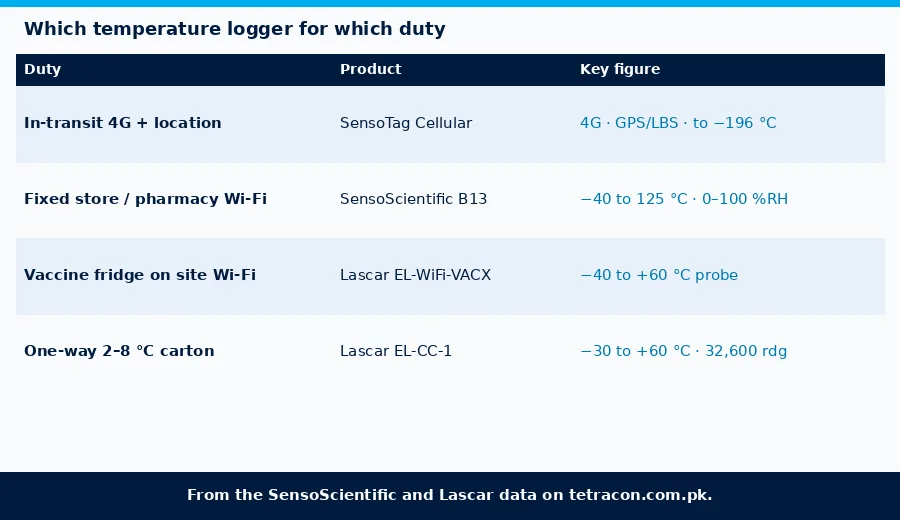
| In-transit 4G logging with location, including ultra-low | SensoScientific SensoTag Cellular | 4G; GPS/LBS; T&H, dual temp or −196 to 150 °C; 100,000-reading buffer (datasheet) |
| Fixed Wi-Fi temperature and humidity in a store, pharmacy or lab | SensoScientific Wi-Fi T/H sensor | −40 to 125 °C, 0–100 % RH; ±0.5 °C (0–60 °C); enterprise Wi-Fi; 3-year warranty (product page) |
| Vaccine fridge kit on site Wi-Fi, with a glycol probe | Lascar EL-WiFi-VACX | Probe −40 to +60 °C; typical ±0.1 °C (−10 to +60 °C); BS EN 12830:2018 (product page) |
| Single-use 2–8 °C shipment logger, no cloud | Lascar EL-CC-1-001 | −30 to +60 °C; ±0.5 °C; 32,600 readings; pre-set 2/8 °C alarms (product page) |
Choose the SensoTag Cellular when the load is moving and you need a live 4G feed, a local buffer and optional GPS. Choose the B13 Wi-Fi temperature and humidity sensor for a room, fridge or warehouse that already has enterprise Wi-Fi — see also our Lascar EL-WiFi-TH+ note and the pharma cleanroom humidity note. Choose the EL-WiFi-VACX when the duty is a fixed vaccine refrigerator. Choose the EL-CC-1 when a one-way carton only needs a start-and-read logger. The wider wireless and compliance range is on the Environmental Monitoring category page and the SensoScientific manufacturer page; Lascar options are on the Lascar Electronics page.
What to send with an enquiry
- Duty (in-transit vaccine or medicine, food, ultra-low / dry ice / LN2, or a fixed store that might be better served by Wi-Fi).
- Which measurement option you need: temperature & humidity, dual temperature, or ultra-low, and the number of measurement points.
- The labelled temperature (and humidity) band and how long a typical trip lasts.
- Whether you need GPS tracking or LBS only, which drives the published battery life.
- How you want alarms delivered, and whether receiving sites must read the local screen as well as the cloud.
- Quantity, recharge arrangements, and any fixed Wi-Fi or single-use loggers needed alongside.
FAQ
What does the SensoTag Cellular measure?
The hosted datasheet lists three options: temperature and humidity (−40 to 80 °C, up to 100 % RH), dual temperature (−40 to 80 °C), and ultra-low temperature (−196 to 150 °C). Tetracon's catalogue page for model SensoTag-C-B80K presents the ultra-low option.
How accurate is it?
Accuracy is ±0.3 °C from −20 to 40 °C, ±0.5 °C from −50 to 85 °C, ±1 °C from −100 to 150 °C, ±2 °C outside those bands, and ±5 % RH for humidity.
How long does the battery last?
At the datasheet reference of 25 °C and a 30-minute upload interval, at least three months with LBS positioning only, or at least 14 days with LBS and GPS together. Faster uploads and hotter vehicle cabins will shorten that, so recharge between trips.
Does it need Wi-Fi at the warehouse or in the vehicle?
No. Communication is 4G cellular. That is the main reason to pick it over a Wi-Fi sensor such as the SensoScientific B13 or a Lascar EL-WiFi vaccine kit when the logger has to travel.
Is the cloud record suitable for regulated storage?
The datasheet states that the SensoScientific Cloud is FDA 21 CFR Part 11 compliant and that it runs on a validated, FIPS-compliant Microsoft Azure cloud, with unlimited cloud storage and a 100,000-reading on-transmitter buffer. Confirm the exact validation package you need when you enquire.
Need help selecting a cellular temperature logger for in-transit cold chain, vaccine shipments or ultra-low payloads in Pakistan? Contact Tetracon with the duty, measurement option, trip length and whether you need GPS. You can also browse the SensoTag Cellular product page and the SensoScientific manufacturer page.