

Boiler rooms, plant rooms, cold stores, underground parking and laboratories in Pakistani facilities often need fixed gas detection even when the area is not classified as hazardous. Carbon monoxide from a boiler flue leak, oxygen deficiency in a sealed cold store, carbon dioxide build-up in a cellar or chlorine near a swimming-pool plant room can all be serious without ever meeting Ex-zone criteria. For those safe (non-Ex) spaces, a stand-alone fixed detector with local and remote alarms can close the gap between portable spot checks and a full hazardous-area system.
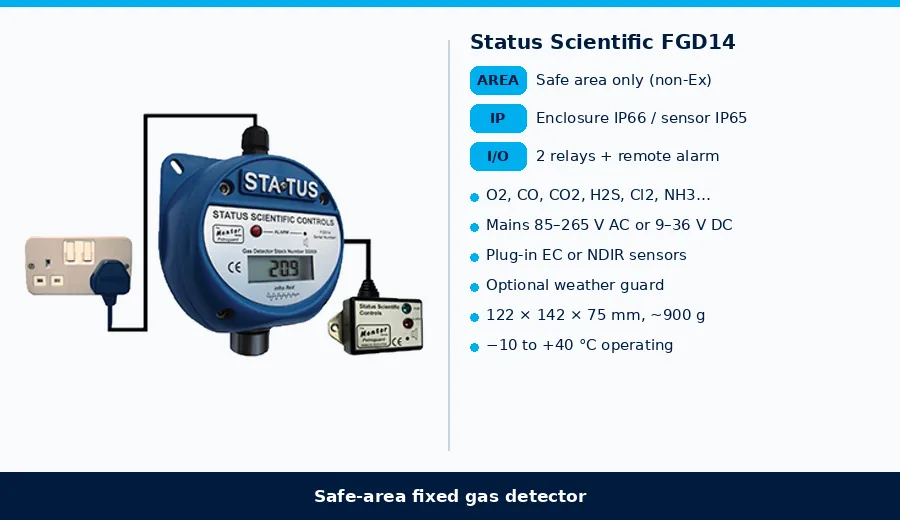
This note looks at the Status Scientific Controls FGD14 safe-area fixed gas detector, a mains- or DC-powered detector for oxygen and toxic gases with a remote visual and audible alarm unit and two built-in control relays. Figures come from the FGD14 datasheet (Dynament Dyn-TD06/139 Issue 7) hosted on our product page and from the current Tetracon product pages. Where we give general engineering advice it is labelled as general. No performance claim here goes beyond the manufacturer's published data. Tetracon (Pvt.) Ltd. is the sole authorized agent for Status Scientific Controls Ltd. in Pakistan.
Why a safe-area fixed detector?
- The hazard is real even when the zone is not. Many Pakistani boiler houses, parking levels, cold rooms and labs are non-hazardous by classification yet still expose people to CO, O2 deficiency, CO2, H2S, Cl2 or NH3 (datasheet application list; general HSE practice).
- Portable checks miss the night shift. A handheld reading once a day does not catch a slow leak that builds after hours. A fixed point with local and remote alarms stays on duty continuously (general).
- Stand-alone control when a panel is not justified. The FGD14 carries two user-adjustable alarm set points and two voltage-free changeover relays, so it can drive a beacon, siren, fan or interlock without a separate gas-detection panel (datasheet).
- Complementary to hazardous-area Status detectors. Where the plant also has Ex zones, see our note on Status Scientific fixed detectors for hazardous areas (FGD10A, FGD3, FGD56). The FGD14 is for safe areas only (datasheet warning).
How the FGD14 works
The FGD14 is a fixed wall-mount detector in a Bayblend (ABS/polycarbonate) enclosure. A plug-in electrochemical sensor, or an NDIR infrared sensor for CO2, measures the target gas. Two user-adjustable alarm set points drive two voltage-free single-pole changeover relays, a flashing red LED and an intermittent alarm tone on both the detector and the remote indicator unit (datasheet; product page).
Two power options are published: a mains version for 85 to 265 V AC at 47 to 440 Hz, and a DC version for 9 to 36 V DC (datasheet). Relay contacts are rated 1 A at 30 V DC non-inductive and can be set normally energised or normally de-energised (datasheet). Cable entries are 1 × M20 or ½" NPT plus 2 × M12 for the remote unit. An optional weather guard adds outdoor protection (detector about 900 g; weather guard 225 g). Enclosure IP66, sensor IP65; operating temperature −10 to +40 °C; dimensions 122 × 142 × 75 mm (datasheet).
The datasheet warning is unambiguous: these detectors must only be used where there is no risk of potentially explosive gases being present or created. For Ex i / Ex d duties, choose an intrinsically safe or flameproof Status model instead (datasheet; see hazardous-area note).
FGD14 at a glance
| Item | From the datasheet (Dyn-TD06/139 Issue 7) |
|---|---|
| Area rating | Safe (non-hazardous) area only |
| Gas types | Oxygen or toxic: O2, CO, CO2, NH3, Cl2, H2, H2S, NO2, SO2 |
| Sensor technology | Electrochemical, or NDIR infrared for CO2; plug-in replaceable |
| Example ranges | O2 0–21 % / 0–25 %; CO 0–50 ppm; CO2 0–2 / 0–5 / 0–100 %; NH3 0–100 / 0–1000 ppm; Cl2 0–20 ppm; H2 0–1000 ppm; H2S 0–50 ppm; NO2 0–20 ppm; SO2 0–20 ppm |
| Supply | Mains 85–265 V AC, 47–440 Hz, or DC 9–36 V DC |
| Alarms | 2 user-adjustable set points; flashing red LED and intermittent tone on detector and remote unit |
| Relays | 2 × voltage-free SPCO; N/E or N/DE selectable; 1 A, 30 V DC non-inductive |
| IP rating | Enclosure IP66, sensor IP65 |
| Size / weight | 122 × 142 × 75 mm; ~900 g (weather guard 225 g) |
| Operating temperature | −10 to +40 °C |
| Options | Remote visual/audible alarm unit; optional weather guard |
Where it fits in Pakistan
- Boiler rooms and plant rooms. Carbon monoxide from combustion plant and oxygen monitoring around confined mechanical spaces (datasheet: boiler rooms / car parks for CO; general).
- Underground and multi-storey parking. Fixed CO points with local indication and relay outputs to ventilation starters (datasheet application; general; see also our parking-garage CO/NO2 note for a dedicated garage transmitter approach).
- Cold stores and food / drinks cellars. Oxygen deficiency and CO2 build-up where doors stay shut for long periods (datasheet: confined spaces, breweries, cellars, food processing).
- Swimming-pool plant rooms. Chlorine monitoring near dosing and storage (datasheet).
- Laboratories, greenhouses and animal processing. CO2, CO, O2 or NH3 as listed on the datasheet application table (datasheet).
- Building health / IAQ projects. Where a fixed CO2 point with relays is preferred over a portable analyser (datasheet; general; compare CO2 monitoring for IAQ / HVAC).
Practical notes for a clean installation
- Confirm the area is safe (non-Ex). The FGD14 must not be used where flammable gas can be present. If the zone is classified, move to FGD3 (Ex i), FGD10A/FGD10B (Ex d) or FGD56 IR (datasheet warning; hazardous-area note).
- Mount for the gas density. CO and H2 tend to rise; heavier gases such as Cl2 and CO2 collect low. Place the sensor head where the gas will accumulate under the ventilation pattern you actually have (general practice).
- Use the remote unit where people look. Put the remote visual/audible indicator on a corridor, control desk or entrance so an alarm is seen and heard without walking into the room (datasheet feature; general).
- Wire the relays to a clear action. Typical safe-area actions are a beacon/siren, extract-fan start, door interlock or BMS digital input. Keep contact loading within 1 A at 30 V DC non-inductive, or use an interposing relay for higher loads (datasheet rating; general).
- Plan for sensor service. Sensors are plug-in replaceable. Keep a spare sensor of the same gas/range for critical points and schedule bump tests / calibration under your site procedure (datasheet; general).
- Weather guard outdoors. Use the optional weather guard where rain, wash-down or direct sun would otherwise hit the sensor (datasheet option; general for Pakistani outdoor plant).
Related Status Scientific detectors and when to choose them
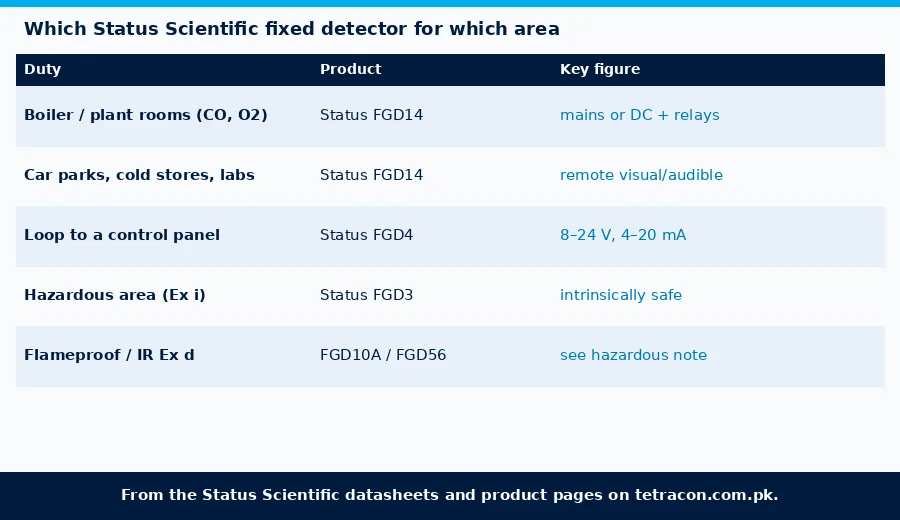
| Duty | Product | From the datasheet / product page |
|---|---|---|
| Safe-area fixed point with local/remote alarm and relays | Status FGD14 | Mains or DC; O2/toxics; 2 relays; remote alarm; IP66; safe area only |
| Safe-area loop-powered transmitter to a panel | Status FGD4 | 8–24 V DC; 4–20 mA 2-wire (3-wire for CO2); ~500 g; wide gas list |
| Hazardous-area intrinsically safe fixed point | Status FGD3 | Ex i fixed detector; see hazardous-area blog |
| Flameproof / infrared hazardous-area fixed point | FGD10A / FGD56 | Ex d and IR options; see hazardous-area Status note |
As a rule of thumb, choose the FGD14 when you need a self-contained safe-area detector with its own alarms and relays; the FGD4 when the reading must go as 4–20 mA into an existing panel; and an Ex-certified Status model when the area is classified. For oxygen-depletion specific rooms, also compare Ntron Gasenz oxygen-depletion monitoring. For HSE programme design across fixed and portable tools, see fixed vs portable gas detection (general).
What to send with an enquiry
- The gas (or gases) and the range you need (for example CO 0–50 ppm, O2 0–25 %, CO2 0–5 %).
- Whether the area is confirmed safe (non-Ex) or classified, and any site zoning drawing.
- Preferred supply: mains 85–265 V AC or 9–36 V DC.
- What the relays should drive (beacon, fan, BMS input, interlock) and the load.
- Whether a remote indicator and/or weather guard are required, and the mounting height / location.
- How many points, and whether you also need loop-powered FGD4 transmitters or hazardous-area Status detectors on the same project.
FAQ
Is the FGD14 suitable for hazardous (Ex) areas?
No. The datasheet states it must only be used where there is no risk of potentially explosive gases. For classified zones use Status FGD3, FGD10A/FGD10B or FGD56 as appropriate.
Which gases can it measure?
The datasheet lists oxygen and toxic gases including O2, CO, CO2, NH3, Cl2, H2, H2S, NO2 and SO2, with electrochemical sensors or NDIR infrared for CO2, in the ranges published on the datasheet table.
Does it need a separate gas-detection panel?
Not necessarily. Two user-adjustable set points drive two voltage-free changeover relays plus local and remote visual/audible alarms, so the FGD14 can operate stand-alone. If you prefer a 4–20 mA feed into an existing panel, consider the FGD4 instead.
What power supplies are available?
A mains version for 85 to 265 V AC (47 to 440 Hz) and a DC version for 9 to 36 V DC.
What is the IP rating and operating temperature?
Enclosure IP66 and sensor IP65, with an operating temperature of −10 to +40 °C. An optional weather guard is available for harsher outdoor mounting.
Who supplies Status Scientific in Pakistan?
Tetracon (Pvt.) Ltd. is the sole authorized agent for Status Scientific Controls Ltd. in Pakistan and supports selection, supply and local technical follow-up.
Next steps
Tetracon (Pvt.) Ltd. is the sole authorized agent for Status Scientific Controls Ltd. in Pakistan and supplies its fixed gas detectors with local technical support. Send us the gas, range, area classification, supply preference and what the relays should drive, and we will confirm whether the FGD14 or another Status model is the right fit. Use the contact page or see our services. Start with the FGD14, compare the FGD4 and FGD3, browse gas detection, or see all Status Scientific products and the full product catalogue. Related notes: Status fixed detectors for hazardous areas, oxygen-depletion monitoring with Gasenz, parking-garage CO/NO2 monitoring and fixed vs portable gas detection. Free technical guides are collected under Guides.