

Basement and multi-level car parks under Pakistani shopping malls, hospitals, office towers, hotels and apartment blocks collect vehicle exhaust in a space with little natural air movement. Carbon monoxide (CO) from petrol engines and nitrogen dioxide (NO2) from diesel vans, pick-ups and delivery trucks build up fastest exactly where people walk to their cars. Most of these car parks have big jet or axial extract fans. Few have a reliable gas measurement telling those fans when to run. So the fans either run flat out 24 hours a day and waste electricity, or they run on a timer and miss the evening rush.
This note covers car-park CO and NO2 monitoring with the ACI Q6/B6 Series dual-sensor gas transmitter. It explains what the ACI Q6/B6 datasheet specifies, how the main CO unit and the remote NO2 unit should be placed, how the three relays and the BACnet or Modbus link drive demand-controlled ventilation, and where the single-gas Q5/B5 Series and a portable Lascar EL-USB-CO logger fit. Instrument figures come from the ACI datasheet, the ACI B6 installation and operation manual, and the live Tetracon product page. No prices are given, and we do not quote exposure-limit numbers: alarm set-points should come from your HVAC consultant and the building code that applies.
Why enclosed car parks need CO and NO2 measurement
A car park is a combustion source with a roof on it. The ventilation design has to handle two quite different gases:
- Carbon monoxide. Mostly from petrol cars, especially cold starts and queues at exit barriers. CO is colourless and odourless, and on the ACI sensor table it is mounted at mid height, around breathing level.
- Nitrogen dioxide. Mostly from diesel engines: delivery vans, pick-ups, SUVs and service vehicles. NO2 is heavier than air, so ACI places the NO2 sensor low, near the floor.
- Energy. Car-park extract fans are among the biggest motors in a commercial building. Running them only when gas levels rise (demand-controlled ventilation) is one of the easiest energy savings in Pakistani buildings with high power tariffs.
- Occupant safety and audits. Malls, hospitals and corporate towers increasingly face fire, life-safety and insurance audits that ask how car-park ventilation is controlled and alarmed.
A CO-only detector leaves diesel NO2 unmeasured. Two separate detectors double the wiring and the BMS points. The Q6/B6 measures both gases with a single main unit.
ACI Q6/B6: what the datasheet says
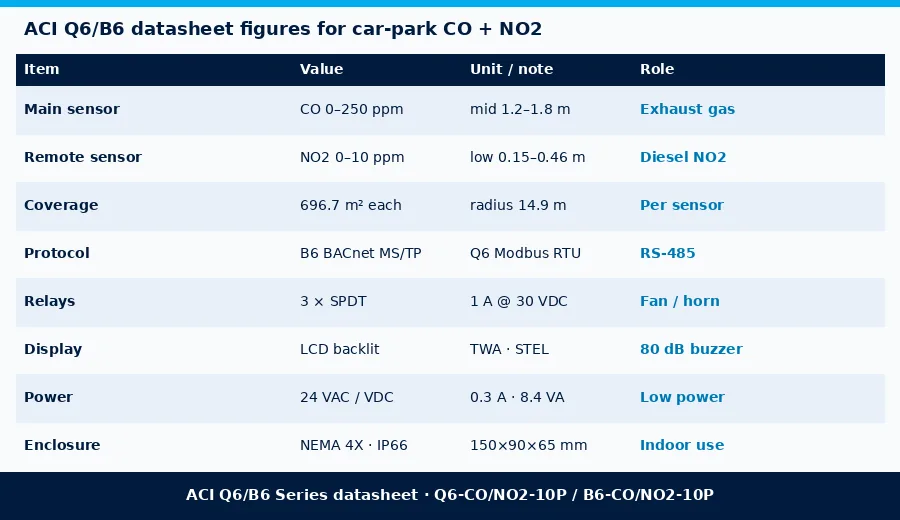
The Q6/B6 is a combo gas transmitter. A main unit always carries the carbon monoxide sensor, the LCD, status LEDs, buzzer and three user-configurable relays. A separate remote sensing unit carries the second gas and is mounted at the height that suits that gas's density. Both concentrations show on the main unit's LCD. The standard car-park pair is Q6-CO/NO2-10P (Modbus) or B6-CO/NO2-10P (BACnet): CO 0–250 ppm on the main unit and NO2 0–10 ppm on the remote. Sensor modules are factory calibrated and plug in. You swap one by removing a couple of screws, and a user password protects the settings.
| Specification | ACI Q6/B6 (ACI Q6/B6 Series datasheet) |
|---|---|
| Standard models | Q6-CO/NO2-10P (item 146117) and B6-CO/NO2-10P (item 146119, BACnet): main CO 0–250 ppm, remote NO2 0–10 ppm |
| Main sensor (CO-250P) | CO 0–250 ppm; −20…50 °C; coverage 7,500 ft² (696.7 m²), radius 49 ft (14.9 m); mid mounting 4–6 ft (1.20–1.83 m) above floor |
| Remote sensor (NO2-10P) | NO2 0–10 ppm; −20…50 °C; coverage 7,500 ft² (696.7 m²), radius 49 ft (14.9 m); low mounting 0.5–1.5 ft (0.15–0.46 m) above floor |
| Other remote gases (examples) | CO 0–1000 ppm, H2, CH4 (high mount), propane / LPG (low mount), NH3, IR CO2 0–5000 ppm, O2 0–25% vol and more, as listed in the datasheet sensor table |
| Communication | Q6: RS-485 Modbus RTU / OptoMux, 1200–76,800 bps (default 4800); B6: RS-485 BACnet MS/TP master or slave (default master), 9600–76,800 bps (default 38,400) |
| Relays | 3 × SPDT (Form C) dry contacts, 1.0 A max at 30 VDC or 0.3 A max at 125 VAC (resistive); 50,000,000 mechanical / 200,000 electrical operations minimum |
| Display, keypad and alarms | Backlit LCD graphic display (TWA, STEL and concentration); 3 capacitive touch keys; 2 green Tx/Rx and 3 red relay LEDs; buzzer 80 dB at 10 cm, 2700 Hz, 3 programmable tones |
| Power | 24 VDC nominal (18–30 VDC) or 24 VAC nominal (15–24 VAC); 0.3 A max, 8.4 VA; 0.750 A resettable polyswitch |
| Warm-up | 24 hours before calibrating the sensor after installation |
| Sensor life | CO: 7 years typical; electrochemical (toxic, e.g. NO2): 2–3 years typical; catalytic 3 years; O2/H2 18 months; infrared >5 years |
| Recommended maintenance | Electrochemical: accuracy and bump test every 6 months (or as required by code); catalytic every 3 months; O2/H2 calibrate every 3 months; infrared yearly |
| Enclosure | Polycarbonate (Lexan), UL94 V-0; NEMA 4, 4X, 12 and 13 (IP66); indoor use only; ¾″ knockouts accept ½″ conduit fittings; 150 × 90 × 65 mm |
| Ambient | 5–95% RH non-condensing; 14.696 psi (1.0132 bar) ±10%; storage 0–20 °C |
| Wiring | De-pluggable screw terminals, 16–24 AWG shielded twisted pair; Belden 9841 or equivalent (120 Ω) for communications |
| Warranty | ACI two-year limited warranty; sensor modules six months (electrochemical) or one year (catalytic) |
The ACI datasheet lists parking garages alongside mechanical rooms, warehouses, refrigeration plants, auto and truck maintenance facilities, industrial plants and oil and gas sites. The ACI B6 manual adds that the transmitter can be used in a "limited outdoor environment" that is not climate-controlled but is sheltered from wind and rain, and it gives parking garages as the example. That describes a typical Pakistani basement or podium car park.
How a car-park CO + NO2 system works
- Zone the car park. Each sensor in the ACI table covers 7,500 ft² (696.7 m²), a 49 ft (14.9 m) radius. Divide each level into zones of that size, then add points at ramps, exit barriers, loading bays and any dead corners the fans do not sweep.
- Mount at the right heights. Put the main CO unit at mid height, 1.20–1.83 m above the floor, where it is also easy to read and service. Put the remote NO2 unit low, 0.15–0.46 m above the floor, out of the way of bumpers and floor washing.
- Stage the relays. The three SPDT relays can switch fans, lights or horns directly without a separate controller. Typical staging is relay 1 for fan low speed, relay 2 for fan high speed and relay 3 for a horn/strobe or a BMS alarm input. The set-points come from your consultant. The LCD shows live concentration plus TWA and STEL values for the operator.
- Connect to the BMS. Choose B6 where the building automation system speaks BACnet MS/TP (default 38,400 bps; each B6 needs a unique MAC address and device instance). Choose Q6 for Modbus RTU, or for ACI's Q-series controllers over OptoMux. Run Belden 9841 or an equivalent 120 Ω cable and enable the RS-485 terminator at both ends of the run.
- Commission patiently. Allow the 24-hour warm-up before calibrating. Then bump-test both channels with the ACI gas calibration kit and calibration adaptor, and record the result for the handover file.
Q6/B6, Q5/B5 and related instruments: who does what
| Instrument | Primary job |
|---|---|
| ACI Q6/B6 | Fixed dual-gas transmitter: CO main unit plus remote second gas (NO2 for car parks); 3 relays; BACnet MS/TP (B6) or Modbus RTU / OptoMux (Q6); NEMA 4X / IP66, indoor. |
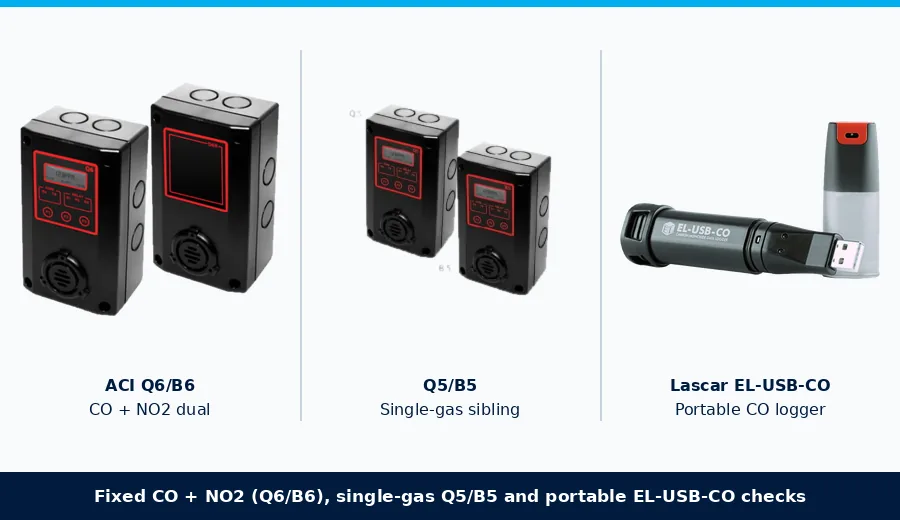
| Q5/B5 Series | Single-gas version of the same platform. One sensor per unit, plus 4–20 mA, 1–5 VDC or 2–10 VDC analog outputs on Q5. The datasheet lists CO models certified to UL 2075. Use it where only one gas is needed or where the controller expects an analog signal. |
| Lascar EL-USB-CO | Portable USB carbon monoxide data logger for surveys before design, for checking fan performance after commissioning, and for complaint investigations. It is not a substitute for fixed detection. See our note on CO data logging. |
| ACI DLP | Configurable-span differential pressure transmitter for building and duct static pressure. It is useful as independent proof that a car-park extract fan is actually moving air when the gas relays call for it. |
| Status Scientific FGD14 / FGD10A | Industrial fixed gas detectors — FGD14 for safe (non-hazardous) areas only, flameproof FGD10A for classified areas. The Q6/B6 is rated for indoor use and its datasheet carries no hazardous-area marking, so fuel-dispensing areas, generator fuel rooms and other classified zones need certified detectors. See fixed gas detectors for hazardous areas. |
Use the Q6/B6 when a car park, loading dock or vehicle workshop needs both CO and a second gas under one controller and one BMS address. Use the Q5/B5 when a single gas will do. Keep a portable CO logger in the facility team's kit for surveys and audits.
Field practice for Pakistani car parks
- Specify the gas pair on the PO. Q6-CO/NO2-10P or B6-CO/NO2-10P is the standard car-park pair. If you add LPG or CNG vehicles, or a generator room, review the remote-gas options and their mounting heights separately.
- Mind dust and washing. The enclosure is NEMA 4X / IP66, but the sensor opening still needs protection. ACI lists a sensor splash-guard kit and a protective guard for areas that are hosed down or very dusty.
- Keep away from switchgear. The B6 manual advises against mounting near 600 VAC switchgear or other RFI/EMI sources, and against running communication wiring beside AC power or relay wiring. Car-park LT panels and VFDs are common culprits.
- Plan the maintenance cycle. NO2 is an electrochemical sensor. Budget an accuracy and bump test every 6 months (or as your code requires) and a sensor module swap at 2–3 years. The CO sensor is rated around 7 years typical.
- Store spares cool. ACI recommends 0–20 °C storage. Electrochemical modules have a six-month shelf life from purchase, so don't stock up years ahead in a hot Karachi or Lahore store room.
- Log it. Trend CO and NO2 on the BMS along with fan status. Fan run-hours compared with gas peaks is the evidence an energy audit or insurance surveyor will ask for.
FAQ
What does the ACI Q6/B6 measure?
The ACI Q6/B6 Series datasheet describes a combo gas transmitter: a main unit that always measures carbon monoxide, plus a remote sensing unit for a second gas. The standard car-park models Q6-CO/NO2-10P and B6-CO/NO2-10P measure CO 0–250 ppm on the main unit and NO2 0–10 ppm on the remote unit. Both readings show on the main unit's backlit LCD with TWA and STEL values.
What is the difference between Q6 and B6?
Communication. The Q6 talks RS-485 Modbus RTU or ACI's OptoMux controller protocol (1200–76,800 bps, default 4800). The B6 talks RS-485 BACnet MS/TP as master or slave (9600–76,800 bps, default 38,400). Both have three SPDT relays, a buzzer, 24 VAC/VDC power and a NEMA 4X / IP66 polycarbonate enclosure for indoor use.
At what height should the CO and NO2 sensors be mounted?
The ACI sensor table places the CO sensor at mid height, 4–6 ft (1.20–1.83 m) above the floor, and the NO2 sensor low, 0.5–1.5 ft (0.15–0.46 m) above the floor. Each sensor covers about 7,500 ft² (696.7 m²), a 49 ft (14.9 m) radius.
How often do the sensors need maintenance?
ACI recommends an accuracy and bump test every 6 months for electrochemical (toxic) sensors such as NO2, or as required by code. Typical sensor life is 2–3 years for electrochemical sensors and 7 years for CO. Allow 24 hours of warm-up after installation before calibrating.
Where can Pakistani teams see the product and ask for support?
See the catalogue page for the ACI Q6/B6, browse gas detection, or contact Tetracon with your car-park area per level, number of levels, fan arrangement, and whether the BMS uses BACnet MS/TP or Modbus RTU.
Next steps
Tetracon supplies gas detection and building instrumentation to Pakistan's commercial, healthcare and industrial sites, including ACI products. Send us your car-park layout, the vehicle mix (petrol, diesel, LPG/CNG), the fan and VFD arrangement, and how alarms must reach your BMS. Use the contact page or see our services. Start with the catalogue pages for the Q6/B6, Q5/B5, DLP and EL-USB-CO. You can also browse gas detection or see all ACI products. Free technical guides are collected under Guides.