

Nitrogen, argon, helium and carbon dioxide are used every day in Pakistani hospitals, laboratories, food plants, pharma units, workshops and process plants. The first three give no warning at all: they have no colour, no smell and no taste, and a person breathing an oxygen-deficient atmosphere usually cannot recognise what is happening before they lose consciousness. A leaking nitrogen generator, a liquid-nitrogen dewar being filled in a small room or a panel vented with backup nitrogen can push the oxygen level in a room down quietly. A fixed room oxygen monitor is the simplest way to catch it in time.
This note explains the oxygen levels that matter, where depletion happens, and how Ntron's Gasenz ambient oxygen monitor is specified and installed. Instrument figures come from Ntron's Gasenz datasheet (NT-DS-2103-EN-01, 05/2025) and the Gasenz user manual (NT-UM-2107-EN-01), with Status Scientific's FGD10A and FGD4 datasheets for the hazardous-area and CO2 options. The oxygen thresholds and gas-handling guidance come from EIGA Doc 44/18, Hazards of oxygen-deficient atmospheres, and the CO2 exposure limits from NIOSH. No prices are given. Your sensor type, alarm points and number of monitors should be settled by your own risk assessment and confirmed at quotation.
The oxygen levels that matter
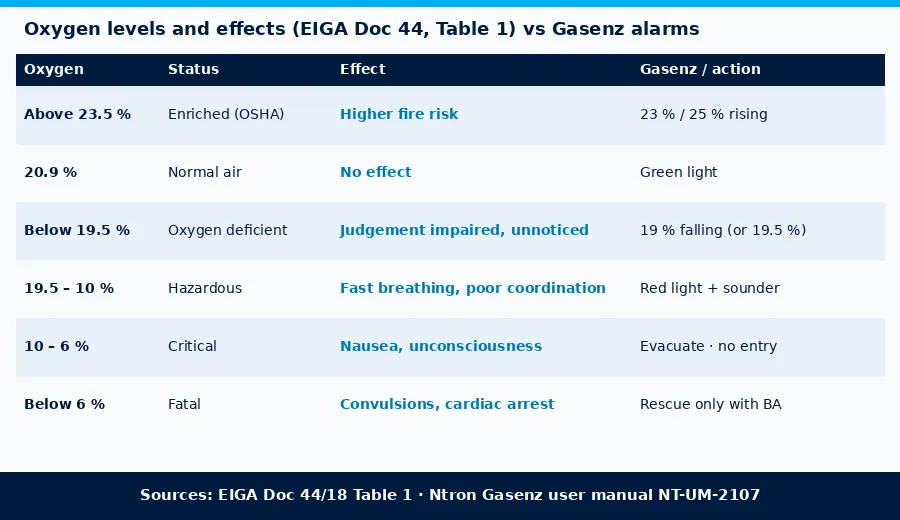
Normal air contains 20.9 % oxygen. EIGA Doc 44 treats any fall below 19.5 % as oxygen deficient and warns that the ability to concentrate, think and make decisions is impaired even slightly below normal levels, without the person noticing. Its Table 1, adapted from the US Code of Federal Regulations (29 CFR), sets out what happens as oxygen falls:
| Oxygen at sea level | Effect (EIGA Doc 44, Table 1) |
|---|---|
| Above 23.5 % | Outside the OSHA safe range on the high side: oxygen enrichment, which raises the fire risk |
| 20.9 % | Normal air |
| Below 19.5 % | Oxygen deficient |
| 19.5 to 10 % | Faster breathing and heartbeat; impaired attention, thinking and coordination |
| 10 to 6 % | Nausea, vomiting, lethargic movements, possible unconsciousness |
| Below 6 % | Convulsions, then breathing stops, followed by cardiac arrest. These symptoms can occur immediately. |
EIGA adds that in a very low-oxygen atmosphere a person can be endangered in one or two breaths and can lose consciousness within seconds. That is why the monitor has to raise the alarm before anyone walks in, not after they feel unwell.
How little gas it takes
EIGA gives a figure that surprises many people: one litre of liquid nitrogen produces about 0.65 m³ of gas when it evaporates, and liquid nitrogen, argon or helium produce roughly 0.65 to 0.78 m³ per litre. Here is a simple worst-case estimate, assuming no ventilation and that the gas mixes evenly and pushes the same volume of air out of the room: oxygen % ≈ 20.9 × (room volume − gas volume) ÷ room volume.
- A 4 m × 3 m room with a 2.5 m ceiling holds 30 m³.
- About 3 litres of liquid nitrogen (roughly 2 m³ of gas) is enough to bring it to 19.5 %.
- 5 litres (3.25 m³ of gas) takes it to about 18.6 %.
- A 25-litre dewar emptied into the room (16.25 m³ of gas) takes it to about 9.6 %, which is in the range where people collapse.
Real rooms have some ventilation, and gas rarely mixes perfectly. Dense, cold gas pools at floor level and can be far worse locally than the average. The arithmetic is only a reminder that small rooms, cold stores and labs do not need a big release to become dangerous. EIGA's guidance for enclosures where inert gas can leak includes continuous ventilation of at least 6 air changes per hour, warning devices for ventilation failure, and atmospheric monitoring placed by risk assessment.
Where oxygen depletion happens in Pakistani facilities
| Location | Why oxygen can fall (or rise) |
|---|---|
| Nitrogen generator (PSA or membrane) rooms and cylinder manifold rooms | Leaking fittings, relief valves and vents release nitrogen into small plant rooms. These rooms are common in food packaging (modified-atmosphere packing), pharma blanketing and electronics. |
| Liquid-nitrogen stores and dewar filling points | Hospital IVF and pathology labs, blood and cell banks, university labs and livestock semen banks fill and store dewars, often in small rooms. EIGA also lists lifts used to carry dewars. |
| Laboratories with GC, ICP and other gas-fed instruments | Carrier and plasma gases (nitrogen, argon, helium) and their cylinder stores in small or basement rooms. |
| Control rooms, analyser shelters and instrument panels | EIGA warns that when nitrogen backs up instrument air, continuously venting instruments can fill poorly ventilated panels and plant rooms with nitrogen. |
| Welding bays and gas stores | Argon and argon/CO2 shielding gases are heavier than air and collect in pits, trenches and basements. |
| Cold stores and food freezing | EIGA lists rooms where liquid-nitrogen food freezers operate and cold stores among the typical oxygen-deficiency locations. |
| Medical oxygen PSA plant rooms and oxygen cylinder stores | The opposite risk: a leak raises oxygen above 23.5 %, which increases the fire risk. See our note on medical oxygen PSA purity monitoring. |
| Hypoxic fire-prevention rooms | Data rooms and archives that are deliberately held below normal oxygen. Ntron lists hypoxic air fire prevention among Gasenz applications. Alarm points there are set by the system designer. |
MRI suites using liquid helium are also on EIGA's list. Any monitor near a scanner has to suit the magnetic environment, so agree the location with the MRI vendor first.
Ntron Gasenz at a glance
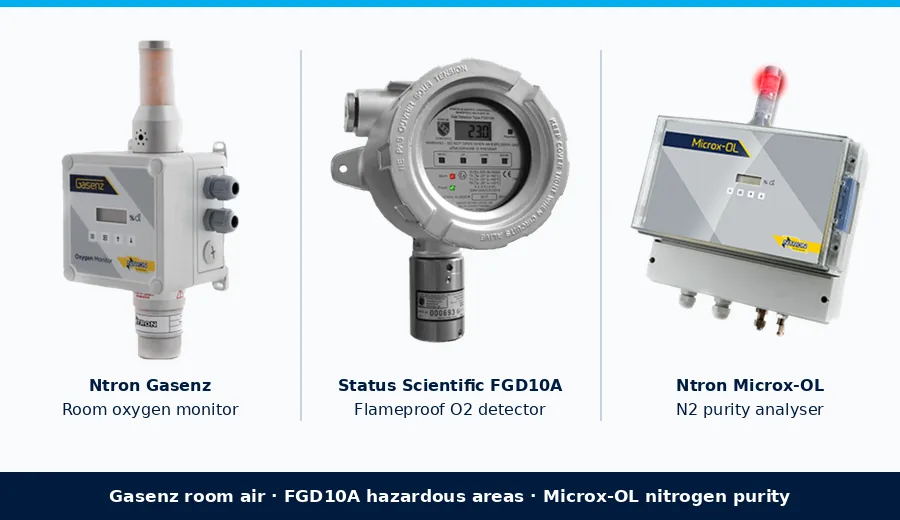
Gasenz is a wall-mounted monitor for personnel protection where oxygen deficiency or enrichment is a risk. It comes pre-calibrated with a factory calibration certificate, measures room air directly at its sensor, and has a built-in two-lamp LED light tower (green for normal, red for alarm) with a sounder. It can run on its own or report to a PLC, DCS or building management system.
| Item | Ntron specification |
|---|---|
| Measurement range | 0 to 25 % O2, 0.01 % output resolution |
| Response time | T90 under 15 seconds within the selected range at 25 °C |
| Sensor options | Zirconia (ZR) or electrochemical (EC). See the comparison below. |
| Ambient pressure range | 900 to 1,100 mbar absolute |
| Humidity | 0 to 95 %rh, non-condensing |
| Outputs | LCD in % O2; 4 to 20 mA (4 mA = zero, 20 mA = full scale); RS232 |
| Relays and alarms | Three relays tied to three alarm levels. Factory settings are 19 % falling (relay 1), 23 % rising (relay 2) and 25 % rising (relay 3), all adjustable, with alarm hysteresis to stop the relays chattering. One or two relays drive the light tower; the rest are volt-free contacts for your own use. |
| Power | 85 to 230 V AC (50/60 Hz) or 24 V DC; 7.2 W maximum (ZR) or 3.6 W (EC) |
| Housing | ABS, wall or vertical surface, about 110 × 109 mm plus the sensor housing (60 mm ZR, 40 mm EC); indoor use only |
| Area rating | Safe (non-hazardous) area only |
| Certification | ETL to UL 61010-1; EMC EN 50270 |
The manual notes that 19.5 % is the US OSHA lower alarm level for oxygen depletion. If your HSE procedure follows that figure, ask for the low alarm to be set at 19.5 % rather than the factory 19 %. Whichever you choose, write it into the risk assessment and the commissioning record.
Zirconia or electrochemical?
| Zirconia (ZR) | Electrochemical (EC) | |
|---|---|---|
| Operating temperature | −25 to +60 °C | 0 to +45 °C |
| Sensor life | Up to 5 years | Up to 18 months |
| Shelf life | Unlimited | Up to 3 months |
| Calibration interval (application dependent) | 12 months | 3 to 6 months |
| Best suited to | Clean rooms and plant rooms, cold stores below 0 °C and hot plant rooms up to 60 °C; lowest running cost over the years | Rooms where solvent or hydrocarbon vapours may be present (a heated zirconia cell can react with them); lower purchase price |
For Pakistan the temperature limits matter. A rooftop plant room in Multan, Sukkur or Jacobabad can go above 45 °C in summer, which is outside the EC sensor's range, and LN2 freezer rooms and cold stores can be below 0 °C. Both point to zirconia. Ntron advises keeping either sensor away from halogens (fluorine, chlorine, bromine), SOx, H2S, silicone-sealant vapours and adhesives, which shorten sensor life. The zirconia sensor runs warm, so let it cool before handling it during a sensor change.
Altitude is the other check. The 900 to 1,100 mbar pressure range comfortably covers Karachi, Lahore and Islamabad (around 950 mbar). For a site above about 1,000 m, such as Quetta, where normal air pressure is roughly 830 mbar, talk to us at quotation. EIGA also points out that the oxygen percentage stays the same at altitude but the oxygen partial pressure falls, so people there are already closer to the effects of oxygen deficiency.
Placing and installing the monitor
- Put it where the gas will be. Ntron's manual says to mount the monitor close to potential leak sources, but not so close that it alarms on trivial leakage, so that it gives early warning. Nitrogen at room temperature has almost the same density as air. Argon, CO2 and cold nitrogen vapour from a liquid spill are heavier and collect low, in pits, basements and lift shafts. Helium rises and collects behind false ceilings. EIGA asks for oxygen to be checked at different heights and locations for this reason.
- Size the coverage. Ntron gives one Gasenz a coverage of about 50 m², or roughly a 5 m radius, halved when it is mounted on a wall. A long LN2 store or a plant room with several leak points may need more than one monitor. Ntron also suggests back-up units where maintaining one monitor would otherwise leave the area unprotected.
- Mount it correctly. Upright, with the light tower on top and the sensor at the bottom, on a firm surface away from heat sources and wet areas. Gasenz is for indoor, safe areas only.
- Make the alarm visible before entry. The built-in tower and sounder warn people inside the room. Use a spare volt-free relay to drive a repeater beacon or sign outside the door, start extra ventilation, or close a gas supply valve. Send the 4 to 20 mA signal to the BMS or DCS so the reading is logged.
- Train people on the response. EIGA says everyone who works in or enters the area must know what to do when an oxygen alarm sounds or ventilation fails. Nobody should go in to rescue a collapsed colleague without breathing apparatus.
Hazardous areas, CO2 rooms and gas purity
Hazardous areas. Gasenz is a safe-area device. For analyser houses, compressor rooms or process units classified as Zone 1 or 2, use a certified detector such as the Status Scientific FGD10A: Ex db IIC T6…T4 Gb flameproof (IECEx SIR 08.0009X, Sira 08ATEX1031X), with an electrochemical oxygen sensor ranged 0 to 21 % or 0 to 25 %, a 4 to 20 mA output, RS232 or RS485 Modbus, and relays for two alarm levels plus fault. See our note on fixed gas detectors for hazardous areas.
CO2 needs its own detector. CO2 is toxic in its own right long before it displaces enough air to trip an oxygen alarm. NIOSH sets the Immediately Dangerous to Life or Health level at 40,000 ppm (4 %), and the OSHA limit for an 8-hour shift is 5,000 ppm. A 4 % CO2 atmosphere still holds about 20.1 % oxygen, which is above a 19.5 % alarm, so the oxygen monitor would stay silent. EIGA says hazard-specific detection must be added wherever CO2, toxic or flammable gases can be present. In beverage carbonation rooms, dry-ice stores and CO2 cylinder banks, use a CO2 detector such as the Status Scientific FGD4 with its NDIR sensor (ranges from 0 to 500 ppm up to 0 to 100 %, safe areas, 4 to 20 mA to a control panel). The FGD10A is the hazardous-area equivalent. Our note on CO2 monitoring covers ventilation-level CO2.
Room air or gas purity? Gasenz watches the air people breathe. Checking the oxygen content of the nitrogen a generator delivers is a different measurement, made on a pressurised sample line with an analyser such as the Ntron Microx-OL (0 to 1,000 ppm, 0 to 25 % or 0 to 96 % O2, with internal pressure and flow regulation and an integral alarm beacon). A nitrogen generator room often needs both. For tank and vessel inerting, see our note on oxygen blanketing and inerting.
Calibration and routine checks
- Calibration interval: Ntron gives 12 months for zirconia and 3 to 6 months for electrochemical sensors, depending on the application. EIGA treats oxygen detectors as critical equipment that must be maintained and calibrated to the manufacturer's instructions.
- Span check: in clean outdoor-quality air (20.9 %), allowing about 2 minutes for the reading to settle, as the manual describes. A lower calibration gas needs longer to stabilise.
- Prove the alarm chain: a fresh-air span check proves the reading, not the alarm. Periodically apply a certified low-oxygen test gas below the alarm point to show that the relay, light tower, sounder, door beacon and BMS signal actually operate, and record the result.
- Watch the sensor's health: after each new sensor is fitted, store its baseline with the "new sensor data" function so later checks show how much of the sensor's capacity remains. A faulty or badly fitted sensor shows FLT on the display.
- Keep it dry: do not expose the sensor to moisture while the monitor is unpowered, and clean the housing only with a damp cloth, never solvents or high-pressure water.
What to send with an enquiry
- The gases stored or used (nitrogen, argon, helium, CO2, oxygen), in what form (cylinders, generator, liquid, pipeline) and the largest credible release.
- Room sizes, ceiling heights, low points such as pits and basements, and the ventilation rate.
- Room temperature range in summer and winter, and the site altitude.
- Whether any part of the area is classified as a hazardous zone.
- Your alarm points (for example 19.5 % falling and 23.5 % rising) and what each relay should do: beacon, ventilation, gas shut-off.
- Signals needed for the BMS, DCS or PLC (4 to 20 mA, relay contacts).
FAQ
At what oxygen level should a room oxygen monitor alarm?
Normal air is 20.9 % oxygen, and EIGA Doc 44 and OSHA treat anything below 19.5 % as oxygen deficient and anything above 23.5 % as enriched. Ntron ships Gasenz with alarms at 19 % falling and 23 % rising (plus 25 % rising on a third relay), and the manual notes that 19.5 % is the OSHA lower alarm level. The points are adjustable to suit your risk assessment.
Can the Ntron Gasenz be installed in a hazardous area?
No. Gasenz is a safe-area, indoor device. For Zone 1 or Zone 2 areas use a certified detector such as the Status Scientific FGD10A flameproof detector with an oxygen sensor.
Should I choose the zirconia or the electrochemical sensor?
Zirconia lasts up to 5 years, has an unlimited shelf life, works from −25 to +60 °C and needs calibrating about every 12 months. Electrochemical costs less to buy but lasts up to 18 months, works from 0 to 45 °C and needs calibrating every 3 to 6 months. Electrochemical suits areas where solvent or hydrocarbon vapours may be present.
Does an oxygen monitor protect against a CO2 leak?
Not on its own. CO2 is dangerous at concentrations that barely lower the oxygen reading: at 4 % CO2 (the NIOSH IDLH level) oxygen is still about 20.1 %. Use a dedicated CO2 detector, such as the Status Scientific FGD4 with an NDIR sensor, wherever CO2 is stored or used.
How many Gasenz monitors does a room need?
Ntron gives a coverage of about 50 m² (roughly a 5 m radius) per monitor, halved for wall mounting. The final number depends on the leak points, gas density, ventilation and room layout, and should come from a risk assessment.
Where can Pakistani facilities see the product and ask for a quotation?
See the Gasenz catalogue page, browse oxygen analysis and gas detection instruments, or contact Tetracon with your gases, room sizes, temperatures and alarm requirements.
Next steps
Tetracon supplies Ntron oxygen monitors and analysers and Status Scientific gas detectors to hospitals, laboratories, food, pharma and process plants across Pakistan. Send us the gases you use, your room sizes and ventilation, your temperature and altitude, any hazardous-area zones and the alarm actions you need, and we will propose the sensor type, number of monitors and alarm wiring. Use the contact page or see our services. Start with the Gasenz catalogue page and the related FGD10A, FGD4 and Microx-OL pages, or see all Ntron and Status Scientific products. For choosing between fixed and portable detection, see our note on fixed versus portable gas detection. Free technical guides are collected under Guides.