

Since 2020, many Pakistani hospitals, from large teaching hospitals to district headquarters hospitals and private clinics, have installed on-site pressure swing adsorption (PSA) oxygen plants. A PSA plant turns compressed air into Oxygen 93 % and feeds it straight into the medical gas pipeline. That makes the hospital its own oxygen manufacturer, and a manufacturer needs to know, minute by minute, that what leaves the plant is actually medical-grade oxygen. A purity reading taken once at commissioning, or a detector tube used once a month, cannot show what happens when a zeolite bed ages, a dryer fails in the monsoon, or a diesel generator's exhaust drifts towards the compressor intake.
This note covers continuous purity monitoring of PSA medical oxygen with the Ntron MoGas medical gas analyser. It explains what the MoGas datasheet specifies, how its oxygen, carbon monoxide, carbon dioxide and optional moisture channels line up against the WHO International Pharmacopoeia limits for Oxygen 93 %, how to install it on a plant, and where the Microx-OL, the Gasenz room monitor and a Michell Easidew I.S. dew-point transmitter fit. Instrument figures come from the Ntron and Michell datasheets and Ntron's medical-use oxygen brochure. Limits come from the WHO International Pharmacopoeia medicinal oxygen monograph (working document QAS/20.867/Rev6). No prices are given. Your hospital's own specification, consultant and regulator decide alarm set-points and release testing.
Why a PSA oxygen plant needs continuous purity monitoring
A PSA generator separates nitrogen from compressed air on zeolite beds and delivers oxygen that is mostly argon and nitrogen for the rest. The WHO monograph defines Oxygen 93 % as 90.0–96.0 % v/v O2, produced by PSA or vacuum swing adsorption, and states plainly that during production, the oxygen content is continuously monitored. Several things can push a plant out of that band, or let impurities through:
- Purity drift. Bed ageing, valve faults, a high flow demand during a surge of patients, or a short cycle can drop oxygen below 90 %. The ward does not notice until patients' saturation falls.
- Moisture. Zeolite does not tolerate wet air. A failed refrigeration or desiccant dryer during Pakistan's humid monsoon months can damage the beds and push water into the pipeline. The monograph limits water to 67 ppm v/v.
- Carbon monoxide. The beds are designed to separate nitrogen, not to guarantee protection against CO drawn in at the compressor intake. Standby diesel generators, ambulance bays and car parks near the plant room are real concerns at Pakistani hospitals. The limit is 5 ppm.
- Carbon dioxide. Intake air near kitchens, boilers or traffic, or a saturated pre-treatment stage, shows up as CO2. The limit is 300 ppm.
- Evidence. Inspectors, hospital management and donors who funded a plant increasingly ask for a purity record, not just a commissioning certificate.
The monograph's own CO, CO2 and water tests use detector tubes, which are spot checks. A wall-mounted analyser fills the gap between those checks with a continuous reading and an alarm.
Ntron MoGas: what the datasheet says
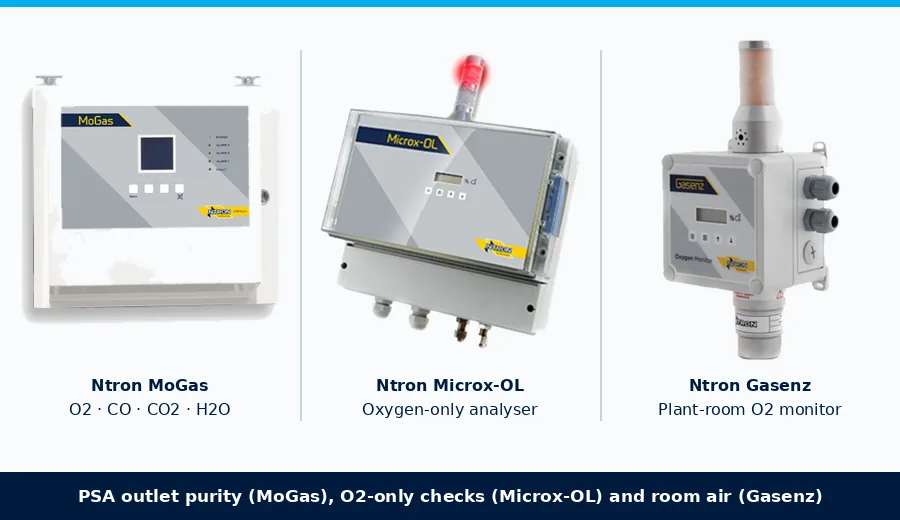
The MoGas is a wall-mounted medical gas purity analyser designed for medical oxygen generation systems. It measures oxygen, carbon dioxide and carbon monoxide, plus moisture as an option, up to four parameters at the same time, and shows them on a large backlit LCD. Ntron describes the MoGas93 configuration as aimed at oxygen generators producing 93 % oxygen, with flow and regulatory control included. Two versions are offered: MoGas-1 with a zirconia oxygen sensor and MoGas-2 with a paramagnetic oxygen sensor, each with or without the moisture channel.
| Specification | Ntron MoGas (Ntron datasheet 06-239-P-001) |
|---|---|
| Oxygen, zirconia (MoGas-1) | 0–96 % O2; T90 < 3 s; −20…+50 °C; sensitivity 0.1 % |
| Oxygen, paramagnetic (MoGas-2) | 0–100 % O2; T90 < 3 s; +5…+45 °C; sensitivity 0.2 % |
| Carbon dioxide, infrared | 0–1000 ppm; T90 < 20 s; −20…+50 °C; sensitivity 3 ppm |
| Carbon monoxide, electrochemical | 0–50 ppm; T90 < 20 s; −30…+50 °C; sensitivity 0.3 ppm |
| Moisture | Optional moisture transmitter (H2O versions in the ordering table) |
| Outputs and alarms | 4–20 mA per channel; 2 alarm contacts per channel; one common fault relay; programmable O2, CO and CO2 alarms; optional built-in audible and visual alarms |
| User interface | Large backlit LCD; 4-button multifunction keypad (Ntron's brochure also lists data and event logging) |
| Sample gas | Positive-pressure samples up to 10 barg, regulated within the enclosure; 6 mm or ¼″ sample connection |
| Power | 100–240 VAC, 50–60 Hz |
| Enclosure | Painted mild steel (RAL 9010), IP65; 422 (w) × 360 (h) × 188 (d) mm; 16 kg; two M20 gland entries |
| Environment | −20…+50 °C overall operating; 15–95 % RH non-condensing |
| EMC | CE marked; tested to EN 61000-6-4, EN 61000-6-2, EN 55022, EN 61000-3-3 and EN 61000-3-2 |
| Ordering (examples) | MoGas-1 O2/CO/CO2 zirconia: 02-715 (6 mm) or 03-822 (¼″); MoGas-2 paramagnetic: 02-572 (6 mm) or 06-245 (¼″); moisture versions 06-271 to 06-274 |
Ntron lists validation of medical oxygen generators, product purity on oxygen generators and compressed air systems, pharmaceutical plants and bottling/filling plants as MoGas applications. The last point matters in Pakistan, where some PSA plants also fill cylinders for smaller hospitals.
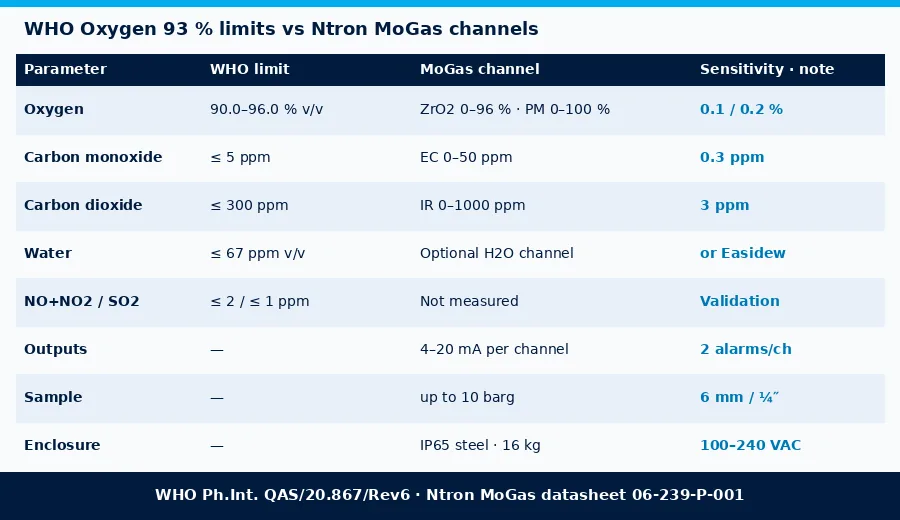
MoGas channels against the Oxygen 93 % limits
| Parameter | WHO Ph.Int. limit (Oxygen 93 %) | MoGas channel | Comment |
|---|---|---|---|
| Oxygen | 90.0–96.0 % v/v | Zirconia 0–96 % (0.1 %) or paramagnetic 0–100 % (0.2 %) | Both cover the band. The monograph's assay uses a paramagnetic analyser, so MoGas-2 follows the same principle. |
| Carbon monoxide | ≤ 5 ppm | 0–50 ppm, 0.3 ppm sensitivity | Range brackets the limit with room to see a rising trend. |
| Carbon dioxide | ≤ 300 ppm | 0–1000 ppm, 3 ppm sensitivity | The limit sits in the lower third of the range. |
| Water | ≤ 67 ppm v/v | Optional moisture channel | Order an H2O version, or add a dew-point transmitter after the dryer. |
| NO + NO2, SO2, oil, particulates | ≤ 2 ppm, ≤ 1 ppm, ≤ 0.1 mg/m³, controlled | Not measured | Covered by the plant's validation and periodic testing. |
A continuous analyser is an early-warning and record-keeping tool. It does not replace the validation of the production method or any release testing your regulator or hospital specification requires.
Installing MoGas on a hospital PSA plant
- Pick the sample point. Take the sample after the oxygen receiver and before the pipeline isolation valve, so the analyser sees what patients will receive. The MoGas accepts positive-pressure samples up to 10 barg and regulates them inside the enclosure, so a typical plant outlet can be connected with a 6 mm or ¼″ tube without an external pump.
- Choose zirconia or paramagnetic. MoGas-1 (zirconia, 0–96 %) suits a plant that only ever delivers Oxygen 93 %. Choose MoGas-2 (paramagnetic, 0–100 %) if the same manifold can switch to cylinder or liquid oxygen (Oxygen 99.5 %), or if your quality team wants the same measuring principle as the pharmacopoeial assay. Note the paramagnetic cell's narrower +5…+45 °C range.
- Decide on moisture. Order an H2O version of the MoGas, or follow Ntron's PSA schematic and put a Michell Easidew I.S. transmitter (−100…+20 °C dew point, ±2 °C, 4–20 mA as dew point or ppmV) on the dryer outlet. That catches a dryer failure before wet air reaches the zeolite beds.
- Wire the alarms. Each channel has a 4–20 mA output and two alarm contacts, and there is one common fault relay. Typical practice is a low-oxygen alarm and high-CO / high-CO2 alarms to the plant PLC (to switch to the cylinder reserve manifold) and to the hospital BMS or nurse-station alarm panel, with the fault relay wired as a separate "analyser not healthy" signal.
- Commission and calibrate. Check each channel with certified calibration gas at commissioning, record the result for the plant file, and set a recurring check interval with your service provider.
MoGas, Microx-OL, Gasenz and related instruments: who does what
| Instrument | Primary job |
|---|---|
| Ntron MoGas | Wall-mounted multi-gas purity monitor for the generator outlet: O2 (zirconia or paramagnetic), CO, CO2 and optional moisture, with 4–20 mA, alarm contacts per channel and a fault relay. IP65 steel enclosure. |
| Ntron Microx-OL | Compact wall-mounted oxygen-only analyser for gas under positive pressure: zirconia 0–1000 ppm / 0–25 % / 0–96 % or electrochemical 0–25 %; ±2 % of reading; inlet up to 21 bar with internal pressure and flow regulation; visual alarm beacon; 4–20 mA and RS232 Modbus. A budget option for smaller plants or a second oxygen check point. |
| Ntron Gasenz | Ambient oxygen monitor for personnel protection where there is a risk of oxygen deficiency or enrichment: 0–25 % O2, integrated audible and visual alarms, 4–20 mA, RS232 and a 5 A relay. It belongs in the PSA plant room and manifold room, which can collect both oxygen leaks and the nitrogen-rich exhaust the plant vents. |
| Michell Easidew I.S. | Dew-point transmitter (−100…+20 °C dew point, ±2 °C) for the compressed-air dryer outlet ahead of the zeolite beds. |
| QED Geotech G210 | Portable analyser for verifying piped O2, N2O, CO and CO2 at ward terminal units after pipeline work. See our note on medical gas verification. |
Use the MoGas where a plant feeds patients directly and you need oxygen, CO and CO2 under one alarm scheme. Use the Microx-OL where an oxygen-only reading is enough. Put a Gasenz in every enclosed room with oxygen generators, receivers or manifolds, and keep a portable analyser for outlet checks.
Field practice for Pakistani hospitals
- Put the analyser on the UPS. The MoGas runs on 100–240 VAC, 50–60 Hz. Feed it from the same UPS or generator-backed supply as the plant controls, so the purity record does not stop during load-shedding, when the plant is restarting and most likely to be off-spec.
- Keep the plant room inside the rating. The overall operating range is −20…+50 °C and 15–95 % RH non-condensing, and the paramagnetic option is rated +5…+45 °C. Compressor rooms in Karachi, Multan or Sukkur summers need ventilation, and the analyser should not hang next to a compressor discharge.
- Watch the compressor intake. If CO alarms appear when the standby generator runs or ambulances queue, move the intake. No analyser can fix a bad intake location, but it will prove the problem.
- Specify on the PO. State MoGas-1 or MoGas-2, with or without H2O, the sample connection (6 mm or ¼″) and the supply voltage, using the Ntron part numbers in the table above.
- Trend it. Log O2, CO, CO2 and dew point on the plant PLC or BMS alongside compressor and dryer status. A purity trend next to the maintenance log is the most convincing evidence for an inspector or a hospital board.
FAQ
What does the Ntron MoGas measure?
The Ntron MoGas datasheet describes a wall-mounted medical gas purity analyser that measures oxygen (zirconia 0–96 % or paramagnetic 0–100 %), carbon dioxide (infrared, 0–1000 ppm) and carbon monoxide (electrochemical, 0–50 ppm), with an optional moisture channel. It shows up to four parameters at once on a backlit LCD.
What purity should a PSA medical oxygen plant deliver?
The WHO International Pharmacopoeia monograph defines Oxygen 93 % as 90.0–96.0 % v/v oxygen produced by PSA or VSA, with limits including carbon dioxide ≤ 300 ppm, carbon monoxide ≤ 5 ppm and water ≤ 67 ppm v/v. It also states that the oxygen content is continuously monitored during production.
Should I choose the zirconia or the paramagnetic MoGas?
The zirconia MoGas-1 (0–96 %, −20…+50 °C) suits a plant that delivers only Oxygen 93 %. The paramagnetic MoGas-2 (0–100 %, +5…+45 °C) also covers Oxygen 99.5 % from cylinders or liquid supply and uses the same principle as the monograph's paramagnetic assay.
What outputs and alarms does the MoGas have?
Each channel has a 4–20 mA output and two alarm contacts, and there is one common fault relay. Oxygen, CO and CO2 alarms are programmable, and built-in audible and visual alarms are optional. The analyser runs on 100–240 VAC and sits in an IP65 painted steel enclosure.
Where can Pakistani hospitals see the product and ask for support?
See the catalogue page for the Ntron MoGas, browse oxygen analysis, or contact Tetracon with your plant capacity, outlet pressure, whether cylinder or liquid oxygen also feeds the pipeline, and where alarms must report.
Next steps
Tetracon supplies oxygen and gas analysis instruments to Pakistan's hospitals, pharmaceutical plants and industrial gas producers, including Ntron products. Send us your PSA plant size, outlet pressure, dryer type, the reserve-manifold arrangement and how alarms must reach your BMS or nurse stations. Use the contact page or see our services. Start with the catalogue pages for the MoGas, Microx-OL, Gasenz and Easidew I.S.. You can also browse oxygen analysis and gas analysis, or see all Ntron products. Free technical guides are collected under Guides.