

Pakistani hospitals and laboratories depend on gases they rarely measure. IVF centres and microbiology labs in Lahore, Karachi and Islamabad trust the CO2 display on their incubators. Operating theatres, dental clinics and veterinary practices use nitrous oxide every day without knowing what staff actually breathe. Many hospitals now produce their own oxygen with PSA plants and receive nitrous oxide and oxygen through pipelines that contractors extend or repair. In each case, a wrong gas, a drifting sensor or a leak can go unnoticed until something goes wrong.
This note covers three practical checks: verifying CO2 incubators, monitoring theatre nitrous oxide exposure, and verifying piped medical gases at the outlet. For each one it explains what the limits are and what a portable analyser can and cannot prove. It maps each check to real catalogue instruments from QED Environmental Systems (Geotech range): the G100 CO2 incubator analyser, the G110 CO2 analyser, the G200 N2O analyser and the G210 piped medical gas analyser. Every instrument specification below comes from the published QED datasheets.
Three gas checks most facilities skip
- CO2 incubator verification. Cell culture, IVF and microbiology incubators control CO2 (commonly around 5 %) and temperature (commonly 37 °C) with their own sensors, which drift. An independent reading shows whether the chamber really holds its setpoint.
- Nitrous oxide exposure. Waste N2O from anaesthesia, sedation and "gas and air" builds up where scavenging or ventilation is poor. The UK workplace exposure limit is 100 ppm as an 8-hour time-weighted average (TWA), and the HSE notes that healthcare shift patterns rarely follow a regular 8-hour day, so readings need careful interpretation.
- Piped medical gas verification. After pipeline work, outlet changes or a new manifold or PSA plant, each terminal unit should deliver the right gas, at the right concentration, without contaminants such as carbon monoxide or carbon dioxide.
Four Geotech analysers compared
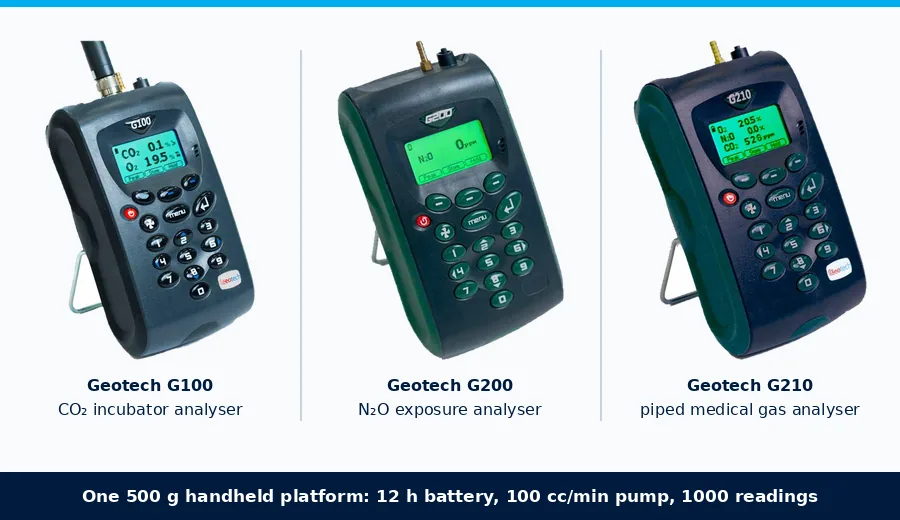
All four share the same handheld platform: 165 × 100 × 55 mm, about 500 g, IP40, a Li-ion battery rated for 12 hours (10 hours with the pump running), a 100 cc/min sample pump, storage for 1000 reading sets plus 270 events, and USB download. The battery life matters during load-shedding, and the small size means one person can carry the analyser from ward to ward.
| Analyser | Gases and ranges | Typical accuracy (after calibration) | Response T90 | Best for |
|---|---|---|---|---|
| Geotech G100 | CO2 0–20 % (dual-wavelength IR); options: O2 0–100 %, two temperature probes 0–50 °C, RH probe | CO2 ±1 % of range; temperature ±0.1 °C from 32 to 44 °C | CO2 ≤20 s, O2 ≤60 s | CO2 incubators in IVF, research, pharma and hospital labs |
| Geotech G110 | CO2 0–100 % (IR); same O2, temperature and RH options | CO2 ±1 % of range | CO2 ≤20 s | High-CO2 atmospheres in food processing, brewing, research and medical use |
| Geotech G200 | N2O 0–1000 ppm (IR), 1 ppm resolution; 0–10,000 ppm leak-detection mode (indication only) | ±5 ppm from 0 to 100 ppm; ±1.5 % of range above 100 ppm | ≤40 s | Background and breathing-zone N2O in theatres, dental, veterinary and X-ray departments |
| Geotech G210 | N2O 0–100 %, CO2 0–2000 ppm (IR); options: O2 0–100 %, CO 0–500 ppm (electrochemical) | N2O ±1 % of range; CO2 ±3 % of range; O2 ±0.5 % of range; CO ±2 ppm from 0 to 20 ppm | N2O and CO2 ≤20 s; O2 and CO ≤60 s | Piped N2O and O2 quality checks and leak detection in hospitals |
Verifying CO2 incubators with the G100
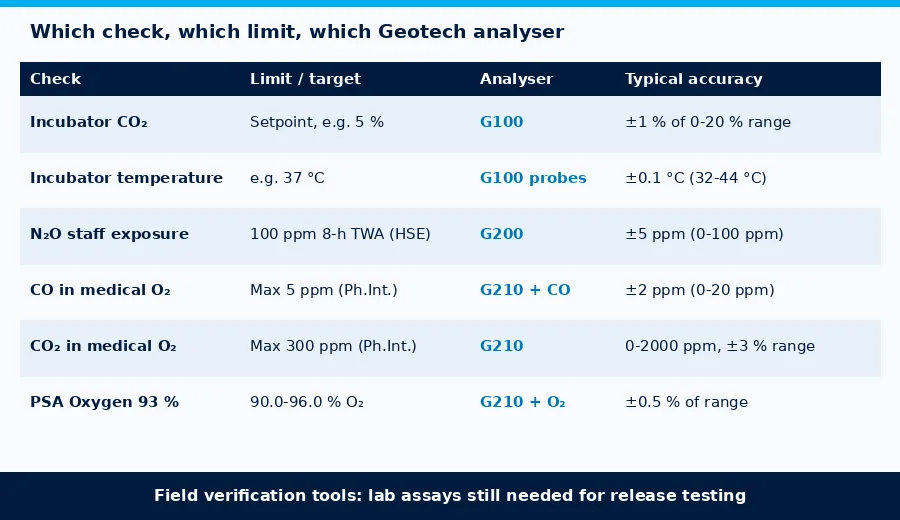
An incubator's built-in CO2 sensor is usually adjusted against itself. If it drifts, the display still shows the setpoint while the chamber does not, and pH-sensitive cultures and embryos pay the price. The G100 was designed for this check. It measures CO2 from 0 to 20 % with a dual-wavelength infrared sensor that has a reference channel, to ±1 % of range after calibration, with a T90 response of 20 seconds or less. A built-in gas dryer tube and a replaceable PTFE water trap protect the sensor from the humid incubator air.
Two optional temperature probes cover 0 to 50 °C, with a typical accuracy of ±0.1 °C between 32 and 44 °C, which is the band that matters for a 37 °C incubator. With two probes you can check two shelves, or two incubators, in one visit. Optional extras include an O2 cell (0–100 %, for low-oxygen incubators) and an RH probe (0–100 %RH non-condensing, ±1.5 %RH). QED states that the G100 is calibrated to ISO 17025 under UKAS certificate number 4533.
Good practice for an incubator check:
- Sample through the incubator's sample port rather than opening the door, so you measure the chamber atmosphere and not room air.
- Let the reading settle and log it with the incubator ID, date and setpoint. The G100 stores 1000 reading sets that can be downloaded to a PC for QA records.
- Record the incubator display next to the analyser value. That gives you the as-found offset before anyone adjusts the incubator.
- Calibrate the analyser itself with certified gas. QED quotes all accuracies after calibration plus the accuracy of the calibration gas used.
For atmospheres above 20 % CO2, such as gas blends in food packaging, brewing or controlled-atmosphere stores, the G110 covers 0 to 100 % CO2 with the same accuracy specification and options. For room air quality in ppm, see our note on CO2 monitoring for indoor air quality.
Theatre and clinic nitrous oxide exposure with the G200
Nitrous oxide is still widely used in anaesthesia, labour analgesia and dental sedation. Leaking hoses, poorly fitting masks, exhaled gas and weak scavenging all add to the room concentration. The HSE sets a long-term workplace exposure limit of 100 ppm (183 mg/m³) as an 8-hour TWA and expects exposure to be assessed through a COSHH risk assessment of each space where it is used.
The G200 is built for this job. It measures N2O from 0 to 1000 ppm with 1 ppm resolution and an accuracy of ±5 ppm from 0 to 100 ppm (±1.5 % of range above that), with a T90 of 40 seconds or less. It calculates the TWA and compares readings against EH40 occupational exposure limits, with user-settable N2O and TWA alarms. A leak-detection mode extends to 10,000 ppm (indication only) for tracing leaks at cylinder manifolds, N2O storage and pipeline joints. A soda-lime filter removes CO2 from the sample, and up to 50 site IDs and 300 sample-point IDs keep surveys organised by theatre and position.
- Background surveys: measure at fixed points such as the anaesthetic machine, the head of the table and the recovery bay during typical cases.
- Breathing-zone checks: sample near the anaesthetist's, dentist's or midwife's breathing zone, because that is where exposure happens.
- Before and after: repeat the survey after fixing scavenging, ventilation or leaks, so you can show the improvement.
- Warm-up: QED recommends a 45-minute warm-up for best performance during continuous monitoring.
Piped N2O and oxygen verification with the G210
A pipeline outlet that delivers the wrong gas is one of the most serious failures a hospital can have, and it usually follows construction, outlet replacement or manifold work. The G210 is designed to verify the quality of piped N2O and O2 in hospitals. It measures N2O 0–100 % (±1 % of range) and CO2 0–2000 ppm (±3 % of range) by infrared, with optional O2 0–100 % (±0.5 % of range) and CO 0–500 ppm (±2 ppm from 0 to 20 ppm) by electrochemical cells. Each outlet can be logged against a site ID and sample-point ID, and alarms can be set for all four gases.
Put those numbers next to the limits. The WHO International Pharmacopoeia monograph for medicinal oxygen allows at most 5 ppm CO and 300 ppm CO2 in both Oxygen 93 % and Oxygen 99.5 %. It defines Oxygen 93 %, the product of PSA and VSA plants, as 90.0 to 96.0 % O2. That gives a practical division of labour:
- Identity and cross-connection checks: the G210 shows immediately whether an outlet delivers oxygen or nitrous oxide, and roughly how much.
- Contaminant screening: CO resolution of ±2 ppm at low levels and a CO2 range of 0–2000 ppm let you screen against the 5 ppm and 300 ppm limits and flag outlets for further investigation.
- PSA oxygen: an O2 accuracy of ±0.5 % of range is enough to confirm that a plant's output stays inside the 90–96 % band at the outlet.
- What it does not replace: the pharmacopoeial assay for oxygen uses a paramagnetic analyser, and the monograph also limits water (67 ppm), oil, NO/NO2 and SO2. Batch release and moisture testing therefore need their own methods. For moisture, see our guide to portable dew-point hygrometers.
Common mistakes
- Uncalibrated analysers. All QED accuracy figures apply after calibration and include the uncertainty of the calibration gas. Keep certified gases and a calibration record for the analyser itself.
- Sampling room air by accident. Opening an incubator door, or a loose connection at an outlet adaptor, dilutes the sample and gives a reading that looks fine when it isn't.
- Condensation. The G100's RH probe is specified for non-condensing conditions, and the sample path relies on its dryer tube and PTFE trap. Replace consumables on schedule.
- Treating one N2O reading as an exposure result. The limit is a time-weighted average. Use the G200's TWA function and survey over representative cases.
- Ageing cells. QED gives about 3 years in air for the O2 cell and about 2 years for the CO cell. Plan replacements.
Specification checklist for your enquiry
- Which checks you need: incubator CO2 (and O2, temperature, RH), N2O exposure, or piped gas verification
- Number of incubators, theatres or outlets, and how often each is checked
- Gas ranges: CO2 up to 20 % or 100 %, N2O in ppm or %, and whether O2 and CO options are required
- Reporting needs: site and sample-point IDs, data download for QA, accreditation or audit requirements
- Calibration gases available locally and who will calibrate the analyser
- Sample connections: incubator sample ports, terminal-unit adaptors, hose lengths
FAQ
How accurate is the Geotech G100 for checking a 5 % CO2 incubator?
The G100 measures CO2 from 0 to 20 % to ±1 % of range after calibration (±0.2 % CO2 absolute), with a T90 response of 20 seconds or less. Its optional temperature probes are accurate to ±0.1 °C between 32 and 44 °C, which covers a 37 °C incubator.
What is the workplace exposure limit for nitrous oxide?
The UK HSE long-term workplace exposure limit for nitrous oxide is 100 ppm (183 mg/m3) as an 8-hour time-weighted average, with no short-term limit listed. The Geotech G200 measures 0 to 1000 ppm N2O and calculates the TWA against EH40 limits.
Can the G210 confirm that medical oxygen meets the pharmacopoeia?
No, not on its own. The G210 confirms gas identity, measures O2 to ±0.5 % of range and screens CO and CO2 against the 5 ppm and 300 ppm limits. The pharmacopoeial oxygen assay uses a paramagnetic analyser, and water, oil, NO/NO2 and SO2 limits need separate tests.
Can the G200 find nitrous oxide leaks?
Yes. Besides its 0 to 1000 ppm measuring range, the G200 has a leak-detection mode up to 10,000 ppm (indication only) for tracing leaks at N2O storage, manifolds and pipeline joints.
How long does the battery last on these Geotech analysers?
The G100, G110, G200 and G210 datasheets give 12 hours on the Li-ion battery, or 10 hours with the pump running, with about 4 hours to recharge.
Key takeaways
Do not rely on an incubator's own display or on a pipeline drawing. Verify CO2 incubators independently with the G100 and keep as-found records. Survey theatre and clinic N2O against the 100 ppm 8-hour TWA with the G200, using its TWA function rather than single readings. Check piped N2O and oxygen outlets for identity and CO/CO2 contamination with the G210 after any pipeline work. Keep laboratory assay methods for release testing. Calibrate every analyser with certified gas.
How Tetracon helps
Tetracon supplies gas analysis and detection instruments to Pakistan's hospitals, laboratories, pharmaceutical, food and process industries, including the QED Geotech range of CO2, N2O and medical gas analysers. Tell us which checks you need, how many incubators, theatres or outlets you cover and how you report results, and we will propose a suitable setup. Use the contact page or see our services. Start with the catalogue pages for the G100, G110, G200 and G210, browse the gas analysis and gas detection categories, or see all QED Environmental Systems products. Free technical guides are collected under Guides.