

Relative humidity probes are everywhere in Pakistani industry and buildings. They sit in pharmaceutical cleanrooms, warehouses and stability chambers in Lahore and Karachi, in hospital operating theatres, in data centres, in textile spinning halls where humidity affects yarn quality, in food and tobacco stores, and in the return-air ducts that a BMS uses to control air-handling units. Every one of them drifts over time, and a probe that reads 45 %rh when the room is really at 52 %rh can mean a failed audit, a wasted batch or an AHU that burns energy over-drying the air.
Checking those probes does not have to mean shipping them abroad. This note explains the difference between a spot check, a validation and a full calibration, the methods available (salt-solution humidity standards, portable validators and laboratory humidity generators), and the practical details that decide whether the result can be trusted: temperature stability, stabilization time and measurement uncertainty. It maps each method to real catalogue instruments from Rotronic: the SCS humidity standards, the HygroCal100 Advanced, the S904 and the HygroGen2. Every specification below comes from the published Rotronic datasheets and application notes.
Calibration, adjustment and validation are not the same thing
It helps to use the words precisely, because auditors and ISO/IEC 17025 assessors do:
- Calibration means comparing the probe against a reference of known value and uncertainty at one or more points, and recording the difference. Nothing on the probe is changed.
- Adjustment means correcting the probe afterwards so that it reads closer to the reference. Rotronic HygroClip probes have a software-based adjustment function, done from the device keypad or from the Rotronic HW4 software.
- Validation or verification means confirming that the probe is still within its stated tolerance, usually at the points where it is actually used.
A good record shows the as-found values (before any adjustment), the adjustment made, and the as-left values. The as-found data is what tells you whether the probe was in tolerance during the period since the last check, and therefore whether past production or monitoring records are affected.
Four calibration tools in the catalogue
| Tool | How it creates the reference humidity | Range | Probes at once | Best for |
|---|---|---|---|---|
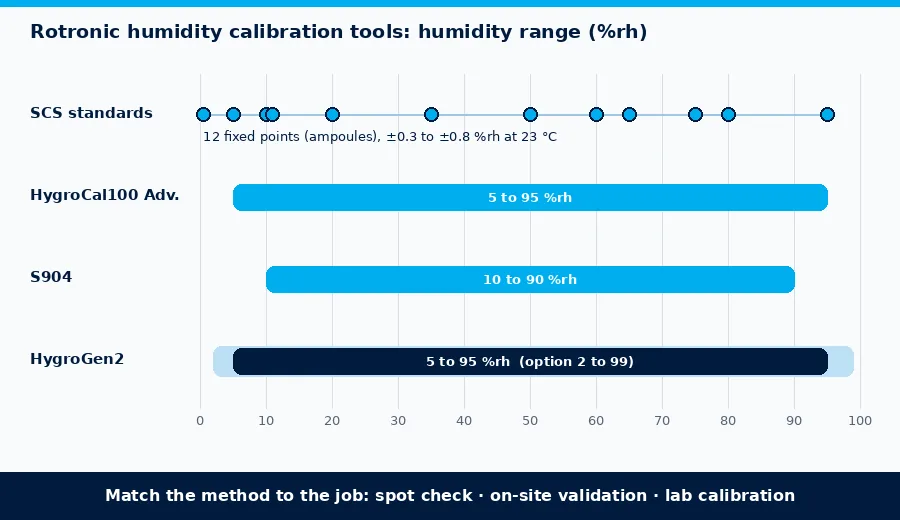
| Rotronic SCS humidity standards | A sealed glass ampoule (about 0.8 ml) of unsaturated salt solution, emptied onto a fibre pad inside a small airtight calibration device fitted over the probe | Fixed points from 0.5 to 95 %rh | 1 per device | Low-cost one-point or few-point checks on site, without removing the probe |
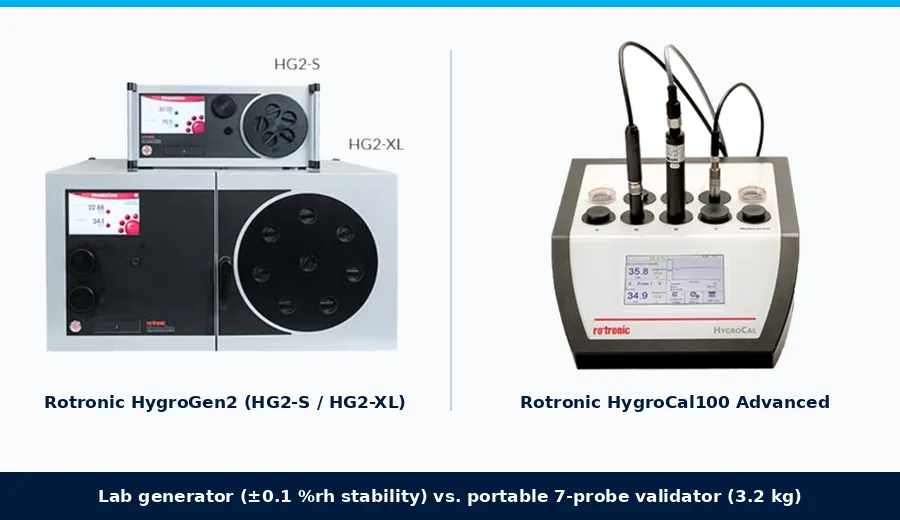
| Rotronic HygroCal100 Advanced | Divided-flow mixing of air through a saturator and a desiccant reservoir, controlled by an HC2A-S reference probe | 5 to 95 %rh | Up to 7 | Portable multi-probe validation in plants and warehouses, including on battery |
| Rotronic S904 | Closed-loop mixing of dry and saturated air in a temperature-controlled chamber with 4-zone Peltier control | 10 to 90 %rh, 10 to 50 °C | Up to 5 | Transportable calibrator for large probe fleets, with temperature control |
| Rotronic HygroGen2-S / XL | Mixed flow with desiccant drier cell and piezoelectric humidifier, Peltier temperature control and a radial mixing fan | 5 to 95 %rh, 0 to 60 °C (extensions to 2–99 %rh and −5 to 60 °C) | Up to 6 (S) or 19 plus shelves (XL) | Pharma QA, metrology rooms and ISO/IEC 17025 humidity laboratories |
Salt-solution humidity standards: simple, cheap and easy to get wrong
The Rotronic SCS standards come in boxes of five ampoules of the same value, at nominal points of 0.5, 5, 10, 11, 20, 35, 50, 60, 65, 75, 80 and 95 %rh. The standards from 5 to 95 %rh are unsaturated aqueous salt solutions titrated at the factory; the 0.5 %rh standard is a dried porous ceramic. Each box carries a batch certificate, and the datasheet states a measurement uncertainty at 23 °C of ±0.3 %rh at 0.5 %rh, ±0.4 %rh at 35 %rh, ±0.6 %rh at 50 %rh, ±0.7 %rh at 75 %rh and ±0.8 %rh at 95 %rh. They are traceable to national standards and work with third-party probes, not just Rotronic ones. Rotronic calibration devices include the ER-15 for 15 mm probes and the ER-05 for 5 mm probes.
The method itself is simple: fit the calibration device over the probe with the receptacle underneath, put a fibre disc in the receptacle, snap the ampoule (with gloves and safety glasses) and empty it onto the disc, close the device so the solution never touches the sensor, wait, then compare and adjust. The waiting and the temperature are where most field checks fail:
- Stabilization time. Rotronic's calibration procedure gives about 45 minutes for standards up to 65 %rh, 60 minutes for 75 and 80 %rh and 120 minutes for 95 %rh, and says to always start with the lowest humidity. Its general guidance is to allow at least 60 minutes and watch the display until it is stable.
- Temperature. The probe, calibration device and standard must be at the same temperature. Rotronic warns that a 1 K difference between the standard and the sensor can cause an error of up to 6 %rh. Room temperature should be stable to ±0.25 °C or better during each point, ideally between 18 and 25 °C, away from air vents, heaters and direct sun.
- Reference temperature. The certified values apply at 23 °C. The box cover shows the temperature effect for each standard, and the HW4 software and several HygroClip instruments can compensate automatically.
In practice this means salt standards suit one or two points, done in an air-conditioned room, by someone who is prepared to wait. Doing them in a plant room next to an AHU fan, or on a rooftop in a Karachi summer, gives numbers that look precise and are not.
Portable validators: HygroCal100 Advanced and S904
HygroCal100 Advanced
The HygroCal100 Advanced is a 3.2 kg, self-contained generator with a chamber milled from solid acetal. It generates 5 to 95 %rh with ±0.5 %rh stability and ±0.5 %rh uniformity, and typically stabilizes within 5 minutes after a 10 %rh step. Its HC2A-S control probe is specified at ±0.8 %rh and ±0.1 °C, with ±1 %rh per year long-term stability. Up to seven probes plug into the unit, which supplies 24 V excitation and reads 0–20 mA, 4–20 mA, 0–1 V, 0–5 V or 0–10 V outputs, so most BMS and cleanroom transmitters can be checked without a separate power supply or multimeter. Port adaptors cover probe diameters from 12 to 25 mm, with a maximum insertion depth of 60 mm.
Three features matter for Pakistani sites. An optional battery pack powers the generator and seven probes for up to 8 hours, which helps during load-shedding and in warehouses with no socket near the sensor. Validation runs are automatic: you define the set points and dwell times, the unit waits until the chamber is stable, and it logs the results as CSV to a USB stick. And you can assign any hygrometer with an analog output as the reference, including an optional Optidew 401 chilled-mirror hygrometer, which turns the validator into a calibrator. Its rated environment is +5 to +40 °C.
S904
The S904 is a larger (20 kg) transportable calibrator with temperature control. It generates 10 to 90 %rh, with an accuracy of ≤±1 %rh from 10 to 70 %rh and ≤±1.5 %rh from 70 to 90 %rh, and ±0.2 %rh stability between 20 and 80 %rh. The chamber runs from 10 to 50 °C with ±0.1 °C accuracy and stability (the lowest set point is 10 °C below ambient). Five interchangeable ports take probes from 5 to 25 mm in diameter. Rotronic quotes a step response of typically under 10 minutes, so a simple 3-point calibration can be completed in under an hour. Maintenance is basic: the desiccant changes colour and is regenerated in an oven at 150 °C for 3 hours. The S904-D adds a digital interface and PC software for automated, unattended profiles.
Laboratory calibration with the HygroGen2
The HygroGen2 is the instrument Rotronic positions for pharmaceutical QA and ISO 17025 humidity laboratories. Two chamber sizes are available:
| Specification | HG2-S | HG2-XL |
|---|---|---|
| Chamber / working volume | 2 L / 1.5 L | 20 L / 15 L |
| Probe mounts | Up to 6 through door ports | Up to 19 through the door, plus internal shelf racks |
| Humidity change 5–95 %rh (to 0.1 %rh stability) | ~5 minutes | ~15 minutes |
| Weight | 13 kg | 37 kg |
Both models control humidity to better than ±0.1 %rh and temperature to better than ±0.01 °C at equilibrium, with thermal gradients under ±0.05 °C between 15 and 50 °C. Rotronic states a typical calibration uncertainty of ±1.5 %rh (k=2) at 23 °C and ±0.15 °C (k=2) from 15 to 50 °C using the built-in HygroClip2 control probe. With the optional external chilled-mirror reference integration, Rotronic says an uncertainty of less than 0.7 %rh at ambient conditions is achievable. That is the configuration for a laboratory that needs to calibrate good probes, rather than just verify them.
The software and automation features are aimed at regulated users. The integrated Rotronic HW4 software is FDA 21 CFR Part 11 compliant. The optional AutoCal function stores 20 programs of up to 200 set points each, can automatically adjust one temperature point and up to ten humidity points on Rotronic HygroClip2 (HC2) probes, and creates a PDF calibration certificate for each probe. A Remote API allows control and logging over TCP/IP from third-party calibration software. A UV sterilisation system treats the water reservoir and the desiccant condition is monitored. Note the operating conditions: 10 to 35 °C ambient, so the HygroGen2 belongs in an air-conditioned laboratory or QA room, not a plant workshop in June.
Matching the method to the job
| Situation | What matters | Suggested catalogue choice |
|---|---|---|
| HVAC and BMS duct and room sensors (offices, malls, hospitals, data centres) | Many probes, mixed brands, analog outputs, limited time on site | HygroCal100 Advanced for multi-probe checks; SCS standards for a quick single-point check at the set point |
| Pharma cleanrooms, warehouses and stability rooms | GMP records, as-found/as-left data, audit trail | HygroGen2 with HW4 software and AutoCal in the QA lab; HygroCal100 Advanced for in-situ verification of fixed probes |
| ISO/IEC 17025 calibration laboratories | Traceability, uncertainty budget, range | HygroGen2 with external chilled-mirror reference, for example a Michell Optidew (±0.15 °C dew point) |
| Large probe fleets with temperature dependence (textile mills, food stores, utilities) | Throughput, temperature-controlled points, simple maintenance | S904, or S904-D for automated profiles |
| Remote sites and spot checks | No mains power, minimal equipment | SCS standards with the right calibration device; HygroCal100 Advanced on battery |
Uncertainty: is your reference good enough for your probe?
A calibration is only meaningful if the reference uncertainty is small compared with the tolerance you are checking. Take a transmitter such as the Rotronic DT722, specified at better than ±2 %rh (5–95 %rh at 25 °C). Checking it against a reference with ±1.5 %rh uncertainty cannot reliably prove it is within ±2 %rh; it can only show that it is not grossly wrong. For high-accuracy probes you need a better reference: a salt standard at its certified point (±0.3 to ±0.8 %rh at 23 °C, depending on the value), or a generator referenced to a chilled-mirror hygrometer. For a typical HVAC sensor with a tolerance of a few %rh, a portable validator is usually enough.
Whatever the method, the result must be traceable: the reference itself needs a valid calibration certificate from an accredited laboratory, and that chain must be documented. Pakistani laboratories seeking ISO/IEC 17025 accreditation through the Pakistan National Accreditation Council (PNAC) also need a written uncertainty budget for each humidity point. It should include the reference, chamber stability and uniformity, temperature effects and the resolution of the probe under test.
Building a practical calibration programme
- Choose points around the use. A cleanroom held at 45 ± 10 %rh needs points that bracket that band (for example 35, 50 and 65 %rh), not just 50 %rh. Add a low and a high point when probes are used across a wide range.
- Record as-found before adjusting. Then adjust and record as-left. If a probe is out of tolerance as found, assess the data it produced since the last check.
- Set intervals from history. Start with the interval your quality system or the probe manufacturer recommends, then lengthen or shorten it based on the drift you actually see.
- Control the calibration environment. Use an air-conditioned room, keep probes and standards at the same temperature, and keep a log of room temperature during each point.
- Do not forget temperature. Rotronic notes that the Pt100 sensors in its probes are stable enough that field temperature calibration is usually not required, but RH is calculated against temperature, so a temperature check is still worthwhile in regulated applications. The HygroGen2 and S904 provide controlled temperature points for that purpose.
- Qualify the generator. Rotronic recommends qualifying a humidity generator for temperature and humidity gradients from time to time, and immersing the probe as fully as possible in the chamber. Rotronic also advises not soaking a probe at 60 %rh and above for more than 30 minutes during calibration and adjustment with a generator, so run the high points last and keep their dwell times sensible.
Specification checklist for your enquiry
- Number of probes to check per year, brands, diameters and output signals (4–20 mA, 0–10 V, digital)
- Required humidity points and range, and whether temperature points are also needed
- Tolerance of the probes you calibrate, so the reference uncertainty can be matched
- On-site, in the lab, or both; mains power availability at the sensor locations
- Regulatory needs: GMP records, 21 CFR Part 11 audit trail, ISO/IEC 17025 accreditation
- Existing reference instruments (for example a chilled-mirror hygrometer) and their calibration status
FAQ
How long should I wait when calibrating a humidity probe with a salt standard?
Rotronic's procedure gives about 45 minutes for standards up to 65 %rh, 60 minutes for 75 and 80 %rh, and 120 minutes for 95 %rh, starting with the lowest humidity. Its general guidance is at least 60 minutes, and the probe reading should be stable on the display before you compare or adjust.
Why does temperature matter so much in humidity calibration?
Relative humidity depends strongly on temperature. Rotronic warns that a 1 K difference between the humidity standard and the sensor can cause an error of up to 6 %rh. Keep the room stable to ±0.25 °C during each point, ideally between 18 and 25 °C, and keep the probe, calibration device and standard at the same temperature.
Can I calibrate other brands of humidity probes with Rotronic equipment?
Yes. The SCS humidity standards are compatible with third-party probes, the HygroCal100 Advanced powers and reads probes with 0–20 mA, 4–20 mA, 0–1 V, 0–5 V or 0–10 V outputs, the S904 ports take probes from 5 to 25 mm in diameter, and the HygroGen2 uses probe sleeves to fit probes from other manufacturers. Automatic adjustment with AutoCal is for Rotronic HC2 and HCD probes.
What calibration uncertainty does the HygroGen2 achieve?
Rotronic states a typical calibration uncertainty of ±1.5 %rh (k=2) at 23 °C and ±0.15 °C (k=2) from 15 to 50 °C with the built-in control probe. With an external chilled-mirror reference integrated, an uncertainty of less than 0.7 %rh at ambient conditions is achievable.
What is the difference between the HygroCal100 Advanced and the HygroGen2?
The HygroCal100 Advanced is a 3.2 kg portable validator (5 to 95 %rh, ±0.5 %rh stability, up to 7 probes, optional 8-hour battery) for checking probes on site. The HygroGen2 is a laboratory-grade generator with humidity and temperature control (5 to 95 %rh and 0 to 60 °C as standard, better than ±0.1 %rh and ±0.01 °C stability), 21 CFR Part 11 software and optional AutoCal, intended for QA and ISO/IEC 17025 calibration labs.
Key takeaways
Decide first whether you need a spot check, a validation or a traceable calibration, and match the reference uncertainty to the probe tolerance. Salt standards such as the Rotronic SCS series are inexpensive and accurate at their certified points, but only with stable temperature and enough waiting time. The HygroCal100 Advanced checks up to seven probes on site, even on battery, and the S904 adds temperature control for larger fleets. The HygroGen2, ideally with a chilled-mirror reference, is the laboratory tool for pharma QA and ISO/IEC 17025 work. Always record as-found and as-left values.
How Tetracon helps
Tetracon supplies humidity measurement and calibration equipment to Pakistan's pharmaceutical, HVAC, textile, food, power and process industries, including Rotronic humidity generators, validators and humidity standards. Tell us how many probes you check, their brands and outputs, the points and tolerances you need, and whether the work is on site or in a lab, and we will propose a suitable setup. Use the contact page or see our services. Start with the catalogue pages for the HygroGen2, HygroCal100 Advanced, S904 and SCS humidity standards, browse the humidity and pressure category, or see all Rotronic products. Free technical guides are collected under Guides.