

Landfill gas does not stay inside the waste. Methane and carbon dioxide migrate sideways through soil, along service trenches and into buildings next to old dumpsites, and the same gases build up under redeveloped industrial land. The usual way to find out is a network of perimeter and site-investigation boreholes, read on a regular round with a portable gas analyser. Each reading records methane, carbon dioxide and oxygen, together with pressure and, where needed, the borehole gas flow.
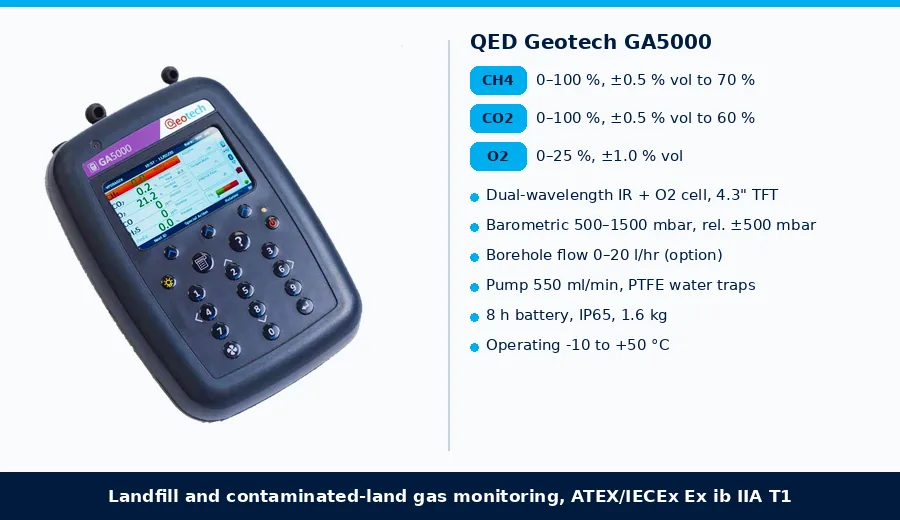
This note looks at the QED Geotech GA5000 portable landfill gas analyser, built for landfill and contaminated-land monitoring. Figures come from the GA5000 datasheet (DS45 Issue 15) hosted on our product page and from the current Tetracon product pages. General engineering advice is labelled as general, and nothing here goes beyond the manufacturer's published data. Tetracon (Pvt.) Ltd. is the sole authorized agent for QED Environmental Systems in Pakistan and supplies QED and Geotech gas analysers with local technical support.
Why borehole and ground-gas monitoring matters
- The listed duties are landfill gas, waste to energy and site investigation. The datasheet names landfill gas monitoring, waste to energy and site investigation as the applications, for landfill and contaminated land (datasheet).
- Migration is a safety issue, not just an emissions one. Methane is flammable and carbon dioxide displaces oxygen. Gas that leaves a site through the ground can collect in basements, manholes and enclosed rooms nearby (general).
- Trends need the same method every time. QED positions the GA5000 as a way to standardise monitoring routines and support environmental legislation compliance, with peak and previous readings, data logging and profiling (datasheet).
- Concentration alone is not the full picture. Barometric pressure, relative (borehole) pressure and borehole flow show whether gas is being pushed out of the ground, which is why the GA5000 measures them alongside the gases (datasheet; general).
GA5000 at a glance
| Item | GA5000 (datasheet) |
|---|---|
| Standard gases | CH4 and CO2 by dual-wavelength infrared sensor with reference channel; O2 by internal electrochemical sensor |
| CH4 range and typical accuracy | 0–100 %; ±0.5 % vol on 0–70 %, ±1.5 % vol on 70–100 % |
| CO2 range and typical accuracy | 0–100 %; ±0.5 % vol on 0–60 %, ±1.5 % vol on 60–100 % |
| O2 range and typical accuracy | 0–25 %; ±1.0 % vol |
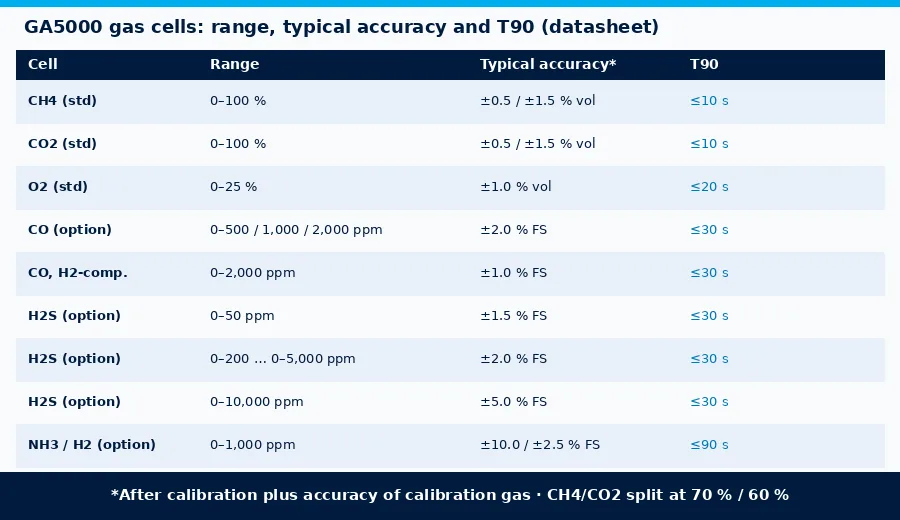
| Optional cells (electrochemical) | CO 0–500, 0–1,000, 0–2,000 ppm (±2.0 % FS); H2-compensated CO 0–2,000 ppm (±1.0 % FS); H2S 0–50 ppm (±1.5 % FS) and 0–200 up to 0–10,000 ppm; NH3 0–1,000 ppm; H2 0–1,000 ppm |
| Response time (T90) | CH4 and CO2 ≤10 s; O2 ≤20 s; CO and H2S ≤30 s; NH3 and H2 ≤90 s |
| Pump | 550 ml/min typical; flow fail point -200 mbar (user settable); restarts up to about -375 mbar at about 80 ml/min |
| Pressure | Relative ±500 mbar (±4 mbar typical when zeroed, ±15 mbar max); barometric 500–1500 mbar, ±5 mbar |
| Borehole flow (option) | 0–20 l/hr internal measurement, ±0.3 l/hr; flow logging option |
| Temperature (optional probe) | -10 to +75 °C, ±0.5 °C |
| Memory and data | 2,000 IDs, 4,000 readings, 2,000 events (IDs and events with Gas Analyser Manager software); USB, optional Bluetooth; GPS / field navigator option |
| Power | Rechargeable NiMH pack, typical use 8 hours; separate mains charger 100–240 V, about 4 hours |
| Environment | Operating -10 to +50 °C; 700–1200 mbar; 0–95 % RH non-condensing; case IP65 |
| Physical | 1.6 kg; 220 x 155 x 60 mm; 4.3 inch colour TFT; external user-changeable 2.0 µm PTFE water traps |
| Certification | ATEX / IECEx II 2G Ex ib IIA T1 Gb (Ta -10 to +50 °C); CSA Ex ib IIA T1 / AEx ib IIA T1; MCERTS MC130238; ISO 17025 calibration to UKAS certificate 4533 |
| Warranty | 3 years |
Choosing the gas cells
CH4, CO2 and O2 are standard. Optional cells are added from a full range that is specified at the time of manufacture, and the datasheet says the analyser is modular and upgradeable, with up to 6 gases monitored (datasheet). Choose the cells from the job, not from a list (general).
- Perimeter and migration boreholes: CH4, CO2 and O2 with borehole flow and pressure is the core set for ground-gas risk work (general; flow is a datasheet option).
- Waste-to-energy and gas collection: add H2S when engines or flares are downstream. The cells run from 0–50 ppm up to 0–10,000 ppm, so pick the range from the H2S you actually expect (datasheet ranges; general).
- Fires and smouldering waste: CO is a common indicator of sub-surface heating on landfills. Where hydrogen may also be present, the H2-compensated CO cell reduces the hydrogen cross-effect to about 1 %, but it should not be used where hydrogen exceeds 10,000 ppm (datasheet; indicator use general).
- NH3 and H2: available as 0–1,000 ppm cells, with a slower T90 of up to 90 seconds, so allow a longer reading time (datasheet; general).
- Accuracy is a percentage of gas, not of reading. CH4 is ±0.5 % vol up to 70 %, so a 2 % CH4 reading at a perimeter borehole means 1.5–2.5 % vol, and the figures are after calibration plus the accuracy of the calibration gas (datasheet; arithmetic).
Running a borehole monitoring round
- Zero relative pressure first. The datasheet notes that relative pressure should be zeroed before reading, giving ±4 mbar typically (general practice; datasheet note).
- Record the weather as well as the gas. Barometric pressure is measured on every reading. Falling atmospheric pressure tends to draw ground gas out, so readings on a falling barometer are often the worst case and worth flagging in the report (datasheet measurement; general).
- Read peak and steady values. The GA5000 shows peak and previous readings and all gases at once. Watch CH4 and CO2 rise to a peak and O2 fall, then record the steady value as your procedure requires (datasheet; general).
- Measure flow where it matters. The optional internal borehole flow measurement covers 0–20 l/hr at ±0.3 l/hr, and flow logging helps on boreholes where the gas is driven by pressure rather than diffusion (datasheet; general).
- Use IDs and GPS. With Gas Analyser Manager the instrument stores up to 2,000 borehole IDs, and the GPS / field navigator option helps a new technician find the right borehole on a large site (datasheet; general).
- Protect the pump. Fit and change the external 2.0 µm PTFE water traps, because wet boreholes and condensate are common in monsoon months. The pump flags a flow fail at -200 mbar, a sign of a blocked line or a waterlogged borehole (datasheet; general).
Hazardous areas, heat and the IIA T1 marking
- Read the marking. The GA5000 is ATEX and IECEx II 2G Ex ib IIA T1 Gb for Ta -10 to +50 °C, with CSA Ex ib IIA T1 and AEx ib IIA T1 (datasheet).
- What that means in practice. Group IIA and temperature class T1 cover methane-type atmospheres, which is the landfill duty. The marking does not cover IIB or IIC gas groups such as hydrogen-rich atmospheres, so check it against your area classification before taking it into other plant areas (general).
- Mind the summer. The operating range is -10 to +50 °C. Landfills in Sindh and southern Punjab have little shade, so keep the analyser out of direct sun between boreholes and do not leave it in a closed vehicle (datasheet; general).
- Battery planning. Typical use is 8 hours from a full charge and recharging takes about 4 hours from the mains, so a long round on a big site may need a planned break or a second instrument (datasheet; general).
Where the GA5000 fits in Pakistan
- Municipal landfills and dumpsites around the large cities, for perimeter borehole rounds and gas migration checks near housing and roads (datasheet application; general).
- Waste-to-energy and landfill gas projects that need routine CH4, CO2 and O2 readings, often with H2S (datasheet application; general).
- Brownfield and contaminated-land site investigation on old industrial plots before construction, with environmental consultants doing ground-gas risk assessments (datasheet application; general).
- Environmental monitoring contracts where results feed compliance reports and the same instrument, method and calibration record are needed every round (general).
Related products and when to choose them
| Duty | Product | Key figure (datasheet / product page) |
|---|---|---|
| Perimeter and site-investigation boreholes, ground-gas migration | QED Geotech GA5000 | CH4 / CO2 0–100 %, O2 0–25 %; barometric and relative pressure; borehole flow option; Ex ib IIA T1 (datasheet) |
| Landfill gas extraction well balancing | QED Geotech GEM5000 | CH4, CO2, O2 with static and differential pressure; gas flow and calorific value with external flow device (product page) |
| Modular landfill gas analyser with field-swappable modules | QED GEM PRO | Up to 7 gases, pre-calibrated swappable modules, Zone 1 certified (product page) |
| Landfill surface emissions walkovers | QED SEM5000 | TDLAS methane, 0.5 ppm to 100 % vol, GPS, ATEX Zone 1 (product page) |
| Portable digester gas checks | QED Geotech BIOGAS 5000 | % CH4, CO2, O2, up to 6 gases (product page) |
| Methane leak surveys on pipes and plant | Huberg LASER One | Methane-only TDLAS, 1 ppm to 100 % vol, T90 ≤2.5 s (product page) |
| Groundwater sampling at the same monitoring wells | QED MicroPurge MP100 | Low-flow groundwater sampling (product page) |
A portable analyser takes readings on a round; it does not replace fixed gas detectors that protect people in buildings or enclosed spaces near a site (general). For more background, read our GEM5000 extraction monitoring note, the SEM5000 surface emissions note, the biogas and landfill gas monitoring guide and the low-flow groundwater sampling note. The wider range is on the Gas Analysis, Environmental and Gas Detection category pages, our selection guides and the QED Environmental Systems manufacturer page.
What to send with an enquiry
- The duty: perimeter or migration boreholes, site investigation, waste-to-energy or gas collection.
- The gases you need beyond CH4, CO2 and O2 (H2S, CO, H2-compensated CO, NH3 or H2) and the expected levels.
- Whether you need borehole flow, flow logging, GPS, Bluetooth or a temperature probe.
- The number of boreholes, how often they are read and how results are reported.
- The area classification where the analyser will be used, and whether ISO 17025 calibration certificates are required.
FAQ
What does the QED GA5000 measure?
As standard it measures CH4 and CO2 from 0 to 100 % with a dual-wavelength infrared sensor and O2 from 0 to 25 % with an electrochemical sensor. It also measures barometric and relative pressure, and optional cells add CO, H2-compensated CO, H2S, NH3 and H2, with up to 6 gases in total.
How accurate is it?
Typical accuracy after calibration is ±0.5 % vol for CH4 up to 70 % and for CO2 up to 60 %, ±1.5 % vol above that, and ±1.0 % vol for O2. The figures are after calibration plus the accuracy of the calibration gas used.
Can it measure borehole gas flow?
Yes, as an option. The internal borehole flow measurement covers 0–20 l/hr with ±0.3 l/hr accuracy, and a flow logging option is available for improved borehole analysis.
Is it certified for hazardous areas?
Yes. It is ATEX and IECEx II 2G Ex ib IIA T1 Gb for Ta -10 to +50 °C, CSA Ex ib IIA T1 and AEx ib IIA T1, and MCERTS certified (MC130238), with ISO 17025 calibration to UKAS certificate 4533.
How long does the battery last?
Typical use is 8 hours from a full charge. The NiMH pack is recharged by a separate mains charger (100–240 V) in about 4 hours from complete discharge, and it is not user replaceable.
Planning ground-gas or landfill borehole monitoring in Pakistan? Contact Tetracon with the duty, the gases, the number of boreholes and the area classification. You can also browse the GA5000 product page and the QED Environmental Systems manufacturer page.