

A lot of oxygen measurement in Pakistani industry happens well below furnace temperatures. Gas-fired textile stenters and dryers, paper and board dryers, wood and biomass dryers, the cooler end of a boiler flue after the economiser, and heat-treatment or inerting atmospheres all need a reliable O2 reading, but the gas at the measuring point may be at 100-300 °C rather than 800 °C. Extractive analysers with long heated sample lines are often more than these duties need, and a plain portable check once a month does not help a burner controller. An in-situ zirconia probe designed for lower process temperatures fills that gap.
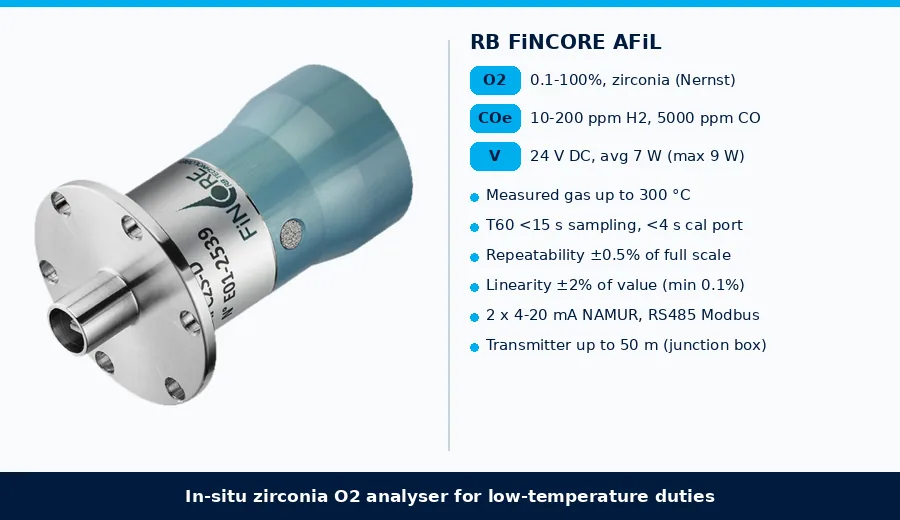
This note looks at the RB Technologies FiNCORE AFiL in-situ oxygen analyser, RB's low-temperature model for process gas up to 300 °C, and at the instruments around it. Figures come from the AFiL product datasheet (ZrO2-AFiL_G.DSE rev 0, August 2025, the copy hosted on our product page) and the current Tetracon product pages. Where we do our own arithmetic it is labelled. No prices are given; configuration, sampling tube design and lead time should be confirmed at quotation.
Why low-temperature duties need their own O2 analyser
RB describes the AFiL as an in-situ zirconium oxygen and "reductors" analyser for low-temperature applications, measuring oxygen and unburnt compounds in gas up to 300 °C, with the transmitter up to 50 m away when a junction box is used. The datasheet presents it as a device for combustion regulation, inerting and metal treatment processes: oxygen measurement lets the plant control the burner fuel/air ratio for combustion efficiency and process safety, and gives a precise O2 reading in inerting and metal treatment.
The sensor itself runs hot whatever the process temperature. A built-in heater regulated by an S-type thermocouple holds the zirconia sensor at 600-800 °C, and the cell measures O2 against an air or gas reference according to the Nernst law. That is why a zirconia probe can be used in a cool duct at all: the measuring element brings its own temperature. What the AFiL rating of "up to 300 °C" describes is the measured gas, which determines the probe and sampling tube design.
Typical low-temperature duties include:
- Dryers. RB lists large-scale dryers (paper, wood) among the environments FiNCORE analysers are built for. In Pakistan the same reasoning applies to gas-fired stenters and dryers in textile finishing, where exhaust oxygen tells the operator how much excess air is being heated and thrown away.
- Boilers and biomass. Our product page lists boilers and furnaces, biomass, incinerators and dryers. Rice husk, bagasse and wood-fired boilers often have a cooler measuring point after heat recovery.
- Inerting and metal treatment. The datasheet header names inerting and metal treatment alongside combustion control, for example protective atmospheres where the oxygen level must stay low.
RB FiNCORE AFiL at a glance
| Item | RB FiNCORE AFiL datasheet (ZrO2-AFiL_G.DSE rev 0) |
|---|---|
| Type | In-situ zirconium oxide O2 and COe/pRed analyser for low-temperature applications, with remote transmitter |
| Application | In-situ O2 %, COe/pRed in combustion flue gas for process control, or in an inerting process |
| O2 range | 0.1-100% |
| COe / pRed | 10-200 ppm H2, 5000 ppm CO; sensitivity down to 10 ppm H2 or CO (O2 + COe sensor version) |
| Measured gas temperature | Up to 300 °C |
| Measured gas pressure | -0.5 to +0.5 bar |
| Response time | T60 < 15 s at the sampling port; T60 < 4 s at the calibration port |
| Repeatability | ±0.5% of full scale |
| Linearity | ±2% of value, not lower than 0.1% |
| Sensor | Zirconia, regulated at 600-800 °C by S-type thermocouple; built-in heater; FiNCORE sensor with built-in DIN connector |
| Warm-up | < 10 minutes |
| Outputs | 2 x 4-20 mA NAMUR (max 1000 Ω); RS485 Modbus RTU |
| Power | 24 V DC, average 7 W, up to 9 W; 115-230 V AC power supply available as an accessory (the cabinet transmitters in the ordering table are 115/230 V AC) |
| Transmitter distance | Cable up to 10 m direct; up to 50 m with an additional junction box |
| Filter holder | Ø 60 mm or Ø 100 mm with SS316L filter and 6 mm calibration port (¼" on request) |
| Sampling tube | Made to order: direct, by-pass or semi-extractive, SS316L, 4" 150 FF flange as standard; length and flange adjustable |
| Calibration gases | Intercept 20.9% O2 (instrument air); slope 1.0% O2; COe 2% vol O2 + 250 ppm CO + 25 ppm H2; manual or automatic calibration set |
| Display options | Standard cabinet with OLED display and 5 buttons, or small cabinet with 4-20 mA displays |
The datasheet also lists redundancy options: two probes, or O2/O2 redundancy built into one probe design, for enhanced reliability and lower maintenance and calibration effort.
How an AFiL is put together
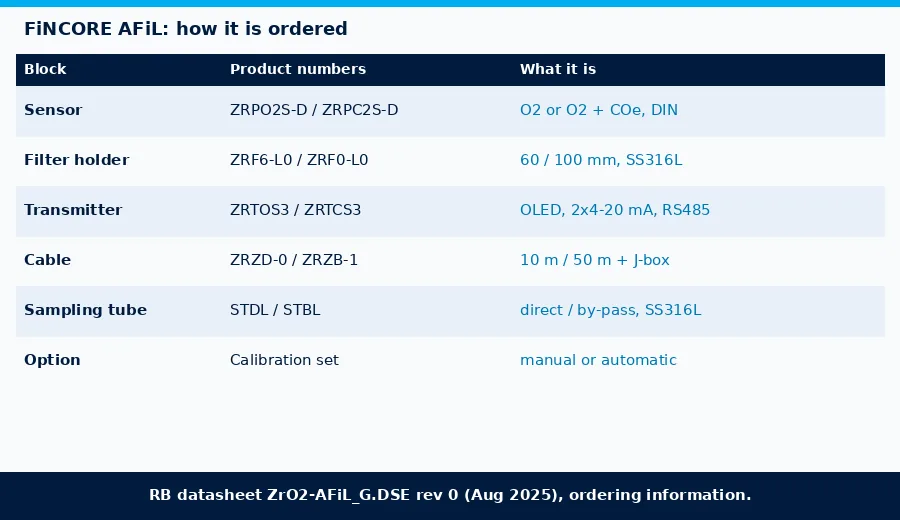
The AFiL is ordered as building blocks rather than as a single part number, which is worth understanding before you ask for a quotation:
- Sensor. ZRPO2S-D for O2 only, or ZRPC2S-D for O2 + COe, both FiNCORE sensors with a built-in DIN connector.
- Filter holder with calibration port. ZRF6-L0 (Ø 60 mm) or ZRF0-L0 (Ø 100 mm), with an SS316L filter and a 6 mm calibration port.
- Transmitter. O2 versions ZRTOS3-0FM0 and ZRTOS3-0FMA, or O2 + COe versions ZRTCS3-0FM0 and ZRTCS3-0FMA: 115/230 V AC, OLED display, 2 x 4-20 mA and RS485 in an SS304 IP cabinet with settable dry contacts. The "A" versions include automatic calibration.
- Cable. ZRZD-0 up to 10 m, or ZRZB-1 with an additional junction box up to 50 m.
- Sampling tube. STDL direct or STBL by-pass tube in SS316L with a 4" 150 FF flange; length, flange type and dimensions are made to order.
- Option. Manual or automatic calibration set for O2 or O2 + COe.
So the questions that decide the configuration are simple: O2 only or O2 + COe, manual or automatic calibration, how far the transmitter must sit from the probe, and the duct size, flange and gas condition at the mounting point.
Reading the repeatability and linearity figures
The datasheet gives two separate figures: repeatability ±0.5% of full scale, and linearity ±2% of value, not lower than 0.1%. The examples below are our own arithmetic. We read "not lower than 0.1%" as a floor of 0.1% O2 on the linearity band; please confirm that interpretation, and the configured output span, with us at quotation.
| Case | Datasheet figure | What it works out to (Tetracon arithmetic) |
|---|---|---|
| Reading 3.0% O2 | Linearity ±2% of value, floor 0.1% | 2% of 3.0 = 0.06, so the 0.1% O2 floor applies: about 2.9% to 3.1% |
| Reading 8.0% O2 | Linearity ±2% of value | ±0.16% O2: about 7.84% to 8.16% |
| Air, 20.9% O2 | Linearity ±2% of value | ±0.42% O2 |
| Output span 0-25% O2 | Repeatability ±0.5% of full scale | ±0.125% O2 |
| Output span 0-100% O2 | Repeatability ±0.5% of full scale | ±0.5% O2 |
Two practical points follow. For combustion trim on a dryer or boiler, where excess oxygen typically sits in the low single-digit percent, ask for the output span to be set to the range you actually use rather than the full 0.1-100%, because repeatability is quoted against full scale. And for any alarm or interlock near a limit, set it with the band in mind rather than exactly at the limit.
Where it sits among Tetracon's zirconia options
- Hotter flue gas: RB FiNCORE AFiH. The medium/high-temperature sister model for measured gas up to 1500 °C, with an O2 range adjustable from 0-1% up to 0-50% (or 0-1,000 to 0-9,999 ppm) and a COe range adjustable from 0-1,000 to 0-9,999 ppm. It uses the same FiNCORE transmitter, outputs and calibration gases, and adds 2 dry-contact inputs and 3 relay outputs. Use it where the probe sits in the furnace or hot flue rather than after heat recovery.
- Certified hazardous-area probes: RB ZTR3 and ZTR-4. The AFiL datasheet says FiNCORE in-situ analysers can be installed in hazardous areas, but it does not give a certificate or marking for the AFiL itself. If your mounting point is a classified area, the ex-proof ZTR3 is the route we cover in our note on in-situ combustion O2 and COe monitoring; confirm certification for any model at quotation.
- OEM equipment and small burners: SST Zirconia Oxygen Analyzer System. An OXY-LC interface board with an M18 zirconia sensor, 0.1-25% or 0.1-100% O2 with 0.5% O2 accuracy after calibration, no reference gas, and process gas from -100 °C to +250 °C. It suits machine builders who want to put an O2 measurement inside their own equipment; see our zirconia oxygen note on SST OXY-Flex.
- Inert-gas purity at ppm level: Ntron Minox-i. Where the job is checking that a nitrogen blanket or purge stays below a low ppm or percent oxygen limit, a loop-powered intrinsically safe O2 transmitter is often the better fit than a combustion-style in-situ probe; see our note on oxygen monitoring for nitrogen blanketing and inerting.
Installation points for Pakistani sites
- Stay inside 300 °C. Measure or estimate the gas temperature at the proposed mounting point across the whole operating range, including start-up and upset conditions. If it can exceed 300 °C, the AFiH is the model to look at instead.
- Cool ducts and condensation. Low-temperature flue gas from fuels containing sulphur or moisture can drop below its dew point in a cold sampling tube or on a cold duct wall. As a general engineering point, insulate the mounting stub and locate the probe away from points where condensate collects; the SS316L filter holder protects the sensor, but it is not a cure for liquid in the duct.
- Hot sensor, flammable gas. The zirconia sensor operates at 600-800 °C. Where a duct or vessel could contain a flammable mixture, for example some inerting or process duties, treat the probe as a hot surface in your hazard review and agree the location and any certification needed with your HSE team.
- Pressure. The measured gas pressure range is -0.5 to +0.5 bar, which covers normal draft and slightly pressurised ducts; check vessels or atmospheres that run higher.
- Electronics away from heat. Use the remote transmitter: up to 10 m with the standard cable, or up to 50 m with the junction-box cable, so the cabinet can sit in a shaded, accessible place rather than on a hot dryer housing.
- Power and load shedding. The analyser draws an average of 7 W (up to 9 W) at 24 V DC and needs less than 10 minutes to warm up. After a power cut the reading is not valid until the sensor is back at temperature, so either put the supply on the plant UPS or tell your PLC programmer to ignore the O2 signal during warm-up instead of driving the burner on it.
- Calibration gas on site. Instrument air serves as the 20.9% O2 intercept gas; you also need a 1.0% O2 slope gas, plus the 2% O2 / 250 ppm CO / 25 ppm H2 mixture if you use COe. Choose the automatic calibration set if the probe is hard to reach.
What to send with an enquiry
- The process (dryer, boiler, furnace, inerting or heat treatment) and the fuel
- Gas temperature and pressure at the mounting point, normal and maximum
- Duct dimensions, wall thickness and the flange you can provide
- O2 only or O2 + COe, and the O2 range you actually operate in
- Distance from the probe to where the transmitter can sit
- Outputs needed (4-20 mA, Modbus RTU), alarms, and manual or automatic calibration
- Area classification at the mounting point, if any
FAQ
What does the RB FiNCORE AFiL measure?
Oxygen from 0.1 to 100% with a heated zirconium oxide sensor, and optionally COe/pRed (unburnt compounds, 10-200 ppm H2, 5000 ppm CO) with the O2 + COe sensor version, in gas up to 300 °C.
What is the difference between the AFiL and the AFiH?
The AFiL is for measured gas up to 300 °C; the AFiH is the medium/high-temperature model for gas up to 1500 °C, with adjustable O2 and COe ranges, relay outputs and dry-contact inputs.
How fast does it respond?
The datasheet gives T60 under 15 seconds at the sampling port and under 4 seconds at the calibration port.
How does it connect to a PLC or DCS?
Two 4-20 mA NAMUR outputs (maximum load 1000 Ω) and RS485 Modbus RTU. The cabinet transmitters also have settable dry contacts.
How is it calibrated?
With instrument air as the 20.9% O2 intercept gas and 1.0% O2 as the slope gas; COe uses 2% vol O2 + 250 ppm CO + 25 ppm H2. Manual and automatic calibration sets are available.
Is the AFiL certified for hazardous areas?
The datasheet says FiNCORE in-situ analysers can be installed in hazardous areas, but it does not list a certificate or marking for the AFiL. Tell us the area classification and we will confirm with RB Technologies what applies.
Next steps
Tetracon supplies RB Technologies combustion and oxygen analysers across Pakistan, together with SST Sensing and Ntron oxygen instruments. Send us your process, gas temperature and duct details, and we will work with the manufacturer on the right sensor, sampling tube and transmitter combination. Use the contact page or see our services. Start with the RB FiNCORE AFiL, compare the AFiH, browse oxygen analysis and gas analysis, or see all RB Technologies, SST Sensing and Ntron products and the full product catalogue. Related notes: in-situ combustion O2 and COe with RB ZTR analysers, oxygen analysers for process safety and combustion control, zirconia oxygen measurement with SST OXY-Flex and oxygen monitoring for blanketing and inerting. Free technical guides are collected under Guides.