

Many oil and gas sites, gas compressor stations, terminals and process plants in Pakistan still run catalytic pellistor heads wired to bridge-type control panels. Pellistors work, but they can be poisoned or inhibited by contaminants, they need oxygen to respond, and they drift until the next calibration shows a problem. Replacing the whole gas detection system to move to infrared is rarely practical. A detector head that fits the existing panel and cabling is often the better first step.
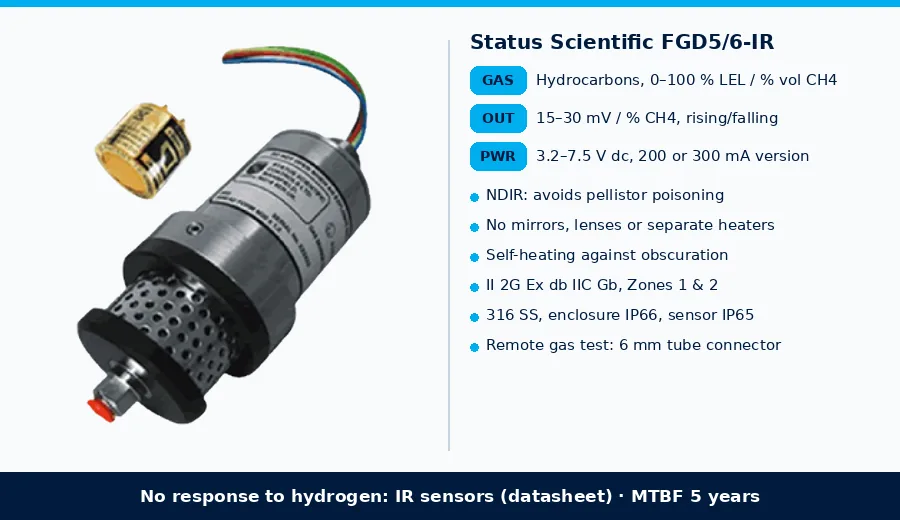
This note looks at the Status Scientific FGD5/6-IR infrared gas detector, an Ex db NDIR head designed for direct replacement of oil and gas industry pellistors. It covers what the datasheet says about range, signal, power and certification, how the head connects to a pellistor-type panel, where infrared is the right choice and where it is not, and when a transmitter-type detector such as the FGD10A, FGD10B or FGD3 is the better fit. Figures come from the Status Scientific datasheets hosted on our product pages and from the current Tetracon product pages. General engineering advice is labelled as general, and nothing here goes beyond the manufacturer's published data. Tetracon (Pvt.) Ltd. is the sole authorized agent for Status Scientific Controls Ltd. in Pakistan and supplies its fixed gas detectors with local technical support.
Why replace pellistors with infrared
- No catalyst poisoning. The FGD5/6-IR avoids the poisoning issues typically seen with pellistor sensors (datasheet). Silicones, sulphur compounds and other contaminants that inhibit catalytic beads are common in oil and gas and process areas (general).
- Long service life. The datasheet quotes an MTBF of 5 years, with minimal maintenance (datasheet).
- Simple optics. The sensor does not use mirrors, lenses or separate heaters, and it is self-heating to protect against obscuration (datasheet).
- Keeps the existing panel. It is compatible with industry-standard control panels and gives a millivolt signal proportional to gas level, so it can replace a pellistor head without replacing the panel (datasheet; product page).
- Typical duties. Methane and hydrocarbon detection in Zone 1 and Zone 2 areas: wellheads and gathering stations, compressor and metering skids, gas turbine and generator enclosures, pump rooms and tank areas (product page applications; general).
FGD5/6-IR at a glance
| Item | FGD5/6-IR (datasheet) |
|---|---|
| Sensor type | NDIR infrared, plug-in sensor |
| Gas types | Hydrocarbons; infrared sensors have no response to hydrogen |
| Measurement range | 0–100 % LEL (5 % vol. CH4) or 0–100 % volume CH4 |
| Resolution | 1 % LEL or 1 % volume (CH4) |
| Output signal | 15 to 30 mV / % CH4; can be set as rising or falling |
| Operating voltage | 3.2 to 7.5 V dc at the detector head; maximum short-term overload 24 V dc |
| Recommended operating current | 160 to 250 mA (200 mA version) or 250 to 350 mA (300 mA version) |
| Environment | Operating and storage -20 to +50 °C; 0 to 95 % RH non-condensing; atmosphere ±10 % |
| IP rating | Enclosure IP66, sensor IP65 |
| Materials | Sensor body 316 stainless steel; weatherguard 304 stainless steel and nylon 66 |
| Size and mounting | 94 mm long x 50 mm diameter, 20 mm thread; 170 mm overall with weatherguard; M20 x 1.5 thread |
| Weight | 1 kg including weatherguard |
| Certification | II 2G Ex db IIC Gb, Zones 1 and 2; CSANe 22ATEX1187U, CSAE 22UKEX1395U, IECEx CSAE 23.0010U |
| Standards | EN IEC 60079-0:2018, EN 60079-1:2014, IEC 60079-0:2017 Ed. 7.0, IEC 60079-1:2014 Ed. 7.0 |
| MTBF | 5 years |
How the drop-in replacement works
- Same type of signal as a pellistor head. The NDIR sensor produces a millivolt signal proportional to gas level, 15 to 30 mV per % CH4, so the head can be wired to industry-standard pellistor control panels (datasheet; product page).
- Match the panel supply. The head runs on 3.2 to 7.5 V dc at the detector and comes in a 200 mA version (160 to 250 mA) and a 300 mA version (250 to 350 mA). Check the bridge supply and current of your existing panel channel and order the matching version (datasheet; general).
- Rising or falling signal. The signal direction is set by the blue wire: connect it to 0 V (black) for a falling signal or to V+ (red) for a rising signal, so the head can suit the panel's input (datasheet).
- Wiring. Red V+, black 0 V, white signal proportional to gas level, blue signal direction, green/yellow earth (datasheet).
- Mechanical fit. The 94 x 50 mm 316 stainless steel body screws in on an M20 x 1.5 thread; the optional weatherguard brings the overall length to 170 mm (datasheet). Check clearance below existing heads before ordering (general).
- Commissioning. After replacement, set the zero and span on the panel channel with methane test gas, as you would after any head change, and record the panel alarm set points (general).
Where infrared is the right choice, and where it is not
- Methane and hydrocarbons: yes. The FGD5/6-IR measures hydrocarbons, with ranges stated for methane: 0–100 % LEL (5 % vol. CH4) or 0–100 % volume (datasheet). For other hydrocarbons, confirm the calibration gas and response with us before ordering (general).
- Hydrogen: no. Infrared sensors have no response to hydrogen (datasheet). Where hydrogen may be present, for example in battery rooms, hydrogen-cooled generators or some refinery units, keep a pellistor or a hydrogen-specific sensor; the FGD10A, FGD10B and FGD3 accept pellistor sensors (datasheets; general).
- Toxic gases and oxygen. The FGD5/6-IR is a flammable gas head only. For H2S, CO or oxygen deficiency in the same area, use an electrochemical sensor in an FGD10A, FGD10B or FGD3 (datasheets).
- Climate. Operating temperature is -20 to +50 °C and humidity 0 to 95 % RH non-condensing (datasheet). In Sindh, Balochistan and southern Punjab summers, shade heads from direct sun and fit the weatherguard on outdoor skids (general).
- Certification. The head is certified II 2G Ex db IIC Gb for Zones 1 and 2 (datasheet). The certificate numbers carry the “U” suffix used for Ex component certificates, so the complete installation, including cable glands and the panel side, should be reviewed by your Ex inspector (general).
Remote gas testing and maintenance
- Remote gas test. The weatherguard has a push-in connector for 6 mm O/D tubing, so test gas can be applied from ground level without a ladder or scaffold (datasheet).
- Bump tests. A fixed tube to a high-mounted head makes routine bump testing quicker, which helps keep a regular test schedule on large sites (general).
- Less recalibration from poisoning. Because the IR sensor avoids catalyst poisoning, there are fewer surprise failures at calibration than with pellistors in contaminated areas; keep the test interval set by your site safety procedure (datasheet; general).
- Plug-in sensor. The infrared sensor is a plug-in unit inside the head (datasheet), which simplifies replacement at the end of its life (general).
When a transmitter-type detector is the better fit
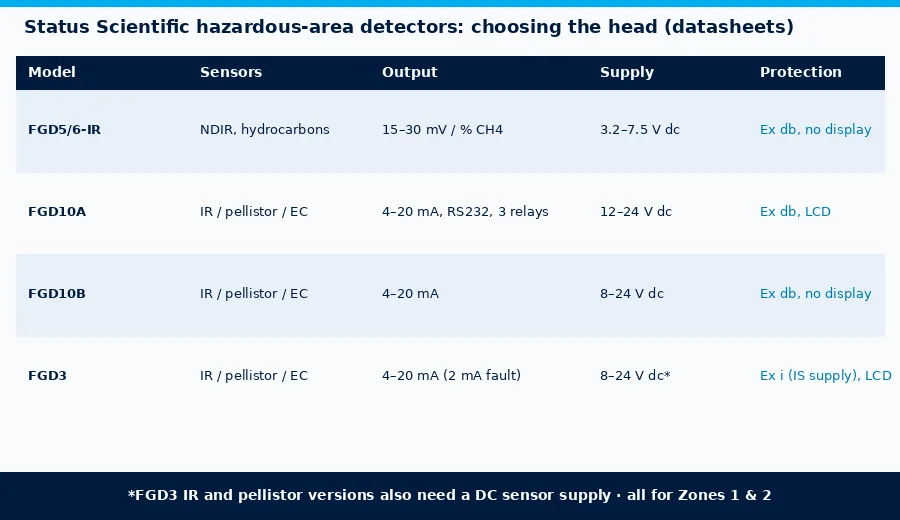
If the plant is moving to a 4–20 mA gas detection system, or you need a local display and relays, a full transmitter head is a better choice than a millivolt replacement head (general). Status Scientific offers three hazardous-area options, all with NDIR infrared, pellistor or electrochemical plug-in sensors:
- FGD10A flameproof detector: Ex db, LCD display, 4–20 mA (10-bit) and RS232 outputs, three relays for Alarm 1, Alarm 2 and Fault rated 3 A 250 V ac, 12 to 24 V dc, magnetic-pen calibration through the window without removing the cover, enclosure IP68 (datasheet).
- FGD10B flameproof detector: the compact non-display version, 160 x 125 x 127 mm, 4–20 mA output, 8 to 24 V dc, calibration via internal ZERO and SPAN buttons or a handheld configuration unit (datasheet).
- FGD3 intrinsically safe detector: for Zones 1 and 2 with an appropriate IS supply, LCD display, 4–20 mA output (2 mA fault, 22 mA over-range), metal enclosure available for IR versions (datasheet).
Related products
| Need | Product | Key point |
|---|---|---|
| Replace pellistor heads on an existing bridge-type panel | Status Scientific FGD5/6-IR | NDIR, 15–30 mV / % CH4, Ex db IIC Gb, MTBF 5 years (datasheet) |
| Flameproof transmitter with display and relays | Status Scientific FGD10A | 4–20 mA and RS232, 3 relays, magnetic-pen calibration (datasheet) |
| Compact flameproof transmitter for panel-monitored loops | Status Scientific FGD10B | 4–20 mA, 8–24 V dc, no display (datasheet) |
| Intrinsically safe loops with barriers | Status Scientific FGD3 | Zones 1 and 2 with IS supply, LCD, 4–20 mA (datasheet) |
| Safe-area rooms with no explosive atmosphere | Status Scientific FGD14 | Safe-area detector with remote alarm unit (product page) |
For more background, read our guide to fixed gas detectors for hazardous areas, the fixed vs portable gas detection guide and the FGD14 safe-area detector note. The wider range is on the Gas Detection and Gas Analysis category pages, our selection guides and the Status Scientific Controls manufacturer page.
What to send with an enquiry
- The make and model of the existing control panel and pellistor heads, and the number of channels.
- The panel bridge supply voltage and current per channel, so the 200 mA or 300 mA version can be selected.
- The target gas and range: % LEL or % volume methane, or another hydrocarbon.
- Whether hydrogen, H2S or other toxic gases may also be present in the area.
- The hazardous area zone, gas group and temperature class required, and whether heads are indoors or outdoors.
- Whether you need weatherguards with remote gas test tubing.
FAQ
Can the FGD5/6-IR replace a pellistor without changing the control panel?
That is what it is designed for. It gives a 15 to 30 mV per % CH4 signal, runs on 3.2 to 7.5 V dc at the head and comes in 200 mA and 300 mA versions, and it is compatible with industry-standard control panels. Check the panel channel supply and current, then choose the matching version.
Does the FGD5/6-IR detect hydrogen?
No. Infrared sensors have no response to hydrogen. Where hydrogen may be present, use a pellistor or a hydrogen-specific sensor, for example in an FGD10A, FGD10B or FGD3 detector.
What ranges are available?
0–100 % LEL (5 % vol. CH4) or 0–100 % volume CH4, with 1 % LEL or 1 % volume resolution.
Which hazardous areas is it certified for?
It is certified II 2G Ex db IIC Gb for Zones 1 and 2, with certificates CSANe 22ATEX1187U, CSAE 22UKEX1395U and IECEx CSAE 23.0010U.
How is the detector tested in service?
The weatherguard has a push-in connector for 6 mm O/D tubing, so test gas can be applied remotely. The head has an MTBF of 5 years and avoids the poisoning issues of pellistors, which reduces maintenance.
Planning to replace pellistor heads or upgrade gas detection in Pakistan? Contact Tetracon with the panel details, gases and area classification. You can also browse the FGD5/6-IR product page and the Status Scientific Controls manufacturer page.