

Nitrogen inerting protects many process steps in Pakistan from fire and explosion: API pharmaceutical reactors and centrifuges, powder mills and dryers, glove boxes, vent headers, additive manufacturing build chambers and, increasingly, hydrogen electrolyzer packages. In each case, the oxygen reading is what tells the plant whether the inert atmosphere is really there. When that reading feeds a safety instrumented function (SIF) that stops a feed, opens a nitrogen valve or trips a machine, an ordinary transmitter is not always enough. The safety study may require a device that is assessed for use in a SIL-rated loop.
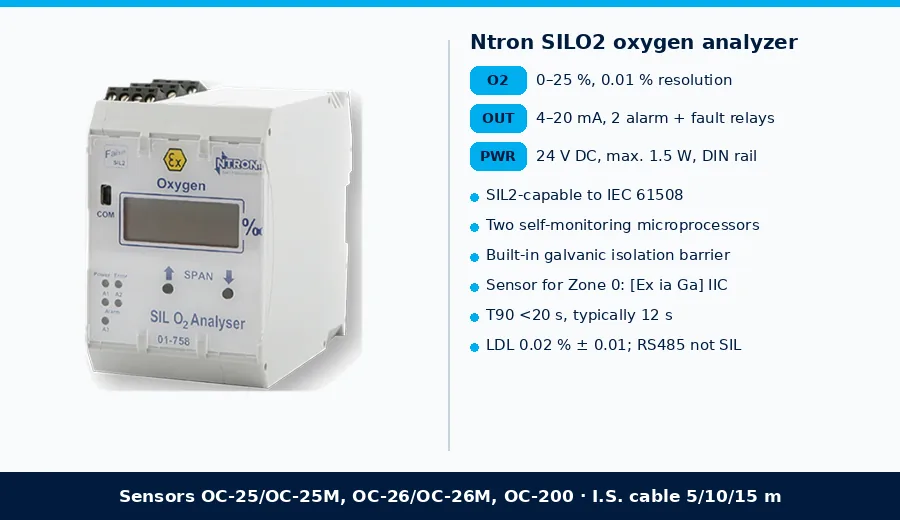
This note looks at the Ntron SILO2 SIL2-capable oxygen analyzer, a DIN-rail analyzer with a built-in isolation barrier and a remote sensor designed for Zone 0 installation. It covers what the datasheet says about range, response, outputs and certification, how the analyzer and sensor fit into an inerting safety loop, which sensor and process connection to choose, and when another Ntron device such as the Minox-i, OxyTx 101 or OxyExtract is the better fit. Figures come from the Ntron SILO2 datasheet (NT-DS-2101-EN-1.3, 05/2025) hosted on our product page and from the current Tetracon product pages. General engineering advice is labelled as general, and nothing here goes beyond the manufacturer's published data. Tetracon (Pvt.) Ltd. is the sole authorized agent for Ntron Gas Measurement Ltd. in Pakistan and supplies its oxygen analyzers with local technical support.
Why inerting needs SIL-capable oxygen measurement
- The O2 reading is the safety barrier. In an inerted reactor, centrifuge or mill, the oxygen concentration must stay below the limiting oxygen concentration for the solvent or dust with a margin set by the process safety study (general). If the measurement fails silently, the plant loses that barrier without knowing it (general).
- IEC 61508 SIL2. SILO2 is designed for safety-critical applications that require compliance with the requirements of IEC 61508 SIL2 (datasheet).
- Fail-safe by design. Two continuous self-monitoring microprocessors deliver fail-safe oxygen measurement, and a dedicated fault alarm relay is provided alongside the two configurable alarm relays (datasheet).
- One device instead of three. The analyzer and the galvanic isolation barrier are built into one DIN-rail unit, so the sensor in the hazardous area connects directly to the analyzer in the safe-area panel (datasheet).
- Typical duties. Inerting of glove boxes and containment, inerting control in API pharmaceuticals, powder handling, gas generation, additive manufacturing and H2 electrolyzers, plus centrifuges, reactors, mills and vent headers (datasheet).
SILO2 at a glance
| Item | SILO2 (datasheet) |
|---|---|
| Sensors | Solid state: OC-25/OC-25M, OC-26/OC-26M, OC-200 series |
| Measurement range | 0–25 % O2 |
| Accuracy (STP) | ±0.02 % at 1 % O2; ±0.01 % at 0.1 % O2 |
| Output resolution | 0.01 % |
| Lower detection limit | 0.02 % ± 0.01 |
| Response time (T90) | <20 seconds, typically 12 seconds |
| Operating temperature | -20 to +50 °C; humidity 0–95 % RH non-condensing |
| Sample flow | Flow-through/extractive 100–500 ml/min (250 ml/min optimal) in a vented atmosphere; direct insertion up to 6 m/s |
| Sensor life expectancy | Up to 24 months (OC-25/OC-26); 12 months (OC-200); application dependent |
| Calibration interval | 6–12 months, application dependent |
| Outputs | 4–20 mA; RS485 (not SIL-capable); 2 configurable alarm relays, 1 fault alarm relay, 1 transistor output |
| Display and indicators | LCD and LED alerts on the analyzer |
| Power | 24 V DC, maximum 1.5 W |
| Mechanical | IP20 PBT enclosure, 35 mm DIN rail; I.S. sensor cable 5, 10 or 15 m |
| Hazardous area | ATEX II (1) G [Ex ia Ga] IIC; II (1) D [Ex ia Da] IIIC, Tamb -20 to +60 °C |
| Compliance | cETLus: CAN/CSA-C22.2 No. 61010-1, UL 61010-1; EMC: EN 50270 |
How SILO2 fits into an inerting safety loop
- Analyzer in the safe area, sensor in the process. The SILO2 analyzer mounts on a 35 mm DIN rail in an IP20 enclosure, so it belongs in a control panel or cabinet in the safe area (datasheet; general). Its intrinsically safe sensor connection, certified [Ex ia Ga] IIC, allows the sensor to be installed in Zone 0 (datasheet).
- No separate barrier. The galvanic isolation barrier is inside the analyzer, so you do not need to select, mount and wire an external I.S. barrier for the sensor (datasheet). The I.S. sensor cable comes in 5, 10 or 15 m lengths, which sets how far the panel can be from the measuring point (datasheet; general).
- Use the 4–20 mA or relays for the safety function. The 4–20 mA output and the alarm and fault relays go to the safety PLC or trip circuit. RS485 is available for monitoring, but the datasheet states it is not SIL-capable, so keep it off the safety path (datasheet; general).
- Wire the fault relay. Bring the fault alarm relay into the safety logic so that an analyzer or sensor fault drives the process to its safe state rather than only raising a message on the DCS (general).
- SIL2-capable is not the same as a SIL2 loop. A SIL2-capable device is one element. The achieved SIL depends on the whole SIF: the logic solver, the final elements, the architecture, the proof-test interval and the site's functional safety management. Ask us for the manufacturer's safety documentation for your SIL verification (general).
Choosing the sensor and process connection
- OC-25/OC-25M. 2-inch tri-clamp or flow-through connection, life expectancy up to 24 months and 12 months shelf life (datasheet). Tri-clamp suits hygienic pharmaceutical and food equipment, and flow-through suits a sample line from a reactor headspace or vent header (general).
- OC-26/OC-26M. KF40 flange connection, life expectancy up to 24 months and 12 months shelf life (datasheet). KF40 is common on glove boxes, additive manufacturing chambers and vacuum-type equipment (general).
- OC-200 series. Connected via the Ntron OxyExtract with a 2-inch tri-clamp or ANSI 150 connection; life expectancy 12 months and shelf life up to 6 months (datasheet). OxyExtract is a retractable in-line probe, so the sensor can be removed or replaced without exposing the process to ambient air (product page).
- Sample flow. For flow-through or extractive installation the datasheet gives 100–500 ml/min, with 250 ml/min optimal, vented to atmosphere; for direct insertion, gas velocity up to 6 m/s (datasheet).
- Spares planning. With 6–12 month calibration and 12–24 month sensor life, plan calibration gas and a replacement sensor as part of the proof-test routine, and keep shelf life in mind when holding spare sensors in stock (datasheet; general).
Notes for Pakistani plants
- Pharmaceutical API and solvent handling. Reactors, centrifuges and dryers handling flammable solvents under nitrogen are the classic SILO2 duty: inerting control in API pharmaceuticals is listed in the datasheet (datasheet). Tri-clamp sensors suit GMP equipment (general).
- Powder handling and mills. Combustible dust under nitrogen is covered by the analyzer's II (1) D [Ex ia Da] IIIC dust certification for the sensor connection (datasheet).
- Hydrogen and gas generation. H2 electrolyzers and gas generation packages are listed applications (datasheet). For electrolyzer OEMs and integrators, the DIN-rail format and built-in barrier ease integration into skid panels (datasheet; general).
- Climate. The operating temperature range is -20 to +50 °C (datasheet). Panels in non-air-conditioned plant rooms in Karachi, Faisalabad or Multan can exceed that in summer, so place the analyzer in a ventilated or cooled panel (general).
- Power. The analyzer needs 24 V DC and at most 1.5 W (datasheet); take it from a UPS-backed safety supply so that a power dip does not cause a spurious trip (general).
When another Ntron device is the better fit
Not every oxygen point on an inerted plant is part of a safety function. For monitoring and control points, a simpler transmitter may be enough (general):
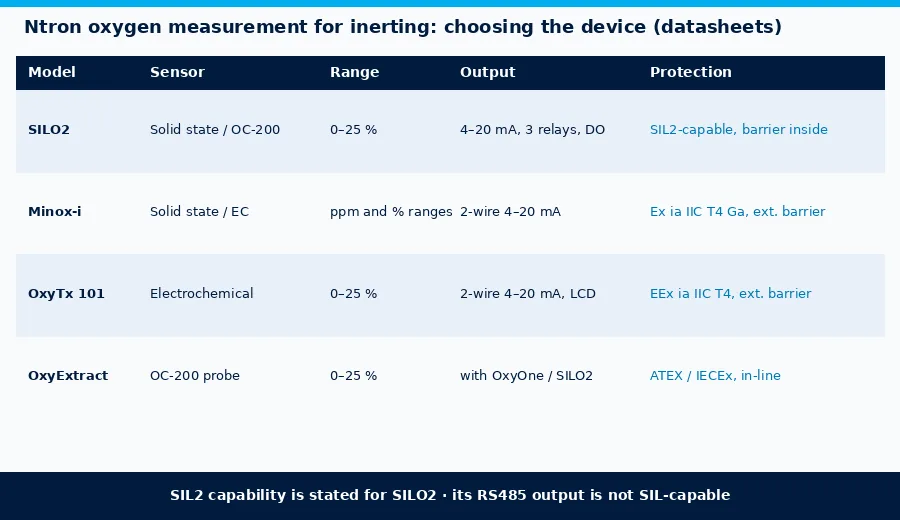
- Ntron Minox-i: intrinsically safe 2-wire loop-powered transmitter in a 316 stainless steel IP66 housing, solid-state (0–25 %) or electrochemical (0–10, 0–100, 0–1000 ppmV) sensors, powered at 24 V DC through a suitable I.S. barrier, IECEx and ATEX Ex ia IIC T4 Ga (product page). Choose it for ppm-level purge and glove-box points.
- Ntron OxyTx 101: intrinsically safe 2-wire transmitter with a 4-digit LCD, electrochemical sensor, 0–25 % O2, ATEX II 2 G EEx ia IIC T4 (product page). Choose it for a simple percent-O2 reading with local display.
- Ntron OxyOne inerting control system: controller for single or dual O2 sensor inputs with auto-calibration, 5.7-inch touchscreen, 8 configurable relays and SD-card logging (product page). Choose it when the plant wants a complete inerting controller with automatic calibration.
Related products
| Need | Product | Key point |
|---|---|---|
| SIL-rated oxygen input to an inerting safety function | Ntron SILO2 | SIL2-capable (IEC 61508), built-in barrier, Zone 0 sensor, T90 <20 s (datasheet) |
| In-line process oxygen with retractable sensor | Ntron OxyExtract | 0–25 % O2 with OC-200, 316 SS or Hastelloy C22, ATEX/IECEx (product page) |
| Loop-powered I.S. transmitter, ppm or percent | Ntron Minox-i | 0–10 ppmV up to 0–25 %, Ex ia IIC T4 Ga (product page) |
| Simple I.S. percent-O2 transmitter with display | Ntron OxyTx 101 | 0–25 %, 4-digit LCD, 2-wire 4–20 mA (product page) |
| Complete inerting controller | Ntron OxyOne | Single or dual sensors, auto-calibration, 8 relays (product page) |
For more background, read our guide to oxygen monitoring for nitrogen blanketing and inerting, the OxyTx 101 intrinsically safe transmitter note and the oxygen analyzers for process safety and combustion control guide. The wider range is on the Oxygen Analysis and Gas Analysis category pages, our selection guides and the Ntron Gas Measurement manufacturer page.
What to send with an enquiry
- The process and equipment: reactor, centrifuge, dryer, mill, glove box, vent header, electrolyzer or other.
- The inert gas, the normal oxygen level and the alarm and trip set points from your safety study.
- Whether the oxygen point is part of a SIF and the SIL target for that function.
- The preferred process connection: 2-inch tri-clamp, flow-through, KF40 or in-line via OxyExtract.
- The hazardous area classification at the sensor (zone, gas or dust group) and the cable distance to the panel.
- Process pressure, temperature, humidity and any solvents or dust present at the sensor.
FAQ
Is the SILO2 certified for SIL2?
The SILO2 is a SIL2-capable oxygen analyzer designed for safety-critical applications requiring compliance with IEC 61508 SIL2, using two continuous self-monitoring microprocessors. The SIL achieved in your plant depends on the complete safety function, so the device data should be included in your SIL verification.
Do I need a separate intrinsically safe barrier?
No. The analyzer and the galvanic isolation barrier are built into one DIN-rail device, with an [Ex ia Ga] IIC sensor connection that allows the sensor to be installed in Zone 0.
What range and response time does the SILO2 have?
0–25 % O2 with 0.01 % output resolution, a lower detection limit of 0.02 % ± 0.01 and a T90 response time below 20 seconds, typically 12 seconds.
Can the RS485 output be used for the safety function?
No. The datasheet states that RS485 is not SIL-capable. Use the 4–20 mA output and the alarm and fault relays for the safety function and RS485 for monitoring only.
Which sensors can be connected?
Solid-state OC-25/OC-25M with 2-inch tri-clamp or flow-through connection, OC-26/OC-26M with KF40 flange, or OC-200 series via OxyExtract with 2-inch tri-clamp or ANSI 150, on I.S. cables of 5, 10 or 15 m.
Planning an inerting safety function or upgrading oxygen measurement on a reactor, centrifuge or electrolyzer in Pakistan? Contact Tetracon with the process details, set points and area classification. You can also browse the SILO2 product page and the Ntron Gas Measurement manufacturer page.