

Metal additive manufacturing (AM), and laser powder bed fusion in particular, builds parts by melting fine metal powder layer by layer inside a closed chamber filled with argon or nitrogen. The quality of that atmosphere matters as much as the laser settings: oxygen left in the chamber can oxidise hot powder and melt pool, and moisture carried in by the gas, the powder or the room air is a second source of oxygen and hydrogen. As universities, defence and engineering workshops in Pakistan add metal printers and inert-gas build chambers, the practical question is how to check what is really in the chamber, independently of the machine's own sensor.
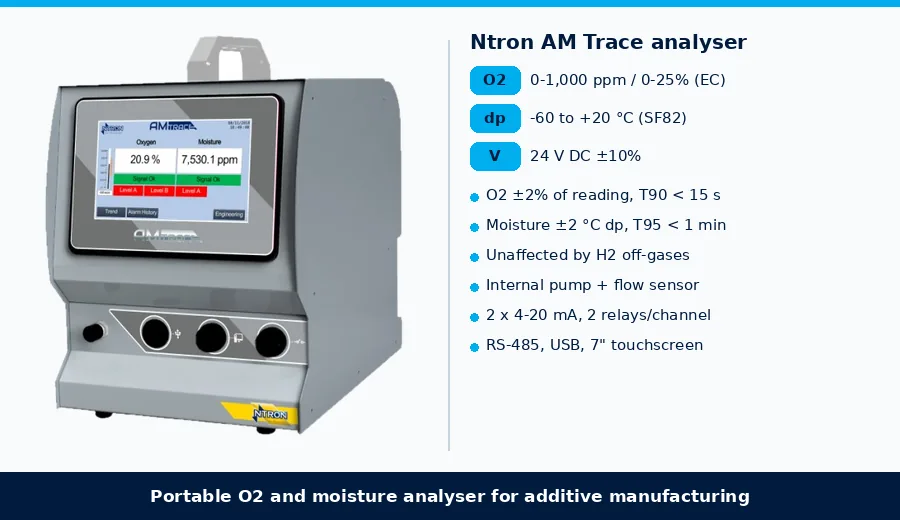
This note looks at the Ntron AM Trace portable O2 and moisture analyser, a transportable benchtop instrument that Ntron Gas Measurement (Ireland) designed specifically for additive manufacturing, and at the fixed Ntron and Michell sensors that can complement it. Instrument figures come from Ntron's AM Trace datasheet (issue AMTRACE_01_V1_EN_0720) and from the current Tetracon product pages. The dew point to ppm conversions are our own calculation and are labelled as such. Oxygen and moisture limits for a given build are set by the machine builder and the material specification, not by this article. No prices are given; options and lead time should be confirmed at quotation.
Why oxygen and moisture both matter in a build chamber
Many AM alloys, for example titanium and aluminium alloys, react readily with oxygen at process temperatures. Oxygen picked up during a build, or by reused powder over many builds, changes the chemistry of the part, so machine builders purge the chamber with inert gas and hold oxygen below a set threshold before and during the build. Moisture is the less obvious half of the problem: water vapour in the shielding gas, adsorbed on the powder or leaking in around seals and filters adds oxygen and hydrogen to the process and is easy to miss if only oxygen is measured.
That is why the AM Trace measures both. It combines an electrochemical oxygen sensor with a Michell SF82 dew-point sensor in one case, with an internal pump to draw the sample out of the chamber, so one connection gives both numbers on the same screen.
Ntron AM Trace at a glance
| Item | Ntron AM Trace datasheet (AMTRACE_01_V1_EN_0720) |
|---|---|
| Oxygen sensor | Electrochemical; stated to be unaffected by off-gases (including hydrogen) produced in the build chamber |
| Oxygen range | Dual range 0-1,000 ppm / 0-25% O2 (the datasheet introduction says it measures from 0.1 ppm, the ordering table lists 1 ppm-25%) |
| Oxygen accuracy / repeatability | ±2% of reading / ±0.5% of reading |
| Oxygen response (T90) | < 15 seconds |
| Moisture sensor and range | Michell SF82; -60 °C to +20 °C dew point (-60 °C dp is about 10 ppm H2O) |
| Moisture accuracy / repeatability | ±2 °C dew point / 0.5 °C dew point |
| Moisture response (T95) | -60 °C to -20 °C dew point in < 1 minute |
| Sampling | Internal pump to extract sample from the process; electronic flow sensor; sample flow listed as 1 litre; 1/8" BSP input and exhaust |
| Display and data | 7" colour touchscreen with status notifications, onboard data logging and trending; USB / flash drive input |
| Outputs | 2 x 4-20 mA (one oxygen, one moisture); 2 relay contacts per channel; RS-485 serial communications |
| Power | 24 V DC ±10% |
| Ambient temperature | 5 °C to 40 °C |
| Size and weight | 350 mm (D) x 253.4 mm (W) x 314 mm (H) excluding handle; 8.5 kg; portable case with handle |
| Compliance | EMC Directive 2004/108/EC |
| Ordering | AM Trace EC, electrochemical, 1/8" BSP, part no. 05-627 |
Ntron lists the applications as additive manufacturing, atmospheric chamber control, inert gas purity, air separation and gas generation (oxygen and nitrogen), so the same instrument can also check the argon or nitrogen supply feeding the printer, or the output of an on-site nitrogen generator.
Reading the moisture number: dew point and ppm
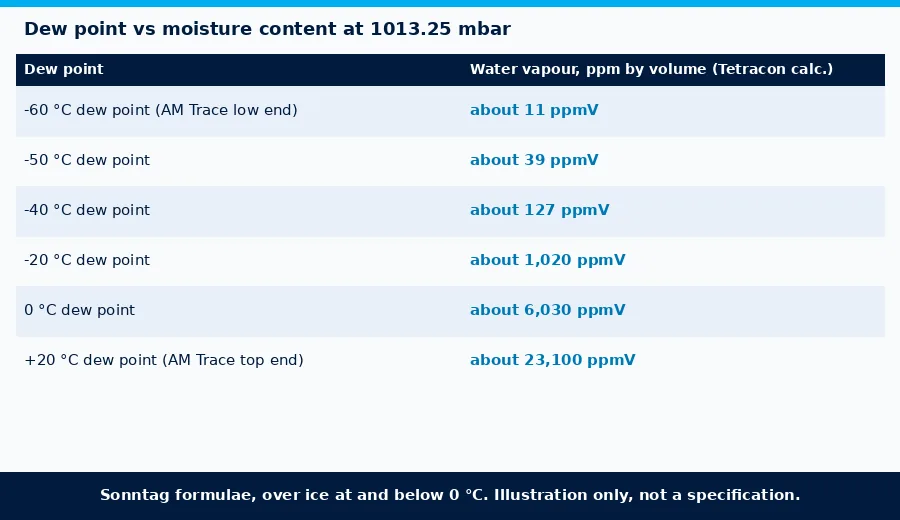
The AM Trace specifies moisture as dew point, while some machine and gas specifications quote ppm by volume. At atmospheric pressure, which is close to the condition in a build chamber, the two convert as below. The table is our own calculation (Sonntag vapour-pressure formulae, over ice at and below 0 °C, at 1013.25 mbar) and is an illustration, not a specification.
| Dew point | Moisture at 1013.25 mbar (Tetracon calculation) |
|---|---|
| -60 °C | about 11 ppmV (Ntron rounds this to 10 ppm) |
| -50 °C | about 39 ppmV |
| -40 °C | about 127 ppmV |
| -30 °C | about 375 ppmV |
| -20 °C | about 1,020 ppmV |
| 0 °C | about 6,030 ppmV |
| +20 °C | about 23,100 ppmV |
Two things follow. First, every 10 °C of dew point changes the water content by a factor of roughly 2.5 to 3.5 in this range, so a chamber that is "only" 10 °C wetter than usual holds about three times the moisture. Second, the -60 °C lower limit (about 10 ppm) is the floor of this instrument: if your specification asks for drier gas than that, tell us at enquiry stage, because it needs a trace moisture analyser rather than the AM Trace. For ppb-level and lower-ppm moisture, see our note on trace moisture in ultra-high-purity gases.
Practical points for Pakistani workshops
- Room temperature. The AM Trace ambient rating is 5 °C to 40 °C. Many Pakistani workshops exceed 40 °C in summer if the air-conditioning fails, so keep the analyser in the conditioned print room and not on a hot shop floor or in a vehicle.
- Monsoon humidity. Every time the chamber or powder handling station is opened, humid room air is introduced. A moisture check after purge, not just an oxygen check, shows whether the chamber has really dried out before the build starts.
- Power. The analyser runs on 24 V DC ±10%; plan a stable supply rather than relying on whatever adapter is nearby, especially where voltage fluctuations and UPS changeovers are common.
- Exhaust. The pump draws chamber gas through the instrument and out of the 1/8" BSP exhaust. That gas is argon or nitrogen, so route the exhaust where it cannot accumulate in a small room, and consider ambient oxygen depletion monitoring around inert-gas printers; see our note on oxygen depletion monitoring with the Ntron Gasenz.
- Safe area use. The datasheet lists EMC compliance only and no hazardous-area certification, so treat the AM Trace as a safe-area instrument.
Portable check or fixed sensor?
The AM Trace is a portable, benchtop instrument. It suits commissioning a new printer, verifying the machine's built-in oxygen reading, troubleshooting a slow purge or a leaking seal, checking incoming argon and nitrogen, and moving between several machines in one facility. Where a chamber, glove box or gas generator needs permanent monitoring with outputs into a PLC, fixed sensors from the same supplier group are the usual companions:
- Ntron SenzTx compact oxygen transmitter: zirconia or electrochemical sensor, ranges from 0-1,000 ppmV up to 0-100% O2 (zirconia), 4-20 mA and RS485 Modbus, flow-through 1/8" NPT or KF40 flange connection; additive manufacturing and glove boxes are among its listed applications. The electrochemical version allows measurement in background gases containing hydrocarbons.
- Ntron Microx-OL wall-mounted oxygen analyser: zirconia or electrochemical, 0-1,000 ppm, 0-25% or 0-96% O2 (96% zirconia only), integral visual alarm beacon and configurable alarm relays, for inert gas supplied under positive pressure.
- Michell SF82 dew-point transmitter: the same sensor family as the AM Trace moisture channel, -60 to +60 °C dew point, ±2 °C dp, with a KF40 flange option and 4-20 mA or Modbus RTU output.
- Ntron Yellow Box portable oxygen analyser: a transportable zirconia analyser for verifying primary oxygen instrumentation, N2 and O2 generators and industrial gas, when moisture is not needed.
Note the sensor choice in the AM Trace: Ntron uses an electrochemical oxygen cell and states that it is unaffected by build-chamber off-gases including hydrogen. If your chamber or gas mixture contains hydrogen or other combustible components and you are considering a zirconia-based fixed sensor instead, send us the gas composition first so the sensor type can be confirmed with Ntron.
A simple check routine
- After purge, before the build: confirm both oxygen and dew point have reached the machine builder's start condition, and record them (the AM Trace logs onboard and exports via USB / flash drive).
- During long builds: trend both channels on the touchscreen; a slow rise in dew point with steady oxygen often points to moisture from powder or a filter rather than an air leak (a general observation, not an instrument specification).
- Gas supply: periodically check the incoming argon or nitrogen at the cylinder, manifold or generator outlet, so a wet or contaminated supply is not mistaken for a chamber problem.
- Machine sensor verification: compare the AM Trace with the printer's built-in O2 reading at the same time and condition, and keep the results with the machine records.
- Use the alarms: the two relay contacts per channel and the 4-20 mA outputs let the AM Trace drive a local alarm or a data logger while it is connected to a machine.
What to send with an enquiry
- The printer or chamber type, the inert gas used (argon or nitrogen) and the oxygen and moisture limits you need to verify
- Whether you need portable checks across several machines (AM Trace) or permanent monitoring on one chamber or generator (SenzTx, Microx-OL, SF82)
- Any hydrogen or other combustible or corrosive components in the gas
- Sample point details: connection, chamber pressure and where the exhaust can be vented
- Required outputs (4-20 mA, relays, RS-485 or Modbus) and how data will be recorded
FAQ
What does the Ntron AM Trace measure?
Oxygen and moisture together. Oxygen is measured by an electrochemical sensor over a dual range of 0-1,000 ppm and 0-25%, and moisture by a Michell SF82 sensor from -60 °C to +20 °C dew point. Both are shown on a 7" touchscreen and output as two 4-20 mA signals.
Is the AM Trace affected by hydrogen in the build chamber?
Ntron states that its electrochemical oxygen sensor is unaffected by off-gases produced in the build chamber, including hydrogen.
How accurate is the AM Trace?
The datasheet gives oxygen accuracy of ±2% of reading with ±0.5% of reading repeatability, and moisture accuracy of ±2 °C dew point with 0.5 °C dew point repeatability.
How dry is -60 °C dew point?
About 10 ppm of water by volume at atmospheric pressure (Ntron quotes 10 ppm; our calculation gives about 11 ppmV). That is the lower limit of the AM Trace moisture range.
Does the AM Trace need its own sample pump?
No. It has an internal pump to extract the sample from the process and an electronic flow sensor, with 1/8" BSP input and exhaust connections.
Can the AM Trace log data?
Yes. The touchscreen provides onboard data logging and trending of gas concentrations, with a USB / flash drive input and RS-485 serial communications.
Next steps
Tetracon supplies Ntron oxygen analysers and Michell moisture instruments across Pakistan. Send us your chamber, gas, oxygen and moisture limits and whether you need portable or fixed monitoring, and we will work with the manufacturer on the right configuration. Use the contact page or see our services. Start with the Ntron AM Trace, browse oxygen analysis, moisture and dew point and gas analysis, or see all Ntron and Michell Instruments products and the full product catalogue. Related notes: oxygen monitoring for blanketing and inerting, trace oxygen in inert gases, online dew point measurement and field calibration of dew-point hygrometers. Free technical guides are collected under Guides.