

Most moisture measurements in Pakistani plants are about keeping water out of a process at the ppm level: instrument air at -40 °C dew point, natural gas to a pipeline specification, a dryer outlet before a compressor. A smaller group of users works two or three orders of magnitude lower. Specialty gas fillers and distributors, air separation units supplying high-purity nitrogen and argon, gas purifier systems, fibre-optic and optical-coating lines and electronics assembly all care about moisture in the low ppb range, where a few parts per billion of water can mean a rejected cylinder, a hazy coating or a purifier that has quietly reached breakthrough.
This note explains what "ultra-dry" means in dew-point and ppb terms, why ppb moisture is hard to measure, and how Michell Instruments' Pura trace moisture transmitter and the Pura Online hygrometer are specified for these duties. Instrument figures come from Michell's Pura Transmitters datasheet (99208 V1.1, 10/23) and the Pura Hygrometer Solutions datasheet (Pura Advanced Online 99209 V1, 01/23). Dew-point to ppm conversions and the pressure example are our own calculations and are labelled as such. No prices are given; versions, options and lead time should be confirmed at quotation.
What "ultra-dry" means: dew point, ppmV and ppbV
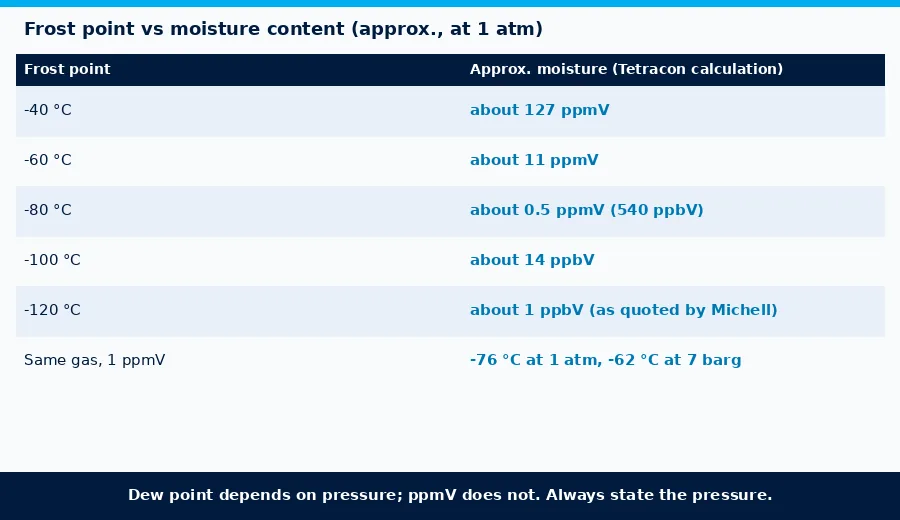
Below about -40 °C the dew point is really a frost point, and the amount of water it represents falls very quickly. The figures below are our approximate conversions at atmospheric pressure (Sonntag formula for vapour pressure over ice); they are given only to show the scale.
| Frost point at 1 atm | Approximate moisture content | Typical meaning |
|---|---|---|
| -40 °C | about 127 ppmV | Dry instrument air; the top of the Pura range (the datasheet's 0 to 127 ppmV analogue scale matches this end) |
| -60 °C | about 11 ppmV | Very dry plant gas |
| -80 °C | about 0.5 ppmV (540 ppbV) | Typical high-purity cylinder gas territory |
| -100 °C | about 14 ppbV | Purifier outlet and ultra-high-purity distribution |
| -120 °C | Michell quotes about 1 ppbV ("less than 1 part per billion") | Bottom of the Pura range |
Two practical points follow. First, at these levels you should agree with your customer whether a specification is written as a dew point or as ppbV, and at what pressure, because published conversion formulas start to differ below about -100 °C. The Pura can be scaled to report dew point, ppmV or ppbV directly, which avoids converting by hand. Second, the dew point depends on pressure while ppmV does not. By our calculation, a gas holding 1 ppmV of water has a frost point of about -76 °C at atmospheric pressure but about -62 °C at 7 barg. Always state the pressure with a dew-point figure.
Why ppb moisture is hard to measure
Water molecules stick to every surface they meet. In a dry gas line, the walls of tubing, fittings, filters and the sensor itself hold far more water than the gas flowing past them, and they release it slowly. That is why a trace-moisture reading "dries down" for hours after a sample line is opened to air, and why a leaking compression fitting or a short length of polymer tubing can add more moisture than the process ever had. Historically, as Michell's datasheet puts it, trace-moisture measurement demanded complex analysers or expensive analytical techniques.
The Pura is designed around those problems. Its sample block is cold-drawn stainless steel with an electropolished internal finish of 0.1 to 0.2 µm Ra, the process connections are metal-gasket VCR fittings (2 × 1/4 in male VCR on the Premium and OEM versions, 1/2 in male VCR on the Sensor version), and the Premium version is supplied double-bagged and sealed in UHP inert gas for clean-room installation. The goal is to add as little wetted surface and as few leak paths as possible between the gas and the sensor.
How the Pura measures: ceramic metal-oxide sensor
The Pura uses Michell's ceramic metal-oxide moisture sensor with microcontroller electronics. Michell describes it as the first low-cost transmitter suitable for large-scale integration into a semiconductor fabrication plant or a high-purity gas line: instead of one expensive analyser shared between many points, a small transmitter can sit on each line, purifier outlet or filling manifold. Each unit is supplied with a traceable 7-point calibration certificate, and Michell states that its calibration system is traceable to NPL and NIST.
For the deepest reference measurements, or to check a transmitter in a laboratory, Michell also offers instruments based on other principles, such as the QMA401 trace moisture analyzer and the S8000 -100 chilled-mirror hygrometer; our note on trace moisture in process gases compares ceramic, chilled-mirror and laser methods.
Pura transmitter at a glance
| Item | Michell Pura Transmitters datasheet (99208 V1.1, 10/23) |
|---|---|
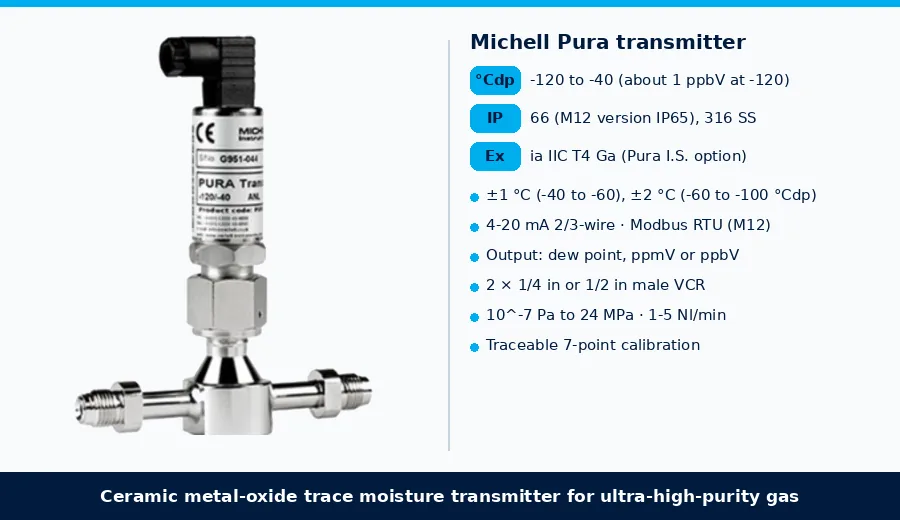
| Measurement range | -120 to -40 °Cdp; non-standard ranges on request |
| Accuracy | ±1 °C from -40 to -60 °Cdp; ±2 °C from -60 to -100 °Cdp; ±4 °C from -100 to -120 °Cdp (extrapolated) |
| Calibration | Traceable 7-point calibration certificate |
| Outputs | 4-20 mA 2-wire (current source) or 3-wire (current sink); Pura M12: Modbus RTU over RS485. Dew point or moisture content (ppmV, ppbV); analogue scale -120 to -40 °C or 0 to 127 ppmV |
| Supply | 12 to 28 V DC (2-wire, 3-wire and I.S.); Pura M12: 5 to 28 V DC (digital); 23 mA max |
| Diagnostics (factory set) | Sensor fault 23 mA; under-range 4 mA; over-range 20 mA |
| Operating pressure | Minimum 10-7 Pa (10-9 torr); maximum 24 MPa (240 barg) |
| Flow | 1 to 5 Nl/min in the standard sampling block; 0 to 10 m/s direct insertion |
| Temperature | Operating -40 to +60 °C; compensated -20 to +50 °C |
| Process connection | Premium (PRM) and OEM: 2 × 1/4 in male VCR; Sensor (SEN): 1/2 in male VCR |
| Housing and protection | 316 stainless steel; IP66 / NEMA 4 (Pura M12: IP65); MiniDIN 43650 form C or M12 5-pin A-coded connector |
| Hazardous area (Pura I.S.) | ATEX/UKCA II 1 G Ex ia IIC T4 Ga; IECEx Ex ia IIC T4 Ga (-20 to +70 °C); cQPSus Class I Div 1 Groups A-D T4; also TR CU |
| Weight | PRM and OEM 450 g; SEN 180 g |
The Ex ia IIC T4 Ga marking of the intrinsically safe version means it can be used in Zone 0, the most onerous gas zone, provided it is connected through an approved galvanic isolator; the datasheets list the approved isolator models. Through its RS485 communication system the transmitter can be re-ranged within -120 to -40 °Cdp and rescaled between dew point, ppmV and ppbV using the Easidew and Pura communications kit.
Transmitter only, or a hygrometer with a display?
If the reading goes straight to a PLC, DCS or a purifier controller, the transmitter alone is usually enough. If operators need a local reading and alarms, Michell supplies the Pura as a hygrometer system with one of two monitors, which also power the transmitter:
- Pura Online: an economical monitor with order-selectable dew-point or moisture-content scaling, a single 4-20 mA analogue output, Modbus RTU over RS485 and 2 programmable relay alarms.
- Pura Advanced Online 2: a touch-screen monitor with moisture and pressure shown together and live pressure compensation, user-selectable dew-point or moisture-content scaling, three 4-20 mA outputs, Modbus RTU over RS485 and 4 programmable relay alarms.
Pressure compensation matters when the sensor sits at line pressure but the specification is written at atmospheric pressure, as in the 1 ppmV example above.
Where it fits in Pakistan
- Specialty and industrial gas producers: moisture in high-purity nitrogen, argon, oxygen, helium and calibration gas mixtures at the filling manifold or on the product line, alongside trace oxygen and nitrogen measurements (see our note on trace nitrogen analysis for specialty gas and air separation).
- Gas purification systems: breakthrough indication at the outlet of a purifier or dryer bed, where the Pura datasheet positions it as an economical solution for moisture breakthrough in ultra-dry purification.
- Fibre-optic, optical-coating and electronics manufacturing: process and purge gases where moisture affects yield, all listed by Michell as Pura applications.
- Laboratories and gas distribution: monitoring of bulk and point-of-use high-purity gas lines.
For moisture at the ppm level in compressed air, dryers and general process gas, the Easidew range is usually the better fit; the Pura is for gas that is already very dry and must stay that way.
Installation good practice for ppb moisture
- Keep the sample path short and all-metal. Use electropolished stainless-steel tubing and VCR or other metal-seal fittings; avoid polymer tubing, which lets water diffuse through and holds moisture.
- Use the sample block flow range. In the standard sampling block Michell specifies 1 to 5 Nl/min. Too little flow lengthens dry-down; venting the sample to atmosphere through a long, narrow line protects it from back-diffusion of room air.
- Plan for dry-down. After installation or any time the line is opened, the reading will take time to fall to the true value as surfaces release water. Purge with dry gas and judge stability by the trend, not the first reading.
- Record the pressure. Note the line pressure at the sensor, or use a monitor with pressure compensation, whenever a dew-point value is reported.
- Hazardous areas. In a classified area use the Pura I.S. version and one of the approved galvanic isolators listed by Michell.
- Calibration and exchange. Michell offers a sensor exchange programme (a reconditioned, calibrated 1/2 in VCR sensor is sent first, so the line need not stop) and a recalibration service. Our note on field calibration of dew-point hygrometers covers checking instruments between visits.
What to send with an enquiry
- Gas (nitrogen, argon, hydrogen, oxygen, helium, a mixture) and its normal and expected maximum moisture level, as dew point or ppbV and at what pressure
- Line pressure and temperature at the measuring point, and available flow if a sample is taken
- Required output (4-20 mA, Modbus RTU) and whether a local display and alarms are needed (transmitter, Pura Online or Advanced Online 2)
- Process connection preference (1/4 in or 1/2 in VCR) and clean-room or industrial packaging
- Hazardous-area classification, if any
FAQ
How low can the Michell Pura measure moisture?
The Pura measures from -40 °C down to -120 °C dew point. Michell quotes -120 °C as about 1 ppbV (less than 1 part per billion) of water.
What is the accuracy of the Pura transmitter?
Michell specifies ±1 °C from -40 to -60 °C dew point, ±2 °C from -60 to -100 °C and ±4 °C from -100 to -120 °C (extrapolated), with a traceable 7-point calibration certificate.
Can the Pura report ppbV instead of dew point?
Yes. The output can be dew point or moisture content in ppmV or ppbV, and the transmitter can be re-ranged and rescaled over its RS485 communication system with the Easidew and Pura communications kit.
Is there a hazardous-area version?
Yes. The Pura I.S. is certified ATEX/UKCA II 1 G Ex ia IIC T4 Ga, IECEx Ex ia IIC T4 Ga and cQPSus Class I Division 1 Groups A to D T4, and must be connected through an approved galvanic isolator.
What is the difference between the Pura Online and the Pura Advanced Online 2?
The Pura Online is an economical monitor with one 4-20 mA output, Modbus RTU and 2 relay alarms. The Advanced Online 2 adds a touch screen, live pressure compensation, three 4-20 mA outputs and 4 relay alarms.
Where can Pakistani users see the product and ask for a quotation?
See the Pura transmitter and Pura Online pages in the Tetracon catalogue and use the contact page; Tetracon supplies Michell Instruments moisture instruments across Pakistan.
Next steps
Tetracon supplies Michell Instruments moisture and dew-point instruments to industry and laboratories across Pakistan. Send us your gas, moisture level, pressure, output and area classification and we will work with Michell on the right Pura version, monitor and accessories. Use the contact page or see our services. Start with the Pura trace moisture transmitter, the Pura Online hygrometer and the Easidew and Pura communications kit, browse moisture and dew point, dew-point transmitters and gas analysis, or see all Michell Instruments products. Related notes: trace moisture in process gases, trace nitrogen analysis for specialty gas, chilled-mirror reference hygrometers, online dew-point monitoring for compressed air and field calibration of dew-point hygrometers. Free technical guides are collected under Guides.