

Every humidity reading in a Pakistani plant goes back to a reference instrument somewhere. A pharmaceutical stability chamber held at 30 °C / 65 % RH, a transformer factory checking that a winding is dry after vacuum drying, a battery or electronics dry room, an ISO/IEC 17025 laboratory calibrating RH probes and dew-point transmitters for its customers: all of them need a reference that does not drift. Polymer RH probes and ceramic dew-point sensors are excellent working instruments, but they are calibrated against something better. In most humidity laboratories that something is a chilled-mirror hygrometer.
This note explains how to choose a chilled-mirror reference from the Michell range that Tetracon supplies: the S8000 Precision, the low-frost-point S8000 RS and S8000 -100, the high-temperature S8000 HT, the S8000 Remote with its separate sensor head, and the fast-responding Optidew. All instrument figures come from the current Michell datasheets. Chamber dew points are calculated from the set-points with the Magnus formula and rounded. No prices are given. Your own uncertainty budget and accreditation body decide whether an instrument is fit to be your reference.
Why a chilled mirror is the reference
A chilled-mirror hygrometer measures a primary property of moisture: the temperature at which it condenses. Sample gas flows over a small gold-plated mirror that a thermoelectric cooler chills until dew or frost forms. An optical system watches the light reflected and scattered by the condensate and holds the mirror at the point where condensation and evaporation balance. A platinum resistance thermometer embedded in the mirror then reads the dew point directly. Michell's datasheets summarise the consequences:
- No drift from a calculated variable. The condensation temperature is measured directly, so there is no sensor coefficient that slowly shifts the way a polymer or oxide film can.
- Repeatability. That is why chilled mirrors are widely accepted as the default humidity calibration reference, and why Michell uses S8000 instruments as references and working standards in its own manufacturing and calibration operations.
- Dew or frost matters. Below 0 °C water can stay super-cooled on the mirror, and the datasheets note that the difference between condensing water and ice can introduce errors of up to about 10 % of reading. Every S8000 and the Optidew include FAST (Frost Assurance Technology), which drives the mirror cold enough to make sure ice has formed before measuring. The S8000 RS and S8000 -100 also come with a microscope as standard, and one is optional on the S8000 Precision, so the operator can see whether the mirror carries dew or frost.
- Contamination is managed. DCC (Dynamic Contamination Correction) periodically rebalances the optics to compensate for dirt on the mirror, and the Optidew's DCC Plus extends operation in dirty environments without stopping to clean the mirror by hand.
The trade-off is that a chilled mirror needs a clean sample at a controlled flow, and the bench models need a reasonably controlled room. It is a reference and validation instrument, not something to bolt onto a dusty process line and forget.
The S8000 family and Optidew at a glance
| Model | Dew/frost-point range | Accuracy | What sets it apart (Michell datasheet) |
|---|---|---|---|
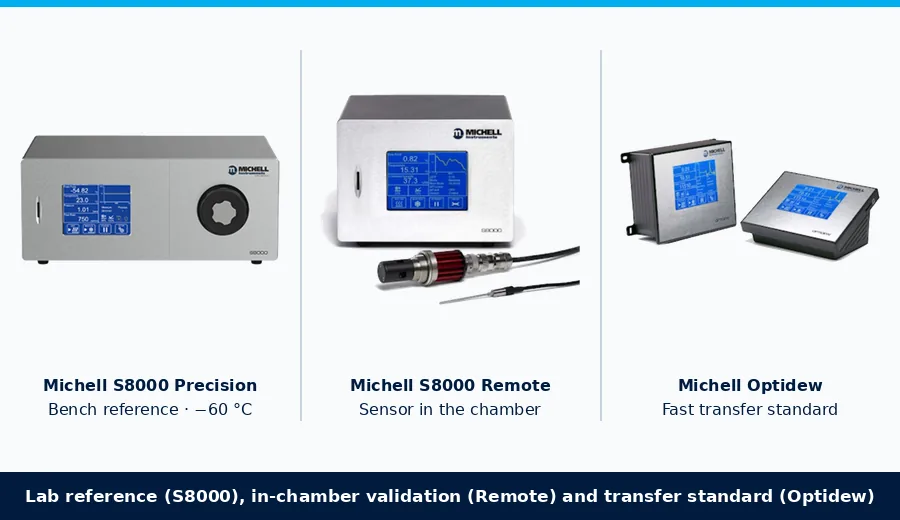
| S8000 Precision | −60…+40 °C | ±0.1 °C; reproducibility ±0.05 °C | Bench instrument for laboratory and industrial use. Low-pressure (0–1 barg) or high-pressure (0–20 barg) versions; 500–1000 ml/min (750 recommended); RRS triple-detection optics; optional internal pressure sensor (0–25 or 0–1.6 bara, 0.25 % FS) for ppmV, ppmW and g/m³; 2 analogue outputs (4–20 mA, 0–20 mA or 0–1 V); Modbus RTU over USB or Modbus TCP over Ethernet; 2 alarm contacts; 85–264 VAC; 12.3 kg |
| S8000 RS | −90 or −80…+20 °C (−90 °C frost point = 95.4 ppbV) | ±0.1 °C; stability ±0.05 °C at −90 °Cfp | Low-frost-point reference with no additional cooling. Reproducibility ±0.05 °C at −90 °Cfp (RS-90) or ±0.025 °C at −80 °Cfp (RS-80); under 2 h to ±0.25 °C at −90 °Cfp; welded stainless tubing and VCR fittings; sample up to 10 barg; microscope standard; 19″ 4U |
| S8000 -100 | −100…+20 °C (−100 °C frost point = 13.8 ppbV) | ±0.1 °C; reproducibility ±0.15 °C at −100 °Cfp | Flagship laboratory reference with no additional cooling. Under 2 h to ±0.25 °C at −90 °Cfp and under 6 h at −100 °Cfp; sample up to 1.6 bara; rear 4-wire Pt100 connections; microscope standard |
| S8000 HT | −30…+95 °C | ±0.1 °C; stability and reproducibility ±0.05 °C | High-temperature reference with thermally compensated optics, an external PRT for RH and 2 m heat-trace lines supplied. 250–1000 ml/min; sample up to 0.5 barg; USB plus Ethernet or RS485; 19″ 4U |
| S8000 Remote | −40…+120 °C (sensor dependent) | ±0.1 °C; reproducibility ±0.05 °C | Open remote sensor (ø45 mm, M36 thread) placed inside a chamber or duct, or in a sample block; 1/10 DIN Pt100 temperature probe for RH (<0.5–100 %, or 10–100 % with the climatic head); sensor heads: 2-stage −40…+90 °C, high-temperature −40…+120 °C, climatic head −10…+120 °C; 20 barg standard (250 barg high-pressure version); 3 analogue outputs; cable 3, 5 or 10 m; 4.2 kg |
| Optidew 401 / 501 | −40…+120 °C | ±0.15 °C dew point; ±0.1 °C temperature | Fast-responding hybrid mirror that tracks climatic chamber transitions. 401 bench top with touchscreen, USB and SD card; 501 wall-mount with display or as a blind transmitter; Modbus over RS485 standard, Modbus TCP optional; optional pressure transmitter for ppmV and g/kg; dual-stage harsh-environment sensor to 120 °C |
The S8000 Precision, RS, -100 and HT all log to an SD card (Michell quotes up to 24 million logs, or 560 days at 2-second intervals) and are set up from a 5.7″ touchscreen.
Matching the model to the job in Pakistan
| Job | Typical dew points | Model to start with | Why |
|---|---|---|---|
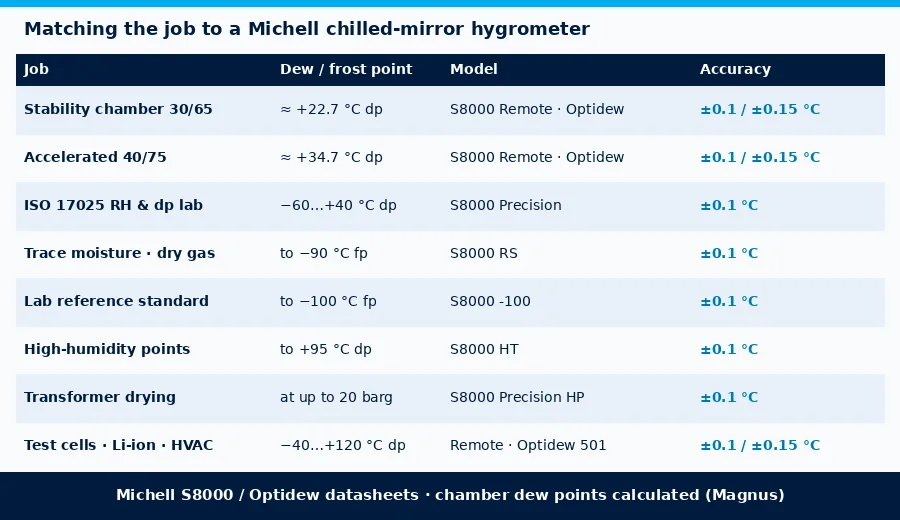
| Pharma stability and climatic chamber validation | 30 °C / 65 % RH ≈ +22.7 °C dp; 30 °C / 75 % RH ≈ +25.1 °C dp; 40 °C / 75 % RH ≈ +34.7 °C dp (calculated) | S8000 Remote or Optidew 401 | The sensor sits inside the chamber, so there is no sample line to condense. Michell lists pharmaceutical validation and environmental chamber verification as S8000 Remote applications, and positions the Optidew 401 as a transportable transfer standard for field calibration of climatic chambers. |
| ISO/IEC 17025 humidity lab, RH and dew-point probe calibration (−60…+20 °C) | −60…+40 °C | S8000 Precision | ±0.1 °C reference for most commercial calibration points, alongside a dew-point generator. Michell lists it as a reference instrument for standards and commercial calibration laboratories. |
| Trace moisture standards, high-purity and semiconductor dry gas, dry rooms | down to −90 or −100 °C frost point | S8000 RS or S8000 -100 | Frost points in the ppb range without extra cooling. These are the references for calibrating trace-moisture analysers and transmitters used on nitrogen, argon and instrument air. |
| High-humidity and high-temperature calibration points, RH sensor test | up to +95 °C dp | S8000 HT | Thermally compensated optics, heat-traced lines supplied and an external PRT for RH at elevated temperature. |
| Transformer vacuum drying verification, compressed-air dryer R&D, metallurgical atmospheres | −60…+20 °C, at pressure | S8000 Precision (high-pressure version) | All three appear in Michell's application list for the S8000. The 0–20 barg version measures at line pressure. |
| Engine test cells, corrosion chambers, precision HVAC, Li-ion battery manufacture | −40…+120 °C | S8000 Remote or Optidew 501 | Remote or wall-mount sensors for continuous measurement where a bench instrument cannot sit. The Optidew 501 networks over Modbus TCP. |
Pakistan's long-term stability condition in the WHO stability table is 30 °C / 65 % RH, and accelerated studies commonly run at 40 °C / 75 % RH. Those chamber dew points sit well inside the S8000 Remote and Optidew ranges. That is why a chilled mirror with its sensor inside the chamber is a strong way to show that the chamber's own RH sensor is telling the truth.
Setting up a chilled-mirror reference in a calibration lab
- Pair it with a stable source. A chilled mirror measures. It does not generate humidity. Use it with a dew-point generator such as Michell's DG2 / DG3 / VDS or ADG400 for dew-point transmitters, or a humidity generator such as the Rotronic HygroGen2 or Michell HygroCal100 for RH probes. (Michell describes the Optidew 401 working with a HygroCal100 to validate RH probes.)
- Respect the sample flow. The S8000 Precision, RS and -100 want 500–1000 ml/min (750 ml/min recommended). The S8000 HT accepts 250–1000 ml/min. Use stainless tubing for dry work, keep lines short, and heat-trace any line carrying gas with a dew point above room temperature. The S8000 HT ships with 2 m of heat-trace line for exactly this reason.
- Watch the pressure. Dew point depends on pressure. Measure at the pressure you intend to report, or use the pressure input (internal sensor on S8000 Precision, barometric transducer on RS, -100 and HT, optional transducer on Remote and Optidew) for ppmV and g/kg.
- Give low frost points time. Michell quotes under 2 hours to reach ±0.25 °C at −90 °C frost point and under 6 hours at −100 °C on the S8000 -100. Build that settling time into your procedure instead of reading too early.
- Control the room. Ambient ratings are −20…+40 °C for the S8000 Precision, +5…+30 °C for the RS and -100, and +10…+30 °C for the HT. A calibration lab in Karachi, Lahore or Multan needs reliable air-conditioning and a UPS to stay inside those limits through the summer and load-shedding.
- Keep the traceability chain. The S8000 Precision comes with a 3-point traceable in-house calibration and the S8000 Remote with a 4-point one. UKAS-accredited calibration is optional through Michell. Plan the recalibration interval and logistics before the instrument arrives, because your reference must go out for calibration too.
Field practice for Pakistani users
- Pharma QA and validation teams. A portable Optidew 401 or an S8000 Remote can be taken to each stability chamber, walk-in room or warehouse mapping point, where it logs to SD card or a PC. Compare it with the chamber's own sensor at the operating set-point and record both.
- Transformer and switchgear makers. Use the S8000 Precision's application listing for transformer vacuum drying verification as the starting point, and sample from the vessel at the pressure you report.
- Gas producers and semiconductor or electronics plants. Your trace-moisture analysers on nitrogen, argon or CDA dry gas are only as good as their check. An S8000 RS or -100 in the lab is the reference those analysers can be compared against.
- Specify on the enquiry. State the dew-point range and the lowest point you must certify, sample pressure, whether you need RH (external PRT) or ppmV (pressure input), outputs and comms, the sensor head type for the S8000 Remote, and whether you want UKAS-accredited calibration.
FAQ
Why are chilled-mirror hygrometers used as humidity references?
They measure the temperature at which water condenses on a cooled mirror, a primary property of moisture, using a platinum resistance thermometer in the mirror. There is no calculated sensor coefficient to drift, so Michell describes them as inherently repeatable and widely accepted as the default choice for humidity calibration references.
Which Michell S8000 model reaches the lowest frost point?
The S8000 -100 measures from −100 to +20 °C frost/dew point (−100 °C is 13.8 ppbV) with ±0.1 °C accuracy and no additional cooling. The S8000 RS reaches −90 or −80 °C frost point, and the S8000 Precision reaches −60 °C dew point.
What is the best chilled mirror for validating a pharma stability chamber?
A chilled mirror with its sensor inside the chamber avoids sample-line errors. The S8000 Remote (−40…+120 °C dew point, ±0.1 °C) lists pharmaceutical validation and environmental chamber verification as applications, and the Optidew 401 (±0.15 °C, −40…+120 °C) is designed as a transportable transfer standard for climatic chamber calibration. At 30 °C / 65 % RH the chamber dew point is about +22.7 °C, well inside both ranges.
What does FAST do on an S8000 or Optidew?
FAST (Frost Assurance Technology) detects when the mirror is in the temperature region where super-cooled water could exist and drives the mirror colder until ice forms. Michell notes that measuring over water instead of ice can introduce errors of up to about 10 % of reading.
Where can Pakistani labs and plants see the products and ask for support?
See the catalogue pages for the S8000 Precision and the other models linked above, browse dew point and moisture, or contact Tetracon with your dew-point range, sample pressure, the instruments you need to calibrate and your accreditation requirements.
Next steps
Tetracon supplies Michell humidity and dew-point instruments to calibration laboratories, pharmaceutical plants, power equipment manufacturers and industrial gas users across Pakistan. Send us the lowest and highest points you must measure or certify, sample pressure and flow, whether you work with RH probes, dew-point transmitters or trace-moisture analysers, and the room conditions in your lab. Use the contact page or see our services. Start with the catalogue pages for the S8000 Precision, S8000 RS, S8000 -100, S8000 HT, S8000 Remote and Optidew. You can also browse dew point and moisture and humidity and pressure, or see all Michell Instruments products. Free technical guides, including our moisture and dew-point guide, are collected under Guides.