

Many oxygen measurements in a process plant are not trace or ppm duties at all. They are percent-level checks: is the nitrogen blanket on a solvent tank still inert, is the purge on a dryer or centrifuge working, is the air in a gas-generation skid or a pump house still safe? Often the measuring point sits inside a classified hazardous area, so the instrument has to be certified for it and still send a signal back to the control room. An intrinsically safe, loop-powered oxygen transmitter is built for exactly that job.
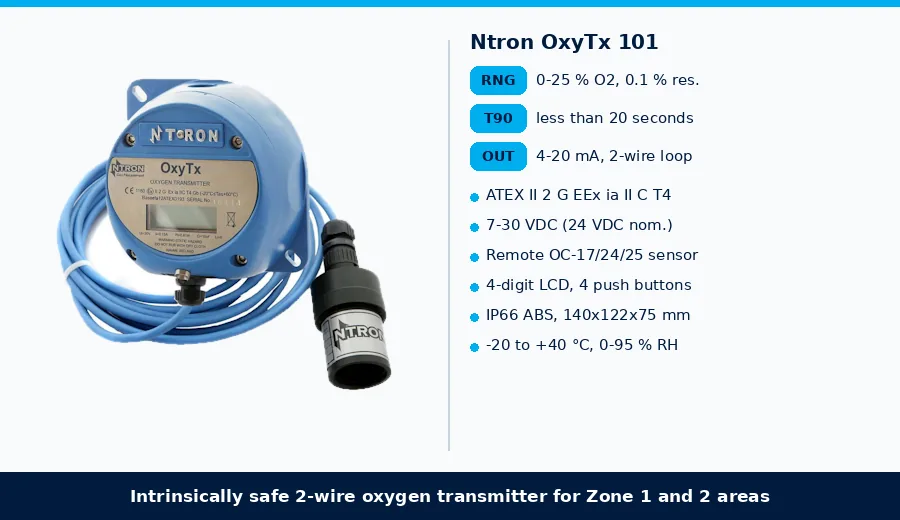
This note looks at the Ntron OxyTx 101, an intrinsically safe, surface-mounted, two-wire oxygen analyser and transmitter for 0-25 % O2. Figures come from the Ntron OxyTx 101 datasheet (D-02-238-P-002) hosted on our product page and from the current Tetracon product pages. Where we give general engineering advice, it is labelled as general. No prices are given; certification details and sensor choice should be confirmed at quotation.
Why percent-level oxygen in hazardous areas needs a dedicated transmitter
- The measurement is simple, the location is not. Inerting, purging and gas-generation checks happen in solvent stores, reactor bays, pharmaceutical process suites and gas plant skids, which are often Zone 1 or Zone 2 areas (general). A safe-area analyser cannot simply be mounted there.
- Intrinsic safety keeps the energy low. The OxyTx 101 is certified ATEX II 2 G EEx ia II C T4 and is suitable for locating within hazardous areas when powered through an intrinsically safe barrier (datasheet). Category 2 G equipment is intended for Zone 1 and Zone 2 gas atmospheres, gas group IIC covers the most easily ignited gases such as hydrogen and acetylene, and T4 limits the surface temperature to 135 °C (general).
- Two wires do everything. The transmitter is loop powered from 7-30 VDC (24 VDC nominal) and returns the reading as a 4-20 mA signal on the same pair (datasheet), so one IS-rated cable carries both power and signal back to the PLC, DCS or alarm panel.
How the OxyTx 101 works
An electrochemical oxygen sensor measures the oxygen partial pressure and produces a current proportional to it; the transmitter converts this into a % O2 reading on a large 4-digit LCD and into the 4-20 mA loop (datasheet, with general sensor principle). The sensor is a remote plug-in unit from Ntron's OC-17, OC-24 or OC-25 range, mounted away from the transmitter for ease of use and maintenance (datasheet). That lets the electronics sit where an operator can read and calibrate them, with the sensor at the point that matters.
Calibration is non-intrusive: four push buttons on the front set zero and span without opening the housing (datasheet). For a 0-25 % electrochemical sensor, a span check on clean ambient air (20.9 % O2) and a zero check with nitrogen is the usual routine (general); follow the Ntron manual for the exact procedure.
Ntron OxyTx 101 at a glance
| Item | OxyTx 101 datasheet |
|---|---|
| Type | Intrinsically safe, surface-mounted, 2-wire loop-powered oxygen analyser / transmitter |
| Gas / range | Oxygen (O2), 0-25 % |
| Sensor | Electrochemical, remote plug-in: Ntron OC-17, OC-24 or OC-25 |
| Sensor life | 2 to 3 years, application dependent |
| Response time (T90) | <20 seconds |
| Resolution | 0.1 % O2 |
| Display / interface | 4-digit LCD; 4 push buttons for non-intrusive calibration |
| Output | 4-20 mA, loop powered |
| Power | 2-wire loop, 7-30 VDC (24 VDC nominal), via a suitable isolation barrier in a hazardous area |
| Certification | ATEX II 2 G EEx ia II C T4 |
| Enclosure | ABS with stainless steel identification label, IP66 |
| Operating temperature / humidity | -20 to +40 °C / 0-95 % RH non-condensing |
| Size / weight | 140 mm (h) x 122 mm (w) x 75 mm (d) / 800 g |
| Mounting | Surface mount, 2 x M6 fasteners |
| Part number | 02-238 (surface mount, electrochemical, 0-25 %) |
With 0.1 % resolution, the OxyTx 101 is a percent-level instrument (datasheet). It is the right tool for "is this space or vessel still inert?" and "is this area still safe to breathe?", not for ppm purity checks on nitrogen or argon, where a ppm-range transmitter is needed (general).
Where it fits
- Nitrogen blanketing and inerting. The datasheet lists the chemical and pharmaceutical industries. On solvent tanks, reactors, dryers and centrifuges, a percent-level O2 reading confirms the inert atmosphere is being held below the limiting oxygen concentration set by the process safety study (general). For SIL-rated inertization loops, see the SILO2 below.
- Gas generation. "Process & gas generation industries" is a listed application (datasheet). Typical points are nitrogen generator outlets at percent purity, buffer tanks and skid enclosures where an oxygen-enriched or oxygen-depleted vent could build up (general).
- Food and beverage. Also listed in the datasheet. Examples are CO2 and nitrogen stores, modified-atmosphere packaging lines and fermentation areas where the transmitter can sit in a classified zone near solvent or ethanol handling (general).
- Area oxygen monitoring inside hazardous zones. The datasheet describes the OxyTx 101 as designed to measure ambient oxygen in process applications. Where oxygen depletion must be watched inside a classified area, the 4-20 mA signal can drive alarms in a safe-area panel (general). In safe areas, a self-contained alarm monitor such as the Gasenz is usually simpler.
Installation and selection notes
- Use the right barrier. In a hazardous area, power the OxyTx 101 through a suitable isolation barrier (datasheet). Match the barrier's entity parameters to the transmitter certificate and the cable, and keep IS wiring segregated and identified (general). Your hazardous-area inspector or the certificate holder's documents are the reference, not this note.
- Check the certification you need. The datasheet gives ATEX II 2 G EEx ia II C T4. If a project specification asks for IECEx, UKEX or North American approval, look at the Minox-i, which lists IECEx, ATEX, cQPSus, UKEX and JPN Ex on its product page.
- Place the sensor where the risk is. The remote sensor lets you put the measuring point in the vessel vent, the purge outlet or the breathing zone while the display stays readable (datasheet, with general advice). Nitrogen and argon releases collect low and spread; think about where an oxygen-depleted atmosphere would actually be (general).
- Keep within the environmental limits. -20 to +40 °C and 0-95 % RH non-condensing (datasheet). In Pakistani summers, shade outdoor installations and keep units away from hot process surfaces so the enclosure stays inside its 40 °C limit (general).
- Plan sensor replacement. Electrochemical sensor life is 2 to 3 years, application dependent (datasheet). Budget a spare sensor and a calibration check routine from day one (general).
Other Ntron oxygen instruments and when to choose them
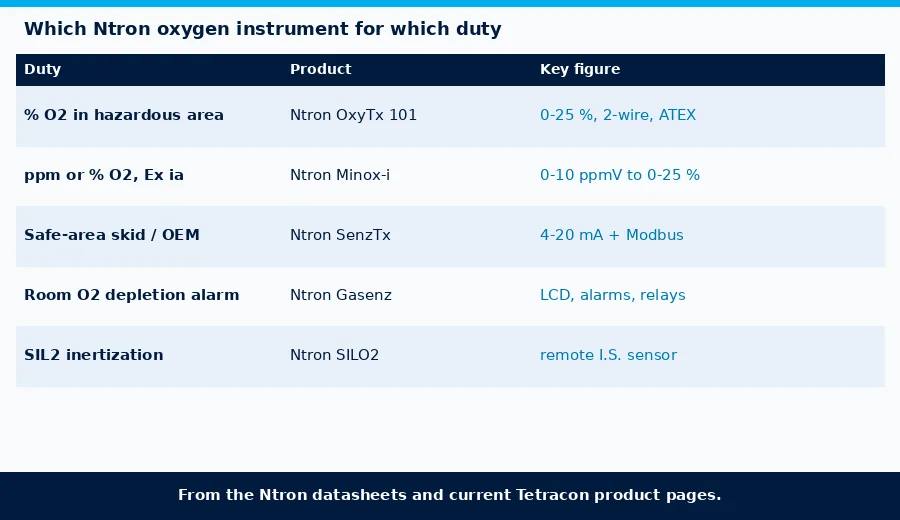
| Duty | Product | From the datasheet / product page |
|---|---|---|
| Percent O2 with a local display in a hazardous area, 2-wire | Ntron OxyTx 101 | 0-25 %, electrochemical remote sensor, 4-digit LCD, 4-20 mA loop powered, ATEX II 2 G EEx ia II C T4, IP66 ABS |
| ppm or percent O2 on a process line in a hazardous area | Ntron Minox-i | OC-92 solid state 0-25 % or electrochemical 0-10 / 100 / 1000 ppmV, 2-wire 4-20 mA, 316 SS IP66, flow-through, KF40 or tri-clamp, IECEx / ATEX / cQPSus / UKEX / JPN Ex |
| Compact transmitter for safe-area skids and OEM panels | Ntron SenzTx | Zirconia or electrochemical, 4-20 mA plus RS485 Modbus, 24 VDC, IP66 |
| Oxygen depletion alarm in safe-area rooms | Ntron Gasenz | 0-25 % O2, LCD, audible and visual alarm, relay outputs, 85-230 VAC or 24 VDC |
| SIL2-capable inertization safety function | Ntron SILO2 | DIN-rail analyser with remote I.S. sensor (5 / 10 / 15 m cable), 0-25 %, alarm and fault relays, ATEX II (1) G [Ex ia Ga] IIC |
| In-line measurement in the process gas stream | Ntron OxyExtract with OxyOne | Retractable probe, 0-25 % with OC-200 sensor, 316 SS or Hastelloy C22, ATEX / IECEx; OxyOne controller with 8 relays, 4-20 mA and Modbus |
As a rule of thumb, choose the OxyTx 101 when you want a simple, certified, display-equipped percent-O2 transmitter on a two-wire loop, and step up to the Minox-i, SILO2 or OxyExtract when the duty needs ppm ranges, wider certification, a SIL-rated function or in-line process measurement (general).
What to send with an enquiry
- The duty (inerting, purge check, gas generation, area monitoring or other) and the gas mixture at the measuring point.
- The hazardous-area classification (zone, gas group and temperature class) and the certification your site requires.
- Expected normal oxygen level and alarm set points, and whether you need percent or ppm resolution.
- Where the 4-20 mA signal goes (PLC, DCS, alarm panel) and whether IS barriers are already installed.
- Ambient conditions: indoor or outdoor, temperature range and humidity.
FAQ
What is the Ntron OxyTx 101?
An intrinsically safe, surface-mounted, two-wire loop-powered oxygen analyser and transmitter from Ntron Gas Measurement. It measures 0-25 % oxygen with a remote plug-in electrochemical sensor, shows the reading on a 4-digit LCD and outputs 4-20 mA.
Can it be installed in a hazardous area?
Yes, when it is powered through a suitable intrinsically safe isolation barrier. The datasheet gives the certification as ATEX II 2 G EEx ia II C T4.
Which sensors does it use and how long do they last?
Ntron OC-17, OC-24 or OC-25 electrochemical oxygen sensors, mounted remotely. Sensor life is 2 to 3 years depending on the application.
How fast and how fine is the reading?
The datasheet gives a T90 response time of less than 20 seconds and a resolution of 0.1 % O2.
Is it suitable for ppm oxygen in high-purity nitrogen?
No. The OxyTx 101 is a 0-25 % instrument with 0.1 % resolution. For ppm measurement in a hazardous area, the Ntron Minox-i offers electrochemical ranges of 0-10, 0-100 and 0-1000 ppmV.
What power supply does it need?
A 2-wire loop supply of 7-30 VDC, 24 VDC nominal, through a suitable isolation barrier when used in a hazardous area.
Next steps
Tetracon (Pvt.) Ltd. is the sole authorized agent for Ntron Gas Measurement in Pakistan and supplies Ntron oxygen analysers, transmitters and sensors with local technical support. Send us your duty, area classification, oxygen range and signal destination, and we will propose the right Ntron instrument and sensor. Use the contact page or see our services. Start with the OxyTx 101, compare the Minox-i, SenzTx, Gasenz, SILO2 and OxyExtract, browse oxygen analysis and gas detection, or see all Ntron products and the full product catalogue. Related notes: oxygen monitoring for nitrogen blanketing and inerting, oxygen depletion monitoring with the Gasenz and selecting fixed gas detectors for hazardous areas. Free technical guides are collected under Guides.