

Engineers who build oxygen measurement into their own equipment, whether a medical device, a controlled-atmosphere store, an incubator or a fire-prevention system, usually start with a bench test. Before a sensor goes into a design, the team wants to see its readings, log them, try the communication protocol and compare it with a reference. Doing that directly on a bare sensor means building interface electronics first. An evaluation board removes that step.
This note looks at the SST Sensing LuminOx Evaluation Interface Board (LOX-EVB), the interface SST supplies for testing its LuminOx optical oxygen sensors. Figures come from the LOX-EVB datasheet (SST-DS-0059 Rev4, the copy hosted on our product page) and the current Tetracon product pages. Where we give general engineering advice, it is labelled as general. No prices are given; sensor variant and quantities should be confirmed at quotation.
Why evaluate an optical oxygen sensor on a board first
- Factory-calibrated sensors, ready to test. The datasheet describes the LuminOx family as factory-calibrated oxygen sensors that measure ambient oxygen using the principle of luminescence quenching by oxygen.
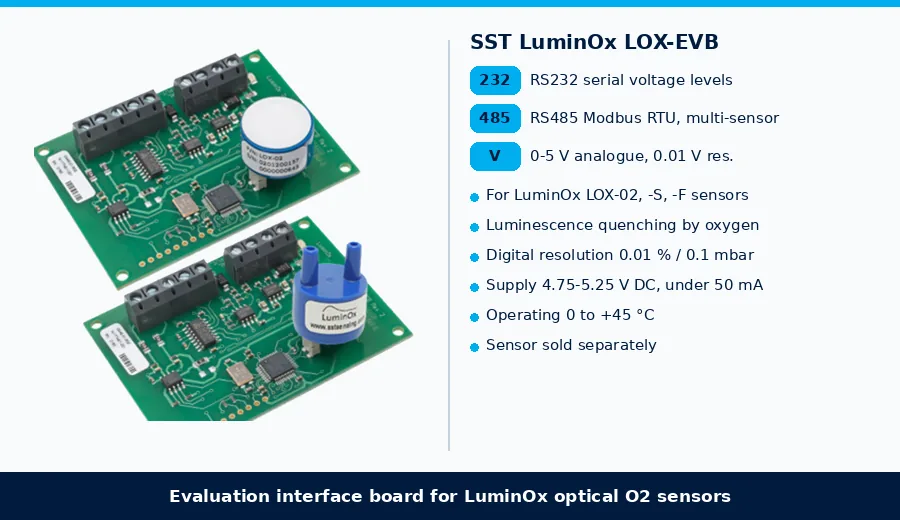
- Three outputs at once. The LOX-EVB simultaneously provides RS232 (standard serial interface voltage levels), RS485 (Modbus RTU) and a 0-5 V analogue output, so one board can be tried against whichever interface the final system will use.
- Several sensors on one bus. The RS485 Modbus RTU port allows multiple sensors to be addressed on a bus, which helps when several samples are tested side by side.
- No configuration when swapping variants. According to our product page, the board automatically detects whether a ppO2 or O2 % LuminOx variant is connected.
SST LOX-EVB at a glance
| Item | LOX-EVB datasheet (SST-DS-0059 Rev4) |
|---|---|
| Function | Evaluation interface board for LuminOx optical oxygen sensors |
| Outputs (simultaneous) | RS232 (serial interface voltage levels); RS485 (Modbus RTU); 0-5 V analogue (basic oxygen measurement only) |
| Compatible sensors | LuminOx LOX-02, LOX-02-S, LOX-02-F (sensor sold separately) |
| Resolution | Digital outputs 0.01 % / 0.1 mbar; analogue output 0.01 V |
| Supply | 4.75 to 5.25 V DC; under 50 mA |
| Temperature | Operating 0 to +45 °C; storage 0 to +60 °C |
| Connections | 9 pins: +5 V, GND, 0-5 V GND, 0-5 V signal, RS232 Rx, RS232 Tx, RS232/RS485 GND, RS485 A (+), RS485 B (-) |
| Order code | LOX-EVB |
What the LOX-EVB is, and what it is not
The LOX-EVB is a development tool. It takes a LuminOx sensor (ordered separately) and converts its native serial output into standard industrial formats, so engineers can connect it to a PC, a PLC, a data logger or a test rig. The datasheet describes it as allowing quick and easy evaluation of the LuminOx sensor and lists two suitable applications: an analogue output for LuminOx optical oxygen sensors, and an evaluation board for simple interface to control and data logging systems.
It is not a finished safety instrument. The SST datasheet states that these products must not be used in safety applications where product failure could cause injury or risk to life. If the goal is protecting people from oxygen deficiency, use a purpose-built monitor (see the comparison below).
Wiring notes from the datasheet
- Common reference. RS232 Rx/Tx and RS485 A/B (pins 5, 6, 8 and 9) are referenced to the RS232/RS485 GND on pin 7. Connect pin 7 to the reference or common of the serial port or RS485 bus.
- RS485 polarity. The datasheet warns that A/B naming differs between the EIA-485 standard and many transceiver makers, including the transceiver on the LOX-EVB. Always connect the board's "+" to the bus "+" and its "-" to the bus "-".
- Supply. Keep the supply within 4.75 to 5.25 V DC. Do not exceed maximum ratings, follow the wiring instructions carefully (incorrect wiring can permanently damage the device) and do not use chemical cleaning agents.
- Handling. Treat the sensor as an electronic component and use correct ESD precautions.
A simple bench test plan
- Start in ambient air. Power the board, read the sensor over RS232 or Modbus RTU and log the value in normal room air as a baseline (general).
- Check each output. Compare the digital reading with the 0-5 V analogue output, so you know which signal suits the final design (general).
- Use known gases. Expose the sensor to a certified test gas, such as nitrogen for a low-oxygen point, and note the response and recovery (general).
- Test the real conditions. Repeat at the temperatures, humidity and pressures the product will see, keeping the board itself within 0 to +45 °C (general; check the LuminOx sensor's own datasheet for its limits).
- Multi-sensor runs. Put several boards on one RS485 Modbus RTU bus to compare sensors from the same batch (general).
Other oxygen options from Tetracon's principals
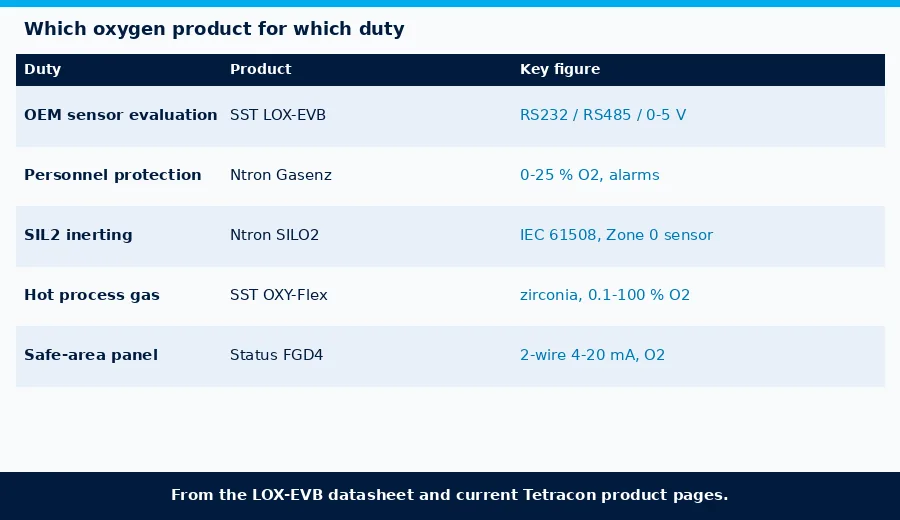
| Duty | Product | From the datasheet / product page |
|---|---|---|
| Evaluating LuminOx optical O2 sensors for OEM designs | SST LOX-EVB | RS232, RS485 Modbus RTU and 0-5 V outputs at once; 0.01 % / 0.1 mbar resolution; 5 V supply |
| Personnel protection, oxygen-deficient rooms | Ntron Gasenz | 0-25 % O2, audible and visual alarms, LCD, 4-20 mA and RS232, pre-calibrated wall mount |
| Safety-critical inerting (SIL2) | Ntron SILO2 | SIL2-capable (IEC 61508), 0-25 % O2, remote sensor for Zone 0, 4-20 mA and relays |
| In-situ O2 in hot process gas | SST OXY-Flex | Zirconia analyser with probe, 0.1-25 % or 0.1-100 % O2, 4-20 mA / 0-10 V and RS232 |
| Fixed detector on a control panel, safe area | Status Scientific FGD4 | Loop-powered 4-20 mA detector, plug-in sensors including O2, 8-24 V DC |
Typical uses in Pakistan
- Medical and laboratory equipment makers prototyping oxygen measurement.
- Universities and research groups that need a quick, logged O2 reading over RS232 or Modbus.
- Agricultural and controlled-atmosphere storage system developers.
- Builders of fire-prevention and oxygen-reduction system control panels, at the evaluation stage.
These are general application areas from our product page and our experience of the sector; they are not customer references.
What to send with an enquiry
- Which LuminOx variant you plan to use (LOX-02, LOX-02-S or LOX-02-F, O2 % or ppO2), or the application so we can suggest one.
- The interface your final design will use: RS232, RS485 Modbus RTU or analogue.
- How many boards and sensors you need for the evaluation.
- Gas, temperature, humidity and pressure conditions in the application.
- Whether the end use involves personnel safety, so we can point you to a suitable monitor.
FAQ
What is the SST LOX-EVB?
The LuminOx Evaluation Interface Board, a board for testing SST LuminOx optical oxygen sensors. It provides RS232, RS485 (Modbus RTU) and 0-5 V analogue outputs at the same time.
Which sensors does the LOX-EVB work with?
The datasheet lists the LuminOx LOX-02, LOX-02-S and LOX-02-F. The sensor is sold separately.
What resolution does it give?
0.01 % / 0.1 mbar on the digital outputs and 0.01 V on the analogue output, according to the datasheet.
What power does it need?
4.75 to 5.25 V DC, with a supply current under 50 mA. It operates from 0 to +45 °C.
Can several sensors share one bus?
Yes. The RS485 (Modbus RTU) port allows multiple sensors to be addressed on a bus.
Can it be used as an oxygen safety alarm?
No. The SST datasheet says these products must not be used in safety applications where failure could cause injury or risk to life. For oxygen-deficiency protection, consider the Ntron Gasenz.
Next steps
Tetracon (Pvt.) Ltd. is the sole authorized agent for SST Sensing Ltd. in Pakistan and supplies SST oxygen and gas sensors with local technical support. Tell us about your design and the interface you need, and we will help you choose the LuminOx variant and set up an evaluation. Use the contact page or see our services. Start with the SST LOX-EVB, compare the Ntron Gasenz, SILO2 and SST OXY-Flex, browse sensors and sensor cells and oxygen analysis, or see all SST Sensing and Ntron products and the full product catalogue. Related notes: zirconia oxygen analysers with the SST OXY-Flex, oxygen depletion monitoring with the Ntron Gasenz and CO2 monitoring for indoor air quality. Free technical guides are collected under Guides.