

Most CO2 sensors are built for rooms and ducts, where the level drifts over minutes and one reading every few seconds is plenty. Some equipment needs far more than that: a breath or respiration monitor has to follow CO2 through every breath, a food-packaging line has to check the gas in each pack as it passes, a sport-science rig records breath by breath, and a CO2 fire-suppression system has to confirm that the gas has actually been released. In Pakistan, that need comes up with medical-device and lab-equipment builders, packaging machine integrators, university and sports research groups and fire-safety system designers.
This note looks at the SST Sensing SprintIR®-6S, a small flow-through NDIR CO2 sensor that takes 20 readings per second. Figures come from the SST SprintIR®-6S datasheet (DS-0181) hosted on our product page and from the current Tetracon product pages. Where we give general engineering advice, it is labelled as general. No performance claim here goes beyond the manufacturer's published data.
Why response speed matters in CO2 measurement
- Fast events need fast sampling. A breath, a passing pack or a gas discharge can be over in well under a second (general). The SprintIR®-6S takes 20 readings per second at a fixed rate and is designed for equipment that needs real-time CO2 analysis or monitoring (datasheet).
- The gas has to reach the sensor quickly. In a flow-through sensor, response depends mostly on how fast the gas in the measuring chamber is exchanged (datasheet). The SprintIR®-6S chamber is about 2.8 ml, and SST's rule of thumb is to pass about five chamber volumes, roughly 14 ml of gas, for each reading (datasheet).
- High concentrations, not just room air. Packaging gas, breath and suppression systems can involve CO2 at percent levels (general). The SprintIR®-6S is offered with ranges of 0-5 %, 0-20 %, 0-60 % or 0-100 % CO2 (datasheet).
How the SprintIR®-6S works
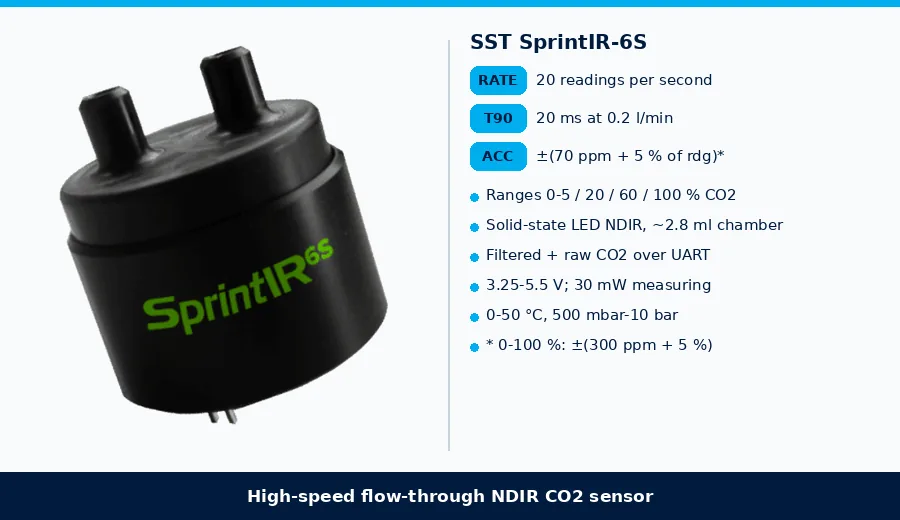
The SprintIR®-6S is a non-dispersive infrared (NDIR) sensor that uses solid-state LED optics; SST makes the low-power LEDs in-house, giving it control of the whole CO2 signal chain (datasheet). The gas chamber is lit by an LED at a nominal 4.25 µm wavelength and the signal is received by a photodiode, then processed and filtered by the sensor (datasheet). Sample gas passes through a standard flow-through adaptor; a version with a membrane cover instead of the flow adaptor (SprintIR®-6S-M) and custom flow-through adaptors are also available (datasheet).
The sensor reports both a filtered CO2 value and a raw, unfiltered value (datasheet). A proprietary low-pass digital filter removes sampling noise; a higher filter setting lowers noise but lengthens the response, and the raw data can be post-processed with your own algorithm (datasheet). Control and data run over a UART interface at 9600 baud, 8 data bits, no parity, one stop bit, using simple ASCII commands (datasheet). The sensor can stream readings (the factory default), report only when polled, or sleep in a command mode with no measurements (datasheet).
SST SprintIR®-6S at a glance
| Item | SprintIR®-6S datasheet (DS-0181) |
|---|---|
| Measurement principle | NDIR, solid-state LED optics, flow-through |
| Measurement ranges | 0-5 %, 0-20 %, 0-60 % or 0-100 % CO2 (one range per sensor) |
| Accuracy (at 25 °C) | ±(70 ppm + 5 % of reading) for the 0-5 %, 0-20 % and 0-60 % sensors; ±(300 ppm + 5 % of reading) for the 0-100 % sensor |
| Measurement rate | 20 readings per second (fixed) |
| Response time | T90 20 ms from 0 ppm, default settings, limited at 0.2 l/min |
| Time to valid reading after power-on | 1.2 s typical (digital filter 16) |
| Measuring chamber volume | About 2.8 ml |
| Supply | 3.25 to 5.5 V (3.3 V typical) |
| Power | 30 mW (9 mA at 3.3 V) while measuring in default mode; 0.03 mW in sleep; peak current 35 mA when sampling, 40 mA at turn-on |
| Interface | UART (Rx/Tx, 9600 baud); filtered and raw CO2 outputs |
| Operating conditions | 0 to +50 °C; 0-95 % RH; 500 mbar to 10 bar operating pressure |
| Weight | About 10 g |
| Ordering code | SPRINTIR-6S - 5 / 20 / 60 / 100 (range) - blank (flow-through adaptor) or M (membrane cover) |
The SprintIR®-6S is a sensor component, not a finished instrument: it has no display, enclosure or analogue output, and it is ESD-sensitive, so it is meant to be built into your own equipment (general reading of the datasheet). SST's datasheet also states that its products are not intended for life-support systems, so medical designs must be qualified by the equipment maker for their intended use (datasheet notice; general).
Where it fits
- Healthcare equipment. Listed in the datasheet. Breath and respiration measurement needs readings fast enough to follow each breath; the 20 readings per second and the raw output let the designer apply their own breath-detection algorithm (datasheet features; general application).
- Food packaging. Listed in the datasheet. Modified-atmosphere packs are often flushed with CO2-rich gas, and a fast flow-through sensor in a checking station can measure the gas drawn from each pack (general). The 0-20 %, 0-60 % and 0-100 % ranges cover these levels (datasheet).
- Sport science. Listed in the datasheet. Breath-by-breath gas measurement in exercise testing relies on a fast CO2 signal combined with flow measurement in the test rig (general).
- CO2 fire-suppression deployment. Listed in the datasheet. A sensor in the protected space or discharge line can confirm that the CO2 concentration has actually risen after release; the 0-100 % range suits these levels (datasheet range; general application).
Practical notes for good readings
- Size the flow and the filter together. SST recommends the highest digital filter setting that does not compromise the flow rate: about 64 at 0.1 l/min, 32 at 0.5 l/min, 16 at 1 l/min and 8 at 5 l/min (datasheet). The published T90 of 20 ms is at default settings and limited by a 0.2 l/min test flow (datasheet).
- Zero it the right way. The sensor can be zeroed in a known gas concentration (SST's recommended method), in nitrogen or in fresh air at a programmable value (400 ppm by default), and only the latest zero is kept (datasheet). A digital filter setting of 32 is recommended while zeroing (datasheet).
- Use auto-zero only where it makes sense. Auto-zero is disabled by default and needs the sensor to see normal background air (400-450 ppm) at least once in each auto-zero period; its settings reset when power is removed (datasheet). In a packaging line or breathing circuit that never sees fresh air, rely on scheduled zeroing instead (general).
- Correct for pressure and altitude. SST calibrates at 1013 mbar and 450 ppm, and NDIR readings rise with pressure and fall as pressure drops (datasheet). The datasheet gives compensation values by altitude, for example about 942 mbar at 610 m, and a value written to the sensor is kept after a power cycle (datasheet). That matters for equipment used in Quetta, Murree or the northern areas as well as at sea level in Karachi (general).
- Keep within the pressure and seal limits. The operating pressure range is 500 mbar to 10 bar, while the flow adaptor seal is tested at 1.3 bar gauge (datasheet). Treat the flow path as a low-pressure sample line, not a direct connection to a pressurised CO2 supply (general).
- Keep it dry and cool. The sensor is rated for 0-95 % RH and 0 to +50 °C (datasheet). Breath and pack gas can be close to saturation, so avoid condensation in the sample line, and in a hot Pakistani summer keep the enclosure below the 50 °C limit (general).
- Interface it correctly. The UART pins are logic level and normally high; a true RS232 device such as a PC needs a level converter that also inverts the signal (datasheet). An evaluation kit is described on a separate SST datasheet (datasheet).
Related CO2 products and when to choose them
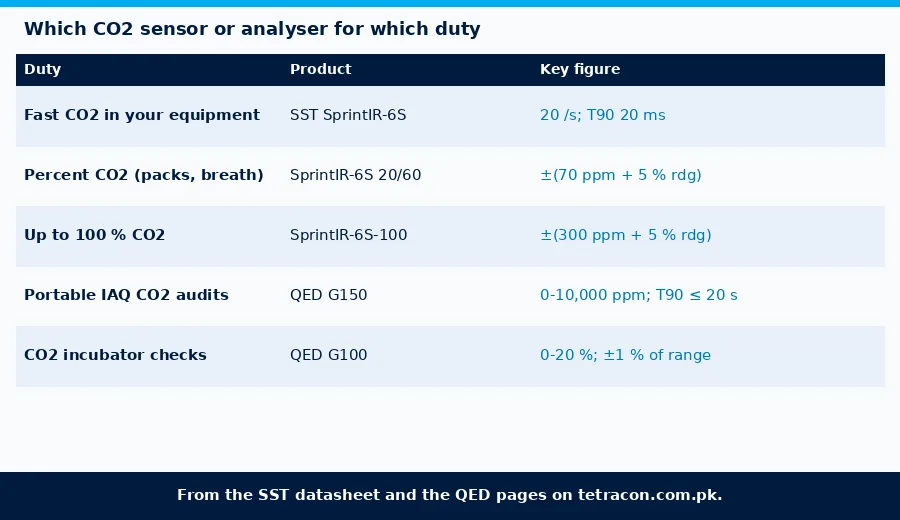
| Duty | Product | From the datasheet / product page |
|---|---|---|
| Fast CO2 built into your own equipment | SST SprintIR®-6S | NDIR sensor, 20 readings per second, 0-5 / 20 / 60 / 100 %, ±(70 ppm + 5 % of reading) up to the 0-60 % version, T90 20 ms at 0.2 l/min, UART, 3.25-5.5 V |
| Portable CO2 checks for indoor air quality | QED G150 | Handheld analyser, 0-10,000 ppm, dual-wavelength IR, ±1.5 % of range, T90 ≤ 20 s, internal pump, data logging and USB |
| Verifying CO2 incubators in labs and IVF | QED G100 | Portable analyser, 0-20 % CO2, ±1 % of range after calibration, T90 ≤ 20 s, optional O2, temperature and humidity |
| Oxygen sensing in your own equipment | SST LuminOx with LOX-EVB | Board for evaluating LuminOx optical O2 sensors (0-25 % O2 or 0-300 mbar ppO2) with RS232, RS485 Modbus RTU and 0-5 V outputs |
As a rule of thumb, choose the SprintIR®-6S when you are designing equipment that must follow CO2 changes in a fraction of a second, a handheld G150 when a facility team needs to audit room CO2, and a G100 when a lab needs to check incubator CO2 without building anything (general). If the design also needs oxygen, SST's LuminOx sensors can be evaluated alongside it on the LOX-EVB board (general).
What to send with an enquiry
- The application (breath or respiration equipment, pack checking, sport-science rig, fire-suppression confirmation, research) and how fast the CO2 level changes.
- The CO2 range you need (0-5 %, 0-20 %, 0-60 % or 0-100 %) and the accuracy you expect at the key operating point.
- How the gas reaches the sensor: pumped or flowing sample and its flow rate, or diffusion (membrane version).
- Sample pressure, temperature, humidity and the site altitude, so pressure compensation can be planned.
- Your electronics: supply voltage, microcontroller UART or PC connection, and whether you need an evaluation kit or custom flow adaptor.
- Quantities for prototypes and production.
FAQ
What is the SST SprintIR-6S?
A small flow-through NDIR CO2 sensor from SST Sensing that uses solid-state LED optics and takes 20 readings per second. It is designed for equipment that needs real-time CO2 measurement and is offered with ranges up to 100 % CO2.
How fast does it respond?
The datasheet gives a T90 response time of 20 ms from 0 ppm at default settings, limited at a 0.2 l/min test flow. The measurement rate is fixed at 20 readings per second, and a valid reading is available about 1.2 seconds after power-on.
How accurate is it?
At 25 °C the 0-5 %, 0-20 % and 0-60 % versions are specified at ±(70 ppm + 5 % of reading), and the 0-100 % version at ±(300 ppm + 5 % of reading).
What output and power does it need?
It communicates over a logic-level UART at 9600 baud using ASCII commands and gives filtered and raw CO2 readings. The supply is 3.25 to 5.5 V; it draws about 30 mW while measuring in the default mode at 3.3 V.
Does it need calibration?
It can be zeroed in a known gas, in nitrogen or in fresh air, and it has a built-in auto-zero function that is disabled by default. SST calibrates the sensor at 1013 mbar and 450 ppm, and a pressure compensation value can be stored for other altitudes.
Can it be used in medical equipment?
Healthcare is one of the applications listed in the datasheet, but SST states its products are not intended for life-support systems. The equipment manufacturer is responsible for qualifying the sensor for its intended medical use.
Next steps
Tetracon (Pvt.) Ltd. is the sole authorized agent for SST Sensing in Pakistan and supplies its oxygen and CO2 sensors and analysers with local technical support. Send us your application, CO2 range, flow and electronics details, and we will propose the right sensor version. Use the contact page or see our services. Start with the SprintIR®-6S, compare the QED G150 and QED G100 analysers, browse gas detection and sensors, or see all SST Sensing and QED products and the full product catalogue. Related notes: CO2 monitoring for indoor air quality and HVAC, portable CO2 analysers for IAQ audits and evaluating SST LuminOx optical oxygen sensors. Free technical guides are collected under Guides.