

Carbon dioxide is the simplest number an HVAC engineer, facilities manager or auditor can use to judge whether a room, a building or an enclosed space is getting enough fresh air. Fixed CO2 sensors on the wall tell you about one point; an audit, a commissioning visit or a complaint investigation needs a portable instrument that can be carried from room to room, logged and trusted. In Pakistan, that need comes up in offices, schools, hospitals, factories, cold stores and, at border crossings and ports, when vehicles and containers have to be checked for people hidden inside.
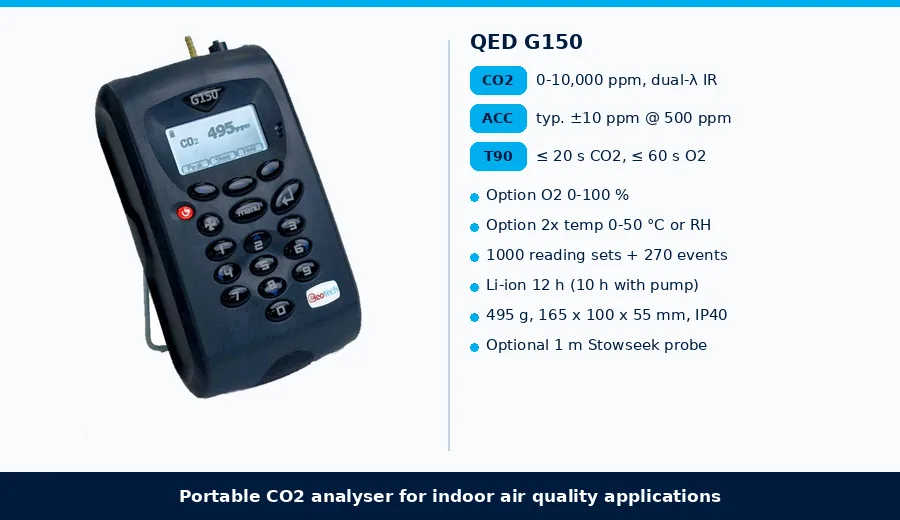
This note looks at the QED G150, a handheld CO2 analyser that QED Environmental Systems designed for indoor air quality applications and for illegal immigrant control and detection. Figures come from the QED G150 datasheet (DS6 Issue 10) hosted on our product page and from the current Tetracon product pages. Where we give general engineering advice, it is labelled as general. No performance claim here goes beyond the manufacturer's published data.
Why a portable CO2 analyser for indoor air quality
- CO2 is a ventilation indicator. People breathe out CO2, so in an occupied room the CO2 level rises above the outdoor level (roughly 420 ppm today) whenever the fresh-air supply does not keep up (general). A reading is a quick, objective way to show whether a meeting room, classroom, ward or production hall is under-ventilated.
- Audits need mobility and records. The G150 datasheet lists general IAQ, environmental site audits and HVAC system approval as applications. A handheld analyser with data storage lets one engineer survey many rooms in a visit and hand over a report instead of a handful of spot readings (general).
- Some checks are not about comfort at all. The same datasheet lists illegal immigrant control and detection, using an optional 1 m probe (Stowseek). People hidden in a closed trailer or container raise the CO2 inside it, so a probe pushed into the space can show elevated CO2 without unloading the cargo (general principle).
How the G150 measures
CO2 is measured by a custom dual-wavelength infrared cell with a reference channel; the optional oxygen measurement uses an internal electrochemical cell with an approximate life of 3 years in air (datasheet). An internal pump draws the sample at typically 100 cc/min, and the gas path includes a built-in gas dryer tube and a user-replaceable PTFE water trap filter to remove moisture before the sensors (datasheet).
The CO2 range is 0-10,000 ppm with a typical accuracy of ±1.5 % of range after calibration, typically ±10 ppm at 500 ppm CO2 after user calibration; T90 response is 20 seconds or less for CO2 and 60 seconds or less for O2 (datasheet). QED notes that all typical accuracies are after calibration plus the accuracy of the calibration gas used, so a good calibration gas and a routine user calibration are part of getting the ±10 ppm figure (datasheet, with general advice).
QED G150 at a glance
| Item | G150 datasheet |
|---|---|
| Type | Portable CO2 indoor air quality analyser; illegal immigrant detection |
| CO2 | 0-10,000 ppm, custom dual-wavelength infrared cell with reference channel |
| CO2 accuracy / T90 | ±1.5 % of range after calibration (typically ±10 ppm at 500 ppm after user calibration) / ≤ 20 s |
| O2 (optional) | 0-100 %, internal electrochemical cell, ±1.0 % of range after calibration, T90 ≤ 60 s, cell life approx. 3 years in air |
| Temperature (optional) | 2 probes, 0 to +50 °C, ±0.2 °C (not available if humidity is selected) |
| Humidity (optional) | RH probe 0-100 % RH non-condensing, ±1.5 % RH across the range |
| Barometric pressure | 800-1200 mbar |
| Alarms | Visual and audible, user-selectable CO2 and O2 alarm levels |
| Data / communications | 1000 reading sets plus 270 events; USB type B mini-connector (HID device class) |
| Sample pump / conditioning | 100 cc/min typically; built-in gas dryer tube and user-replaceable PTFE water trap filter |
| Power | Li-ion battery, 12 h (10 h with pump), 600 cycles; 5 V DC supply, 4 h charge |
| Operating conditions | 0 to 50 °C; 0-95 % RH non-condensing; ±500 mbar from calibration pressure; IP40 |
| Physical | 495 g; L 165 x W 100 x D 55 mm; ABS / polypropylene with silicone rubber inserts; 17 keys; 128 x 64 LCD with RGB backlight |
| Probe option | Optional 1 m probe (Stowseek) |
| Certification | EN 50270:2006 (EMC) and EN 61010-1:2010 (safety) |
The G150 is a safe-area, IP40 handheld instrument, not a certified device for hazardous areas, and its 0-10,000 ppm range is aimed at indoor air rather than process CO2 (general reading of the datasheet). For percent-level CO2 in incubators, cellars or controlled atmospheres, the G100 and G110 below are the better fit.
Where it fits
- IAQ surveys in offices, schools and hospitals. Walk the building at occupied hours, log CO2, temperature and humidity in each zone and compare against the outdoor reading (general). Rooms that climb well above outdoor CO2 during occupancy are candidates for ventilation fixes.
- HVAC commissioning and approval. HVAC system approval is a listed application (datasheet). After an air-handling unit or fresh-air system is installed or rebalanced, a CO2 survey under real occupancy shows whether the design ventilation is actually reaching the rooms (general).
- Environmental site audits. Also listed in the datasheet. The 1000 reading sets and USB download make it straightforward to attach CO2 data to an audit or a client report (general).
- Vehicle and container checks. With the optional 1 m Stowseek probe, the G150 is designed for illegal immigrant control and detection (datasheet). Border posts, dry ports and seaports can use it as a fast, non-intrusive screening check on closed trailers and containers (general).
- Controlled spaces that need O2 too. Where a room uses stored CO2, nitrogen or other gases, the optional O2 cell (0-100 %) adds an oxygen reading to the same survey (datasheet), though it does not replace fixed oxygen-depletion detection (general).
Practical notes for good readings
- Calibrate before a survey. The ±10 ppm at 500 ppm figure is after user calibration, and all accuracies include the calibration-gas accuracy (datasheet). Use a certified gas and record the calibration with the survey (general).
- Take an outdoor reference. Indoor CO2 means most when compared with outdoor air at the same time (general). Start and end the round with an outdoor reading.
- Stay away from people's breath. Hold the inlet at breathing-zone height but not directly in front of anyone, and let the reading settle for at least the 20 s T90 before logging (general, T90 from datasheet).
- Mind the environmental limits. The G150 operates from 0 to 50 °C and 0-95 % RH non-condensing, within ±500 mbar of its calibration pressure (datasheet). Pakistani summer rooftops, plant rooms and parked trailers can exceed 50 °C, so keep the instrument shaded and bring it in from the sun before measuring (general).
- Look after the water trap. Replace the PTFE water trap filter when it is dirty or wet, especially after container or humid basement checks (general, filter from datasheet).
- Plan battery and charging. 12 hours of battery, 10 hours with the pump, and a 4-hour charge from 5 V DC (datasheet) cover a full survey day; charge overnight before multi-site audits (general).
Other CO2 instruments and when to choose them
| Duty | Product | From the datasheet / product page |
|---|---|---|
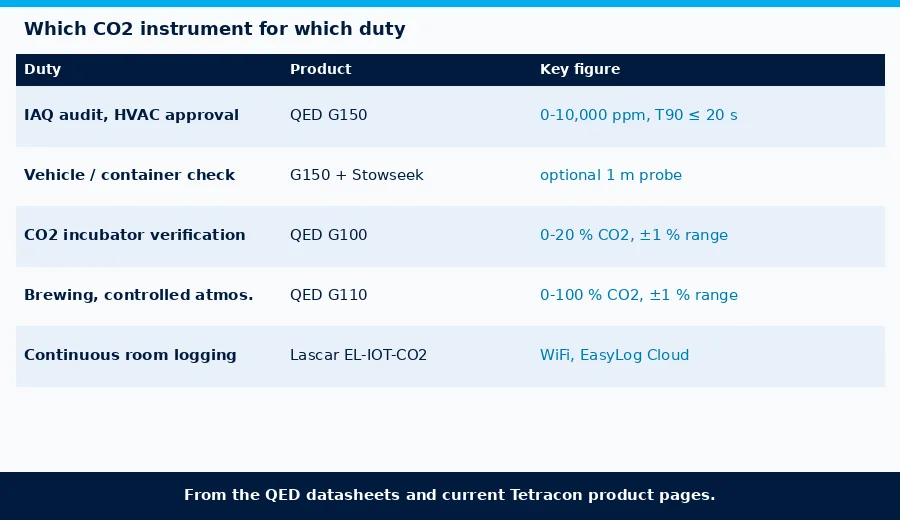
| Portable IAQ audits, HVAC approval, concealed-person checks | QED G150 | CO2 0-10,000 ppm, ±1.5 % of range (typ. ±10 ppm at 500 ppm), T90 ≤ 20 s, optional O2 / 2 x temperature / RH, 1 m Stowseek probe, IP40 |
| CO2 incubator verification in IVF, research and pharma labs | QED G100 | CO2 0-20 %, ±1 % of range after calibration, T90 ≤ 20 s, optional O2, temperature and humidity |
| Percent-level CO2 in brewing and controlled atmospheres | QED G110 | CO2 0-100 %, ±1 % of range after calibration, optional O2, temperature and humidity |
| Continuous room monitoring with cloud alerts | Lascar EL-IOT-CO2 | 0-40,000 ppm, ±(50 ppm + 5 % of reading) at 400-2,000 ppm, self-calibrating, WiFi to EasyLog Cloud, 300,000+ readings (product page) |
As a rule of thumb, use the G150 to find and prove ventilation problems room by room, and fixed loggers such as the EL-IOT-CO2 to watch the rooms that matter continuously once the survey is done (general). For percent-level CO2, move to the G100 or G110.
What to send with an enquiry
- The application: IAQ survey, HVAC commissioning, site audit, or vehicle and container screening.
- Whether you need the optional O2 cell, the two temperature probes or the RH probe (temperature probes are not available if humidity is selected).
- Whether the optional 1 m Stowseek probe is required.
- How many sites or rooms you survey and how you want the data reported.
- Your calibration arrangements, including whether you need calibration gas or calibration support from us.
FAQ
What is the QED G150?
A handheld CO2 analyser from QED Environmental Systems designed for indoor air quality applications and for illegal immigrant control and detection. It measures CO2 from 0 to 10,000 ppm with a dual-wavelength infrared cell and can add O2, temperature or humidity options.
How accurate is the CO2 reading?
The datasheet gives ±1.5 % of range after calibration, typically ±10 ppm at 500 ppm CO2 after user calibration, with a T90 response of 20 seconds or less. Typical accuracies are after calibration plus the accuracy of the calibration gas used.
Can it measure temperature and humidity as well?
Yes, as options. It can take two temperature probes (0 to 50 °C, ±0.2 °C) or an RH probe (0-100 % RH non-condensing, ±1.5 % RH); the temperature probes are not available if humidity is selected.
What is the Stowseek probe?
An optional 1 m probe listed in the G150 datasheet for illegal immigrant control and detection, used to sample the air inside closed vehicles, trailers or containers.
How long does the battery last?
12 hours, or 10 hours with the pump running, from a Li-ion battery rated for 600 cycles. It charges from a 5 V DC supply in about 4 hours.
Can it be used in hazardous areas?
The datasheet lists EN 50270 (EMC) and EN 61010-1 (safety) certification and an IP40 rating, with no hazardous-area approval, so treat it as a safe-area instrument.
Next steps
Tetracon (Pvt.) Ltd. is the sole authorized agent for QED Environmental Systems in Pakistan and supplies QED and Geotech gas analysers with local technical support. Send us your application, the options you need and your survey plan, and we will propose the right G150 configuration. Use the contact page or see our services. Start with the G150, compare the G100, G110 and Lascar EL-IOT-CO2, browse gas analysis and gas detection, or see all QED Environmental Systems and Lascar Electronics products and the full product catalogue. Related notes: CO2 monitoring for indoor air quality and HVAC, medical gas and CO2 incubator verification and humidity and temperature monitoring for pharma cleanrooms. Free technical guides are collected under Guides.