

Carbon dioxide, humidity and temperature are the three numbers most building operators actually use to run ventilation. CO2 tracks how many people are breathing in a room, humidity drives comfort, mould risk and static, and temperature closes the loop for the air-handling unit (general). In Pakistan, offices, schools, hospitals, malls, banks and data-centre support rooms are moving from fixed fresh-air settings to demand-controlled ventilation, both to cut cooling load in long summers and to keep indoor air healthy in crowded rooms (general).
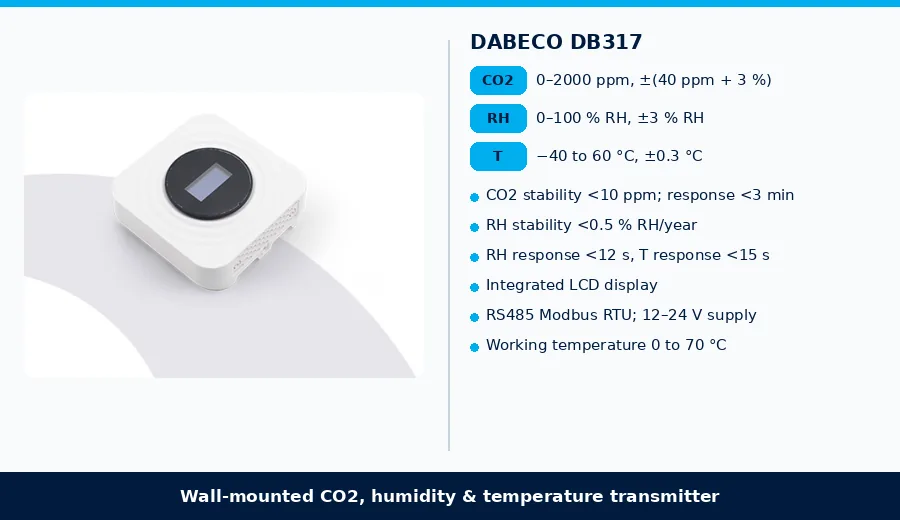
This note looks at the DABECO DB317 CO2, humidity and temperature transmitter, a wall-mounted three-in-one sensor with an LCD and an RS485 Modbus RTU output. It covers what the DB317 datasheet says, how to use it for demand-controlled ventilation and BMS integration, installation points, and when another DABECO or Tetracon-supplied sensor is the better fit. Figures come from the DB317 datasheet hosted on our product page and the current Tetracon product pages. General engineering advice is labelled as general, and nothing here goes beyond the published data. Tetracon (Pvt.) Ltd. is the sole authorized agent for DABECO Co. Ltd. in Pakistan.
Why one sensor for CO2, humidity and temperature
- Three IAQ parameters, one device. The DB317 combines CO2, humidity and temperature measurement in one wall-mounted enclosure (datasheet), so one cable run and one Modbus address replace three separate sensors (general).
- Built for ventilation control. The datasheet positions it for smart ventilation, HVAC and demand-controlled ventilation, where real-time data is used to optimise airflow, reduce energy consumption and keep indoor environments healthy (datasheet).
- Digital, not analog. All three readings go over a single RS485 Modbus RTU interface (datasheet), which a BMS, PLC or ventilation controller can poll directly without separate analog input cards (general).
- Local readout. The integrated LCD shows live readings on site (datasheet), which helps facility staff and commissioning engineers check a room without a laptop (general).
- Cost-effective. The datasheet describes the DB317 as a cost-effective design (datasheet), which matters when a building needs one sensor per classroom, meeting room or ward (general).
DB317 at a glance
| Item | DABECO DB317 (datasheet) |
|---|---|
| Measurement | CO2, relative humidity and temperature in one device |
| CO2 range / accuracy | 0 to 2000 ppm; ±(40 ppm + 3 % of reading) |
| CO2 stability / response | <10 ppm; response time <3 min |
| Humidity range / accuracy | 0 to 100 % RH; ±3 % RH at 25 °C |
| Humidity stability / response | <0.5 % RH per year; <12 s (63 %) |
| Temperature range / accuracy | −40 to 60 °C; ±0.3 °C at 25 °C |
| Temperature stability / response | <0.1 °C; <15 s (63 %) |
| Display | Integrated LCD |
| Digital output | RS485, Modbus RTU |
| Supply voltage | 12 to 24 V |
| Working temperature | 0 to 70 °C |
| Storage | −40 to 80 °C (non-condensing) |
| Mounting | Wall-mounted |
Using the DB317 for demand-controlled ventilation
Demand-controlled ventilation adjusts outdoor-air flow to the actual occupancy, using CO2 as the proxy for people in the space (general). A typical scheme looks like this (general):
- Baseline. Outdoor air is roughly 400 ppm CO2; occupied rooms rise above that as people breathe (general).
- Setpoint. Many designers start opening the outdoor-air damper or speeding up the fresh-air fan as CO2 approaches about 800 to 1000 ppm, and run at design airflow above that. Check the setpoint against your project's ventilation design basis (general).
- Range fit. The DB317's 0 to 2000 ppm range (datasheet) covers that control band with headroom for crowded rooms (general).
- Humidity and temperature in the same loop. Using the humidity and temperature readings from the same sensor (datasheet), the BMS can stop extra fresh air from overloading the cooling coil on humid monsoon days, or flag rooms drifting out of the comfort band (general).
- Response. CO2 response time is under 3 minutes (datasheet). That is fine for room-level ventilation control, where occupancy changes over minutes; for millisecond-level CO2 measurement in equipment, use a fast NDIR sensor instead (general).
BMS and Modbus integration
- One bus, many rooms. RS485 Modbus RTU (datasheet) lets you daisy-chain sensors on one twisted pair to a BMS controller, PLC or gateway. Give each sensor a unique address, terminate the end of the bus and keep the cable away from VFD and power cables (general).
- Map three points per sensor. Bring CO2, humidity and temperature into the BMS as separate points, and trend them; trends are what show whether a damper sequence is actually working (general).
- Power. The datasheet gives a 12 to 24 V supply (datasheet). Plan a common low-voltage supply in the riser or controller panel and size it for the number of sensors on each run (general).
- Gateways. If the site BMS speaks BACnet or KNX rather than Modbus, a protocol gateway in the controller panel usually handles the conversion (general). Tell us the BMS make when you enquire.
Installation tips
- Height and position. Mount at breathing-zone height on an inside wall, away from doors, windows, supply diffusers, direct sun and people's breath at desks (general).
- Return air vs room. One room sensor per zone gives the most honest CO2 reading; return-duct mounting averages zones and can hide a crowded room (general). For duct humidity and temperature, use a duct-mount transmitter instead.
- Operating limits. The DB317 datasheet lists a 0 to 70 °C working temperature, a −40 to 60 °C temperature measurement range and non-condensing storage (datasheet). It is an indoor, wall-mounted device, so keep it out of wet or condensing areas (general).
- Commissioning. After installation, compare readings with a reference instrument such as a portable CO2 analyser before you tune the ventilation sequence (general).
Where it fits in Pakistan
- Offices and commercial buildings. Office buildings and commercial spaces are listed applications (datasheet). Meeting rooms and open-plan floors in Islamabad, Lahore and Karachi towers see large occupancy swings that fixed fresh-air settings handle poorly (general).
- Schools and universities. Schools are a listed application (datasheet). Crowded classrooms are where CO2 climbs fastest, and the on-device LCD gives staff a direct reading (general).
- Healthcare. Healthcare facilities are listed (datasheet), for waiting areas, wards and OPD halls where ventilation and comfort matter (general). Regulated pharma rooms and GMP storage usually need audit-ready loggers; see the related products below.
- Smart building retrofits. Smart building automation and IAQ monitoring are listed applications (datasheet). In a retrofit, one Modbus sensor per zone is often the cheapest way to add IAQ data to an existing BMS (general).
When another sensor is the better fit
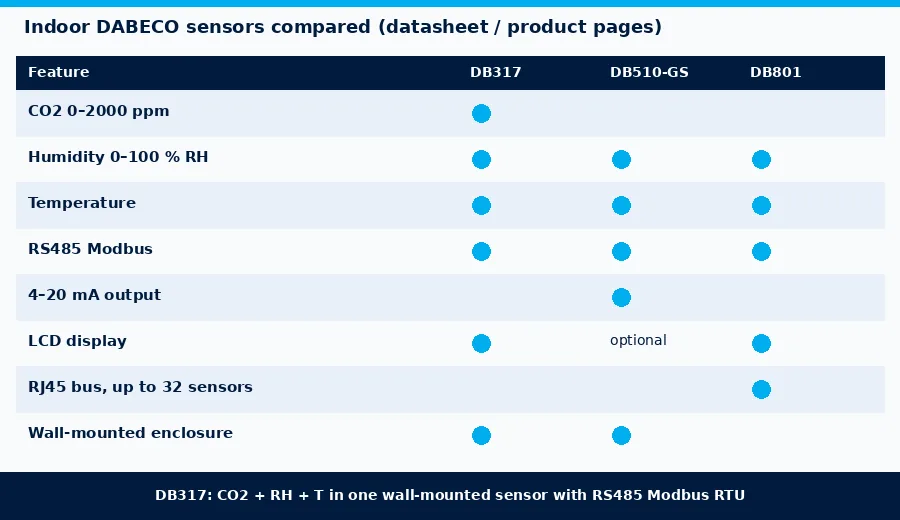
- DABECO DB510-GS: wall-mounted indoor humidity and temperature transmitter, ±2.0 % RH (0–90 % RH at 25 °C) and ±0.2 °C, −40 to +120 °C, 4–20 mA or RS485 Modbus RTU, 9–36 VDC (product page), when you need an analog output or tighter humidity accuracy and no CO2.
- DABECO DB801: RS485 bus-type humidity and temperature sensor with an RJ45 interface, up to 32 sensors per network, Modbus addresses 1–255 and communication distance up to 1200 m (product page), for many-point server room or warehouse networks.
- DABECO DB5301: high-precision RS485 humidity and temperature transmitter, ±2.0 % RH and ±0.2 °C, with wall, duct, remote-probe and other mounting types and optional IP67 (product page), for ducts and harsher spots.
- Lascar EasyLog EL-IOT-CO2: wireless CO2, temperature and humidity data logger, 0 to 40,000 ppm CO2, cloud upload with email/SMS alarms and storage for 300,000+ readings (product page), when you want cloud logging and alerts rather than a BMS input.
- SST SprintIR-6S: fast-response 20 Hz NDIR CO2 sensor (product page) for OEM equipment rather than rooms; see our SprintIR-6S note.
- ACI Q6/B6: dual-sensor BACnet/Modbus gas sensor (product page), when the ventilation is driven by CO and NO2 in car parks rather than CO2; see our car park note.
Related products
| Need | Product | Key point |
|---|---|---|
| CO2 + RH + T for DCV | DABECO DB317 | 0–2000 ppm, 0–100 % RH, LCD, RS485 Modbus RTU (datasheet) |
| Indoor RH + T, analog or Modbus | DABECO DB510-GS | ±2.0 % RH, ±0.2 °C, 4–20 mA or RS485 (product page) |
| Multi-point RH + T network | DABECO DB801 | RJ45 RS485 bus, up to 32 sensors, up to 1200 m (product page) |
| RH + T for ducts and probes | DABECO DB5301 | Wall, duct, remote probe mounting; optional IP67 (product page) |
| Cloud CO2 logging | Lascar EL-IOT-CO2 | 0–40,000 ppm, cloud upload, email/SMS alarms (product page) |
| Fast CO2 for OEM equipment | SST SprintIR-6S | 20 Hz NDIR CO2 sensor (product page) |
For more background, read our CO2 monitoring guide for indoor air quality and HVAC and the ACI DLP duct static pressure note. The wider range is on the Humidity & Pressure category page, our selection guides and the DABECO manufacturer page.
What to send with an enquiry
- The building type and the rooms or zones to be monitored, with the number of sensors.
- What the readings will do: drive dampers or fresh-air fans, feed a BMS dashboard, or both.
- The BMS, PLC or controller make and protocol (Modbus RTU, BACnet, KNX) and the available low-voltage supply.
- Cable distances from the sensors to the controller panel.
- Whether you also need duct humidity and temperature, differential pressure or car park CO / NO2 sensing in the same project.
Send these to Tetracon and our engineers will confirm the right sensor mix and lead time. Our services team in Islamabad supports installation and commissioning across Pakistan.
FAQ
What does the DABECO DB317 measure?
It measures CO2 from 0 to 2000 ppm, relative humidity from 0 to 100 % RH and temperature from -40 to 60 °C in one wall-mounted device, with an integrated LCD and an RS485 Modbus RTU output (datasheet).
How accurate is the DB317 CO2 reading?
The datasheet gives CO2 accuracy of ±(40 ppm + 3 % of reading), stability of less than 10 ppm and a response time of less than 3 minutes. Humidity accuracy is ±3 % RH and temperature accuracy ±0.3 °C, both at 25 °C.
Can the DB317 connect to a building management system?
Yes. All three readings are transmitted over RS485 Modbus RTU (datasheet), which most BMS controllers, PLCs and gateways can poll directly. For BACnet or KNX systems a protocol gateway is normally used (general).
Does the DB317 have an analog 4-20 mA output?
The DB317 datasheet lists RS485 Modbus RTU as its output. If you need 4-20 mA for humidity and temperature, the DABECO DB510-GS offers 4-20 mA or RS485 (product page).
Who supplies DABECO sensors in Pakistan?
Tetracon (Pvt.) Ltd., Islamabad, supplies the DABECO range in Pakistan with local technical support. Contact us with your building and BMS details for a quotation.
Planning demand-controlled ventilation or an IAQ upgrade in Pakistan? Contact Tetracon with the building, number of zones and BMS details. You can also browse the DB317 product page and the DABECO manufacturer page, or the full product catalogue and all manufacturers.