

Two batches of granules can both pass a loss-on-drying test and still behave very differently on the shelf. One cakes, grows mould or loses its dissolution profile; the other stays stable. The difference is often not how much water the product holds but how freely that water is available, and that is what water activity (aw) measures. For Pakistani pharmaceutical plants, spice and dried-fruit processors, biscuit and bakery lines, milk-powder and confectionery makers and feed mills, water activity is the number that links a moisture result to microbial risk, texture and shelf life.
This note explains what water activity is, which thresholds matter, and how Rotronic's HC2A-AW water activity measurement head is used in a QC lab. All instrument figures come from Rotronic's HC2A-AW & HC2A-AW-USB datasheet (59111E, 2023-06), the HC2A-AW short instruction manual, Rotronic's online manuals for the HC2A-AW, HygroLab and HygroSoft, and the HygroLab C1 instruction manual. Thresholds come from USP <1112> and the method requirements from ISO 18787:2017. No prices are given, and the indicator model and software licence for your lab should be confirmed at quotation.
Water activity versus moisture content
Moisture content (loss on drying, Karl Fischer or an oven method) tells you how much water is in a sample. Water activity tells you how much of that water is free to take part in microbial growth, chemical reactions and migration. Formally it is the ratio of the water-vapour pressure in equilibrium with the product to the saturation vapour pressure of pure water at the same temperature, so it runs from 0 (completely dry) to 1 (pure water). At equilibrium, the relative humidity in a small sealed space above the sample equals 100 × aw, which is why a well-specified humidity sensor can measure it.
USP <922> makes the same distinction for pharmacopeial articles: some water is tightly bound, for example in hydrates, while some is available for hydrolysis or microbial growth, and water activity tells you which fraction is active. Two products with the same moisture content can have very different water activities, which is why it is worth specifying and measuring both.
The thresholds that matter
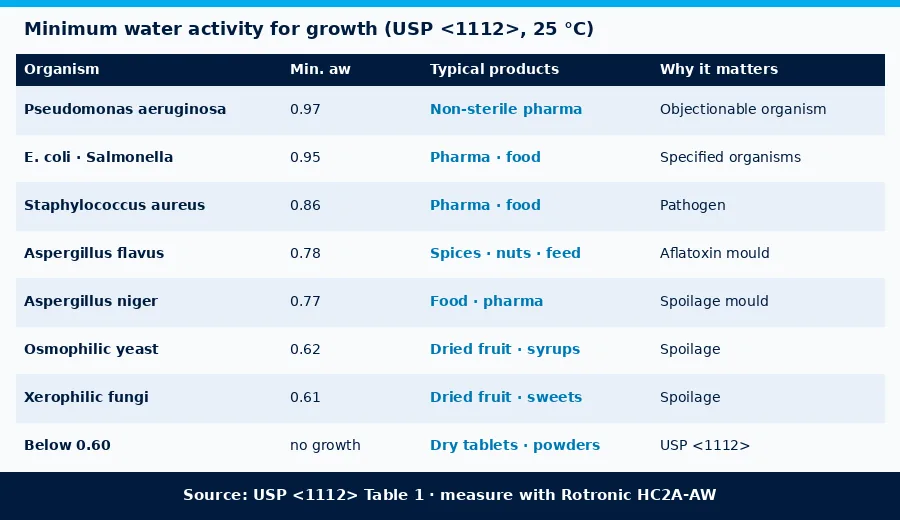
USP <1112> (application of water activity determination to non-sterile pharmaceutical products) lists the water activity each organism needs to grow, measured at 25 °C. A few values from its Table 1:
| Organism | Minimum aw for growth | Why it matters |
|---|---|---|
| Pseudomonas aeruginosa | 0.97 | Objectionable organism in non-sterile products |
| Escherichia coli, Salmonella spp. | 0.95 | Specified organisms in pharmacopoeial microbial limits; food safety |
| Staphylococcus aureus | 0.86 | Lowest aw limit among the common pathogenic bacteria in the table |
| Aspergillus flavus | 0.78 | The mould associated with aflatoxin; relevant to chillies, spices, nuts, grain and feed |
| Aspergillus niger | 0.77 | Common spoilage mould |
| Osmophilic yeast / xerophilic fungi | 0.62 / 0.61 | Spoilers of dried fruit, jams, syrups and confectionery |
USP <1112> adds that even the most osmophilic yeasts and xerophilic fungi do not proliferate below aw 0.60, and that products well below 0.75 (direct-compression tablets, powder- and liquid-filled capsules, non-aqueous liquids, ointments) are good candidates for reduced microbial limit testing. It is equally clear that water activity alone cannot justify dropping microbial testing; it supports a risk assessment together with raw-material quality, the process, packaging and the product's testing history.
Rotronic HC2A-AW at a glance
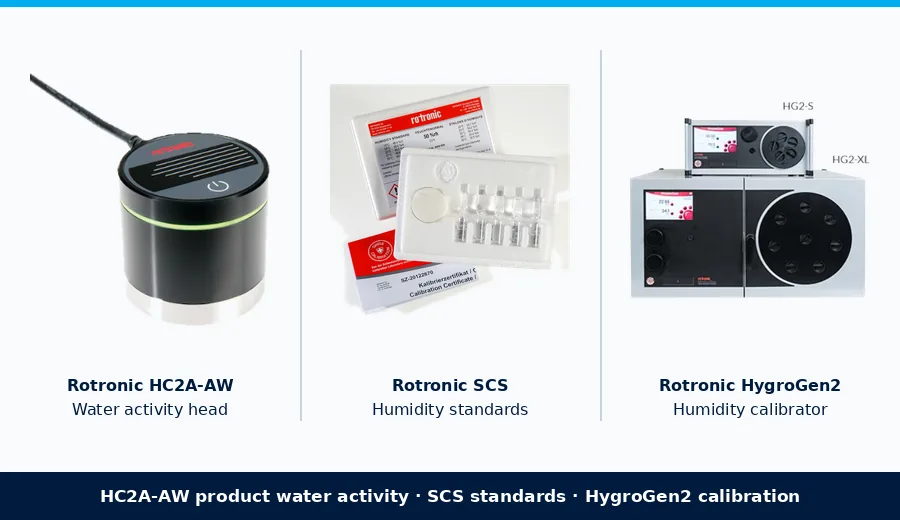
The HC2A-AW is a bench measurement head that sits on a sample holder over a disposable sample cup. Inside is Rotronic's HYGROMER WA-1 capacitive humidity sensor and a temperature sensor, read by Rotronic's AirChip3000 electronics, which store the adjustment data in the probe so heads can be swapped without re-adjusting.
| Item | Rotronic specification |
|---|---|
| Sensor | HYGROMER WA-1 (capacitive humidity) plus temperature sensor |
| Accuracy at 23 ±5 °C | ±0.008 aw (0.8 %rh), ±0.1 K |
| Repeatability | 0.3 %rh; 0.05 K (Rotronic online manual) |
| Long-term stability | <1 %rh per year under normal conditions |
| Operating conditions | −40 to 85 °C |
| Versions | HC2A-AW: HC2 connector, 1 m cable, for the Rotronic HygroLab bench indicator (or a PC with HygroSoft via the AC3001 cable). HC2A-AW-USB: USB-A connector, 3 m cable, PC with HygroSoft only (not HygroLab). |
| Measuring modes | AwQuick (projected result, typically about 5 minutes) and AwE (full equilibrium, typically 30 to 60 minutes or longer), via the HygroLab or the HygroSoft water-activity licence |
| Housing | Aluminium, stainless steel and PC; Ø68 × 65 mm; 540 g; IP65; ON/OFF touch button and green LED ring |
| Accessories | Sample holders WP-14-S (14 mm, stainless), WP-40 (40 mm) and WP-40TH (40 mm, nickel-plated brass, connects to a water bath for temperature control); disposable cups PS-14 and PS-40 in packs of 100 |
Where water activity earns its place in Pakistan
| Industry and product | What water activity tells you |
|---|---|
| Pharmaceuticals: granules, tablets, capsules, powders for suspension | Whether a batch is dry enough for stability and packaging, and supporting evidence for a reduced microbial testing strategy under USP <1112>. Useful at granulation end-point, before compression and on incoming excipients. |
| Spices and chillies | Whether dried product is below the aw at which moulds such as Aspergillus flavus can grow, before it goes into storage or export packing. |
| Dates, dried apricots and other dried fruit | Spoilage risk from osmophilic yeasts and xerophilic moulds, plus texture: aw drives softness and stickiness. |
| Biscuits, rusks, snacks and confectionery | Crispness and shelf life, and moisture migration between components such as a cream filling and a biscuit shell. |
| Milk powder, infant formula ingredients and other powders | Caking and flow behaviour, and microbial stability after drying. |
| Rice, grain, oilseed and animal feed | Safe storage and mould risk in warehouses and silos. ISO 18787 covers both food and animal feed. |
| Cosmetics and chemicals | Rotronic lists cosmetics and chemicals among the HC2A-AW's applications, for example powders and hygroscopic intermediates. |
Water activity is a product test. It does not replace monitoring the air around the product: warehouses and finished-goods stores still need relative humidity and temperature monitoring, for example with a fixed transmitter such as the Rotronic DT722 or the loggers described in our notes on pharma cleanroom and storage monitoring and cold-chain temperature monitoring.
Getting a reliable result
Most poor water activity results come from temperature, not from the instrument. Rotronic's measurement guidelines and ISO 18787:2017 point the same way:
- Control temperature. Rotronic calls a temperature-stable area essential: no bench near an AC vent, heater, window or direct sun. For best accuracy the temperature should drift no more than 0.01 °C per minute (0.0075 °C per minute for products above 0.80 aw). ISO 18787 specifies measurement at 25 °C, with temperature regulation or a thermostatic enclosure holding 25 °C ± 1 °C. With the HC2A-AW that means an air-conditioned lab held steady, or the WP-40TH holder connected to a water bath. In a Lahore or Karachi summer, with load-shedding switching the AC off and on, that is the first thing to sort out.
- Acclimatise samples. Put each sample in a disposable cup with the lid on and leave it beside the probe until both are at the same temperature. Rotronic names two common mistakes: measuring samples straight out of a refrigerator and measuring samples straight off a hot production line. Don't hold the probe, holder or cup in your hand for long.
- Fill the cup correctly. About one third full is usually enough, and never above the fill line, to keep the sensor clean. Use the shallow PS-14 cups for liquids, pastes and powders, and the deep PS-40 cups for products in larger pieces. Check the sealing O-ring under the probe before measuring.
- Choose the mode. AwQuick projects the equilibrium value after a dwell time (default 4 minutes) and typically finishes in about 5 to 6 minutes. When product and probe temperatures are stable, Rotronic says the result is generally within ±0.005 aw of the full-equilibrium AwE value. Use AwE for method validation, disputes and products that equilibrate slowly. The HygroLab bench indicator runs up to four HC2 probes at once.
- Mind the scope. ISO 18787 excludes frozen products, water-in-fat emulsions and crystalline products such as sugar, salt and minerals, and notes that samples with volatiles such as alcohol may need special set-ups. It also warns about hysteresis with humidity-sensor instruments: ventilate the cell between samples so the next one starts from ambient.
Calibration and verification
ISO 18787 asks for a check against a standard close to your samples before each analytical series, with adjustment if the mean deviation exceeds 0.005; calibration with at least two standards that bracket your samples; verification with a maximum tolerated error of ±0.005; and results reported to two decimal places. Rotronic says the shallow PS-14 cups are suitable for checking the HC2A-AW with Rotronic certified humidity standards (the SCS ampoules, which are unsaturated salt solutions) or with saturated salt solutions; see the SCS humidity standards page. Labs that also calibrate other RH probes in-house can add a humidity generator such as the HygroGen2 (see our note on humidity probe calibration in Pakistan).
One point to be clear about: Rotronic's datasheet accuracy for the HC2A-AW is ±0.008 aw at 23 ±5 °C, while ISO 18787 sets a ±0.005 tolerance for the verification point. Whether your set-up meets your own method, after adjustment against standards and with the lab held at 25 °C, should be confirmed with Rotronic and Tetracon at quotation and then shown in your method validation, not assumed.
What to send with an enquiry
- The products you will test (powder, granule, paste, liquid, large pieces) and their expected water activity range.
- The method or standard your customer or auditor expects (in-house SOP, ISO 18787, USP <922>) and the measurement temperature.
- How many samples per shift, and whether you want several probes running at once on a bench indicator or a single probe on a PC.
- Data needs: printed or PDF reports, data export, audit trail expectations.
- Lab conditions: is the room temperature-controlled, and is a water bath available?
- Calibration plan: which humidity standards you want and whether you also calibrate other RH probes on site.
FAQ
What is the difference between water activity and moisture content?
Moisture content is the total amount of water in a sample. Water activity is the fraction of that water that is free to support microbial growth and chemical reactions, expressed from 0 to 1. Two products with the same moisture content can have very different water activities and very different shelf lives.
How accurate is the Rotronic HC2A-AW?
Rotronic specifies ±0.008 aw (0.8 %rh) and ±0.1 K at 23 ±5 °C, with 0.3 %rh repeatability and long-term stability better than 1 %rh per year under normal conditions.
How long does a water activity measurement take?
With Rotronic's AwQuick mode a result typically takes about 5 minutes and is generally within ±0.005 aw of the full-equilibrium value when temperatures are stable. Full equilibrium (AwE) usually takes 30 to 60 minutes and can take longer for some products.
What is the difference between the HC2A-AW and the HC2A-AW-USB?
The HC2A-AW has an HC2 connector and 1 m cable and works with the Rotronic HygroLab bench indicator, or with a PC running HygroSoft via the AC3001 cable. The HC2A-AW-USB has a USB-A connector and 3 m cable and works only with a PC running HygroSoft.
Where can Pakistani labs see the product and ask for a quotation?
See the HC2A-AW catalogue page, browse humidity and pressure instruments, or contact Tetracon with your products, expected water activity range, method and sample throughput.
Next steps
Tetracon supplies Rotronic humidity and water activity instruments to pharmaceutical, food, agri-export and industrial labs across Pakistan. Send us the products you need to test, their expected water activity range, the method your customers or auditors expect, your daily sample count and your lab conditions, and we will propose a probe, indicator or software set-up and the humidity standards to go with it. Use the contact page or see our services. Start with the HC2A-AW catalogue page and the related SCS humidity standards, HygroGen2 and DT722 pages. You can also browse humidity and pressure instruments or see all Rotronic products. For dew-point references, see our note on chilled-mirror reference hygrometers. Free technical guides are collected under Guides.