

Water is the contaminant that natural gas, LNG, hydrogen and petrochemical plants in Pakistan spend the most effort removing. Glycol contactors, molecular sieve beds and dryers exist to take it out, and pipeline sales gas agreements set a limit on what is left. Too much water causes hydrates, corrosion and freezing in pipelines, regulators and cryogenic equipment; too little attention to the measurement lets an under-performing dehydration unit go unnoticed until something blocks or corrodes (general). An online process moisture analyzer at the outlet of the dehydration unit, or on the pipeline itself, is what tells operations that the gas is really dry.
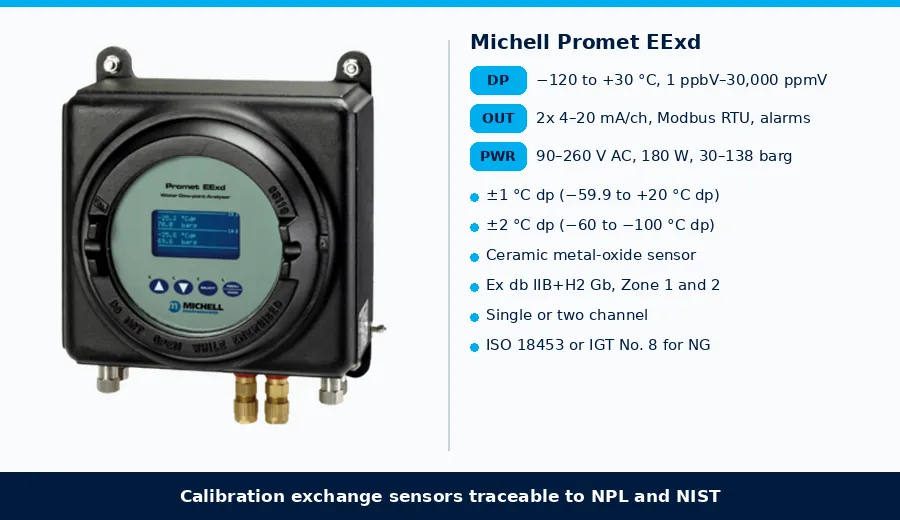
This note looks at the Michell Promet EExd process moisture analyzer, a single- or dual-channel moisture analyzer with integrated pressure reading, built into a flameproof housing that installs directly in the hazardous area next to the pipeline or process. It covers what the datasheet says about range, accuracy, outputs and certification, how the ceramic sensor and sampling system work at line pressure, the calibration options, and when the Promet I.S. or another Michell analyzer is the better fit. Figures come from the Michell Promet EExd datasheet (issue 97151 V9.2, 09/2023) hosted on our product page, the Promet I.S. datasheet (97150 V6.2, 02/2024) and the current Tetracon product pages. General engineering advice is labelled as general, and nothing here goes beyond the manufacturer's published data. Tetracon (Pvt.) Ltd. is the sole authorized agent for Michell Instruments Ltd. in Pakistan and supplies its moisture analyzers with local technical support.
Why process moisture needs a dedicated online analyzer
- Dehydration performance. The datasheet lists natural gas glycol dehydration, offshore export pipeline gas and transmission pipeline monitoring as core applications (datasheet). An outlet moisture reading is the most direct check that a glycol contactor or dryer is doing its job (general).
- Trace moisture before cryogenics. A dedicated trace moisture sampling system is offered for continuous measurement in low ppmV and ppbV ranges for molecular sieve dehydration of natural gas prior to cryogenic liquefaction (datasheet).
- Hydrogen and petrochemicals. Hydrogen production, storage and transportation including natural gas injection, ethylene feedstock to polymer plants and speciality gas production are also listed applications (datasheet).
- Measured at process pressure. The Promet EExd measures dew point and pressure together and converts between them, so it can report moisture content or the dew point at another pressure, such as the pipeline contract pressure (datasheet).
- Installed where the gas is. The main unit and sampling system are certified flameproof for IEC Zone 1 and 2 / NEC Class 1 Div. 1 and 2, so they can be mounted next to the pipeline instead of at the end of a long sample line to a safe-area shelter (datasheet).
Promet EExd at a glance
| Item | Promet EExd (datasheet) |
|---|---|
| Channels | Single or two channel |
| Sensor | Michell Ceramic Metal-Oxide Moisture Sensor |
| Measurement range | -120 to +30 °C dew point; 1 ppbV to 30,000 ppmV |
| Calibration range | -100 to +20 °C dew point; 10 ppbV to 23,000 ppmV |
| Accuracy | ±1 °C dew point between -59.9 and +20 °C dp (moisture content ±10 % of reading); ±2 °C between -60 and -100 °C dp (±20 % of reading); analysis pressure ±0.25 % FS |
| Resolution | 0.1 °C from +20 to -80 °C dp; 1 °C from -80 to -100 °C dp |
| Units | Dew point °C/°F; ppmV (ideal gas and natural gas); lb/MMSCF and mg/m³ for natural gas; pressure barg, MPa, psig |
| Natural gas conversion | ISO 18453 or IGT Research Bulletin No. 8, to customer order |
| Outputs | Two non-isolated 4–20 mA per channel (500 ohm max.); Modbus RTU at 9600 baud; two volt-free alarm contacts per channel (one process, one instrument status) |
| Data logging | Rolling maximum of 150 logs (time, date, moisture and pressure per channel), interval 5 to 60 minutes |
| Operating pressure | 30 to 138 barg (435 to 2000 psig); other variants to order |
| Sample | 1/8 in NPT (F) connections; 1 Nl/min; sample flow alarm as standard |
| Power | 90–260 V AC, 50/60 Hz, 180 W main unit |
| Environment | Indoor/outdoor -20 to +60 °C, max. 95 %rh, shaded location |
| Enclosure | Flameproof EExd, cast copper-free aluminium, internally temperature controlled |
| Hazardous area | ATEX/UKCA II 2 G Ex db IIB+H2 Gb and IECEx Ex db IIB+H2 Gb: T5 (Tamb -40 to +44 °C) and T4 (Tamb -40 to +60 °C) to 60 barg, T3 (Tamb -40 to +60 °C) to 138 barg; cQPSus Class I Div. 1 Groups B, C, D and Class I Zone 1 |
The ceramic sensor and measurement at line pressure
- Ceramic metal-oxide technology. The sensor uses thick- and thin-film semiconductor technologies with metallized ceramics, with measurement sensitivity to 10 ppbV moisture content and high-pressure capability up to 138 barg (2000 psig) (datasheet).
- Pressure shock and sour gas. Unlike older aluminium-oxide technologies, the ceramic sensor is immune to pressure shock, avoiding sensor failure at commissioning or shut-down, and its inert nature gives long-term resistance to chemical attack, even in extremely sour gas with percentage-level H2S (datasheet).
- Temperature controlled. The main unit is internally temperature controlled at the normal maximum local environmental temperature, which reduces adsorption and desorption effects in the sampling system during daily temperature swings; a compensation algorithm maintains accuracy if the heater fails or the climate exceeds the set level (datasheet).
- Minimal trace sampling. In the trace moisture configuration, a particulate filter and isolation valve are the only components before the sensor, and measurements are made at pipeline conditions with no regulators upstream, so the analyzer stays in equilibrium with the process gas without significant response lag (datasheet).
- Natural gas sampling. The natural gas processing and transmission sampling system uses micro-porous membrane filtration with continuous by-pass flow to remove liquid contaminants, plus a glycol adsorption cartridge that removes residual glycol vapour that could otherwise interfere with the moisture signal (datasheet).
Calibration: exchange sensors or field checks
- Calibration Exchange Service. Michell supplies newly calibrated replacement sensors certified traceable to NPL and NIST. Because the calibration data is stored in the sensor's on-board memory, fitting an exchange sensor renews the calibration with minimal downtime and no programming by the user (datasheet).
- Recommended interval. Calibration or exchange is recommended annually for sweet gases and six-monthly for sour gases (datasheet).
- Field calibration. Field calibration against a portable dew point generator (ASTM D5454), a calibrated reference hygrometer or certified moisture-in-gas cylinders is also possible, with adjustment at one point or at multiple points across the range (datasheet). For a calibration laboratory or test stand reference, Michell dew-point generators are also on our catalogue (product page).
- Beware "automatic calibration". The datasheet points out that an internal automatic field check is not traceable and does not represent a true calibration (datasheet). Keep traceable certificates in the analyzer file for audits and gas-quality disputes (general).
Notes for Pakistani gas and process plants
- Gas fields and processing plants. Glycol dehydration outlets at gas processing facilities and the inlet to transmission pipelines are the classic Promet EExd duty (datasheet applications). Sour fields need the six-monthly calibration interval in the maintenance plan (datasheet; general).
- Heat and sun. The operating environment is -20 to +60 °C, max. 95 %rh, in a shaded location, and the T5 temperature class applies only up to Tamb +44 °C (datasheet). In Sindh and Balochistan summers, install the analyzer under a sun shade and check that the temperature class you need is valid at your site ambient; enclosure cooling is listed as an option (datasheet; general).
- Pressure range. The standard operating pressure is 30 to 138 barg (datasheet). For low-pressure distribution or plant utility points, ask us about variants or about a different Michell instrument (datasheet; general).
- Hydrogen and LNG projects. Hydrogen production, storage and transportation including natural gas injection, and LNG production are listed applications, and the flameproof certification covers gas group IIB+H2 (datasheet).
- Power and integration. One low-power single-phase AC supply feeds both analyzer and sampling system, with no barrier units or safety earth required (datasheet). Bring the 4–20 mA, Modbus RTU and the instrument status alarm into SCADA so a sensor or flow fault is visible in the control room (datasheet; general).
When another Michell instrument is the better fit
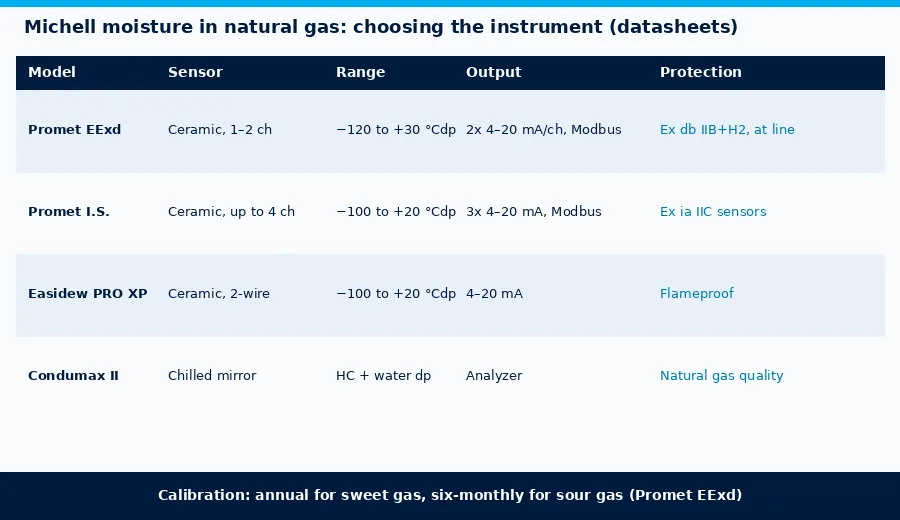
- Michell Promet I.S.: intrinsically safe sensors on up to 4 independent channels from one 19-inch control unit in the safe area, direct dew-point measurement at process pressure up to 45 MPa (450 barg), -100 to +20 °C dew point, three 4–20 mA outputs and Modbus RTU, II 1 G Ex ia IIC T4 Ga sensors, with an optional O2 measurement (datasheet). Choose it when several points are brought back to one analyzer house or when pressure exceeds the EExd range.
- Michell Easidew PRO XP: explosion/flameproof dew-point transmitter for gas and liquid moisture in hazardous areas, -100 to +20 °C dp, ±1 °C dp (datasheet; product page). Choose it when a 4–20 mA transmitter is enough and no analyzer display or sampling package is needed.
- Michell Condumax II: fully automatic chilled-mirror hydrocarbon and water dew-point analyzer for natural gas quality (product page). Choose it when the contract also specifies hydrocarbon dew point.
- Michell OptiPEAK TDL600 and Michell QMA601: TDLAS moisture in variable natural gas and biomethane, and quartz crystal microbalance trace moisture for hazardous areas (product pages). Compare them with the ceramic technology in our ceramic vs chilled mirror vs TDL guide.
Related products
| Need | Product | Key point |
|---|---|---|
| Flameproof online moisture analyzer next to the pipeline | Michell Promet EExd | -120 to +30 °C dp, 1 or 2 channels, Ex db IIB+H2 Gb, 30–138 barg (datasheet) |
| Multi-point I.S. moisture analyzer, safe-area control unit | Michell Promet I.S. | Up to 4 channels, up to 450 barg, Ex ia IIC T4 Ga (datasheet) |
| Flameproof dew-point transmitter | Michell Easidew PRO XP | -100 to +20 °C dp, ±1 °C dp (datasheet) |
| Hydrocarbon and water dew point | Michell Condumax II | Automatic chilled mirror for natural gas quality (product page) |
| Calibration reference | Michell dew-point generators | Dew-point generators for calibration laboratories and test stands (product page) |
For more background, read our guide to hydrocarbon and water dew point in natural gas, the Condumax II and OptiPEAK TDL600 note and the field calibration of dew-point hygrometers guide. The wider range is on the Dew Point & Moisture and Gas Analysis category pages, our selection guides and the Michell Instruments manufacturer page.
What to send with an enquiry
- The measuring point: glycol contactor outlet, molecular sieve outlet, pipeline, hydrogen, ethylene or other process gas.
- The gas composition, including H2S and hydrogen content, and whether glycol or liquids may be carried over.
- Normal and minimum/maximum line pressure and the expected moisture level or dew point.
- The unit and reference pressure you report in: dew point at line pressure, ppmV, lb/MMSCF or mg/m³, and whether ISO 18453 or IGT No. 8 is required.
- Single or dual channel, hazardous area classification and site ambient temperature range.
- Required outputs (4–20 mA, Modbus RTU, alarms) and the calibration approach you prefer.
FAQ
What range does the Promet EExd measure?
The measurement range is -120 to +30 °C dew point, or 1 ppbV to 30,000 ppmV, with a calibration range of -100 to +20 °C dew point. Accuracy is ±1 °C dew point between -59.9 and +20 °C dp and ±2 °C between -60 and -100 °C dp.
Can it be installed in a Zone 1 hazardous area?
Yes. The main unit and sampling system are flameproof certified for IEC Zone 1 and 2 and NEC Class 1 Div. 1 and 2, with ATEX/UKCA and IECEx Ex db IIB+H2 Gb ratings. No barrier units or safety earth are required.
Is the sensor suitable for sour gas?
Yes. The datasheet states that the ceramic metal-oxide sensor has long-term resistance to chemical attack even in extremely sour gas with percentage-level H2S. Calibration or exchange is recommended six-monthly for sour gas and annually for sweet gas.
Which outputs does it provide?
Two non-isolated 4–20 mA outputs per channel (500 ohm maximum load), Modbus RTU at 9600 baud, and two volt-free alarm contacts per channel, one for a process value and one for instrument status.
How is the analyzer calibrated?
Through the Michell Calibration Exchange Service, which supplies newly calibrated sensors traceable to NPL and NIST with the calibration data stored in the sensor, or in the field against a portable dew point generator (ASTM D5454), a reference hygrometer or certified moisture-in-gas cylinders.
Planning moisture measurement on a dehydration unit, pipeline, LNG or hydrogen project in Pakistan? Contact Tetracon with the gas composition, pressure and area classification. You can also browse the Promet EExd product page and the Michell Instruments manufacturer page.